Mail us at: legal@janethalaw.com
Contact: 703-880-6409

Immigration eNews Letter

Issue No. 10, October 2025

Visa Bulletin For November-2025

Final Action Date: Determines when the Department of State or USCIS can make a decision on the applications.


Filing Date: Determines when individuals can submit their permanent residence applications


August Adjustment of Status Filing Charts(USCIS)


For Family-Sponsored Filings:

For all family-sponsored preference categories, you must use the Dates for Filing chart in the Department of State Visa Bulletin for November 2025.


For Employment-Based Preference Filings:

For all employment-based preference categories, you must use the Final Action Dates chart in the Department of State Visa Bulletin for November 2025.

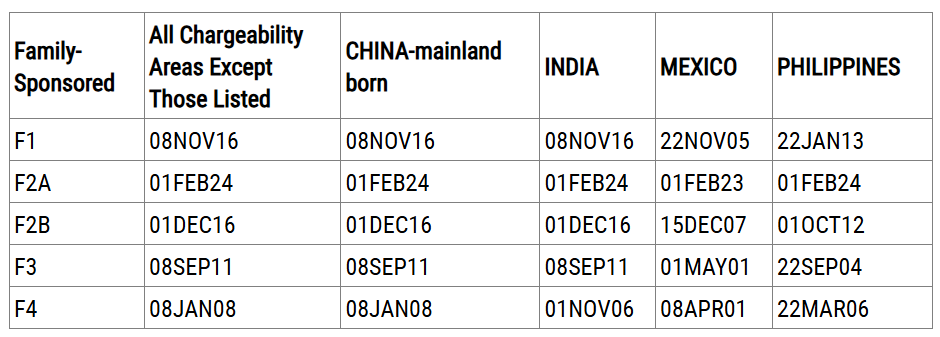
Final Action Dates for Family-Sponsored preference cases.

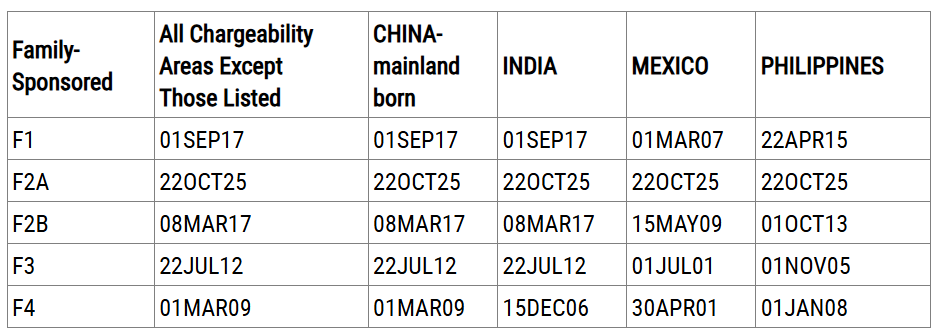
Dates for filing Family-Sponsored visa applications.

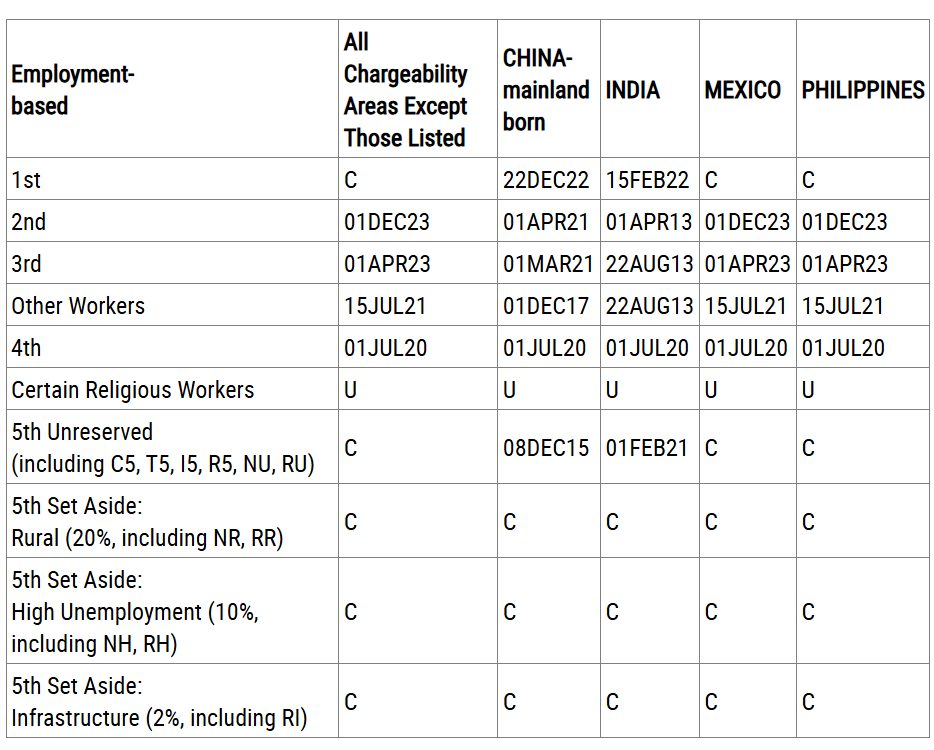
Final action dates for Employment-based preference cases.

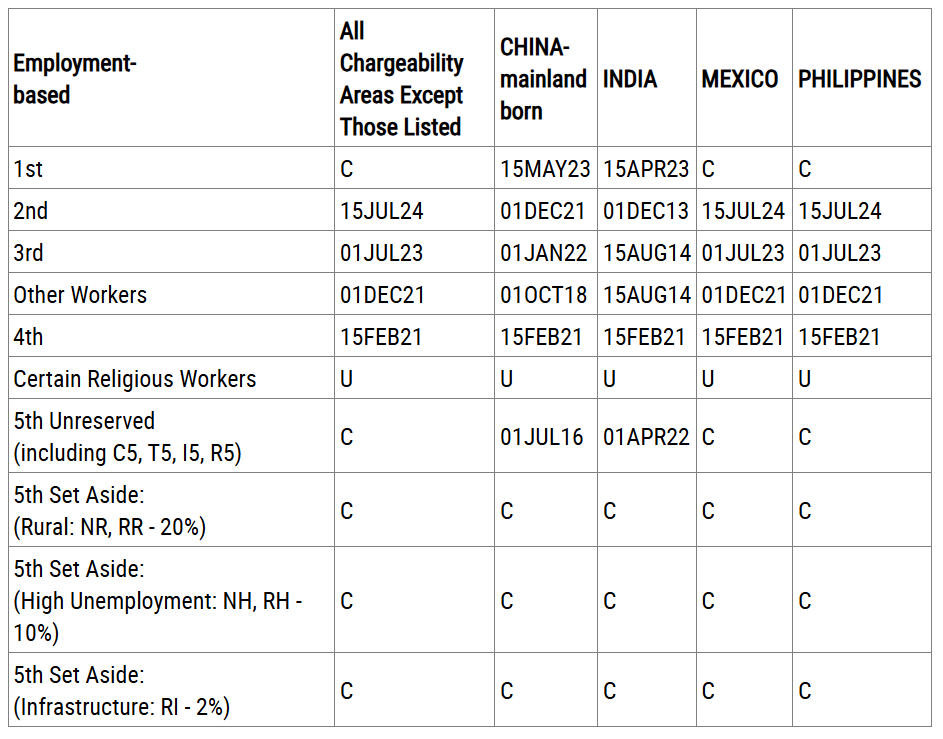
Dates for filing of Employment-based visa applications

When to File:

Use the Visa Bulletin charts above to determine when to file your adjustment of status application.

To use the charts:
  1. Find your visa type in the first column of the appropriate chart (Family-sponsored or Employment-based).
  2. Stay in that row and move directly to the right to find the corresponding date.
  3. If the date on the chart is current ("C"), or your priority date is earlier than the date on the chart, you may file your adjustment of status application, if otherwise eligible to do so.
  4. "U" means unauthorized; for example, numbers are not authorized for issuance.

Your priority date is generally the date when your relative or employer properly filed the immigrant visa petition on your behalf with USCIS. If a labor certification is required to be filed with your immigrant visa petition, the priority date is the date the labor certification application was accepted for processing by the Department of Labor.

Presidential Proclamation on Restriction on Entry of Certain Nonimmigrant Workers.

On September 19, 2025, the President issued a Proclamation, Restriction on Entry of Certain Nonimmigrant Workers, an important initial step to reform the H-1B nonimmigrant visa program. Under the Proclamation, new H-1B petitions filed at or after 12:01 a.m. eastern daylight time on September 21, 2025 must be accompanied by an additional $100,000 payment as a condition of eligibility.


Who is subject to the $100,000 payment:

The Proclamation applies to new H-1B petitions filed at or after 12:01 a.m. eastern daylight time on September 21, 2025, on behalf of beneficiaries who are outside the United States and do not have a valid H-1B visa. The Proclamation also applies if a petition filed at or after 12:01 a.m. eastern daylight time on September 21, 2025, requests consular notification, port of entry notification, or pre-flight inspection for an alien in the United States.


In addition, if a petition filed at or after 12:01 a.m. eastern daylight time on September 21, 2025, requests a change of status or amendment or extension of stay and USCIS determines that the alien is ineligible for a change of status or an amendment or extension of stay (e.g., is not in a valid nonimmigrant visa status or if the alien departs the United States prior to adjudication of a change of status request), the Proclamation will apply and the payment must be paid according to the instructions provided by USCIS.


The Proclamation does not apply to any previously issued and currently valid H-1B visas, or any petitions submitted prior to 12:01 a.m. eastern daylight time on September 21, 2025. In addition, the Proclamation does not prevent any holder of a current H-1B visa, or any alien beneficiary following petition approval, from traveling in and out of the United States.

The Proclamation also does not apply to a petition filed at or after 12:01 a.m. eastern daylight time on September 21, 2025, that is requesting an amendment, change of status, or extension of stay for an alien inside the United States where the alien is granted such amendment, change, or extension. Further, an alien beneficiary of such petition will not be considered to be subject to the payment if he or she subsequently departs the United States and applies for a visa based on the approved petition and/or seeks to reenter the United States on a current H-1B visa.


How to pay the $100,000 payment:

Petitioners should submit the required $100,000 payment using pay.gov, following the instructions on pay.gov at the following link: https://www.pay.gov/public/form/start/1772005176.


When to pay the $100,000 payment:

Payment must be made prior to filing a petition with USCIS, as petitioners must submit proof that the payment has been scheduled from pay.gov or evidence of an exception from the $100,000 payment from the Secretary of Homeland Security at the time of filing the H-1B petition. Petitions subject to the $100,000 payment that are filed without a copy of the proof of the payment from pay.gov or evidence of an exception from the Secretary of Homeland Security will be denied.


Exceptions granted by the Secretary of Homeland Security:

Exceptions to the $100,000 payment are granted by the Secretary of Homeland Security in the extraordinarily rare circumstance where the Secretary has determined that a particular alien worker’s presence in the United States as an H-1B worker is in the national interest, that no American worker is available to fill the role, that the alien worker does not pose a threat to the security or welfare of the United States, and that requiring the petitioning employer to make the payment on the alien's behalf would significantly undermine the interests of the United States. Petitioning employers who believe their alien worker satisfies this high threshold may seek an exception by sending their request and all supporting evidence to H1BExceptions@hq.dhs.gov.


Source: USCIS

DHS Ends Automatic Extension of Employment Authorization.

The Department of Homeland Security has announced an interim final rule ending the practice of automatically extending employment authorization documents for aliens filing renewal applications in certain employment authorization categories. With this rule, DHS prioritizes the proper screening and vetting of aliens before extending the validity of their employment authorizations.


Aliens who file to renew their EAD on or after Oct. 30, 2025, will no longer receive an automatic extension of their EAD. There are limited exceptions to this rule, including extensions provided by law or through a Federal Register notice for TPS-related employment documentation. Ending automatic extensions of EADs results in more frequent vetting of aliens who apply for employment authorization to work in the United States. Reviewing an alien’s background more often will enable U.S. Citizenship and Immigration Services (USCIS) to deter fraud and detect aliens with potentially harmful intent so they can be processed for removal from the United States. 


USCIS recommends aliens seek a timely renewal of their EAD by properly filing a renewal application up to 180 days before their EAD expires. The longer an alien waits to file an EAD renewal application, the more likely it is that they may experience a temporary lapse in their employment authorization or documentation.


The interim final rule does not affect EADs automatically extended before Oct. 30, 2025.


Source: USCIS

USCIS to Mandate Electronic Payments for Applications.

As previously announced, on Oct. 28, U.S. Citizenship and Immigration Services will only accept electronic payments for paper-filed forms. Payments may be made either via credit card or debit card using Form G-1450, Authorization for Credit Card Transactions, or ACH debit transactions from a U.S. bank account using Form G-1650, Authorization for ACH transactions.


By requiring electronic payment, USCIS eliminates the need for benefit requestors and third-party payors to bring funds into field offices. This practice also complies with the transition to government-wide electronic payments required by Executive Order 14247, Modernizing Payments To and From America’s Bank Account.


USCIS continues to accept online payments for forms filed online. USCIS encourages benefit requestors and their accredited representatives to use their USCIS account to file online through the guided process or the electronic intake process, if either of these filing options is available for their form type. Benefit requestors and accredited representatives filing online have access to helpful instructions and tips on completing their forms. They can also pay their fees online using the secure pay.gov platform.


In limited instances, benefit requestors and third-party payors may be exempt from submitting electronic payments with their application, petition, or request. See Form G-1651, Exemption for Paper Fee Payment, for a list of exemptions.


Source: USCIS

USCIS Implements New Immigration Parole Fee Required by H.R. 1.

The Department of Homeland Security is publishing a Federal Register notice to implement a new immigration parole fee required by the H.R. 1 Reconciliation Bill. The fee is $1,000 for FY 2025 and is subject to annual adjustments for inflation. You must pay this fee when you are paroled into the United States, unless you qualify for an exception.


The Federal Register notice explains when the immigration parole fee takes effect, exceptions to the fee, and consequences if you do not pay.


USCIS will collect the immigration parole fee if you are physically present in the United States and we are granting you parole or a new period of parole (also known as re-parole). Beginning on Oct. 16, 2025, if we determine that we can approve your request for parole or re-parole and that it requires payment of the immigration parole fee, we will notify you that you must pay this fee before we can approve your request. The notice will have payment instructions and a deadline. We will not grant parole unless you pay the immigration parole fee as instructed and within the specified time period.


Do not pay the immigration parole fee when you submit Form I-131, Application for Travel Documents, Parole Documents, and Arrival/Departure Records. The immigration parole fee will be collected when you are paroled into the United States. For more information about when Customs and Border Protection or Immigration and Customs Enforcement will collect the immigration parole fee, see the Federal Register notice.


Source: USCIS

DHS Streamlines the Filing Process for Certain Agricultural Workers.


The Department of Homeland Security announced a final rule, effective Oct. 2, 2025, to streamline the filing process for certain temporary agricultural worker petitions.


The new rule allows U.S. Citizenship and Immigration Services to begin processing petitions for H-2A temporary agricultural workers while the Department of Labor reviews the requested employment to ensure it would not harm American workers.


Beginning Oct.2, petitioners seeking unnamed beneficiaries can electronically file the newly published Form I-129H2A, Petition for a Nonimmigrant Worker: H-2A Classification, after DOL issues a notice of acceptance of the application for temporary labor certification (TLC) and before DOL approves a TLC. Petitioners must provide the ETA case number issued by DOL with the initial filing. This allows USCIS to immediately begin processing electronically filed petitions with unnamed beneficiaries and gives petitioners the flexibility to file with USCIS sooner. USCIS will not approve any petitions until after DOL has approved the corresponding TLC.


The TLC serves as DHS’s consultation with the DOL regarding whether an able, willing, and qualified U.S. worker is available to fill the petitioning H-2A employer’s job opportunity and whether an alien worker’s employment in the job opportunity will adversely affect the wages or working conditions of similarly employed U.S. workers.


The newly developed streamlined version of Form I-129, called Form I-129H2A, Petition for a Nonimmigrant Worker: H-2A Classification, can only be filed online by uploading the completed PDF in a USCIS online account. USCIS will reject any paper filed Form I-129H2A petitions. At this time, we are only accepting Form I-129H2A for petitioners seeking unnamed beneficiaries filing without Form G-28. In the coming weeks, we will expand availability of Form I-129H2A to H-2A petitioners seeking named beneficiaries or filing with Form G-28. For petitioners who prefer to file their H-2A petition by paper, there is no change, and they must continue to use Form I-129, Petition for Nonimmigrant Worker. The procedural change in this rule does not apply to H-2A petitions with named beneficiaries or to H-2A petitioners who file by paper. These petitioners must continue to submit petitions to USCIS only after DOL approves the TLC application.


Source: USCIS

462 Herndon Pkwy, Ste # 108A
Herndon, VA 20170
703-880-6409
Facebook  Twitter  Linkedin  Youtube  Instagram  
We handle a variety of immigration matters, including employment and family based cases, as well as the areas of adjustment of status and naturalization. We will be very happy to assist you in all your immigration matters.
NOTE: The Information provided in this newsletter is of a general Nature and may not apply to any particular sets of facts or under all circumstances. Please contact our office for case specific suggestions.