JULY 6, 2026

CONTRIBUTIONS HELP PAY FOR THE WEBSITE, CONSTANT

CONTACT, AND DUES TO ATTEND CLUBS TO HEAR

SPEAKERS. THANK YOU FOR YOUR CONTINUED SUPPORT!

FOLLOW ME ON SOCIAL MEDIA @PATRIOTNHEELS

Money Matters in Politics


Every election cycle we hear the same message: "This is the most important election of our lifetime." While that phrase may be overused, one thing is true—every election matters.

As Arizona heads toward the 2026 election, political advertising is increasing rapidly. Television commercials, digital ads, campaign mailers, text messages, yard signs, palm cards, and endorsements are becoming a daily part of life. Campaigns know that visibility matters, and visibility costs money.


Recent campaign finance reports show the Arizona Republican Party has approximately $1.38 million on hand, while the Arizona Democratic Party has approximately $720,000. Those numbers provide an indication of each party's financial resources, but they tell only part of the story.


State political parties are only one source of campaign spending. Arizona elections also attract significant financial support from organizations and donors across the country. National political committees, issue advocacy groups, labor organizations, business associations, and political action committees all invest heavily in Arizona because it is considered one of the nation's premier battleground states.


Progressive organizations frequently receive support through platforms such as ActBlue and from nationally known donors like George Soros. Conservatives also benefit from substantial support from organizations such as Turning Point Action (TPA), along with other national Republican committees and advocacy organizations.


The result is that hundreds of millions of dollars can ultimately be spent trying to influence Arizona voters.


Does money guarantee victory?


No.


History has shown that well-funded candidates sometimes lose while lesser-funded candidates win. However, money unquestionably gives campaigns the ability to communicate their message to more voters. It pays for advertising, mail pieces, voter outreach, polling, data analysis, field operations, and get-out-the-vote efforts.


Money matters most with voters who have limited time to research every candidate and ballot measure. Many people are balancing careers, raising families, and managing busy lives. They often rely on campaign advertising, endorsements, or recommendations from trusted organizations when making voting decisions.


Independent voters can be especially influential. Unlike strong Republicans or Democrats who consistently support their party's nominees, many independents evaluate each race individually. Campaigns spend significant resources trying to persuade these voters because they frequently determine the outcome of competitive elections.


Ultimately, campaign spending should never replace an informed electorate. Every voter should take time to research candidates, compare voting records, examine campaign finance reports, and look beyond television commercials or social media posts.


Money can amplify a message, but it cannot substitute for informed citizens. The strongest defense against misleading advertising is a voter who takes the time to ask questions, verify claims, and make decisions based on facts rather than slogans.

Federal Judge Blocks Expanded SAVE Database, but Questions Remain in Arizona


A federal judge has blocked the Trump administration's use of an expanded immigration database that had been used by states to identify potential noncitizens registered to vote.


In a 75-page opinion, U.S. District Judge Sparkle Sooknanan ruled that the federal government's expanded use of the Systematic Alien Verification for Entitlements (SAVE) database posed concerns related to privacy and voting rights. The ruling stops further use of the expanded system but does not invalidate investigations that have already begun.


Across the country, states have used the SAVE database to review voter registration records. In Texas, more than 2,700 registered voters were flagged for additional review. Other states, including Louisiana and Georgia, also conducted similar reviews with far smaller numbers of potential noncitizens identified.


Arizona has also participated in these efforts.


Earlier this year, Maricopa County Recorder Justin Heap announced that his office had used the SAVE database to identify 137 individuals who required further review. The Recorder's Office stated that approximately 60 of those individuals had previously voted. More recently, the office referred more than 200 potential cases to state and local prosecutors for investigation.


At this stage, it is important to understand what a referral does—and does not—mean.

A referral to prosecutors is not a finding of wrongdoing. It simply asks the appropriate authorities to investigate whether a violation of Arizona law occurred. Maricopa County Attorney Rachel Mitchell and other prosecutors will determine whether any individual was ineligible to register or vote and whether criminal charges are warranted.


The recent federal court ruling also does not invalidate investigations that are already underway. Those cases may continue while the legal challenge to the expanded SAVE system proceeds.


The unanswered question is whether the SAVE database accurately identified individuals who were not eligible to vote or whether some lawful voters were mistakenly flagged for investigation. Similar reviews in other states have shown that some individuals initially identified through database matching were later determined to be eligible voters.


Election integrity and voter rights should not be viewed as competing goals. Arizona has a legitimate interest in ensuring that only eligible citizens vote. At the same time, every eligible voter has the right to due process and to remain registered unless removed according to the procedures established by law.


As the Maricopa County investigations move forward, transparency will be critical. The public deserves to know:


  • How many of the referred cases involve individuals who were ultimately determined to be noncitizens.
  • How many referrals resulted from outdated or inaccurate records.
  • Whether any criminal prosecutions are filed.
  • Whether any eligible voters were incorrectly identified during the review process.


The federal court's decision does not end Arizona's investigations, nor does it determine whether any individual voter acted unlawfully. Those questions remain for investigators and prosecutors to answer. Until those investigations are complete, it is important that conclusions be based on verified facts rather than assumptions.


Regardless of where one stands on election policy, Arizonans should support both secure elections and the constitutional rights of every eligible voter. The integrity of our election system depends on protecting both.

Arizona Republicans Should Pay Attention to the Numbers


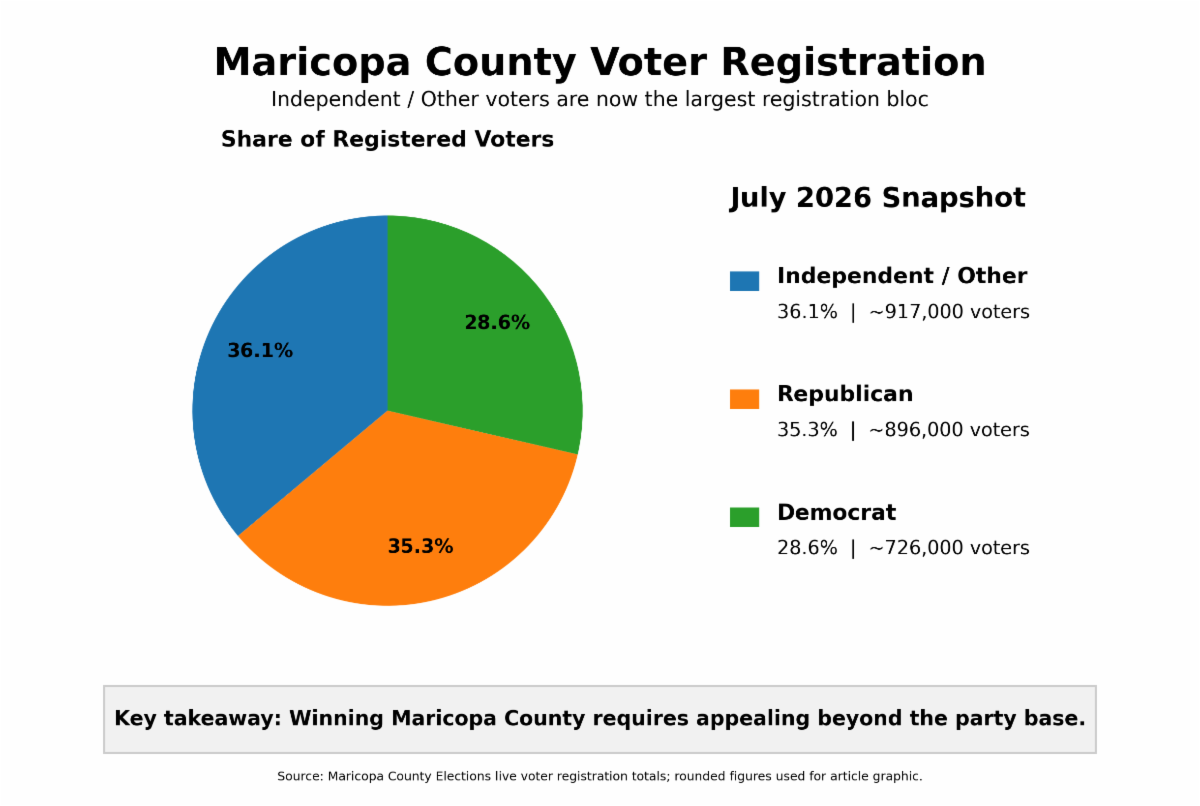
For well over a year, I have been sounding the alarm about the changing voter registration trends in Arizona and, particularly, Maricopa County. The latest registration report suggests those trends are continuing, and Republicans should take notice.


Before looking at the monthly gains, it's important to understand that Maricopa County recently completed routine voter list maintenance. This process removes voters who have died, moved away, or are otherwise no longer eligible to remain on the voter rolls.


During that maintenance:


  • Republicans: 11,490 voters removed
  • Democrats: 9,739 voters removed
  • Independents: 10,851 voters removed


After list maintenance, June registration still showed growth in every major voting bloc:


  • Republicans: +1,931
  • Democrats: +3,085
  • Independents: +5,170


Current numbers for Maricopa County:


  • Republicans: 884,370
  • Democrats: 705,935
  • Independents: 897,410


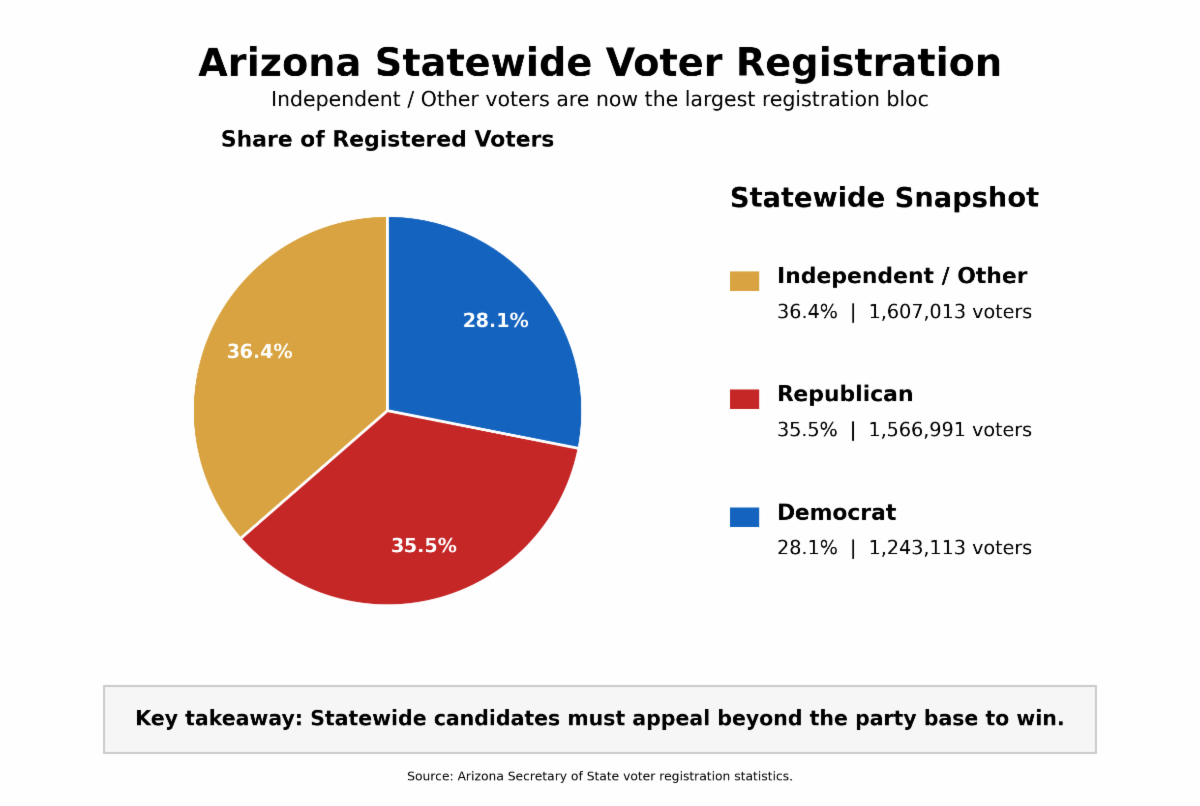
These numbers reflect a broader trend that has been occurring for several years. While Republicans remain the largest registered political party in Arizona, voters registered as independents or with no party preference now represent a significant and growing share of the electorate.


Why does this matter?


Arizona is currently in the middle of a primary election. Primary elections often reward candidates who appeal most strongly to their party's most active voters. But the general election is different. Candidates must build a broader coalition that often includes independents and, in some cases, voters from outside their own party.


Arizona's election laws also allow independent voters to participate in Republican or Democratic primaries by requesting that party's ballot, giving them an opportunity to influence which candidates advance to the general election.


As Republicans, we should ask ourselves an important strategic question.


Do we want to nominate candidates whose views most closely align with the most conservative primary voters, or do we want to nominate candidates who can also appeal to the independent voters who frequently help decide statewide elections?


Reasonable Republicans will answer that question differently. Some believe it is more important to nominate the candidate who best represents the party's principles, regardless of the general election environment. Others believe that winning statewide office requires candidates who can attract support beyond the Republican base.


The 2022 gubernatorial race involving Kari Lake is often cited in this discussion. Supporters point to high enthusiasm among Republican voters, while critics argue that her inability to win the general election illustrates the challenge of building a coalition broad enough to prevail statewide. That debate continues today.


The voter registration numbers themselves do not tell us which strategy is correct. They do, however, tell us something important: Arizona's electorate is changing.


Ignoring that reality would be a mistake.


Remember the Buckley Rule: "Vote for the most conservative candidate in the primary who can win in the general election." Winning the primary is only the first step. To advance conservative principles, Republicans must also nominate candidates who can build a coalition broad enough to succeed in November.


Political parties succeed when they understand the voters they hope to represent. As the number of independent voters continues to grow, every candidate—Republican, Democrat, or independent—will need to consider how to earn the confidence of an increasingly diverse electorate.


Whether one favors a more ideologically conservative nominee or a more broadly appealing one, the registration trends deserve careful attention because they are shaping the future of Arizona politics.


State of Arizona numbers


The Supreme Court Reaffirms the Purpose of Women's Sports


The U.S. Supreme Court's recent decision allowing states to preserve girls' and women's sports for biological females is, for many Americans, a reaffirmation of the original purpose of Title IX: ensuring equal athletic opportunities for women and girls. The Court held that states may limit participation on girls' and women's teams based on biological sex without violating Title IX or the Equal Protection Clause, leaving those policies in place in states such as Idaho and West Virginia.


Perhaps the most surprising part of this debate is that it required a Supreme Court decision at all. For decades, Americans worked to create equal opportunities for women in athletics. Title IX opened doors that had long been closed, allowing millions of girls and women to compete, earn scholarships, and pursue dreams that earlier generations never had.


So where is the women's rights movement today?


For generations, advocates fought tirelessly to ensure women received equal treatment in education, athletics, and the workplace. Yet many of those same voices have been noticeably quieter during a debate that many female athletes say directly affects their opportunities to compete on a level playing field.


Supporters of biological-sex-based athletic policies argue that when biological males compete in girls' and women's sports, the result can be fewer roster spots, fewer championship opportunities, fewer records for female athletes, and fewer college scholarships available to young women. They believe that preserving separate women's divisions is consistent with the very purpose of Title IX—to create opportunities specifically for females.


The discussion extends beyond athletic competition. Across the country, many parents and students have expressed concerns about privacy in school locker rooms and changing facilities. Some girls have reported feeling uncomfortable when required to share those spaces with students who are biologically male. Regardless of where people stand politically, those concerns deserve to be heard respectfully rather than dismissed.


This issue has become emotionally charged, but it should not prevent honest discussion. Americans can treat every individual with dignity while also recognizing that biological differences between males and females exist and have long been the basis for separate athletic competitions.


Reasonable people may disagree about how best to balance inclusion and fairness. However, the Supreme Court's ruling recognizes that states may conclude that maintaining separate girls' and women's sports based on biological sex serves legitimate interests in fairness, safety, and equal athletic opportunity.


The broader question now is whether society will continue protecting the opportunities generations of women fought to obtain. If equal opportunities for female athletes remain the goal, then preserving fair competition, protecting privacy in intimate spaces, and ensuring scholarships intended for women remain available to women will continue to be central issues in the years ahead.

DHS Agrees to Pause ICE Detention Center Renovations in Surprise


The controversy over the proposed Immigration and Customs Enforcement (ICE) detention center in Surprise has taken another turn.


The U.S. Department of Homeland Security (DHS) and Arizona Attorney General Kris Mayes have jointly asked a federal judge to pause litigation while DHS completes an environmental review of its planned conversion of a warehouse into an immigration detention facility.


For many Surprise residents, the announcement represents the first significant pause in a project that has divided the community since it quietly began earlier this year.


  • DHS will first prepare an Environmental Assessment.
  • The agency must provide the court with status reports every 60 days while the review is underway.
  • If the EA concludes there are no significant environmental impacts, DHS could issue a Finding of No Significant Impact (FONSI) and proceed.
  • If the EA identifies significant impacts, DHS would likely have to prepare a full Environmental Impact Statement, which could delay the project by several years.


Given the controversy surrounding the Surprise facility—including its proximity to schools, compatibility with the surrounding area, traffic, public safety concerns, and the public interest—it would not be surprising if the Environmental Assessment takes a year or more. If a full EIS is required, the project could be delayed well beyond 2027.


A Project That Began Without Local Input

In January, DHS purchased a 418,000-square-foot warehouse at 13290 W. Sweetwater Avenue for approximately $70 million with plans to convert it into an ICE detention center.


Because the federal government is not subject to many local zoning approval processes under the Supremacy Clause of the U.S. Constitution, the City of Surprise was not asked to approve the project. There were no neighborhood meetings, planning hearings, or public forums before the purchase was completed.


The proposed facility is located in an industrial area near several schools, including multiple Title I schools. It also lies within the Luke Air Force Base compatibility area, where Arizona law places restrictions on overnight lodging uses designed to protect military operations. Those issues have become central arguments raised by opponents of the project.


Community Divided

Few issues in recent Surprise history have generated as much public debate.


Many residents strongly support the facility, believing it will assist federal immigration enforcement and improve border security.


Others strongly oppose it, arguing the location is inappropriate and that the project will permanently change the character of Surprise.


The disagreement has dominated numerous City Council meetings, many lasting more than five hours due to lengthy public comment. Protesters have regularly demonstrated outside the warehouse and at City Hall. The issue has even spilled into meetings unrelated to immigration, including Dysart Unified School District Governing Board meetings.


Tensions have occasionally escalated beyond peaceful protest. One individual has been arrested after allegedly throwing a propane tank into the warehouse, causing a fire.


City Leaders Seek Answers

Although city officials have acknowledged they have limited legal authority to stop the project, they have actively sought assistance from state and federal officials.


Surprise City Council members have met with Congressman Paul Gosar, U.S. Senators Mark Kelly and Ruben Gallego, and Arizona Attorney General Kris Mayes. The city also formally requested that DHS comply with applicable state and local requirements wherever possible.


Mayor Kevin Sartor has consistently stated that the city lacks the legal authority to prohibit the federal government from using the property.


Meanwhile, DHS agreed to pay the City of Surprise $300,000 annually to help offset lost tax revenue after the warehouse was no longer developed as a private commercial distribution center.


Environmental Review Now Required

Attorney General Mayes filed suit in April seeking to stop the project, arguing DHS failed to complete environmental reviews required under the National Environmental Policy Act (NEPA).


Under the agreement filed with the court, DHS will prepare an environmental assessment evaluating the proposed conversion of the warehouse.


Until that review is complete—and until either a decision document or, if necessary, a full Environmental Impact Statement has been issued—DHS has agreed not to house detainees at the facility or perform work directly related to converting the building into an ICE detention center.


The department must provide status reports to the court every 60 days while the review is underway. Once the environmental process concludes, Arizona will have ten days to determine whether to continue pursuing a preliminary injunction.


The agreement does allow DHS to perform maintenance or other work at the property that is unrelated to converting it into a detention center.


My Perspective as a Surprise Resident

I have opposed this facility from the beginning— I believe this is the wrong location.


The warehouse sits near several Title I schools and in a community that has worked hard to build a family-friendly identity. I believe placing a federal immigration detention center there changes the character of our city.


Regardless of where someone stands on immigration policy, I believe local communities deserve a voice when projects of this magnitude are proposed. While federal law gives DHS broad authority, the residents of Surprise are the ones who will live with the long-term impacts.


Unfortunately, the proposal has already changed our community. Public meetings have become contentious. Residents have become increasingly divided. Demonstrations have become commonplace, and at least one act of criminal violence has occurred at the facility.


Whether the detention center is ultimately built remains uncertain. The environmental review provides an opportunity to carefully examine the project's impacts before any further conversion work proceeds. For the sake of the community, I hope that review is thorough, transparent, and gives residents confidence that every concern has been fully considered.

Sometimes the Answer Is Simply "No"


Every time the U.S. Supreme Court issues a controversial decision, a familiar pattern unfolds. Those who disagree with the ruling often call for judges to be impeached, accuse them of being political, or question their integrity.


But that's not how our judicial system is supposed to work.


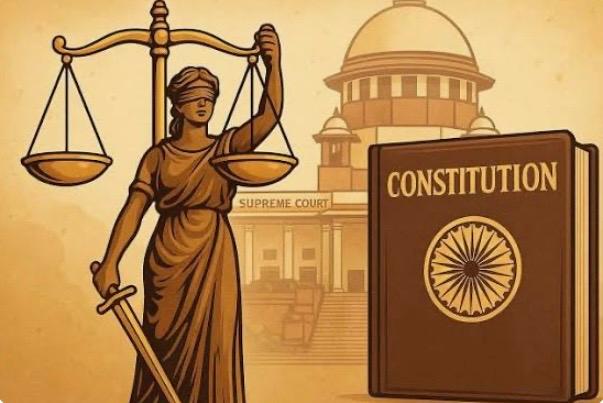
Judges—from local trial courts to the United States Supreme Court—do not decide cases based on public opinion, political pressure, or which outcome is the most popular. Their responsibility is to interpret the Constitution and apply existing law. Sometimes that means issuing decisions that disappoint the very people who once supported their appointment.


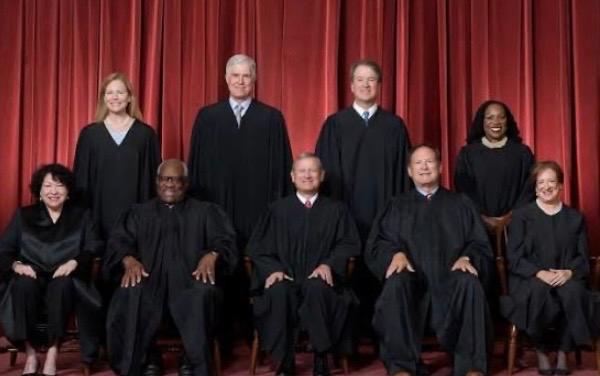
A perfect example is Justice Amy Coney Barrett. When President Donald Trump nominated her to the Supreme Court in 2020, many conservatives celebrated her appointment. They viewed her as a constitutional conservative who would faithfully interpret the law.


Since then, however, she has participated in decisions that some conservatives strongly oppose. As a result, some of the same people who praised her nomination have criticized her personally and even suggested she should be impeached.


The same phenomenon occurs on the political left. When a court issues a ruling that progressives dislike, similar calls are often made to impeach justices, expand the Court, or question the legitimacy of the decision.


This reaction misses an important point.


The role of a judge is not to deliver the outcome we want. The role of a judge is to determine what the Constitution and the law require. Sometimes the answer is "yes." Sometimes the answer is "no." And sometimes the answer is one neither side particularly likes.


Disagreeing with a court's interpretation is entirely appropriate. Healthy debate about judicial decisions is part of our constitutional republic. But disagreement alone is not evidence of judicial misconduct.


If citizens believe a law should be different, the proper avenue is usually through the legislative process. Elect representatives who share your views. Advocate for new legislation. If necessary, work to amend the Constitution. Those are the tools our system provides for changing public policy.


Impeachment, on the other hand, is reserved for serious misconduct—not for legal opinions with which we disagree.


Our constitutional system depends on an independent judiciary. If judges begin deciding cases based on fear of political retaliation rather than their understanding of the law, the rule of law itself is weakened.


No court is infallible. Courts have made mistakes throughout American history, and some decisions have later been overturned. But our legal system includes mechanisms to correct those errors through appeals, future cases, legislative action, and, in some instances, constitutional amendments.


In a nation governed by the rule of law, we will not always get the answer we want. Sometimes, the answer is simply "no." When that happens, our responsibility as citizens is not to attack the judge personally but to work through the constitutional process to change the law if we believe it should be different.

Why Maricopa County Uses Vote Centers


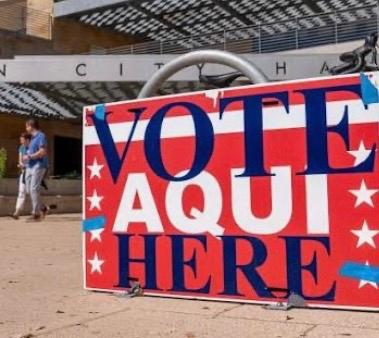
Maricopa County operates Vote Centers instead of assigning voters to a single neighborhood polling place. This system gives voters greater flexibility by allowing them to cast their ballot at any Vote Center in the county on Election Day, regardless of where they live.


One of the key features that makes Vote Centers possible is Ballot on Demand (BOD) technology. Rather than printing thousands of ballots for every precinct and risking shortages or waste, Ballot on Demand allows election workers to print the correct ballot style for each voter when they check in.


This is especially important in Maricopa County, where there are hundreds of different ballot styles based on a voter's residence and the districts in which they are eligible to vote. School board races, city elections, fire districts, special taxing districts, and legislative boundaries can all affect which ballot a voter receives.


When a voter checks in at a Vote Center, election officials verify the voter's eligibility, and the Ballot on Demand printer produces the exact ballot for that voter within seconds. This reduces printing costs, minimizes the number of unused ballots, and helps prevent voters from receiving the wrong ballot.


The Vote Center model also offers convenience. Voters can cast their ballot near work, school, or other daily activities instead of traveling to a single assigned polling location. If lines are long at one Vote Center, voters have the option of going to another nearby location.


Like any election system, Vote Centers require reliable technology, trained poll workers, and contingency plans in case equipment experiences problems. However, when operating as designed, Ballot on Demand technology and Vote Centers work together to provide voters with flexibility while ensuring they receive the correct ballot for the contests in which they are eligible to vote.

Thank you,

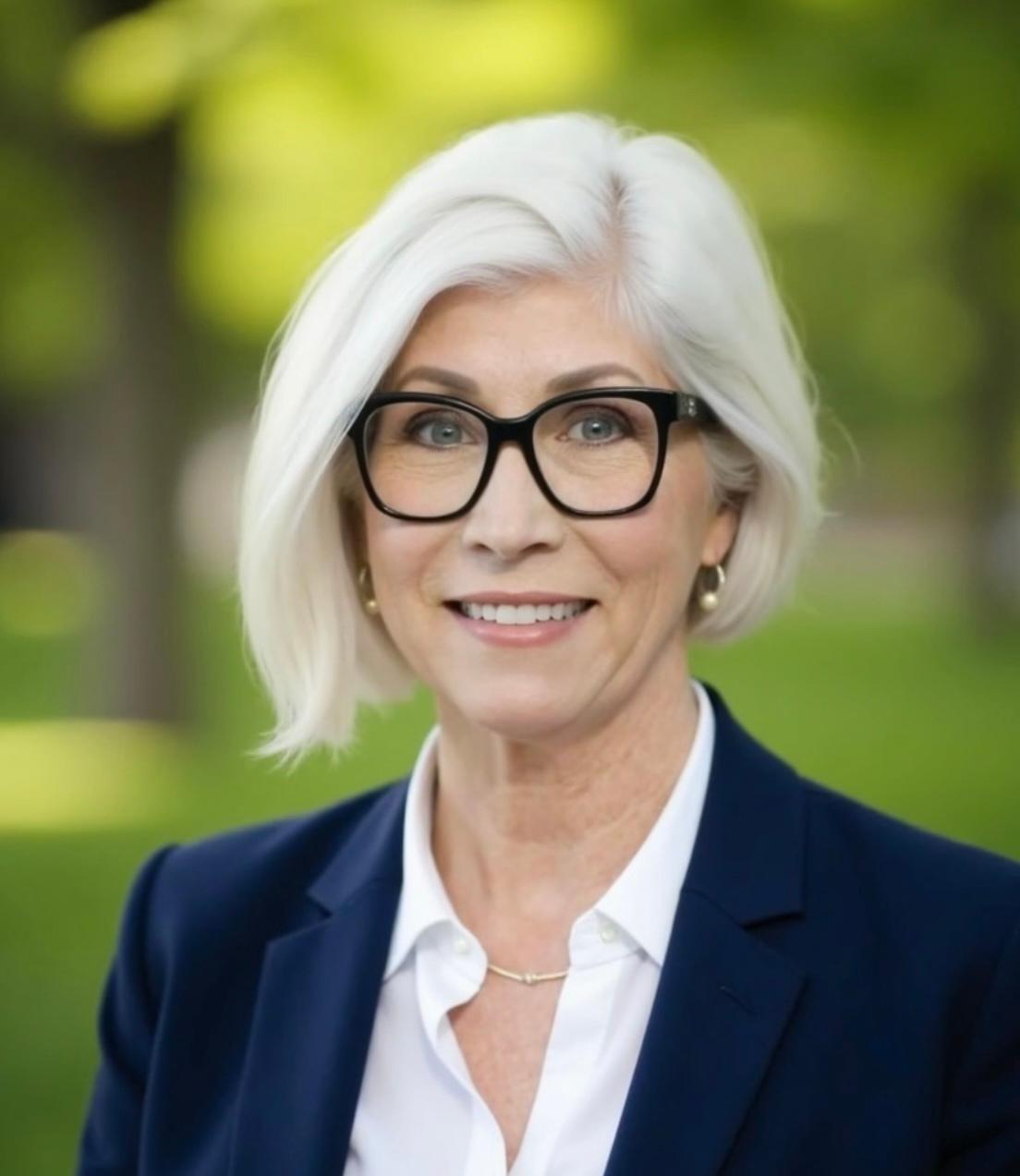
Lisa Everett


www.patriotnheels.com


Follow me on:

X - @patriotnheels

Facebook - @patriotnheels

Instagram - @patriotnheels