We hope you have a peaceful weekend. This newsletter will return on Tuesday, Sept. 8. |
|
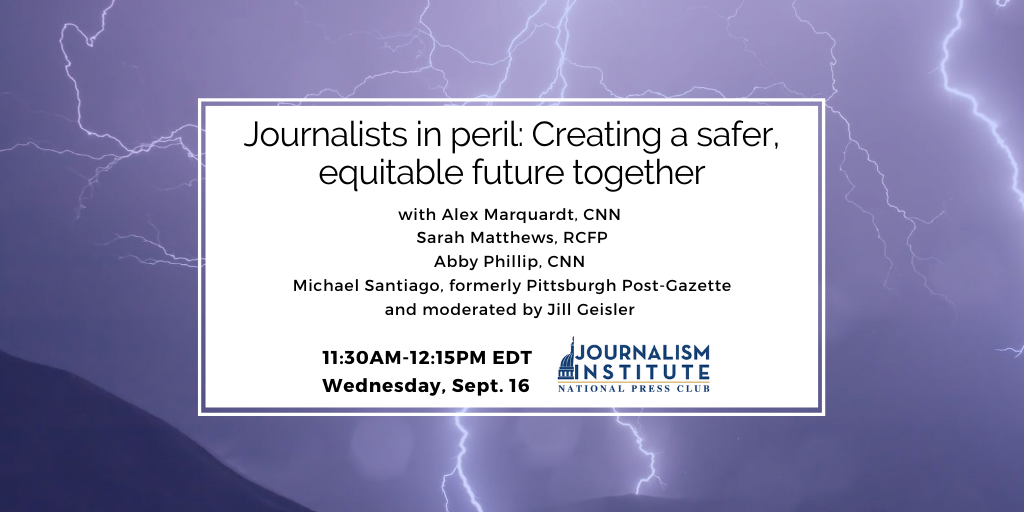
Safety for journalists has taken on a renewed sense of importance as newsrooms grapple with the convergence of hostility toward those in the field and systemic racism that pervades even the most revered journalistic institutions. It seems journalists have more reason than ever to be allies for each other as the industry confronts itself while serving conflicted communities.
Registration is open for this program, which will take place from 11:30 a.m. to 12:15 p.m. Wednesday, Sept. 16, 2020.
|
|
During the pandemic we've heard from several great writers about how they are writing through the pandemic. Here are their top tips:
Let your experience guide the narrative
Sarah Maslin Nir, staff reporter at The New York Times: Living the experience is the key, right? … This is sort of the ultimate shoe leather.
Elizabeth Flock, Emmy-award winning journalist: I think as journalists we often feel that we need to sort of project this air of having it all perfectly together. I know when I published a piece for The Atlantic, I was worried that no one would ever hire me again because they think that, ‘Oh well this person has depression and anxiety so they’re not going to publish,’ or something like that. But I found that so many journalists reached out to me and said that they were feeling the same way. I felt that actually just even acknowledging that feeling lifted the burden a little bit.
Use emotions as motivation
Jon Mooallem, author: I’m drawn to people who feel frustrated or thwarted in some way. I also just think that when someone is feeling frustrated, it means they’re probably in a pretty fascinating predicament. There’s a good story there to tell. It brings up questions of, how do they think this thing should be going, and what idealism is inherent there. It’s sort of their vision of how things should be meeting a clumsier version of reality.
Connie Schultz, columnist and novelist: I would say fear is one of the things that most intrigues me, because fear is always about something else. … So much of what has intrigued me over time is what makes people afraid. And can we get to the other layers of that so that we can, first of all, understand that better. And secondly, perhaps to silence it somewhat in ourselves to live our bigger lives.
Be careful with the details
Kelley Benham French, Indiana University professor and narrative editor for the USA Today network: It’s a constant winnowing, but the narrower you can get with your focus, the more detail you can include in your story. To have a story that is rich, evocative and emotional you have to eventually arrive at a tight focus.
Jessica Contrera, enterprise reporter at the Washington Post: Right now I feel everyone’s capacity for reading, especially heart-wrenching stories, is just lower. So I’m trying to make my stories tighter. I‘m trying to choose my details more carefully so that in the precious time they have given me to read, I’m giving them more bang for their buck.
Share your ideas early (in any form)
Tom Huang, assistant managing editor for journalism initiatives at The Dallas Morning News: What I found has helped me as a writer is to actually write short pieces and share them on Facebook with my friends. Step away from those dispatches, and then take some of that material and write essays that have been published over the last seven years.
Keith Woods, chief diversity officer at NPR: I tell the story a lot before I write the story. That’s generally how I do essays. And then the actual writing of it, I find that I have to sit down and read the emotions. I’m pretty clear on how I’m feeling when I’m feeling. I’m not having to discover that point. I think in a lot of ways, my challenge is to sort it all out and find words for it.
Lori Gottlieb, psychotherapist and writer: I think everybody’s writing even if they’re not putting anything on the page — meaning everybody’s collecting these experiences or they’re doing the prewriting right now. That’s a crucial step in the writing. So if you’re just trying to publish, you might not be putting out something that will be as meaningful or important or resonate as widely as you will later on when you’ve had some time to really sit in your experience.
Deborah Netburn, staff writer at The Los Angeles Times: I feel better always when there are words on the page. Just even if they’re bad words, and I know they’re not going to stay on the page, it feels like I did something.
Ask for help during difficult times
Tim Herrera, Smarter Living co-editor at The New York Times: I think a kind of weird but very nice benefit is that people have been extremely generous with their time and expertise when they have it. And I think people really are extremely willing to help. And so people who are having ... frustration right now, I think it’s a really good time to reach out and ask for help.
Breaks are part of the process, too
Lane DeGregory, a Pulitzer-Prize winning enterprise writer at the Tampa Bay Times: I think it has made me a world of good just to leave and take a walk, to go to the beach, get in my car just to drive, just to see something different. … Even when you’re walking away and doing something else, you can still be productive in your brain without beating yourself up for not being in front of a blank computer.
Marla Broadfoot, a science writer with a PhD in genetics: I agree. When I hit a wall, the idea is maybe to get something done before I walk away from it. So maybe I’ll just say, ‘Make sure you’ve read about this, don’t forget to include that research.’ Almost like a to-do list that I’ll tackle when I come back so that when I come back I’m not back at that wall.
Need more writing tips?
|
|
Bill Plante Chair in Leadership & Media Integrity, Loyola University Chicago
Freedom Forum Fellow in Women’s Leadership
Will you spend the long holiday weekend working, or will you get a bit of time to rest, regroup and return re-energized, ready to help your team succeed? We’ve collected our favorite columns to inspire you. Learn to:
|
|
|
This Labor Day weekend get a jump on the fall season by prioritizing your well-being. Here are 12 ways to relieve stress, have fun and rethink self-care.
-
Stiff? Stretching can help you relax and ease any soreness from sitting too long.
-
Get moving. We all know the benefits of exercise. This weekend is a perfect time to try a new workout routine or go for a run outside.
-
Take a walk with purpose. If running or weight lifting isn’t for you, try a mural walk in your neighborhood. You’ll reap the benefits of exercise and enjoy local artwork.
-
Go for a scavenger hunt to help boost your mood and ease stress while socializing with friends and family.
-
Or find a local labyrinth to wander through as a form of meditation and reflection, inspired from ancient times.
-
Host a virtual gallery night in your home to rediscover art and photographs that are meaningful to you.
-
Feeling charitable? Learn about volunteering options near you. Volunteering can provide a sense of purpose, introduce new skills and bring communities together.
-
Take some time to turn off the screens and relax with a puzzle. Solving puzzles is good for your brain and a fun way to pass the time.
-
Looking for more of an escape? Video games offer many benefits.
-
Journaling is another way to work through stress.
-
If you are extra tired this weekend, take a nap. Sleep is one of the best protectors to overall health.
-
And finally, don’t forget the ABCs of self-care: Awareness, balance, and connection
|
|
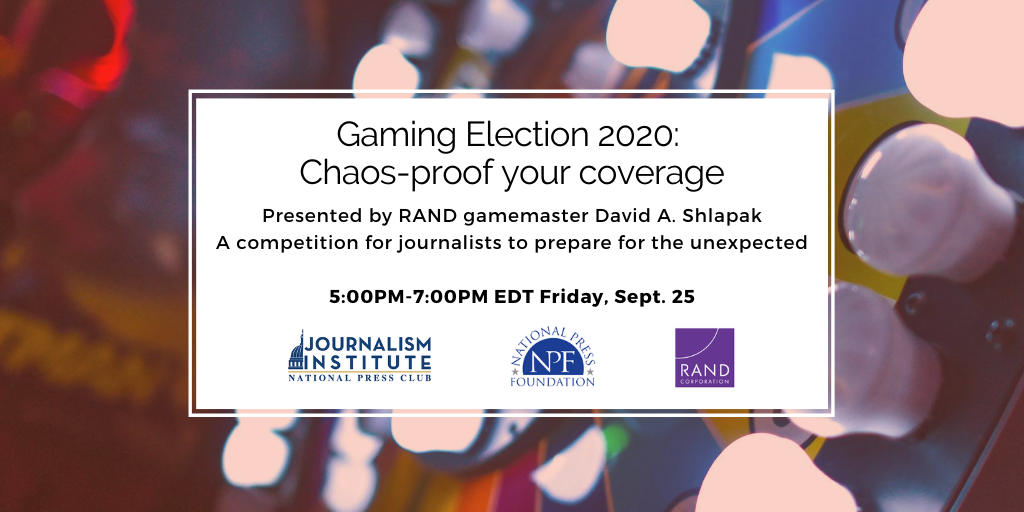
The National Press Club Journalism Institute, the National Press Foundation, and the RAND corporation are offering journalists a new way to prepare for the unexpected in Election 2020 news: Gaming your coverage plan.
Registration is open for this free program, which will be held on Friday, Sept. 25 from 5-7 p.m. ET.
RAND gamemaster David A. Shlapak will present players with scenarios based on current and likely events, and each team will make coverage decisions, not knowing what the next roll of the dice will bring.
The game will surface journalists’ assumptions and test decisions as reporters and editors balance competing goals, commit limited resources, and assess tradeoffs. The game’s timeline will begin in September, continue through Election Day, and end on Inauguration Day.
|
|
This newsletter is written & edited by the National Press Club Journalism Institute staff: Beth Francesco, Holly Butcher Grant, and Julie Moos. Send us your questions and suggestions for topics to cover.
|
|
|
|
|
|
|