Greetings!,


Happy June! 


Read on to explore how the Southwestern Medical District Transformation team is shaping a greener, healthier future as we highlight recent progress, ways to get involved, and share the things that are inspiring us.

This past month, we visited with leadership from Children’s Health, Parkland Health, and UT Southwestern at the Four-Person and Planning Advisory Committees. It was great to re-engage these groups and outline processes for ongoing coordination during the current project phase, ensuring that we continue to receive key insights and feedback from the Medical District as the project progresses.


The City of Dallas Dallas Department of Transportation & Public Works also hosted our second quarterly Harry Hines Corridor Projects Coordination meeting in May, convening a broad coalition of leaders for this quarter’s focused discussion on utilities coordination: including the City of Dallas Mockingbird Interchange rebuild, the Children’s Health new pediatric campus, and the City-led engineering team and Texas Trees-led landscape design team for Harry Hines: The Green Spine, Phase One, local franchise utility companies, Dallas Water Utilities, and Dallas Area Rapid Transit. 


Key takeaways included aligning the utility companies’ typical timeline for utility conflict resolution design period with the Phase One engineering and landscape design schedules to ensure smooth coordination and on-time project delivery. The utility companies represented were generally receptive to the proposed idea of an underground joint utility trench. This is great news, as this approach could minimize associated costs, construction time, and conflicts between utility locations and the new construction. The next step is for the project team to host individual meetings with each utility company that services the Medical District. 

So where can you expect to see the Southwestern Medical District Transformation first take root? 🌱


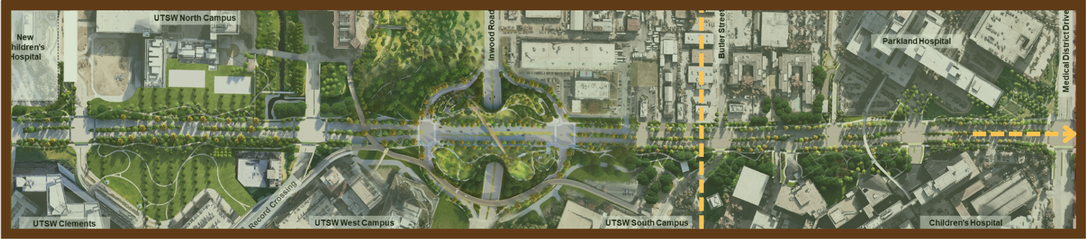
Our current work focuses on Phase One: The Green Spine, extending from Butler Street to just south of Medical District Drive, with the project's southern extent continuing beyond the map shown. Key to our approach is to deliver the project in phases, minimizing disruption to the critical daily operations of the Medical District and ensuring dedicated focus for each project phase to maximize resources and impact. Phase One features enhanced landscaping and tree canopy, improved site furnishings, safer intersections, a two-way cycle track, and more, all designed with the key purpose of improving human health and well-being by transforming the outdoor environment. 

Evidence-Based Design represents our commitment to designing a project that is based on the most credible evidence available for improving human health and quality of life through nature-based design solutions. As we progress through design, we are continuing to explore and evolve how our project can live up to this commitment. Lately, this has encompassed exciting conversations with our partners at Texas A&M University and our landscape architect consultants, Field Operations, and biophilic design consultants, Terrapin Bright Green. 


Our partners are actively shaping the scope of this work for a summertime pilot. A key part of this work entails Texas A&M leading baseline data collection of current environmental conditions, building upon the project’s historical evidence-based design approach, and helping further tell the story of pre- and post- project impact.


We also anticipate exciting opportunities for community members and project stakeholders to participate in mini-experiments and surveys that will help us understand the physiological response and preference for elements of the project design compared to the current conditions. Please stay tuned for more information and ways to get involved! 📣

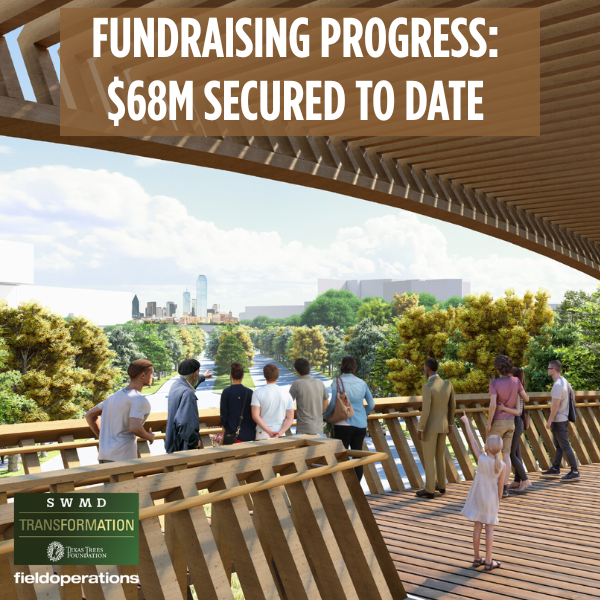
Much like the Green Park's pedestrian bridge will offer awe-inspiring views towards the Downtown Dallas skyline, we're looking ahead at a similary hopeful future for the Southwestern Medical District.


Momentum continues to build across the Southwestern Medical District Transformation Campaign. Since our last update, total funding commitments have grown to more than $68 million, demonstrating increasing confidence in both the vision and long-term impact of this generational investment. With each new commitment, we move closer to transforming the District into a national model for health, mobility, environmental resilience, and economic vitality. 


We remain inspired by the growing coalition of partners who are helping advance this work and are encouraged by the significant funding opportunities currently underway. Together, we are creating lasting change that will benefit Dallas and all of North Texas for generations to come. Interested in learning about Naming Opportunities for both Phase One: The Green Spine and Phase Two: The Green Park? Please reach out to Heather Stevens to learn more. 

A Texas sized congratulations to Lyda Hill, founder of Lyda Hill Philanthropies, who was recently named to TIME100 Most Influential People in Philanthropy 2026.


Lyda truly embodies her philosophy of 'science as a solution'. From investing hundreds of millions into cancer research, STEM innovation, uplifting female role models, and improving our natural environment, she continues to redefine what bold and purposeful philanthropy looks like. We are proud to be one of the many organizations Lyda has supported over the years. Her pioneering support has allowed us to provide a more sustainable future for Dallas through our
Cool Schools Program and the Southwestern Medical District Transformation project.


This honor reflects not only her leadership, but the countless partners and changemakers she empowers along the way. Congratulations, and thank you for inspiring a future where science, innovation, and generosity shape a better world.

We enjoyed being in Austin this past week to speak at the City Parks Alliance’s Greater & Greener Conference for a panel conversation with esteemed statewide groups advancing parks and green space for our session, Resilient Park Planning in Big Texas Cities. 


On July 17th, our team is delighted to join Philip Haigh of The Loop Dallas for a conversation at the Dallas Friday Group. Our conversation will center on public-private partnerships advancing green space networks and pedestrian connectivity in Dallas. For information on attendance, please reach out to Heather Stevens, Project Campaign Advisor. 


We are excited for the opportunity to share and learn from the attendees at these events. We would love to see you there! 

This research is one of the latest in a growing repository that demonstrates how the places where we live and work deeply mpact our health and well-being.


Image Credits: Washington State University

Walkable Neighborhoods Can Boost Physical Activity, Population Health       


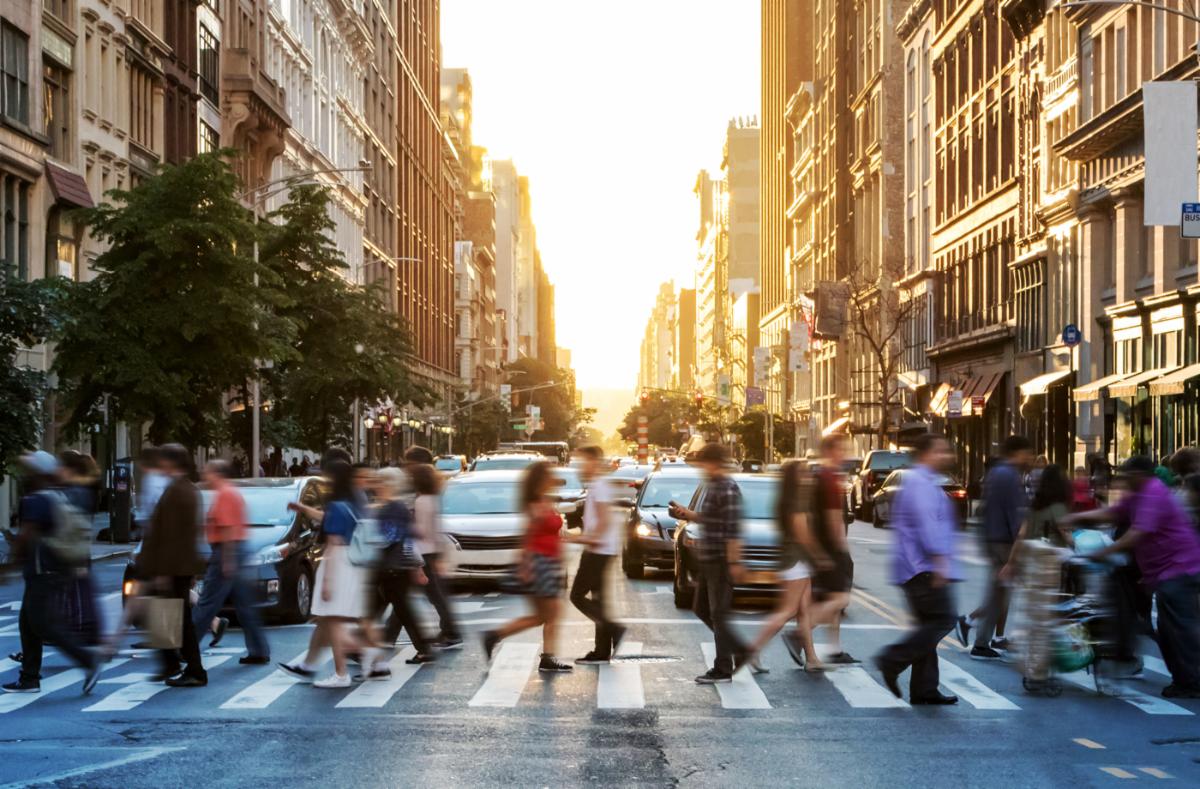
This recent research correlates improvements in neighborhood-scale walkability with people's walking behaviors. Knowing how profoundly impactful walking is on human health, these findings are meaningful. Researchers scaled their discovery, finding that a 55% increase in walkability caused people to walk 19 more minutes per week on average. Consider these findings in action in the Medical District, where time is limited and the pace hurried. The Green Park will be, at most, a fifteen-minute walk from the furthest boundaries of the Medical District. Improvements in walkability along the Green Spine will allow providers to walk between facilities and appointments, rather than resorting to short-distance drives. 

Equity, Accessibility, and Regional Impact: Why the Southwestern Medical District Transformation Matters for All of North Texas 


Our most recent blog edition explores how the project will touch countless lives of North Texans and beyond, who depend on the District day in and day out for unique reasons.


From providers dedicating their career to caring for the health and well-being of our community, to patients seeking a range of routine to critical care, to the broader engines of innovation, economic activity, and mobility that this district facilitates - every facet of the transformation is uniquely tailored to the Medical District and is aligned with regional and national goals that center the critical role of infrastructure in our daily lives.

Thanks so much for reading! Have an idea, question, or want to connect further in the meantime? To reach our team, drop us a line at swmdproject@texastrees.org.