Soil salinity is an issue across all of North Dakota. Over 10 million acres are impacted by salinity or roughly the size of the state of Vermont! Water soluble salts are the culprit that causes the saline white spots. Water management is the only way to reduce and prevent soil salinity.
When soil salinity is tested, we mix up soil and distilled water and use an electrical conductivity meter. This lab tool is similar to an electrical multi-meter you may have for fixing electrical things on your farmstead. As salinity increases, so does the electrical conductivity (E.C.). If your E.C. is greater than two, your crops and forage are likely taking a hit on yield.
We can manage water through crop selection (i.e. perennial forages, cover crops, salt tolerant crops, salt tolerant forages) and drainage systems. The first step to managing salinity is to soil test. That way you know what plants can grow in those areas. The earlier you catch the salinity issue, the more tools you have available and the remediation process will be shorter.
One thing that all the aforementioned practices have in common are that they lower the water table and encourage leaching. Salts are brought near the surface soil water. As water evaporates, salts are left behind and accumulate over time. Tillage masks the salinity by mixing black soil with the white salt.
Evaporation is like conveyor belt for soil salinity. Keeping residue on the soil slows the conveyor belt. A growing plant using moisture stops the conveyor belt. Tillage turns soil black and destroys soil structure. Destroying soil structure increases a soil’s ability to wick up moisture through capillary rise and speeds up the conveyor belt. That white spot is where we see a yield monitor drop down to nothing, but the water and salts are coming from up the landscape. So to effectively manage salinity, we need to manage water across the landscape.
I have helped many producers manage salinity through crops like A.C. saltlander, salt tolerant alfalfa, late seeded barley cover crops, and salt tolerant cash crops (i.e. barley, canola, and sunflower). I use what I call the “Bulls-eye” method. When I visit a field I will take several soil samples and test for salinity. Generally, I start at the top of a hill that isn’t saline and work my way into the wet saline ground. I look for thresholds. When the E.C. is less than four, you plant what you want. When it is between four and six, plant a salt tolerant alfalfa. When the salinity is six or greater, plant a salt tolerant forage like A.C. Saltlander or tall wheatgrass. Along this gradient, flags are placed in the soil to establish the thresholds. Then a producer will plant the desired plants between the specific flags.
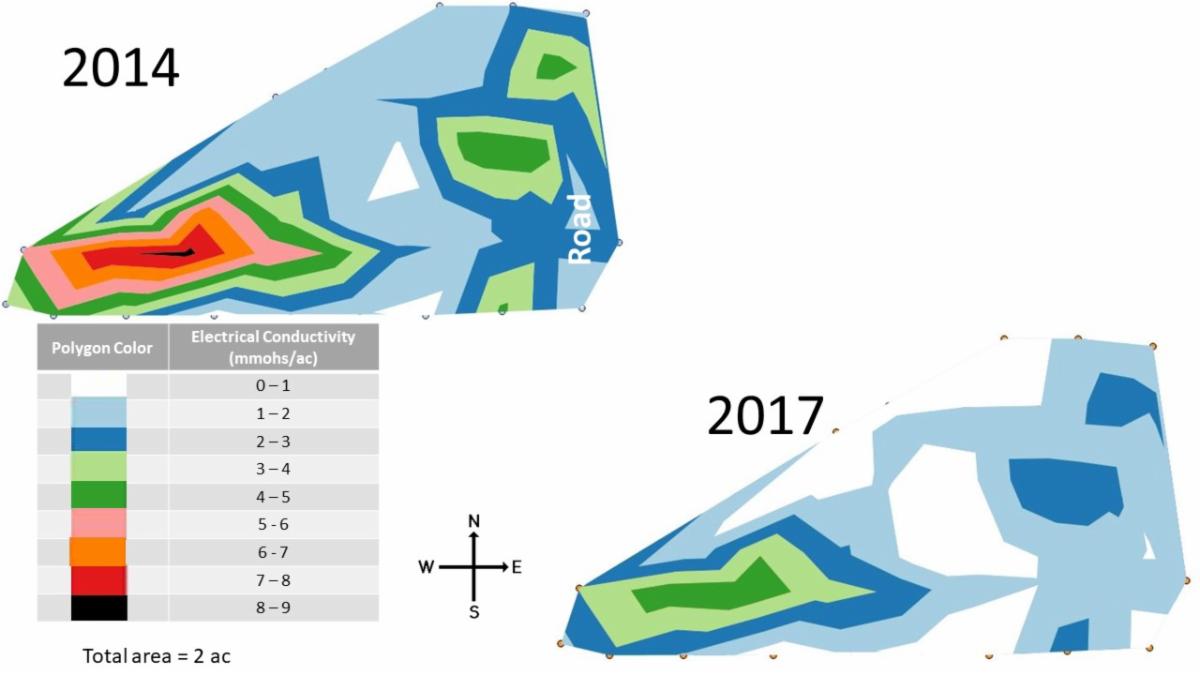
Figure 1 is an example of an area that was saline and after three years, greatly improved. This area was near Bowbells and was about two acres. Because of the nature of the field, the bulls-eye method couldn’t be completely followed. The green, blue, and white areas (E.C. of five or less) were planted with salt tolerant alfalfa. The pink, orange, red, and black areas were seeded with tall wheatgrass, A.C. Saltlander, critina thickspike, and Canada wildrye.
Salinity remediation will take time and is perpetual management. Plan on five or more years before you see some big improvements. When the area is fixed, plant what you want, but be sure to keep soil testing those areas. If you catch the salinity before it becomes too bad, you have more tools and it will take less time to fix.