Friday, July 10, 2026


INCLUDED WITHIN:


  • SPECIAL ALERT: New LPTV/TX Rules and Filing Opportunities
  • What That Means from Davina Sashkin
  • Letter from SuperFrank
  • FCC Strengthens Emergency Alert System Security - Start Preparing Now
  • Remember: FREE ATSC 3.0 Certificate Authority exclusively for LPTVBA Members
  • Tune In to the Podcasts
  • Join Us!


Frank "SuperFrank" Copsidas

Founder and Board Chair of the LPTV Broadcasters Association

SPECIAL ALERT: New LPTV/TX Rules and Filing Opportunities


Just in! The Public Notice from the FCC is out. It covers both the new rules AND clarifies issues with the ongoing filing opportunities.


MEDIA BUREAU ANNOUNCES EFFECTIVE DATE FOR RULE CHANGES IN LPTV ADVANCEMENT REPORT AND ORDER

MB Docket No. 24-148

EFFECTIVE DATE: JULY 9, 2026


AND


GUIDANCE CONCERNING MEDIA BUREAU’S ONGOING LPTV FILING OPPORTUNITY


Read the Notice Here

WHAT THAT MEANS...

From the Desk of Davina Sashkin

Wilkinson Barker Knauer LLP


Today, the FCC’s Media Bureau (the “Bureau”) released a Public Notice which: (1) announced that July 9, 2026 was the effective date of certain rules that the FCC adopted in its December 2025 Report and Order, which revised the FCC’s rules applicable to LPTV Service stations (i.e., Class A TV, LPTV, and TV translator stations); and (2) provided guidance regarding filing new and major change applications for LPTV and TV translator stations. 


Our summary of the Public Notice is provided below.


A. Effective Date of LPTV Service Rules


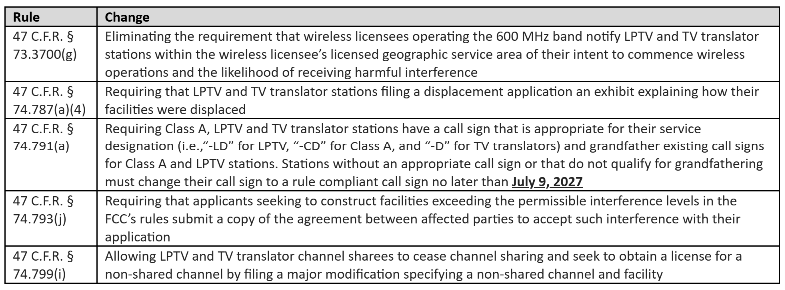
The Bureau announced that the following rule amendments and additions adopted in the Report and Order—which required approval of the Office of Management and Budget (“OMB”) under the Paperwork Reduction Act prior to becoming effective—are now effective as of July 9, 2026:

The Bureau also noted that certain other rule amendments adopted in the Report and Order required changes to the FCC’s forms—meaning that they needed OMB approval before becoming effective, including:


  • 47 CFR § 73.6001(d) (Class A to LPTV status change applications for stations no longer eligible for Class A status);
  • 47 CFR § 73.6002(a)(2) (updating Class A license application form reference from “FCC Form 302-CA” to “FCC Form 2100 Schedule F”);
  • 47 CFR § 73.6002(b)(2) (Class A station community of license change applications for Class A stations);
  • 47 CFR § 74.787(a)(1)(ii) (LPTV and TV translator community of license change applications); and
  • 47 CFR § 74.787(a)(2)(ii) (LPTV to TV translator status change applications)


As OMB approval remains pending for those rules, the Bureau stated that it will issue a separate Public Notice announcing when those rule amendments will take effect.


B. Guidance Concerning the Ongoing LPTV Filing Opportunity


The Bureau provided guidance for applicants completing the FCC Form 2100 – Schedule C in filing for new LPTV and TV translator stations. Specifically, for the “Attributable Interest – Other Authorizations” section of the application, which asks “Does the applicant or any party to the application have an attributable interest in any other broadcast station(s),” the Bureau clarified that the question may be answered by applicants as follows:


  • “Yes” – Applicants must include an exhibit listing the applicant’s attributable interests in other broadcast station(s)
  • “No” – Applicants without interests in any other broadcast station must provide this answer
  • “N/A” – Although the Bureau did not previously accept applications with an “N/A” response, the Bureau stated that applications would not be rejected solely on the basis of providing such a response and any pending applications providing an “N/A” response do not need to be amended


The Bureau also stated that it will be issuing a separate Public Notice regarding the treatment of mutually exclusive (“MX”) new and major change LPTV and TV translator applications (group of applications that cannot all be granted together pursuant to the FCC’s technical rules), and will also provide further guidance for resolving MX applications through settlement or engineering amendment—which may be submitted either before or during a settlement window. 


***

Please feel free to contact us if you have any questions.


Davina Sashkin | dsashkin@wbklaw.com
Partner

Wilkinson Barker Knauer LLP


Hello LPTVBA Family and Friends!


We are absolutely thrilled to be back with another exciting update, and we’ve got some fantastic news to share! First off, our brand-new podcast series is turning out to be a huge hit — and we’re having so much fun making them! Bill Christian and I are pouring our energy into every episode, and with your incredible support and feedback, we know we’re going to keep getting better and better. We’ve been completely stunned (in the best way possible!) by how many of you are tuning in and listening to the full podcasts. Thank you from the bottom of our hearts! We promise to keep the content fresh, lively, and packed with value. More episodes are on the way — stay tuned for some really exciting guests and topics!


Listen on YouTube


Listen on Spotify


On a more serious but equally important note, we’re turning our attention to something that affects all of us: the Emergency Alert System (EAS). Given the article that appears below in this newsletter, it’s time for a major upgrade. The current system is outdated and antiquated, especially when you consider how far technology has come. We believe it’s time to bring emergency alerts into the modern age by using the power of the internet — just like cell phones do so effectively today. Of course, we’ll back it up with reliable satellite service for those critical moments when redundancy matters most. There’s a lot more to come on this front, and we’re excited to keep you in the loop as we push for real improvements that will better protect our communities.


As we head deeper into this beautiful summer season, we want to wish each and every one of you a spectacular time ahead! Get outside, soak up the sunshine, make wonderful memories with family and friends, and enjoy every moment. You’ve all worked hard — now it’s time to have some fun!


Thank you for being such an amazing part of the LPTVBA family. We can’t wait to bring you more great content, updates, and initiatives in the months ahead.


Stay safe, stay connected, and keep smiling!


SuperFrank

FCC Strengthens Emergency Alert System Security – Time for Stations to Act Now


At its regular monthly meeting last week, the FCC approved new rules designed to better protect the Emergency Alerting System (EAS) from hackers.


The Commission acted after several incidents where bad actors broke into the system and sent false emergency alerts over the air. The new three-part plan aims to secure not just the EAS equipment itself, but the entire chain of systems stations use to air programming. The goal is to prevent unauthorized people from inserting fake alerts or other harmful content.


Important Deadline Note

There was some initial confusion about when these rules take effect. An erratum released today clarifies that the new requirements will go into effect 60 days after the order is published in the Federal Register. That publication could happen at any time, which likely means a September compliance deadline. Stations should begin working on compliance right away—especially with summer vacations in full swing.


The Three Requirements

1. Strong Password Security (Easy to Do – Start Today)

Broadcasters must use much stronger passwords for their systems. 

- Passwords must be at least 15 characters long. 

- They cannot be common dictionary words (these are too easy to guess or crack). 

- Passwords should not be reused across other accounts, equipment, or services. 


Stations should also have a policy to change passwords whenever an employee who had access leaves the station.


2. Keep Equipment Updated

Make sure all available software updates and security patches for your EAS equipment are installed. 

You must also create an ongoing process to regularly check for new updates and install them promptly. This is a straightforward but important step.


3. Protect Your Systems with a Firewall (Most Involved – Start Planning Now) 

All EAS equipment and programming systems connected to the internet must be placed behind a network firewall or use similar network segmentation methods. 


In simple terms: EAS systems should be separated from your regular office/business networks so that outsiders cannot easily reach them from the internet.


These changes are mandatory. Starting compliance efforts early will help stations avoid last-minute rushes. If you have questions about how to implement these requirements, your station’s engineering or IT team should begin reviewing your current setup now.

DON'T FORGET: NEW MEMBERSHIP BENEFIT


The LPTV Broadcasters Association has partnered with Silicondust & the ATSC 3.0 Certificate Authority (ATSC3CA) to offer our members a new membership perk! 

You may already know Silicondust as the makers of the HDHomeRun, the #1 selling NextGen TV DVR in the United States! ATSC3CA is a service provided by Silicondust and has recently launched FullTrust ATSC 3.0 signing certificates. 


As a member of the LPTVBA, these certificates are available to you for FREE!


If you have trouble logging into the Member Portal, reset your password.

Local Power TV Podcasts


Have you been listening? Our podcasts are a great way to hear about current news and all things happening in the Local Power TV industry. You can now listen to them on YouTube and Spotify. Join us and "Follow" and let us know what topics you would like for us to cover.


Email us anytime: Podcast@LPTVBA.org


What did you do locally to celebrate America's 25th Anniversary?

LPTVBA MEMBERSHIP


We are THE association for the LPTV, Class A, and independent full-power television station business community in the USA. Members include station owners, brokers, legal, consulting, technology, and engineering community.


LPTV Broadcasting Association’s mission is to promote industry collaboration and opportunities - to provide a one source platform for insights, issues, and standards that enable the LPTV industry to thrive. Advisory services include station brokerage, maximizing station value, subchannel leasing, and resource connections.


We provide representation for our members with legislators and policy makers in an increasingly complex security-focused communications landscape.

Thank you to our 2026 LPTVBA Annual Sponsors!