|
Dear Presidents’ Alliance Member,
In this week’s Member Update:
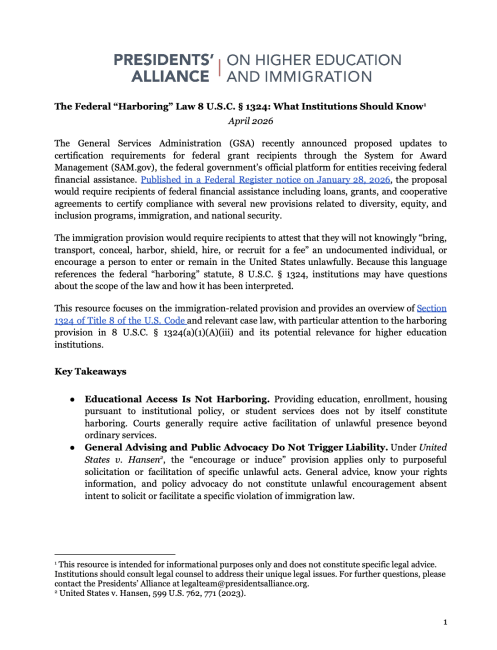
- New Resource! The Federal “Harboring” Law and the GSA Proposal: What Institutions Should Know
- Kansas Governor Vetoes SB 254 Preserving In-State Tuition Access
- DACA Renewal Delays and Ongoing Vulnerabilities for Dreamers
- States Restrict Access to Career and Dual Enrollment Programs For Undocumented Students
-
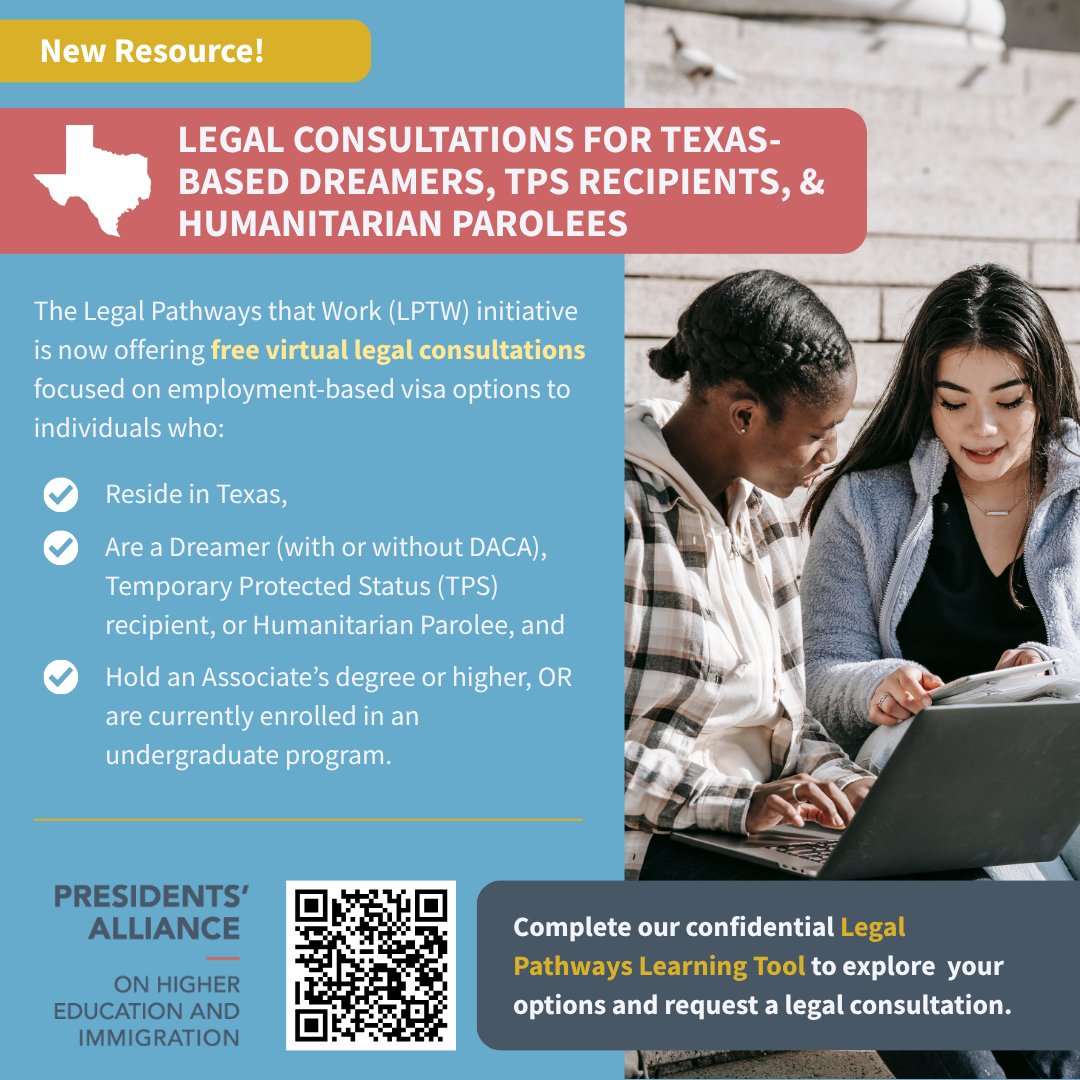
FREE Legal Consultations Available for Texas-Based Students & Graduates in Precarious Immigration Statuses
- Register for Our Upcoming Webinar: The End of Duration of Status? What Campuses and Students Need to Know to Prepare
- Join Our Biweekly Policy Update Meetings
- Immigration in Brief
- Calendar of Events
- Top Reads
| | New Resource! The Federal “Harboring” Law and the GSA Proposal: What Institutions Should Know | | |
The General Services Administration (GSA) recently announced proposed updates to certification requirements for federal grant recipients through the System for Award Management (SAM.gov), the federal government’s official platform for entities receiving federal financial assistance. Published in a Federal Register notice on January 28, 2026, the proposal would require recipients of federal financial assistance, including loans, grants, and cooperative agreements, to certify compliance with several new provisions related to diversity, equity, and inclusion programs, immigration, and national security.
The immigration provision, which would require recipients to attest that they will not knowingly “bring, transport, conceal, harbor, shield, hire, or recruit for a fee” an undocumented individual, or encourage a person to enter or remain in the United States unlawfully, has generated concern and confusion among institutions. We developed this resource to support institutions by providing clear analysis and takeaways on what they need to know, including why education access and related support for undocumented students do not constitute harboring, why general advising and public advocacy do not trigger liability, and more.
To read the full takeaways for campuses, the analysis of the statutory framework, key legal concepts, and relevant circuit case law, please refer to the full resource here.
| | |
Kansas Governor Vetoes SB 254 Preserving In-State Tuition Access
Kansas Governor Laura Kelly vetoed SB 254 on April 6. Among other provisions, the bill would have restricted access to in-state tuition for undocumented students. In her veto statement the governor emphasized the importance of educational access and workforce development in her decision. Lawmakers are set to return Thursday, April 9, to attempt veto overrides. The bill previously passed the Senate 22-18 and the House 78-46, both short of the 27 and 84 votes needed to override a veto.
| | |
DACA Renewal Delays and Ongoing Vulnerabilities for Dreamers
DACA renewal delays continue to create uncertainty for recipients and the campuses that support them. There are also growing concerns about paused cases and additional review for some applicants, including reports that certain DACA renewals for nationals of countries listed in Presidential Proclamations 10949 and 10998 have been placed on hold, sometimes without applicants being notified, as reflected in recent letters from members of Congress. USCIS recommends filing between 150 and 120 days before a current DACA period expires. Applications filed more than 150 days in advance may be rejected, while filing too late can increase the risk of a gap in work authorization or protection from removal. Applicants may use NILC’s DACA Renewal Calculator and follow the guidance to submit during the recommended time period.
At the same time, the recent detention of Annie Ramos, an ASU student, TheDream.US Scholar, and Dreamer who applied for DACA in 2020 but was never able to receive it after the program was halted for new applicants, offers a separate reminder of the continued vulnerability facing Dreamers, including those without access to DACA protections. For practical renewal guidance, see NILC’s resource, Why Some DACA Renewals Are Taking Longer — and What You Can Do.
| | |
States Restrict Access to Career and Dual Enrollment Programs For Undocumented Students
Recent reporting highlights how federal guidance under the Trump administration is influencing states to limit undocumented high school students’ access to certain educational opportunities, including dual enrollment and career and technical education (CTE) programs.
At least three states, Virginia, Iowa, and Georgia, have taken steps to restrict access to programs funded with federal or state dollars. These efforts stem from a broader push to limit public benefits for undocumented immigrants, including a reinterpretation of federal law suggesting that protections for K-12 students may not extend to programs beyond “basic education.”
These interpretations are not legally binding, and ongoing litigation has blocked the guidance in some states. Despite this, the federal policy has already influenced state-level decisions, creating a patchwork of access across the country.
| | |
FREE Legal Consultations Available for Texas-Based Students & Graduates in Precarious Immigration Statuses
The Presidents’ Alliance’s Legal Pathways that Work (LPTW) initiative continues to offer free, virtual legal consultations for students and graduates in Texas exploring employment-based visa options. This resource is particularly timely for Texas-based individuals in precarious statuses given continued uncertainty around the future of DACA and recent restrictions on H-1B sponsorship in the state.
Eligible individuals must:
- Reside in Texas;
-
Be a Dreamer (with or without DACA), Temporary Protected Status (TPS) recipient, or Humanitarian Parolee; AND
-
Hold an associate degree or higher, OR be currently enrolled in an undergraduate program.
Consultations are conducted by our trusted Texas-based partner law firm, focusing on employment-based visa options while also screening for all potential pathways to lawful status.
| | | | |
How it Works:
Direct eligible students and graduates to first complete our Legal Pathways Learning Tool – a confidential online questionnaire developed by immigration legal experts. It helps users explore possible employment-based pathways and determine next steps. Those who meet our program criteria will then have access to the legal consultation request form.
| | For more information on our legal consultations program of the LPTW initiative, visit our Legal Pathways that Work resource hub or email Caitlin Johnson at caitlin@presidentsalliance.org. | |
|
Register for Our Upcoming Webinar: The End of Duration of Status? What Campuses and Students Need to Know to Prepare
Join us on Tuesday, April 28, 2026, at 1:00 PM ET for a timely webinar on the anticipated final rule to end duration of status (D/S) for international students and scholars. As institutions await the final rule, this session will provide an overview of what we know so far, including potential implications for campuses, administrators, and students, and how colleges and universities can prepare for the possible changes.
Hosted by the Presidents’ Alliance, NAFSA, and International Student Resource Center, the webinar will outline practical steps institutions can take now to mitigate disruption and support the impacted students and scholars. Our speakers will also explore potential legal and policy pathways, including possible scenarios for challenging the rule, and what different stakeholders can anticipate in the months ahead. Participants will leave the session equipped with tools and insights to navigate the transition, respond to evolving developments, and support their campus communities effectively.
| |
|
Join Our Biweekly Policy Update Meetings
Current Presidents’ Alliance members are invited to join our biweekly policy update meetings for timely policy updates, practical takeaways, and discussion with peers. Our next meeting will take place on April 10 at 12:00 p.m ET. If you or a member of your senior leadership team would like to receive the invitations, please contact Corinne Kentor at federalpolicyteam@presidentsalliance.org.
| | |
Immigration in Brief
-
Congressional Republicans are weighing a narrow reconciliation package to fund ICE and CBP after the Senate advanced a DHS funding bill that excluded those operations and omitted key enforcement guardrails. However, divisions in the House over scope, offsets, and sequencing, alongside a competing short-term continuing resolution with no Senate path, continue to complicate efforts to resolve the stalemate.
-
POLITICO reported that more than a dozen immigrant doctors have been forced to stop working because of delays in renewing visas for individuals from travel-ban countries, even after years of living and practicing in the United States. The disruptions are further straining an already understaffed health care workforce.
-
Pew provides an overview of the 32 countries, most in the Western Hemisphere, with birthright citizenship laws that are substantively similar to those of the United States.
| | |
Calendar of Events
-
April 21, 2026 | Campus Compact & ECAR Webinar – Meeting the Moment: How Campuses Are Continuing to Support Refugees | Register Here
-
April 28, 2026 | Webinar – The End of Duration of Status? What Campuses and Students Need to Know to Prepare | Register Here
-
June 9, 2026 | In-Person Policy and Legal Strategy Session + DACA Anniversary Reception | Register Here
| | |
Thank you for your support and engagement.
The Presidents’ Alliance Team
| | | | |