|
Palm Beach County State Legislative Update
Week of January 26
| | UPDATES FROM THE EXECUTIVE BRANCH | | |
Executive Office of the Governor DOGE Report
A report released by the Florida Department of Government Efficiency (DOGE) presents findings from 13 jurisdictions reviewed to date. Common findings that the report outlines are claims that there was uncovered evidence of “widespread DEI and ESG activities, both past and present, that contravene state policy.” It also states that the review identified broad themes in local government spending growth, along with numerous specific examples of inefficient or excessive spending.
Specifically relating to Palm Beach County, the report states that:
- Since Fiscal Year 2016-17, Palm Beach County General Fund spending increased by 89%, while population grew by only 10%.
- Spending in many county departments has grown at a rapid rate.
- Some policies have added DEI and ESG complexity to every project.
Excessive Spending Examples
The report cites significant spending growth in Palm Beach County by focusing on sharp increases in health services, paratransit, employee salaries and overtime, and homeless services. It highlights rising reliance on property taxes, paratransit costs that exceed neighboring counties, salary growth outpacing inflation, and homeless spending that has coincided with an increase in the homeless population.
DEI Examples
The report highlights Palm Beach County’s past participation in and spending on DEI-related initiatives, including grants, training programs, and funding tied to social equity goals, but gives credit to the Board of County Commissioners for cancelling further participation in certain programs and recognizes that the county's new County Administrator has reorganized county functions to eliminate the Office of Resilience.
See full report here.
| | UPDATES FROM THE LEGISLATURE | |
Senate President Ben Albritton Treated for Blood Clot
Earlier this week, the Senate President’s Office announced that President Albritton was admitted to the emergency room on Sunday after experiencing chest pain. Physicians determined that he had a small blood clot in his lung. After receiving treatment, President Albritton was discharged from Shands Hospital in Gainesville late Tuesday afternoon. In a memo, he stated that no abnormalities were found in his heart and that he will continue under the care of a hematologist and take medication as a preventive measure.
| |
|
HJR 213: Modification of Limitations on Property Assessment Increases - This property tax joint resolution by Representative Griffitts has passed its final committee stop and is now one of the 3 property tax proposals ready for the House Floor. The other two are HJR 203 by Representative Miller and HJR 209 by Representative Busatta.
The joint resolution proposes a constitutional amendment to limit how frequently and by how much local governments can increase property assessments for ad valorem taxes. Under the proposal, assessments for individual properties would only change once every three years. Increases for homestead properties would be capped at 3% or the change in inflation over that period, whichever is lower, while non-homestead properties could increase by up to 15% every three years. Assessments cannot rise if the property’s current just value is lower than its value at the last assessment change.
The resolution also proposes a new provision requiring local governments to maintain funding for first responder services at or above a specified base year level. If approved by at least 60% of voters in the 2026 general election, the amendment would take effect on January 1, 2027, and would not be subject to the Governor’s veto.
| | TUESDAY COMMITTEE MEETINGS | | |
Senate Rules
SB 48: Housing - This bill by Senator Gaetz has passed its final committee. No members posed substantive questions on the bill or its amendments, and debate focused on the urgent need to address Florida’s housing shortage by allowing accessory dwelling units as a flexible, cost-effective solution, with no expressed opposition.
It addresses housing supply and affordability by expanding local requirements related to accessory dwelling units (ADUs) and creating incentives tied to land donations for affordable housing. The bill requires every county and municipality to adopt an ordinance by December 1, 2026, allowing ADUs in all single-family residential areas. While local governments may continue to regulate the permitting, construction, and use of ADUs, the bill establishes certain limitations on those regulations. Under current law, adoption of ADU ordinances is optional; this bill makes it mandatory statewide.
The bill also expands affordable housing options by allowing land donated to local governments for affordable housing to be used to serve military families receiving a basic allowance for housing. Additionally, it directs the Office of Program Policy Analysis and Government Accountability to study the effectiveness of mezzanine financing to encourage owner-occupied affordable housing development and to assess the potential role of tiny homes in meeting affordable housing needs. The bill now heads to the Senate Floor for final consideration.
| | |
Senate Community Affairs Committee
SB 380: Legal Notices - This bill by Senator Trumbull, aims to expand the options for publishing legal notices and advertisements by allowing municipalities, clerks of court, tax collectors, and water management districts to post them on their own websites, designated private websites, county websites, or in local newspapers. The bill maintains existing requirements that online notices be searchable, dated, more cost-effective than newspaper publication, and establishes timeframes for how long notices must remain posted online. In committee, members questioned cost savings for smaller counties and proof-of-notice standards in a digital environment, while the bill sponsor argued that allowing agencies to publish directly online would reduce taxpayer expenses. The bill ultimately passed without any votes against it and moves on to its final stop in Senate Rules.
SB 962: Affordable Housing - This bill by Senator Bradley provides that for the purposes of the Live Local Act, passed during the 2023 Regular Session, farms or farm operations, including the packaging and sale of those products raised on the premises, are excluded from the definitions of commercial, industrial, or mixed use zoning which would require the local government to approve certain affordable housing developments. As a result, counties and municipalities are not required to allow multifamily or mixed-use residential development in areas that are farms or farm operations. No members posed questions during committee and the bill passed without opposition. The bill moves to its second stop in Senate Agriculture.
SB 948: Local Government Land Development Regulations and Orders - This bill by Senator McClain establishes the “Florida Starter Homes Act,” significantly limiting local government control over single-family zoning and residential development regulations. The bill sets statewide standards for lot development, density, and housing types, streamlines and mandates timelines for development approvals, expands allowed housing options, and creates legal remedies which include fee recovery and waived sovereign immunity for challenges to local government actions. Members focused on balancing local government autonomy with the goal of expanding small-lot starter homes. The bill passed 7-1 in committee and moves on to its second stop in Senate Judiciary.
SB 984: Firefighter Cancer Benefits and Prevention - This bill by Senator DiCeglie expands firefighter cancer benefits by allowing a $25,000 payout upon cancer diagnosis for up to 10 years after employment ends and removing limits tied to an initial diagnosis or continued health coverage. The bill also extends eligibility for the $75,000 cancer death benefit to one year after termination and removes duplicative rulemaking provisions. No questions were raised by committee members and Senator Nick DiCeglie briefly explained that SB 984 clarifies the firefighter cancer law by extending death benefits for one year after employment and decoupling the one-time payment from employer-sponsored health coverage. The bill passed its first committee with no voiced opposition and moves on to its second stop in Senate Government Oversight and Accountability.
SB 1434: Infill Redevelopment - This bill by Senator Calatayud creates the “Infill Redevelopment Act,” allowing certain environmentally impacted parcels (at least 5 acres) to bypass local land development rules. These parcels must be approved administratively for development consistent with nearby zoning or for specified residential uses, with limited restrictions. The bill also sets standards for recreational uses on qualifying parcels and preempts any local rules that are more restrictive or burdensome. Members raised questions about the definition of “environmentally impacted” parcels, the potential for overdevelopment, and the need to safeguard public health, while debate highlighted concerns with bypassing local input and imposing preemptive mandates. Despite some opposition, all members voted for the bill and indicated support contingent on further refinements. The bill proceeds to its second stop in Senate Judiciary.
SB 1444: Preemption to the State - This bill by Senator Martin expands state preemption by restricting local governments from limiting religious gatherings, regulating certificates of occupancy and building permits, and treating mutual benefit corporations differently than other businesses by specifically restricting local regulation of parking standards for home-based operations. Members raised questions around local parking requirements for churches, local sovereignty concerns, and unintended consequences for private clubs. They also expressed strong support for protecting religious freedoms and property rights but urged refinements to address sovereign immunity and preemptions that might conflict with federal and local regulations. The bill passed with a 6-2 vote and proceeds to its second stop in Senate Judiciary.
SB 1612: Electronic Payments to Local Governments - This bill by Senator DiCeglie requires each unit of local government, and each department, subagency, and division of such units of local government, to accept electronic payment online by use of credit cards, charge cards, bank debit cards, and electronic fund transfers for payments received by and financial obligations owed to the local government. Members asked no questions in committee and the bill sponsor emphasized cost savings for local businesses by requiring local governments to accept electronic payments. No committee members debated or opposed the bill and it passed unanimously. It now moves to its second stop in Government Oversight and Accountability.
| | |
Senate Environment & Natural Resources
SB 558: Standards for Stormwater Systems - This amended bill by Senator Burgess requires all new stormwater systems owned by counties and municipalities to comply with the Florida Department of Transportation’s standard specifications for pipe culverts and pipe liners. The bill also requires final inspections for all storm pipes and storm structures to be performed by a NASSCO-certified technician employed by a third-party licensed engineering firm or any general contractor and authorizes the use of closed-circuit television inspection equipment. The bill further provides that these installation and inspection standards supersede all existing local standards. Members raised concerns that local autonomy and existing codes could be displaced by a uniform FDOT baseline and questioned the feasibility of third-party inspections, while supporters favored consistent standards and stronger oversight. There was also broad agreement on the need for better maintenance provisions and the possibility of local governments exceeding these baseline rules. The bill passed 7-1 and proceeds to its second committee stop in Community Affairs.
SB 1468: Advanced Wastewater Treatment - This bill by Senator Berman requires sewage disposal with a permitted capacity of greater than one million gallons per day to submit an annual report to the Department of Environmental Protection (DEP) beginning July 1, 2027. The report must include the facility’s year of construction and any maintenance or upgrades, permitted and actual wastewater treatment volumes, current treatment levels and concentrations of specified contaminants, pollutant load estimates, disposal methods and volumes discharged to receiving waterbodies, spill history, elevation, and location relative to floodplains and coastal hazards. DEP must then provide an annual summary to the Governor and Legislature on facility data and the condition and management of affected waterbodies. The committee debate clarified the bill’s overall goal to improve data reporting and protect water quality and passed unanimously, and now heads to the Appropriations Committee on Agriculture, Environment, and General Government.
SB 1682: Local Administration of Vessel Restrictions - This bill by Senator Trumbull allows counties and municipalities to enforce laws on at-risk, derelict, and long-term anchored vessels by ordinance, in coordination with FWC. Local code enforcement officers may assess vessel status and issue administrative citations, while criminal enforcement remains with law enforcement. No members asked questions, and Vice Chair Mayfield, Senator Harrell, and Chair Rodriguez strongly supported the bill, emphasizing its effectiveness in empowering local governments to address derelict vessels. The sponsor noted the costly challenges of removing vessels once they sink and pledged to refine the language alongside the Fish and Wildlife Conservation Commission. The bill passed unanimously and proceeds to its next stop in Senate Appropriations Committee on Agriculture, Environment, and General Government.
SB 1628: Net-zero Policies by Governmental Entities - This amended bill by Senator Avila bill prohibits governmental entities from adopting net-zero policies, including through comprehensive plans, land development regulations, transportation plans, or any other government policy or procedure. The bill defines “net-zero policy” to include any target, threshold, action, initiative, framework, requirement, or policy related to reducing the use of carbon-intensive products or activities, including policies related to achieving goals under the Paris Agreement. The bill defines “carbon-intensive products” and “carbon-intensive activities” to include products and activities related to transportation, agricultural, energy production and transmission, hunting, mining, and manufacturing of products to support the continued livelihood of mankind.
The bill also prohibits governmental entities from expending funds to implement, support, or advance net-zero policies, including through procurement preferences, vehicle purchasing decisions based solely on the fuel source, or payment of dues to organizations that support net-zero policies. The bill further prohibits the imposition of taxes, fees, penalties, charges, offsets, or assessments to advance a net-zero policy. Governmental entities are also prohibited from implementing, administering, or enforcing cap-and-trade or carbon emissions trading programs, including establishing emissions caps, allocating or trading emissions allowances or credits, or requiring participation in such programs.
It requires annual compliance affidavits starting in 2027 and applies to actions taken on or after July 1, 2026. Questions and debate in committee centered on the impact of the bill on local government decision-making and local government ability to set climate resiliency goals versus allowing private marketplace to determine. The bill passed 5-3 and proceeds to its next stop in Senate Finance and Tax.
| | |
Senate Judiciary Committee
SB 332: Public Meetings/Private Property Rights - This amended bill by Senator Bradley creates a public meetings exemption allowing members of a local government board to meet privately to review and discuss claims filed under the Bert J. Harris, Jr., Property Rights Protection Act. Once a claim is resolved, all records of the private meeting, including transcripts, must be made public. The bill aligns the treatment of these pre-litigation claim discussions with existing exemptions that allow private meetings to discuss litigation strategy and settlement during an active lawsuit.
The bill recognizes that, under current law, Bert Harris Act claim discussions must be conducted publicly even though they often involve settlement considerations similar to litigation. It may result in an undetermined positive fiscal impact on state and local governments. Because it creates a public records and meetings exemption, the bill is subject to the constitutional requirement of a two-thirds vote of each chamber for final passage. Members asked how the bill impacts closed-door discussions under Florida’s sunshine law and discussed the scope of the pre-suit period in Bert Harris property rights claims. The sponsor emphasized that it would permit confidential strategy sessions while still requiring public disclosure later. The bill passed unanimously and proceeds to its second committee stop in Government Oversight and Accountability.
| | |
Senate Transportation Committee
SB 706: Commercial Service Airports – This amended bill by Senator Mayfield preempts to the state the naming of major commercial service airports, which are defined as commercial service airports classified by the Federal Aviation Administration (FAA) as large or medium hub airports. The bill codifies in law the names of Florida’s seven major commercial service airports. The only name being changed from its current name is “Palm Beach International Airport,” which the bill renames as the “Donald J. Trump International Airport.”
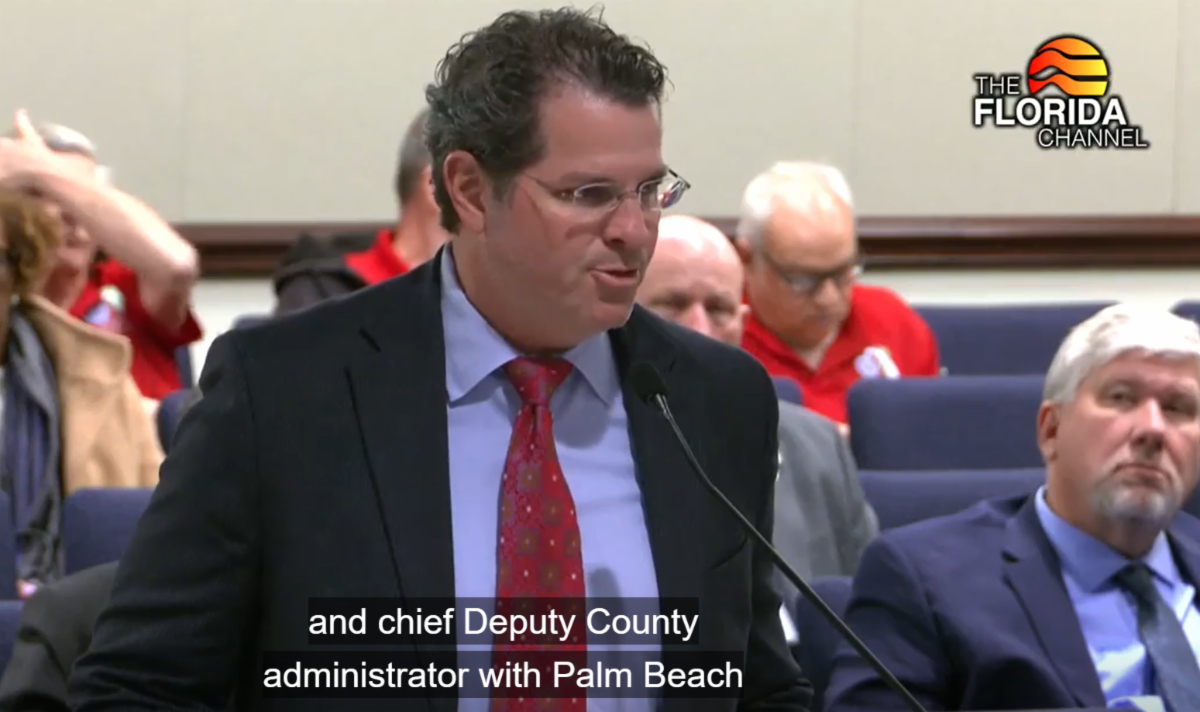
The committee voted to approve the amendment from the county with Chief Deputy County Administrator Todd Bonlarron present to thank the Chair, Sponsor, and Committee staff for working with the county on this amendment. The amendment clarifies the following:
- Name change from Palm Beach International Airport to Donald J. Trump International Airport is subject to approval by the Federal Aviation Administration and execution of an agreement between PBC and the trademark holder, authorizing the commercial use of the name "Donald J. Trump International Airport".
- Amendment also acknowledges that airport names function as brand identities rather than separate legal identities.
- Finally, the amendment allows a reasonable implementation period for a local government to implement a name change. This gives the county time to allocate funds, develop new branding procurement services, install signage and update material.
Members primarily discussed the implementation timeline for Palm Beach County to adopt the airport name change and whether the bill’s preemption applied more broadly. The sponsor clarified that the transition period would be flexible to accommodate local needs and that only Palm Beach International Airport would be renamed. The bill was reported favorably and proceeds to its second committee stop in Community Affairs, where it will be heard on Tuesday.
| | |
House State Affairs Committee
HB 967: Electronic payments Made to Units of Local Governments - This amended bill by Representative Buchanan has passed its final committee stop. The bill requires each unit of local government, including all municipalities, special districts, counties, and county constitutional officers, to accept payment by the use of credit cards, charge cards, bank debit cards, and electronic funds transfers for financial obligations owed to the local government, except when another form of payment is required by law. The bill also requires each local government to have a method for accepting electronic payment online. Members did not pose any questions, and the sponsor clarified that the qualifying fees process will stay the same and changed the effective date to January 1, 2027 based on feedback. No one spoke in opposition. The bill has now been added to the Special Order Calendar and will be on the House Floor next Wednesday.
| | |
House Commerce Committee
HB 267: Local Housing Assistance Plans - This amended bill by Representative Stark has passed its final committee stop. The bill updates the State Housing Incentives Partnership (SHIP) Program to expand assistance for mobile home owners. It allows SHIP funds to be used for lot rental assistance, homeownership support, and rehabilitation or emergency repairs for mobile homes. It also requires local governments to plan for residents affected by mobile home park closures and removes the cap limiting SHIP spending on manufactured housing. No members asked any questions. The sponsor described how the bill addresses discrimination against mobile homeowners, and members unanimously supported the measure with no opposition voiced. The bill has now been added to the Special Order Calendar.
HB 405: Commercial Construction Projects - This amended bill by Representative Griffitts has passed its final committee stop. The bill makes provisions in public construction contracts which waive, release, or extinguish certain rights of the contractor void if the delay is due to the acts or omissions of the awarding body and directs the Florida Building Commission, by December 31, 2027, to adopt a uniform commercial building permit application to be used throughout the state. It also directs local enforcement agencies to reduce permit fees for plans review or building inspection services when an owner or contractor retains a private provider for those purposes and specifies how permit fees must be limited to actual and reasonable costs, but limits local government requirements for glazing on new or restoration commercial projects. The bill passed favorably and has now been added to the Special Order Calendar.
| | WEDNESDAY COMMITTEE MEETINGS | | |
Senate Finance & Tax
SB 110: Homestead Exemptions - This amended bill by Senator Arrington amends current statute to provide that lessees owning the leasehold interest in a bona fide lease of 98 years or more in a homesteaded residential parcel or a condominium parcel have legal or beneficial and equitable title to said property for homestead exemption purposes, even if such leasehold interest terminates upon the death of the lessees. The bill states that this change is remedial and clarifying in nature. The bill passed unanimously and proceeds to its next stop in Appropriations.
SB 434: Assessment of Property Used for Residential Purposes - This bill by Senator Leek provides that, in determining the assessed value of real property used for residential purposes, any increase in just value attributable to changes or improvements made to improve the property’s resistance to wind damage may not be considered. It defines the term “changes or improvements made to improve the property’s resistance to wind damage,” which include measures such as reinforcing roof attachments and installing storm shutters. This excludes any increase in just value from these wind-resistance improvements when determining a property’s assessed value. No members asked questions, and there was no debate on the bill. Senator Leek explained that SB 434's aim is to prevent property tax increases for homeowners who make wind-resistance improvements. The bill passed unanimously and proceeds to its next stop in Appropriations.
SB 856: Disclosure Of Estimated Ad Valorem Taxes - This bill by Senator DiCeglie requires online real estate listing platforms to display estimated ad valorem property taxes for residential properties using standardized calculation methods, rather than the current owner’s tax assessment. Estimates must be based on either a formula or countywide average millage rate developed by the Department of Revenue. It also mandates disclaimers explaining that actual taxes may vary due to differing millage rates, exemptions, and non-ad valorem assessments, and prohibits showing a current owner’s tax amount in listing materials.
The bill provides liability protection for platforms regarding estimate accuracy and directs the Department of Revenue to publish the required calculation tools. Members asked about ensuring listing platforms clearly display the estimated tax calculations and suggested working with banks for accurate escrow estimates. They broadly supported the bill’s consumer transparency aims and emphasized protecting first-time homebuyers from unexpected increases. The bill passed unanimously and proceeds to its next stop in Appropriations.
| | |
Senate Commerce &Tourism
SB 1672: Tax Credits for Contributions to Assist Homebuyers - This bill by Senator McClain establishes the Homebuyer Workforce Tax Credit, allowing eligible employers to receive a 100% tax credit for contributions made to help employees purchase their first Florida home, either directly or through a government down payment assistance program such as the Florida Hometown Hero Program.
The credit provides at least $1,000 per employee, up to $5,000 per employee, and may be applied against corporate income or insurance premium taxes. Total credits are capped at $5 million per year for fiscal years 2026–27 through 2028–29, awarded on a first-come, first-served basis, with unused credits eligible for a three-year carryforward. The program takes effect July 1, 2026, and is set to repeal on January 1, 2030. No members asked questions, and Senator McClain summarized how employers could claim a tax credit for helping employees buy their first home. The bill advanced without any opposition and proceeds to Senate Finance and Tax.
| | |
Senate Appropriations Committee on Transportation, Tourism, and Economic Development
SB 382: Electric Bicycles - This amended bill by Senator Truenow has cleared its second committee. The bill provides that a person operating an electric bicycle on certain shared pathways must adhere to certain protocols. It also provides that a person operating an electric bicycle on a sidewalk or other area designated for pedestrians may not operate the electric bicycle at a speed greater than 10 miles per hour if a pedestrian is within 50 feet of the electric bicycle.
The bill creates the Electric Bicycle Safety Task Force, adjunct to the Department of Highway Safety and Motor Vehicles (Department), and provides certain requirements for membership and administrative requirements related to data collection and reporting. Members asked how to incorporate e-scooters, manage enforcement of speed limits and traffic laws, and collect uniform crash data for electric bicycles. They voiced support for a balanced approach that creates a task force to clarify regulations, expand coverage to e-scooters, and address public safety concerns. The bill passed unanimously and now heads to its final committee stop in Fiscal Policy.
| | |
House Intergovernmental Affairs Subcommittee
HB 4071: Palm Beach County - This county local bill being carried by Representative Snyder has cleared its first committee stop with unanimous support. The bill revises the impacts of annexation within Palm Beach County to avoid adverse health and safety impacts to the citizens and visitors of the county. It provides a method to allow the Palm Beach County Fire/Rescue Municipal Service Taxing Units ("PBFire MSTU") to avoid adverse financial impacts associated with annexations within its boundaries, while at the same time not restricting municipalities' ability to annex. Members primarily questioned how projected annexations would affect fire and emergency services and whether municipalities were actively engaged in resolving their concerns. Debate centered on ensuring that service levels remain stable, with Representative Snyder confirming that discussions continue and amendments are anticipated to address remaining issues.
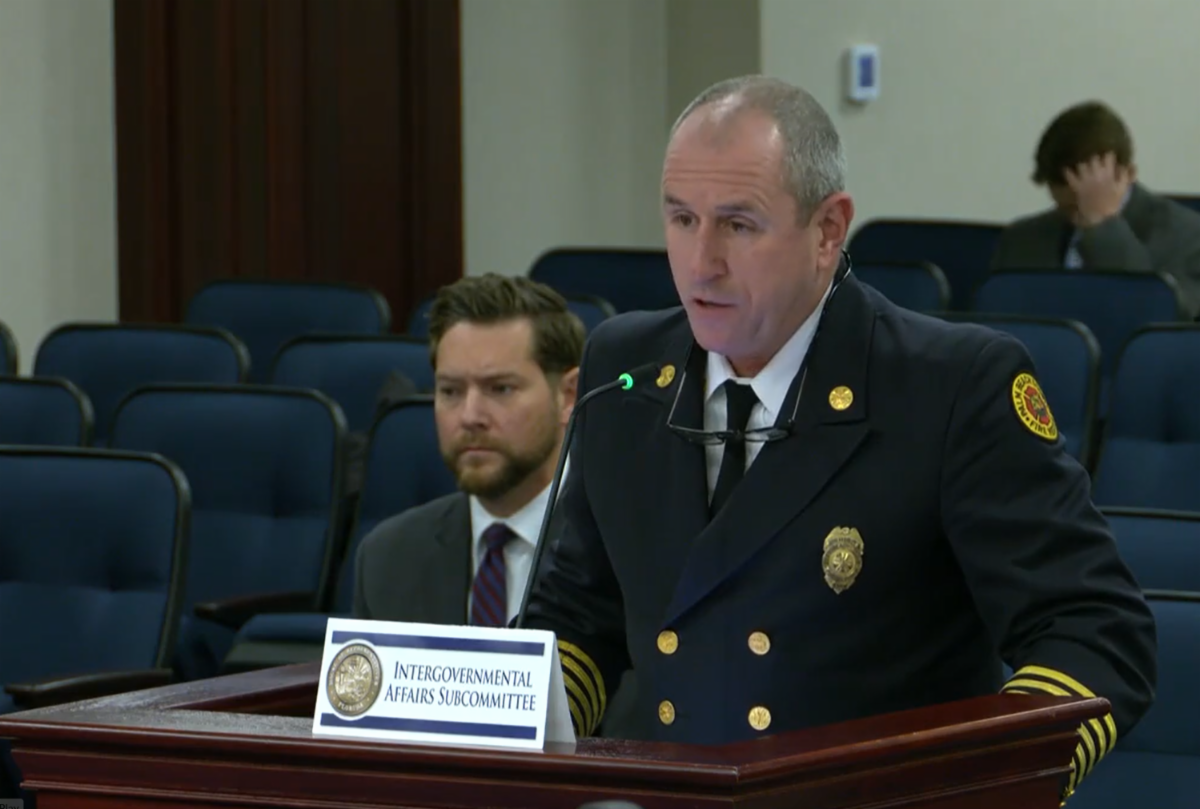
Chief Patrick Kennedy spoke in support of the bill. He thanked the Chair, Vice Chair, committee members, Representative Snyder, and the local delegation for listening and incorporating constructive feedback. He stated that the bill serves as a planning and transition framework, a public safety protection measure, and a guardrail against fiscal instability. He explained that Palm Beach County Fire Rescue currently operates 16 fire stations serving communities throughout the county that are included in active annexation plans. He stated that the bill allows for necessary conversations, fiscal responsibility, and orderly transitions when a municipality annexes territory. He concluded that the bill protects taxpayers, respects municipal authority, and allows Palm Beach County Fire Rescue to plan and continue delivering the level of service residents have come to expect.The committee voted to report the bill unanimously and it now proceeds to Ways & Means Committee, where it will be heard on Monday.
| | |
HB 105: Local Government Enforcement Actions - This amended bill by Representative Brackett creates a new, exclusive process for challenging certain enforcement actions taken by counties and municipalities. The bill prohibits local governments from initiating or threatening enforcement actions that a court finds to be arbitrary, unreasonable, or not authorized by local ordinance. It allows affected individuals to request administrative review and, in specified circumstances, to challenge enforcement actions in court, with defined procedures and timelines.
The bill also extends Whistle-blower’s Act protections to individuals who disclose information during these proceedings and preempts conflicting local laws or policies, making this process the sole legal avenue for such challenges. Representative Gantt inquired about the removal of special districts as a result of a filed amendment, and the sponsor explained that most special districts do not adopt ordinances. No members engaged in further debate, and the amended bill advanced with broad support and proceeds to its final committee stop in Judiciary.
HB 399: Land Use and Development Regulations - This amended bill by Representative Borrero revises land use and development regulations by requiring that development permit fees be tied to actual review costs, rather than a percentage of project costs. It also establishes that amendments to a comprehensive plan’s future land use element must be adopted by a majority vote of the governing body at a hearing, overriding any conflicting county charter provisions. Additionally, local plans and land development regulations must include factors for assessing residential compatibility and outline requirements for evaluating development applications.
The bill directs the Office of Program Policy Analysis and Government Accountability (OPPAGA) to study the potential impacts of removing the Urban Development Boundary or similar boundaries in Miami-Dade and other counties. OPPAGA’s study must include specified elements and submit its findings by October 1, 2026. Members questioned local preemption, clarity of compatibility standards, and tying development fees to review costs. Supporters highlighted the bill’s potential to ease housing shortages and streamline reviews, while opponents criticized overriding county charters and limiting local decision-making, particularly around urban development boundaries. The bill passed with a 10-3 vote and proceeds to Housing, Agriculture, & Tourism Subcommittee.
HB 589: Onsite Sewage Treatment and Disposal System Permits - This amended bill by Representative Nix prohibits a municipality or political subdivision from requiring an owner or builder of a single-family residence that requires the use of an onsite sewage treatment and disposal system (OSTDS)—commonly referred to as a septic system—to receive a construction permit for the OSTDS as a condition for issuing a building or plumbing permit, as long as proof is provided that the OSTDS construction permit has been applied for. The bill requires the owner or builder of the single-family residence to provide such proof to the municipality or political subdivision when applying for the building or plumbing permit.
The bill also prohibits new rules for the use and installation of OSTDS from applying to permit applications submitted within 120 days after such rules are adopted. Representative Gerwig asked who assumes the risk if a septic tank application is rejected, and Representative Nix clarified that the liability falls on the builder. Members were generally supportive, with Representative Holcomb praising the bill for addressing permit delays and creating a more efficient process. The committee voted to report the bill favorably and it now proceeds to its final committee stop in State Affairs.
HB 691: Agricultural Enclaves - This bill by Representative Botana repeals the existing procedure allowing the owner of an agricultural enclave to apply for an amendment to a local government’s comprehensive plan and replaces it with a new public hearing and review process that allows for development of the parcel without a comprehensive plan amendment. The revised process applies to development plans for single-family residential housing on the parcel that are consistent with the land use requirements, or future land use designations, including uses, density, and intensity, of one or more adjacent parcels or an adjacent development.
Members questioned how the new public hearing process would affect local government authority and environmental protections, while the sponsor emphasized private property rights. Supporters argued owners should develop land similarly to neighboring areas, while public testimony raised concerns about sprawl, local government workloads, and preserving farmland. The committee voted to report the bill favorably and it now proceeds to Housing, Agriculture, and Tourism Subcommittee.
HB 1009: Governmental Agency Publication of Advertisements and Public Notices - This amended bill by Griffitts updates the rules for publishing legal notices by broadening who counts as a “governmental agency” and how those notices can be posted online. The bill expands the definition of governmental agency to explicitly include clerks of the circuit court, tax collectors, and water management districts, bringing these entities clearly under the legal notice framework.
The bill also increases flexibility in where legal notices may be published. In addition to a county’s official website or a county-designated private site, governmental agencies would be allowed to post notices on their own official websites or on private websites they designate. Finally, HB 1009 sets specific timeframes for how long public notices must remain posted on an agency’s website, creating clearer and more uniform standards for public access to these notices. Members questioned whether notices would still appear in newspapers and if agencies could handle affidavit requirements when posting online, reflecting concerns about accessibility for seniors, cost savings, and public trust. The sponsor emphasized that the bill simply adds publishing options to modernize notification methods, while opponents cautioned against diluting or fragmenting how the public receives critical legal notices. The bill passed 10-3 and proceeds to its last stop in Judiciary Committee.
HB 1139: Impact Fees - This amended bill by Gentry revises how impact fees are calculated and limited, with a particular focus on transportation-related impacts. It requires that impact fees for transportation capacity be calculated using a plan-based methodology rather than ad hoc approaches. The bill also limits the duration of certain interlocal agreements used to mitigate transportation impacts, providing that agreements entered into on or before October 1, 2024, may not be extended beyond October 1, 2031. In addition, when determining whether “extraordinary circumstances” exist to justify deviations from standard limits, the bill requires the use of a plan-based methodology supported by localized data.
The bill places firm caps on impact fee increases by local governments, school boards, and special districts. It prohibits these entities from exceeding phase-in limitations by claiming extraordinary circumstances in specified situations and bars any impact fee increase of more than 100 percent, requiring that any such increase be divided evenly over a four-year period. The bill also includes provisions related to the payment of interest and prevailing costs associated with impact fee collections, further standardizing and constraining how impact fees may be imposed. No members posed questions on HB 1139. In debate, the sponsor (Rep. Gentry) explained clarifications for plan-based methodology and extraordinary circumstances. The committee voted to report the bill favorably and it now proceeds to Housing, Agriculture, and Tourism Subcommittee.
HB 253: Veterans Dental Care Grant Program - This amended bill by Representative Edmonds expands eligibility for the Veterans Dental Care Grant Program within the Florida Department of Veterans’ Affairs (FDVA) by providing expressed statutory authorization for the program to provide services to veterans with incomes of up to 400 percent of the federal poverty level. Current law does not establish an explicit income limitation for the program; however, FDVA has limited eligibility to veterans with incomes of up to 300 percent of the federal poverty level by rule. No questions were raised, but during debate, Representative Woodson praised the bill’s focus on expanding veterans’ access to dental services and Representative Tramont noted that dental care is often overlooked in health policy, and other members expressed strong support. The bill passed unanimously and now heads to its final committee stop in State Affairs.
| | |
House Industry & Professional Activities Subcommittee
HB 1049: Building Permit Requirements - This amended bill by Representative Espocito has passed its second committee. It clarifies that local governments may not deny a building permit for placing a mobile home on any lot within a recreational vehicle park. It also creates new exemptions from building permit requirements for certain residential projects, including low-value work under $7,500 performed on a single-family home by the owner or the owner’s contractor, provided records are maintained for five years. In addition, the bill exempts work related to backup power systems serving one- or two-family dwellings or townhomes when performed by a licensed contractor or public utility.
The bill limits local government regulation of backup power systems by prohibiting alternative review or approval processes that function like a permit and by preventing standards that exceed the Florida Building Code or Florida Fire Prevention Code. However, local governments may still require inspections of backup power systems and may allow those inspections to be conducted by private providers. Members asked why the threshold was set at $7,500, whether HOAs were included, and whether local government authority would be preempted, with assurances that splitting up projects to avoid permitting would be addressed. The Florida Association of Counties voiced concern that the new exemption could hamper inspections, while committee members largely supported the bill’s goal of reducing unnecessary permits for smaller projects. The bill passed unanimously and proceeds to its final committee stop in State Affairs.
HB 4035: Palm Beach County - This county local bill being carried by Representative Edmonds has cleared its second committee stop with unanimous support. It revises the Palm Beach County Construction Industry Licensing Board’s (Board) process for issuing certificates of competency by requiring applicants to pass the required examination before their application is reviewed by the Board. The bill requires applicants to submit preliminary paperwork to ensure certain requirements are met before the examination is scheduled. No questions were asked in committee and the bill now proceeds to its final committee stop in State Affairs.
HB 441: Conservation Lands - This amended bill by Representative Kendall increases notice and transparency when the state or water management districts are considering selling or exchanging state or district-owned conservation lands by creating specific statutory notice requirements when such actions are being formally considered. The bill requires at least 30 days’ notice before formal consideration and requires publication of certain information related to the proposed sale and exchange, including the parcels involved and why such lands are no longer needed for conservation purposes or how the proposed land exchange will result in a conservation benefit, as applicable.
The bill also requires that when state-owned land is being considered in a land exchange, at least one appraisal must occur. During discussion, members asked about how the division would effectively publish proposed sales or exchanges, the rationale behind their benefit, and whether stakeholders had been fully consulted. They broadly supported the measure, emphasizing the need for increased notice and transparency to protect Florida’s conservation lands. The measure garnered support and passed favorably and proceeds to its final committee stop in State Affairs.
| | |
House Economic Infrastructure Subcommittee
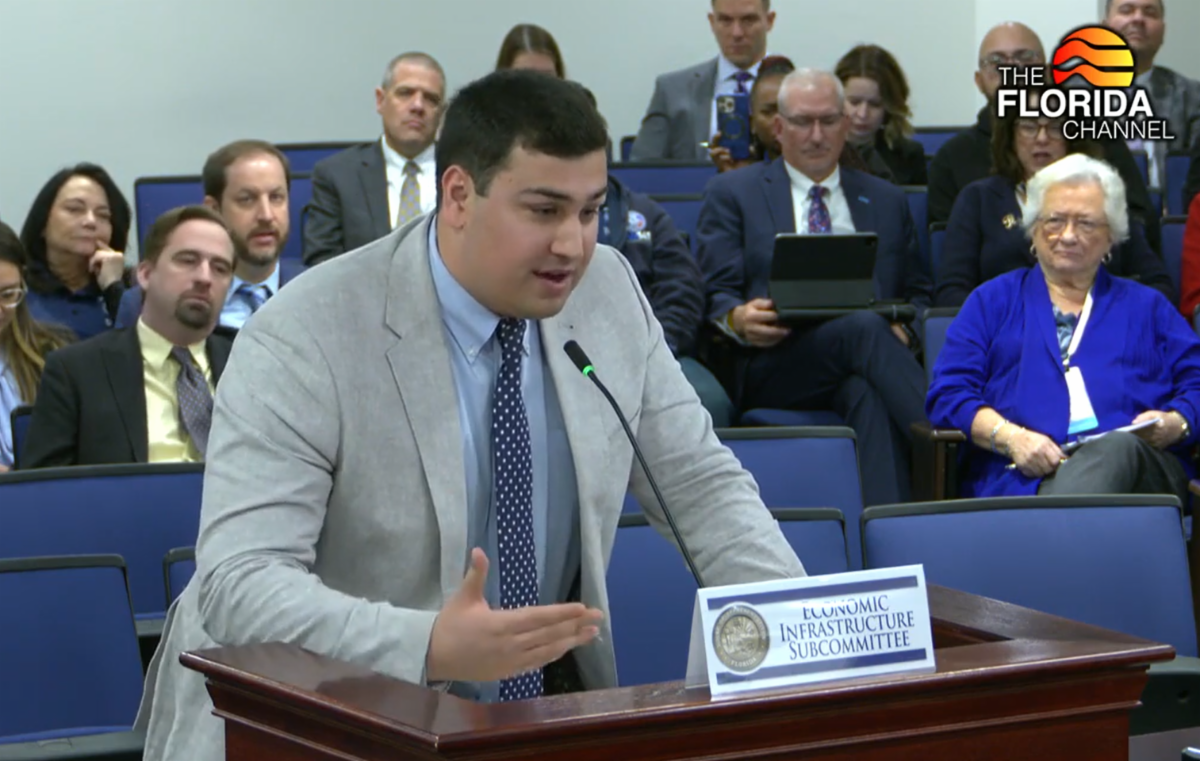
HB 919: Commercial Service Airports - The House companion bill to SB 706 regarding the renaming of Palm Beach International Airport to “Donald J. Trump International Airport” was heard in the House after it passed its first Senate committee. This bill is carried by Representative Weinberger and unanimously passed this first committee stop after the county's amendment was adopted into the bill. Alessandro Marchesani was present to speak in favor of the amended bill. The amendment clarifies the following:
- Name change from Palm Beach International Airport to Donald J. Trump International Airport is subject to approval by the Federal Aviation Administration and execution of an agreement between PBC and the trademark holder, authorizing the commercial use of the name "Donald J. Trump International Airport".
- Amendment also acknowledges that airport names function as brand identities rather than separate legal identities.
- Finally, the amendment allows a reasonable implementation period for a local government to implement a name change. This gives the county time to allocate funds, develop new branding procurement services, install signage and update material.
The measure garnered support and passed favorably and proceeds to its final committee stop in Commerce.
HB 1075: Municipal Utility Connections - This bill by Representative Sirois requires a municipality to extend utility service to other municipalities or property owners located outside its municipal boundaries if: (1) the municipal utility has sufficient capacity to serve without material impact on service to existing customers; and (2) the requesting municipality or property owner agrees to pay all applicable rates, fees, and charges under current law (including surcharges). Otherwise, service extension is by agreement, as provided in current law. The bill clarifies that it does not prohibit a municipality from imposing reasonable fees necessary to fund system expansion required for a new connection. The measure garnered support and passed favorably and proceeds to its next stop in the Intergovernmental Affairs Subcommittee.
| | |
House Natural Resources & Disasters Subcommittee
HB 673: Release of Conservation Easements -This amended bill by Representative Duggan directs water management districts (WMDs) to release conservation easements upon application by the fee simple owner of a parcel of land subject to a conservation easement if that land meets certain requirements. The bill provides that upon the release of the conservation easement, the ad valorem taxes on the property must be based on the just value of the property, and the property may be used for development. If the property will be developed, the bill specifies that the property owner assumes responsibility for any requirements, including compliance with all local ordinances and seeking approval for modification of any permits issued on the condition of the conservation easement. The bill also specifies that the provisions do not apply to conservation easements in residential developments or proprietary conservation easements held by the WMD. The measure garnered support and passed favorably and proceeds to its next stop in Civil Justice & Claims Subcommittee.
HB 1019: Perfluoroalkyl and Polyfluoroalkyl Substances - This amended bill by Representatives Conerly and Blanco phases out the use of firefighting foam containing intentionally added PFAS, commonly known as aqueous film-forming foam (AFFF), through a series of escalating restrictions. Beginning in July 2026, the bill prohibits the use of AFFF for nonemergency instruction, training, or testing and requires entities that possess AFFF to submit inventories to the Department of Environmental Protection (DEP). Starting July 1, 2027, the bill bans the sale, purchase, or distribution of AFFF and requires affected entities to submit a disposal plan to DEP.
By July 2028, the bill generally prohibits the possession and use of AFFF, with limited exceptions for certain federal aviation facilities, specific military applications, and emergency firefighting situations. In addition to addressing firefighting foam, the bill requires certain public entities that dispose of domestic wastewater biosolids and treated effluent to conduct quarterly sampling for PFAS and report the results to DEP, increasing oversight of PFAS contamination. Representatives Cross and Tendrich highlighted honoring the late Joe Casello and emphasized firefighter safety. The measure garnered support and passed unanimously and proceeds to its next stop in Agriculture & Natural Resources Budget Subcommittee.
HB 1035: Nature-based Coastal Resiliency - This bill by Representative Mooney promotes the use of nature-based solutions to strengthen coastal resiliency by directing the Department of Environmental Protection (DEP) to establish a statewide permitting process for these projects. It also requires DEP to develop design guidelines and standards for green and hybrid green-gray infrastructure, such as living shorelines, and to work with local governments to increase public awareness and education about the benefits of nature-based coastal protection.
In addition, the bill expands where these resiliency projects may be implemented. It authorizes the construction of nature-based resiliency structures in all state preserves and allows dredging, filling of submerged lands, and the placement of living shorelines and seawalls in the Biscayne Bay Aquatic Preserve when done for coastal resiliency purposes. The measure garnered support and passed unanimously and proceeds to its next stop in State Affairs Committee.
HB 1103: Local Administration of Vessel Restrictions - This bill by Representative Andrade is the House companion bill to SB 1682 which passed unanimously in the senate the day before being heard in this House committee. Members asked no questions; the bill sponsor emphasized how giving local governments authority to handle the noncriminal paperwork on derelict vessels would speed enforcement. The only amendment corrected a title reference. Members asked no questions and the bill sponsor emphasized how giving local governments authority to handle the noncriminal paperwork on derelict vessels would speed enforcement. The only amendment presented by the bill sponsor corrected a title reference and the bill passed unanimously. It now proceeds to its second committee stop in Intergovernmental Affairs Subcommittee.
| | THURSDAY COMMITTEE MEETINGS | | |
Senate Floor
SB 296: Victims of Domestic Violence and Dating Violence - This amended bill by Senator Berman passed its final committee stop and then proceeded to pass on the Senate Floor 35-0. Its companion bill in the House has not had a committee hearing at this time. The bill directs a feasibility study for a 911 alert system specifically for victims of domestic and dating violence, requiring the Division of Telecommunications to work with 911 service providers and public safety agencies to explore a web-based alert system. It also expands the address confidentiality program to include victims of dating violence, ensuring they receive the same privacy protections as domestic violence victims.
The bill defines dating violence within existing legal frameworks and allows designated state, local, and nonprofit agencies to help victims apply for the address confidentiality program. It also extends public record privacy protections to victims of dating violence, providing equal safeguards and remedies alongside those already available to domestic violence victims.
The bill now heads over to the House in Messages.
| | |
House Transportation & Economic Development Budget Subcommittee
HB 243: Electric Bicycles - This bill by Representative Benarroch is the House companion bill to Senator Truenow's SB 382. It has now passed its second committee stop in the House and proceeds to its final stop in Transportation & Economic Development Budget Subcommittee. Members inquired about data collection methods and considered an opaque study versus law enforcement reporting, with the sponsor emphasizing the practicality of uniform crash data. During debate, speakers stressed the rise in injuries and fatalities among e-bike riders, supported stronger safety measures, and highlighted the need for comprehensive data to guide future regulations. The measure garnered support and passed unanimously and proceeds to its final committee stop in State Affairs.
| | | | |