Lights Out, Dallas!
Spring 2025 • Season Observations
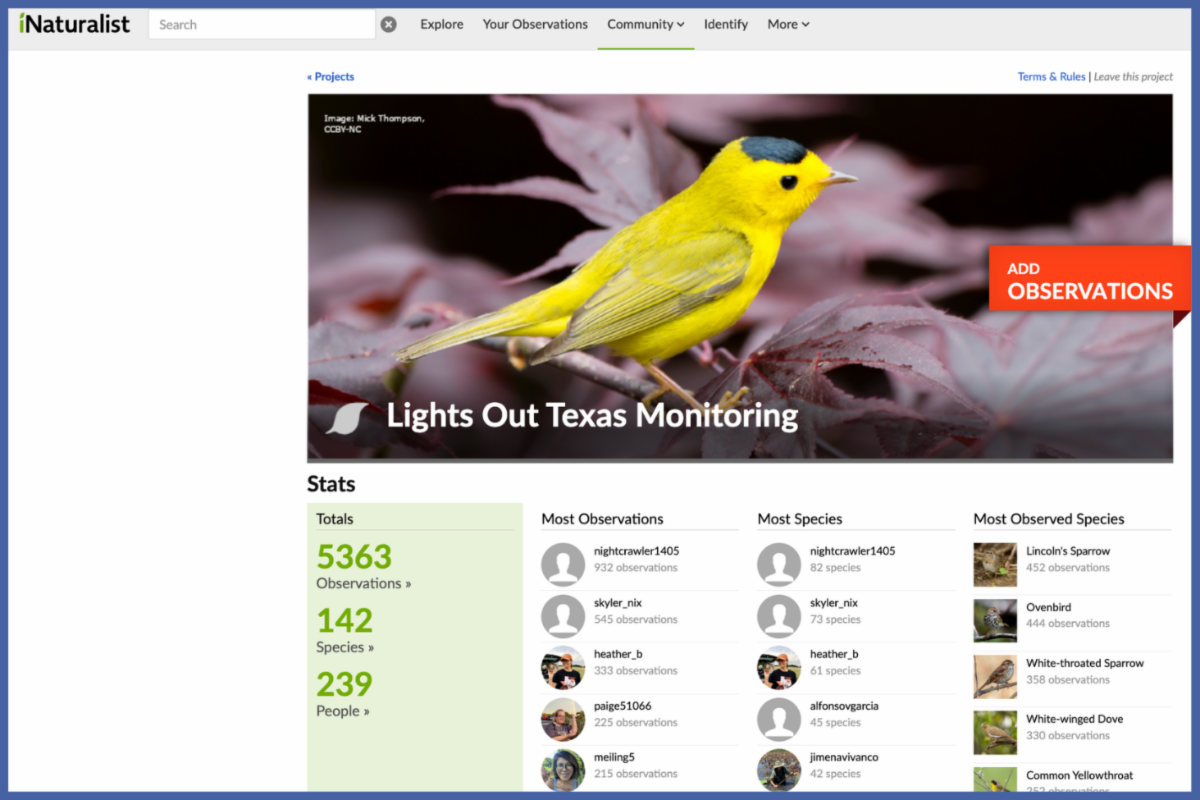
| | Screenshot of the Lights Out, Texas! Monitoring Project on iNaturalist. iNaturalist has served as the primary platform for the Lights Out, Texas! monitoring program, documenting bird—building collisions across Texas since 2021. | | |
Collision Monitoring: A Core Focus of Lights Out, Dallas!
Collision monitoring has been a central part of the Lights Out, Dallas! campaign. Since 2021, the monitoring protocol, developed in collaboration with Texan by Nature, Texas Nature Trackers, Cornell Lab of Ornithology, and A&M Biodiversity and Teaching Collections, has guided the Dallas team in documenting bird—building collisions.
This spring marks five years of data collection. Heather Bullock, the Lights Out, DFW! Data Scientist, shared key insights from the dataset, highlighting what the data reveals about bird migration patterns, collision hotspots, and opportunities for further research.
| |
Bird—Building Collision Survey
Observations 2025
| | |
Observation 1: Changes in Family Composition Throughout the Season
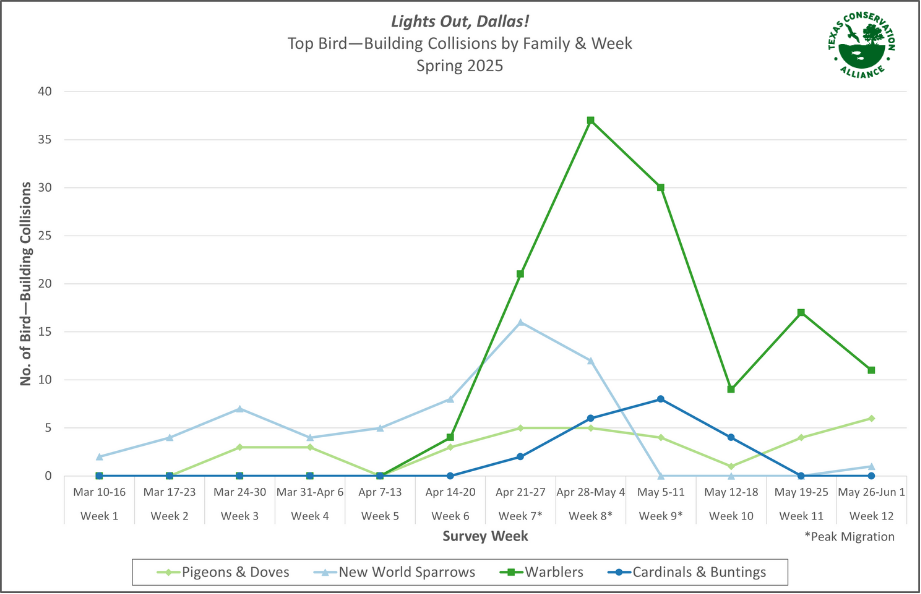
As in past springs, New World Warblers (Parulidae) were the most frequently documented collision victims this spring (n = 129), making up 46% of all birds recorded. Their numbers peaked in early May before tapering off later in the season.
New World Sparrows (Passerellidae) were the second most common family (n = 59), peaking in mid-season, followed by Pigeons and Doves (Columbidae, n = 34), which appeared in low but steady numbers throughout the spring. Cardinals and Buntings (Cardinalidae) rounded out the top four families, with 20 individuals recorded.
The graph below depicts these changes in survey composition throughout the season. Together, these four bird families made up 87% of all bird—building collisions recorded in downtown Dallas this spring (n = 279).
| | Changes in prevalence of the four most frequently found families in Dallas throughout spring migration this year. | | |
Observation 2: Top Colliders Similar to Past Springs
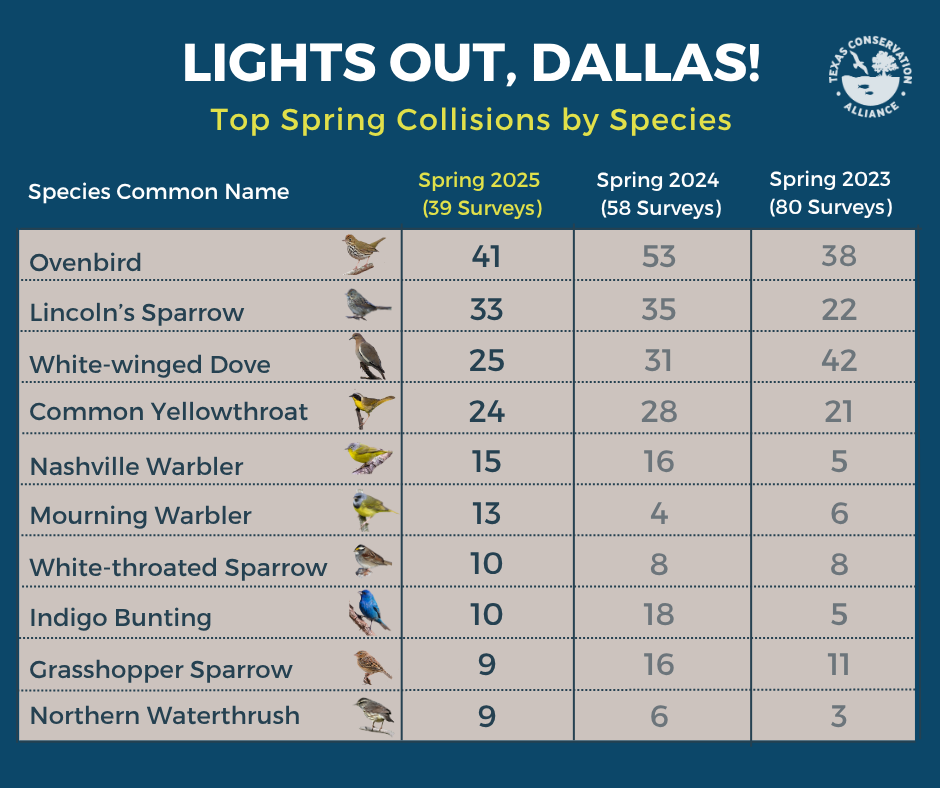
This spring’s top ten list included many familiar names — like Ovenbird, Lincoln’s Sparrow, and Common Yellowthroat — all of which have consistently ranked among the most frequent collision victims in past springs.
Northern Waterthrush made the top ten for the first time, while Painted Bunting, a regular in past springs, was notably absent from the list.
Despite fewer surveys this season, we saw significantly more collisions per survey than in any previous spring — in the top ten species and overall — pointing to a troubling trend and highlighting the ongoing risk many species face during migration through downtown Dallas.
| | Top bird—building collision species found in Dallas this spring compared to the last two springs | | |
Observation 3: Collision Trends Over Time: A Closer Look
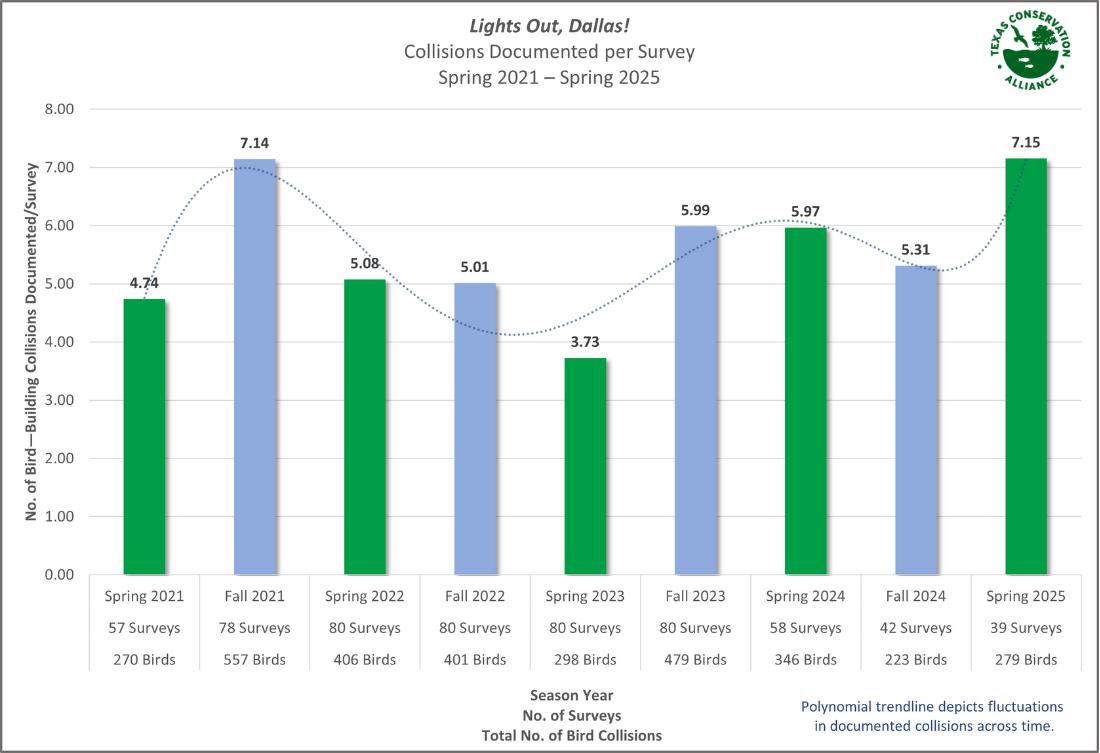
Since the number of surveys has varied by season, tracking the average number of bird—building collisions per survey allows us to better compare trends over time. This spring saw a concerning increase, averaging 7.15 collisions per survey — the highest ever recorded by Lights Out, Dallas!
While fall migration typically sees more collisions due to higher bird numbers and inexperienced fledglings, it’s encouraging that fall collisions have gradually declined.
Several factors may have contributed, including an increase in severe spring storms across the Dallas-Fort Worth area, which can disorient migrating birds and increase collision risk. Despite the progress observed in fall seasons, the upward trend in spring collisions, combined with the absence of a significant overall decline, underscores the continued need for public education and advocacy. Light pollution and building glass remain serious threats to birds.
| | Changes in the number of collisions per survey in Dallas between Spring 2021 and Spring 2025 | | |
Observation 4: Cumulative Impact: Five Years of Lights Out, Dallas!
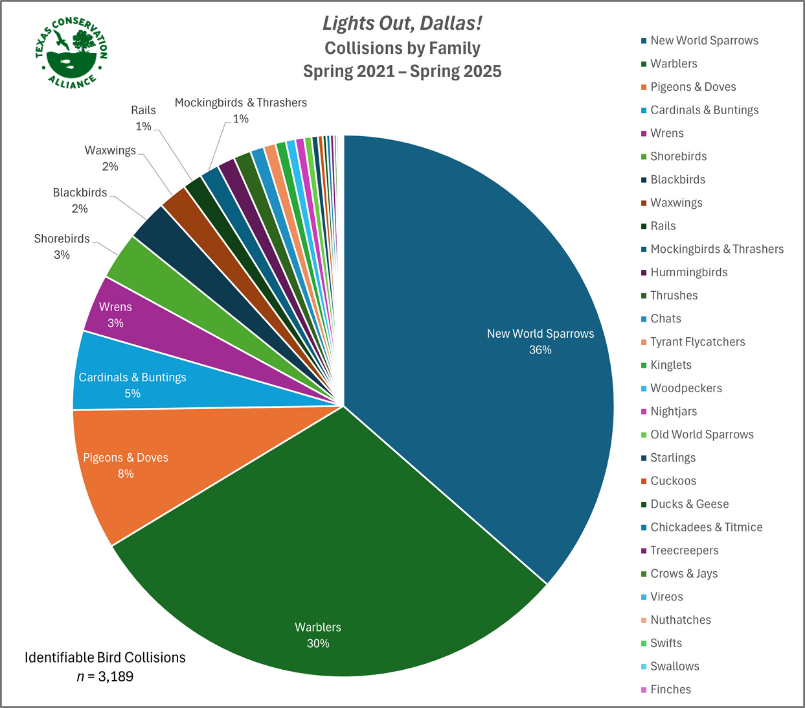
Since Spring 2021, 3,339 bird—building collisions have been documented in downtown Dallas, representing 110 species across 29 avian families. (Note: Unlike the above analyses, this includes incidental collisions found on non-survey days.) As shown in the pie chart below, two-thirds of identified victims were New World Sparrows or Warblers — groups that consistently dominate collision totals each migration season.
Many of these species are also of conservation concern. In total, Lights Out, Dallas! has documented 25 warbler species, 16 sparrow species, and several others listed as Texas Species of Greatest Conservation Need or on the Partners in Flight Watch List.
| | Identifiable Lights Out, Dallas! collisions by family, 2021–2025 | | |
While building collisions may not occur in numbers large enough to threaten species at a global scale, they represent an added (and preventable) risk, especially for populations that are already declining and species like the Ovenbird that experience disproportionately high collision rates relative to their population size. This underscores the importance of continued collective action to keep our feathered neighbors safe and flying free.
To explore the details behind each observation, please see the full report HERE.
| | |
Special thanks to Heather Bullock for her invaluable contributions in ensuring the accuracy and integrity of the Lights Out, Dallas! data over the past few years. As she transitions out of this role, we are deeply grateful for the expertise and dedication she has shared, which have helped us better understand the broader story behind these data.
For any questions or to connect with Heather, you may reach her at HeatherBullock@my.unt.edu.
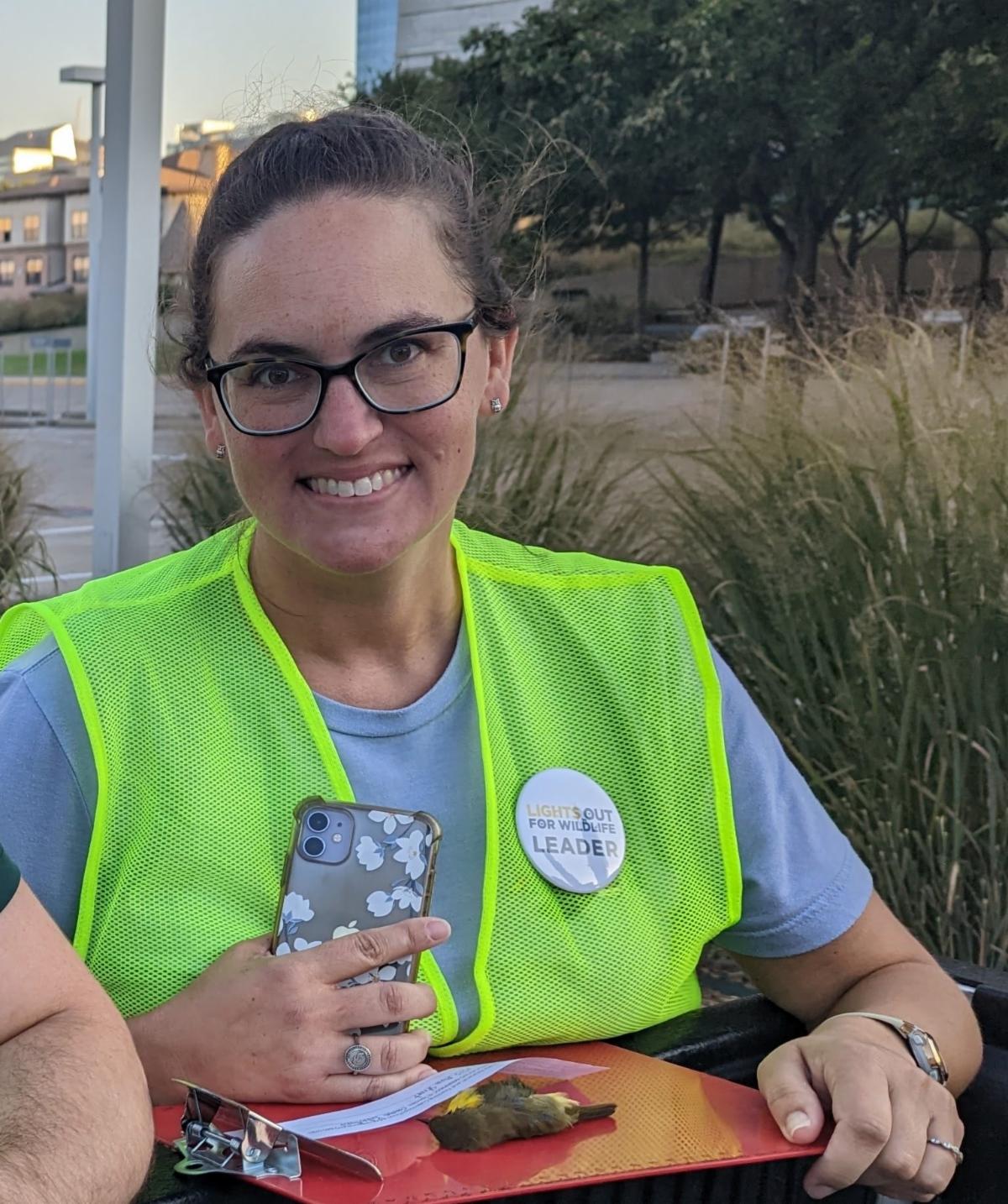
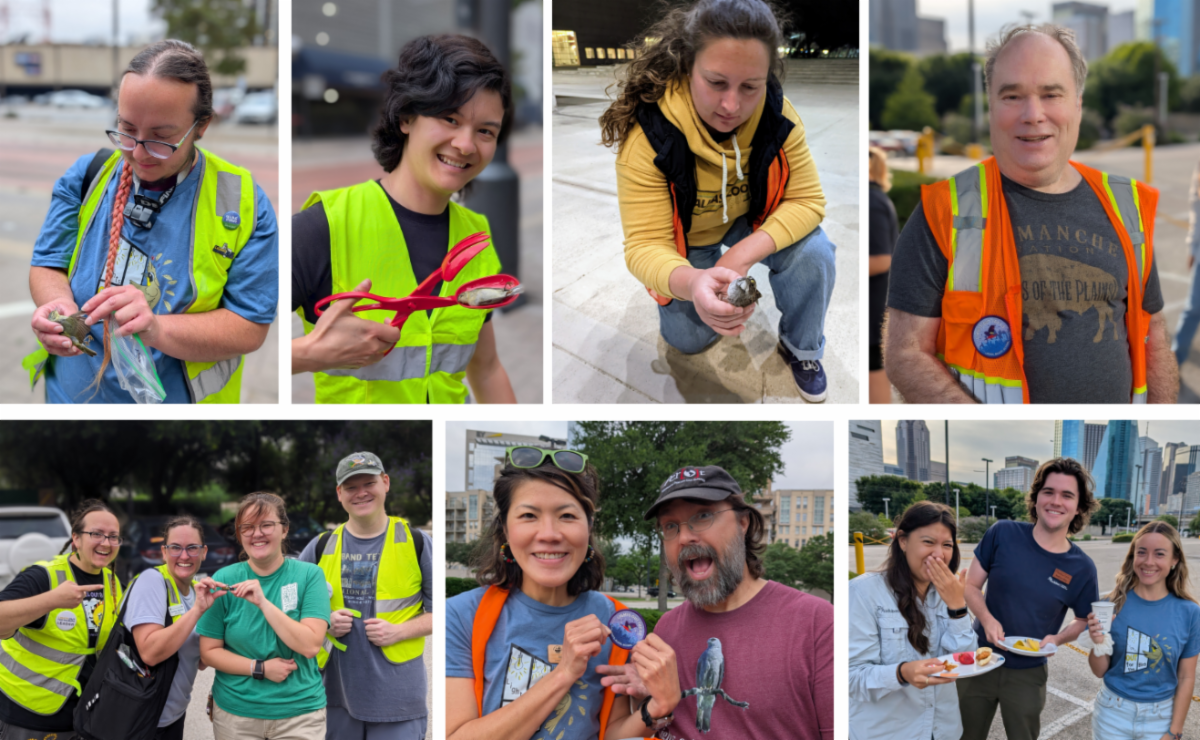
| | This monitoring program is a collaboration between the Dallas Zoo, Perot Museum of Nature and Science, and Trinity River Audubon Center, along with our dedicated volunteer survey leaders and the many volunteers who supported the effort this season. Thank you all for your commitment to protecting migratory birds. | | Change takes time and we’re working on it. | | |
Hope is the thing with feathers that perches in the soul…”
— Emily Dickinson
As we reflect on the progress of Lights Out, Dallas! and our collective efforts to protect migratory birds, this quote reminds us that birds carry with them a quiet, persistent hope. Hope is present in every early morning collision survey, every community outreach event, and every policy change we help shape.
Each window retrofitted, each message shared, and each data point collected speaks to the power of collective action. Thank you to everyone who has supported the Lights Out, Dallas! campaign and rolled up your sleeves alongside us.
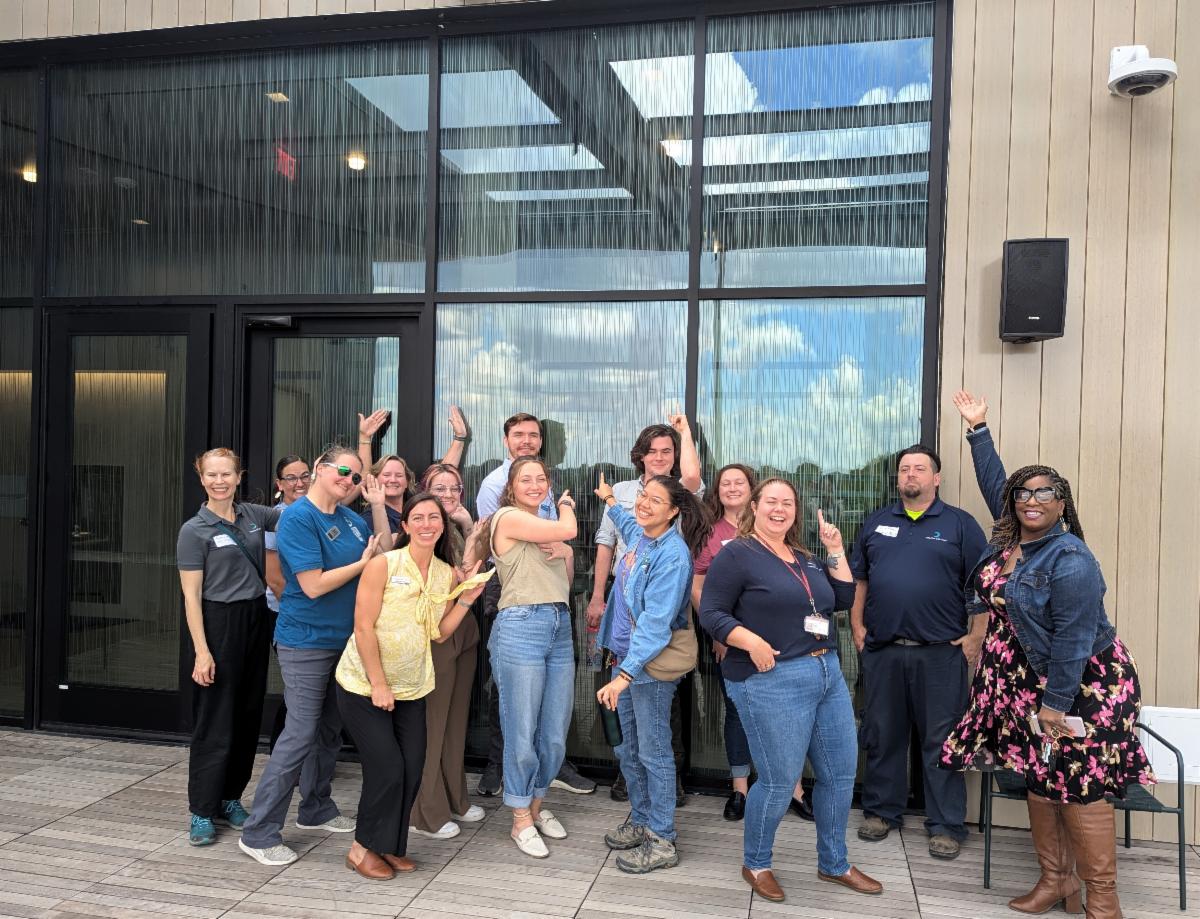
| | Opened in 2024 with bird-friendly glass installed throughout the building, Traphene Library reflects the City of Cedar Hill’s commitment to protecting birds and creating a more sustainable urban environment. This photo was taken during the 2024 Lights Out, DFW! workshop for municipalities and building managers. | | |
You're Invited!
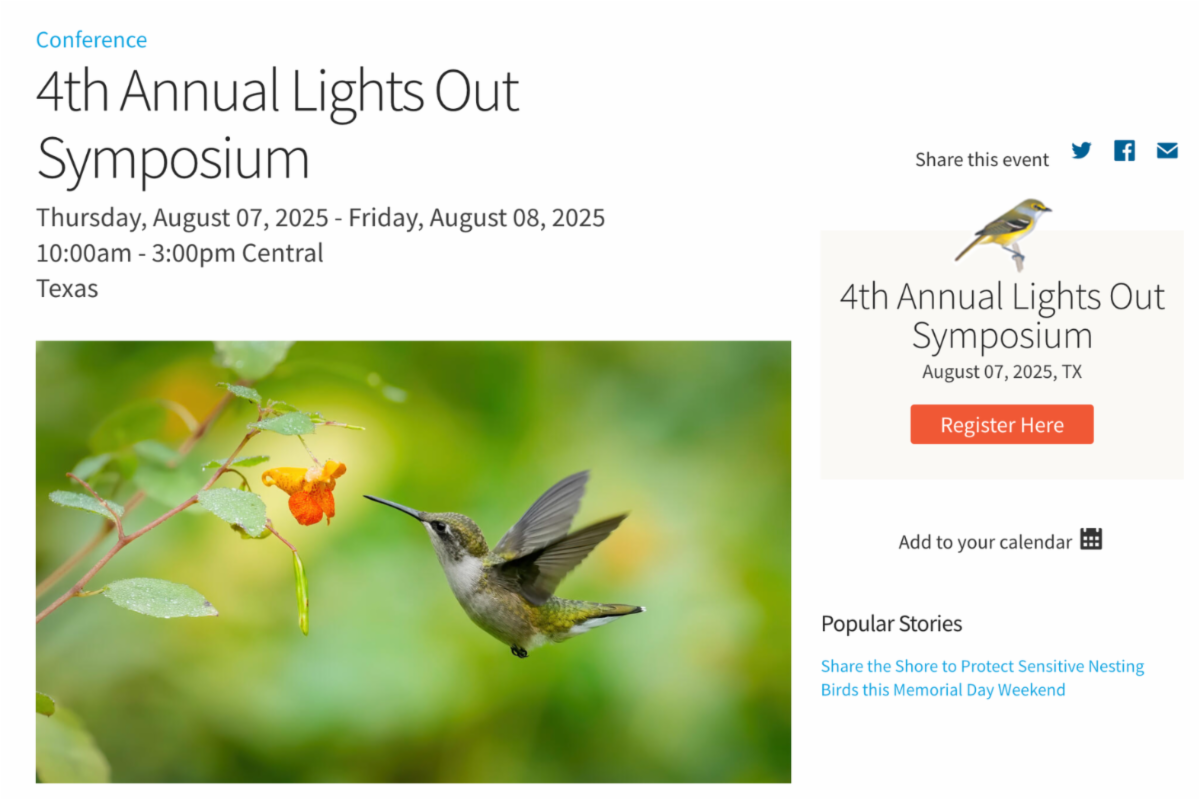
4th Annual Lights Out, Texas!
Gathering & Symposium
| | |
Join Us in College Station!
We’re excited to announce this year’s Lights Out, Texas! Symposium, hosted by Texas A&M University’s Biodiversity Research and Teaching Collections (BRTC), which has been instrumental in advancing the campaign’s success.
If you’ve been following the progress of Lights Out, Dallas!, you know BRTC plays a vital role in supporting research and collaboration across Texas. This year’s event will feature expert speakers representing diverse perspectives, including leaders from the bird-friendly glass industry and government officials from the U.S. Fish and Wildlife Service, who have been at the forefront of nationwide efforts to prevent building collisions.
Don’t miss this opportunity—seating is limited!
When:
- Thursday, August 7 | 10:00 AM – 5:00 PM (followed by Science on Tap at 6:00 PM – dinner included)
- Friday, August 8 | 9:00 AM – 3:30 PM
Hosted by: Texas A&M Biodiversity Research and Teaching Collections
Agenda: 🔗Here
Registration:🔗 Register here
| | Thank you to our partners and generous donors for their support, which enables us to continue our critical work in education and advocacy for safer environments for birds. |
| | | |