RETIREMENT SECURITY MATTERS
A forum for retirement innovation information sharing focused on
states, supporters, and service providers.
Vol 30 | May 20, 2021
|
|
Greetings! welcome! to Retirement Security Matters – where we talk about retirement readiness innovation by states, supporters, and service providers.
|
Did you miss us?! We took a spring break to fit those COVID vaccines in. While we’ve been laying around developing antibodies like mad, there’s been *so much* going on in the world of retirement security! You will not want to miss:
-
Mark Iwry on the concept of Automatic – and how getting there really wasn’t …
- Fresh state stats: funded accounts are up 25% year to date!
- Action updates from California, Colorado, Delaware, Illinois, New Mexico, New York City, North Carolina and Oregon.
- Grant’s Go To: State Programs and Pandemic Withdrawals – What Gives
-
Hot Stuff Toa Te Ching, anyone? And fresh research from Pew, Boston College, and NIRS.
-
And … PIX of the Week. We hit the Oregon 🌊 Coast for some fresh air.
|
|
Turning 'Negative Elections' into Automatic!: A true story
|
|
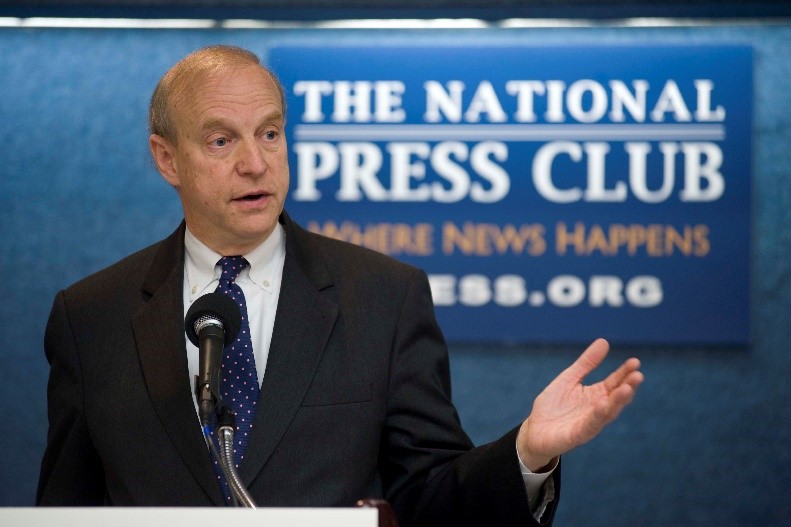
Mark Iwry
Nonresident Senior Fellow
The Brookings Institution
|
|
Mark ❤ Iwry’s bio runs long and deep. He served as Senior Advisor to the Secretary of the Treasury from 2009 to January 2017, and served concurrently as the Treasury Department’s Deputy Assistant Secretary for Retirement and Health Policy. His portfolio included pensions/retirement (DB and DC/401(k) plans, IRAs, etc.) and national savings policy; related tax policy and other tax and legal aspects; legislative and regulatory implementation of the Affordable Care Act, and other health policy; other employee benefits and compensation, and related legislative, policymaking, and rulemaking/regulatory responsibilities.
|
|
Currently a Nonresident Senior Fellow at the Brookings Institution and a Visiting Scholar at the Wharton School at the University of Pennsylvania, Mark is the originator or co-author of the Saver’s Credit, the SIMPLE IRA, the startup tax credit for small business, the QLAC, auto rollovers, direct deposit and splitting of tax refunds in IRAs and savings bonds, the automatic IRA proposal (with David John), and various other reforms and innovations, including the nationwide movement to involve the states in promoting retirement savings through auto-enrollment of uncovered citizens in private-sector IRAs.
While in government, Mark also spearheaded the initiative to define, approve, and promote the practice of automatic enrollment in 401(k)s and similar plans, which laid the groundwork for automatic escalation, default investment in QDIAs, default rollovers and retirement income, and, in later years, the federal and state auto IRAs. We talk about how the auto enrollment concept first came to light. Twists and turns ahead!
Mark, how did the “automatic” enrollment movement in retirement readiness begin?
In 1997, while I was at the US Treasury Department with responsibility for overseeing national retirement policy and the regulation of pensions, 401(k)s, and other tax-qualified plans, an obscure legal question arose. Could 401(k) plans put people into the plan without the employees signing up so long as they could opt out if they wanted to? Could a 401(k) impose this kind of “negative election”?
Most people were unaware of this question, although we heard there actually were a couple of companies using these negative elections in 1997. It was definitely a gray area: people who heard about it tended to be surprised and to wonder whether it was even legal.
It's always a gray area when you do it for the first time, isn't it!
Yes, like lots of things. So this somewhat esoteric question came to our attention.
I remember thinking: (… continued here. Great stories ahead)
Thank you so much for the scoops Mark Iwry! As part of his continuing illustrious career, Mark focuses on tax and retirement policy, sometimes in the forefront and sometimes behind the scenes. You can connect directly with Mark here. You can follow Mark’s work at the Brookings Institution here. You can also connect with Mark on LinkedIn.
|
|
*Fresh!* State Program Metrics - Auto IRAs |
|
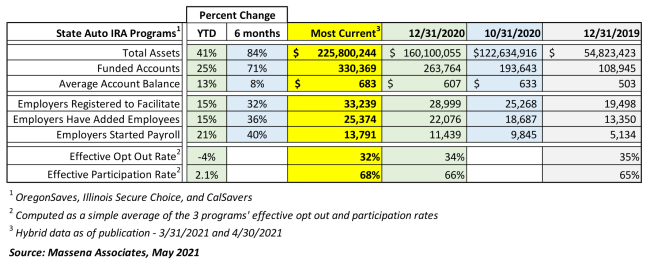
What’s interesting here: current assets are right at about $226 million, up 41% and $66 million since January 1. Assets are up $104 million and 84% over the last six months (thank you California?) Funded accounts are up 25% year to date, at over 330,000 savers across the three programs. That’s an increase of about 67,000 savers in 2021. Average account balances are up 13% this year to more than $680. That puts a nice spanner between the saver and a typical emergency. Longer term savers across the three programs have larger balances, although only a few have passed the $10,000 mark.
Opt out rates are holding steady at about 32%, and are down both year to date and over the historical measured periods.
More than 33,000 employers have registered to facilitate program savings. Three-quarters of these (25,374) have added employee rosters. 40% (13,791) have started payroll deductions for their participating employees. That’s 4,240 additional registered employers, and 2,350 employers newly facilitating savings in 2021.
|
|
State Facilitated Retirement Programs - Fresh Highlights |
|
California (workforce 17.9 million) – The 9th U.S. Circuit Court of Appeals issued an opinion on the Howard Jarvis Taxpayers Association suit against CalSavers on May 6, 2021. The unanimous panel concluded that: “CalSavers is not an ERISA plan because it is established and maintained by the State, not employers; it does not require employers to operate their own ERISA plans; and it does not have an impermissible reference to or connection with ERISA. Nor does CalSavers interfere with ERISA’s core purposes. Accordingly, ERISA does not preempt the California law.” That should provide some comfort to other states about the legal feasibility of auto-IRA programs with required employer participation.
The CalSavers Board met on May 19, 2021. The agenda included items to approve an interagency with the California Franchise Tax Board for enforcement services and an item to discuss a draft 3-year strategic plan. The agenda also included an item for the Board to consider adopting a support position on AB 470. AB 470 would prohibit the use of assets (including CalSavers accounts), to determine eligibility for Medi-Cal, the state’s Medicaid program.
|
|
Colorado (workforce 3.2 million) – The Colorado Secure Savings Program Board met on May 6. The agenda items included a discussion of the RFP evaluation process, program governance and staffing, and financial education and outreach. Winning bidders for the Investment and Program Consultant contracts are expected to be announced in June.
|
|
Illinois (workforce 5.7 million) – The Illinois Secure Choice Board met on May 13, 2021. The agenda included staff updates, a discussion of the most recent quarterly report and an “Environmental Landscape” presentation by program consultant AKF Consulting. Also included on the agenda were a legislative update and the approval of program expansion wave deadlines and auto-escalation structure.
|
|
New Mexico (workforce 1.0 million) – The New Mexico Work and Save Board met April 29, 2021. You can view the agenda here. The board heard updates from the Rules, Education and Outreach, and Finance and Funding Committees. The Board also voted to approve staff’s recommendation to award a contract to AKF Consulting for consultant services through the end of the current fiscal year.
|
|
Oregon (workforce 1.9 million) – The OregonSaves Board met on May 4. With the transition of its services from Ascensus to BNY Mellon (anticipated October 2021), the program finds itself in a place where it will be required to add an account fee for savers. The proposed level is $18 a year, alongside 35 basis points in combined program management and investment fees. This compares to roughly 100 basis points all in, today. Based on Oregon’s analysis, early savers (years 1-4) will pay more under the new structure. The structure is more favorable for savers after year 5.
Following close discussion, the Board approved this change, along with a change to the treatment in the Capital Preservation Fund usage from the first $1,000 saved to the first 90 days of saving. After 90 days, account balances will be transitioned to a saver’s Target Date Fund except where other elections are made. The Oregon team will be making a personnel hire to cover the employer outreach and engagement activity previously executed by Ascensus field reps.
A C T I V E
|
|
New York City (workforce 3.9 million) – On April 29, 2021, the New York City Council voted in favor of a bill to establish a City-facilitated Auto IRA program. The Mayor is expected to sign it. According to a press release, the Program will require participation for private sector employers with 5 or more employees who do not already offer a qualified plan. Another bill established a Retirement Security Board, which would have up to two years to implement the program.
|
|
North Carolina (workforce 5.0 million) – On May 5, NC introduced HB 899 enabling a small business retirement savings IRA program. The list of states to watch keeps growing!
|
|
Rhode Island (workforce 540,000) – on March 18 introduced SB640, an Act Relating to Public Finance -- Rhode Island Secure Choice Retirement Savings Program Act. This Act establishes the Rhode Island secure choice retirement savings program. Establishes a board which is a public corporation. Allows for creation of IRA-type retirement investments managed by the board. On May 13 the Senate Finance Committee recommended the measure be held for further study.
|
|
Delaware (workforce 490,000) - *breaking news* - State Treasurer Colleen Davis Brings Forth Landmark Retirement Program for Delaware. Following thoughtful evaluation within the state and engagement with internal and external experts, Treasurer Davis and several lead sponsors introduced HB205 today enabling Delaware EARNS - Expanding Access for Retirement and Necessary Saving. Delaware EARNS would be a payroll-deduction Auto IRA program. Watch this space for more!
|
|
Meetings on Deck.
-
California (workforce 17.9 million) –The next meeting of the CalSavers Board is scheduled for June 22, 2021.
-
Oregon (workforce 1.9 million) – The next meeting of the OregonSaves Board is scheduled for Aug. 3, 2021.
|
|
Grant's Go-To's: SFRP Withdrawals - Pandemic Panacea or Just Panic?
|
|
After touching recently on early withdrawal options for state-facilitated retirement savings programs (SFRPs), I got to thinking about whether the pandemic led to increases in the number of people tapping into retirement accounts to help pay the bills.
The Federal CARES Act allowed people to take up to $100,000 out of their retirement accounts without the 10 percent early withdrawal penalty for people under the age of 59½. It appears that not too many did so. Anne Tergesen’s January 20, 2021 Wall Street Journal article, Americans Aren’t Draining Their Retirement Funds in the Pandemic, indicates the number of people taking early withdrawals has been lower than expected. Fidelity and Vanguard report that about 6 percent of participants in their plans took early withdrawals, and the increase in hardship withdrawals was slight.
Is the picture different for state-facilitated retirement savings programs (SFRPS)? …
|
|
Do these results surprise you? Given the relatively short time that CalSavers, Illinois Secure Choice and OregonSaves have been in existence, it may be too early to draw definitive conclusions for the long term – what would you expect to see? We’d love to hear from you.
Stay tuned! / Grant
|
|
Columnist and Senior Associate Grant Boyken is based in California. You’ll see his Golden State perspectives reflected here – along with 50-state insights into retirement security innovation around the country. He’s also a good sport when we mess with his head shot.
|
|
We’ve got new research from Pew, and there are some hidden gems for states implementing or considering Auto IRA programs. The paper asks Is the OregonSaves Retirement Program Expensive for Employers? – and focuses on employer-reported out of pocket expenses to facilitate. Bottom line, four out of five report they don’t have any. And here’s a nugget: “Among all firms, 55.9% reported using a payroll provider.” Setting your program up to focus on small businesses who use a payroll service? This is an important number to you. Interestingly, the smallest firms were also the least likely to report out of pocket expenses to facilitate – making an Auto IRA program potentially pretty appealing for this group. This latest research is the third in a series from Pew’s survey of employers participating in OregonSaves. The first two reports cover employers’ satisfaction with the program and discuss the level of employee questions and concerns.
New from NIRS: “The COVID-19 pandemic has made the economic outlook for women even worse. More than 2.3 million women have left the workforce since February 2020, with female workforce participation dropping to 57%, the lowest level since 1988.” Yipes! Check out this infographic with stats and policy recommendations.
This is fascinating! Boston College’s CRR asks: Do Men Who Work Longer Live Longer? We’d give you the answer but we don’t want to spoil it. Let’s just say we’ll be showing this to our spouses.
What We’re Reading: We just cracked this baby open, Tao Te Ching: the definitive edition, translation and commentary by Jonathan Star of original work credited to Lao Tzu. We admit we thought this would be way out of our league, but we needed some Zen this morning. We found it as we read this in verse three: “When action is pure and selfless, everything settles into its own perfect place.”
This week we had to hear Alec Baldwin’s new interview, Marlo Thomas Is Still That Girl. Remember Marlo Thomas?! As a youngling we thought That Girl was the bomb. The actress and activist Marlo has a lot to share. #worthit
Yes we are also *still reading* The Gentleman Boss. Chester Arthur has just assumed the presidency and he’s surprising a few people by reversing position and supporting the assignment of civil service jobs based on merit, and not for the sole benefit of the financial gain of his party. Apparently we can’t get enough of this obscure, one-term president, because we’re also now listening to The Unexpected President, by Scott Greenberger. Greenberger’s work is shorter, well-read, and it’s going a lot faster. Just sayin’.
... and, Pix of the Week!
|
|
It’s May at the Oregon Coast – a little sun, a little cool. Dogs love it no matter what! Here’s Addie kicking it up at Seaside this last weekend.
|
|
If you’re lucky afterward, you’ll get a chance to snuggle with your person: |
|
That’s it for this edition! ❤ Hug your people and change the world.
If you like this piece, please stick with us. We’ll be back in about two weeks. If you don’t like it, please unsubscribe below. Comments for us? Please let us know. Want your own subscription? Request one here. All information shared is from public sources or used with express permission.
|
|
Massena Associates provides process, policy, and implementation consulting on retirement savings programs and products.
Our clientele includes states, governments, policy organizations, and private sector providers. Our specialty – efficient, targeted results. We are an active speaker on retirement security topics, including state-facilitated programs, MEPs and more.
If you’d like to explore working together, we welcome the conversation. Connect with us here, and at 339-236-0684. |
|
Looking for a great retirement savings innovation resource? Led by Dr. Alicia Munnell, the Center for Retirement Research at Boston College develops and hosts terrific content and proprietary research related to states, financial security, social security, and more.
Pew’s Retirement Savings Project studies the challenges and opportunities for increasing retirement savings and is another great resource - check out the work of John Scott and his terrific team.
|
|
|
|
|
|
|