The results are in. The 13th annual CalAPA "Better or Worse" survey found respondents more pessimistic about the year ahead than in 2021 when the COVID-19 pandemic cast a pall over work and personal lives. Respondents worried about the economy, inflation, finding enough skilled workers and supply-chain disruptions.
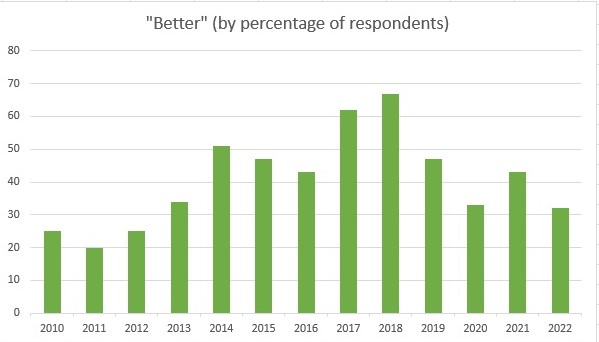
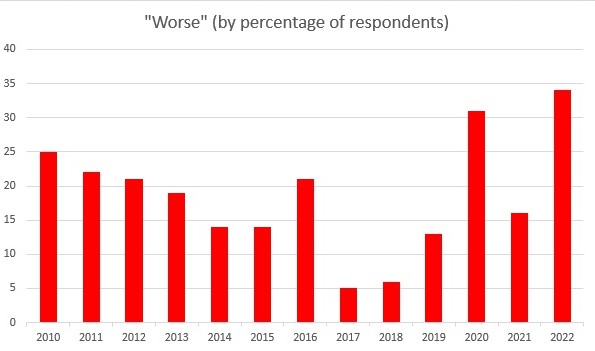
The brief, non-scientific poll of more than 2,600 "Asphalt Insider" newsletter subscribers, conducted over the past month, found optimism in short supply and similar to the levels recorded during 2020 when the COVID-19 pandemic was rampaging through the state. The number of respondents who said next year would be better than 2022 stood at 32%, which was down sharply from the 43% recorded in the survey a year ago. Those who said next year would be worse than 2022 came in at 34%, which also represented a steep drop from last year, when the number of respondents who voted for “worse” was at 19%
That is in stark contrast to the heady days in 2017 and 2018, when the passage of SB1 promised to funnel billions of dollars to deferred pavement improvement projects. In 2017 the “Better” figure was 62% and 2018 was at 67%, an all-time high for the survey. The “worse” tally in 2017 was just 5%, the all-time low for the survey, and the 2018 figure was 5%.
The levels of pessimism were approaching the gloom reflected in the surveys taken during the depths of the last major economic downturn in the state. In 2011 the share of survey respondents that said the next year was going to be better was just 20%, the lowest ever recorded in the survey. The same year the number of respondents who said 2012 would be worse stood at 22% -- dramatically better than this year’s 34%.
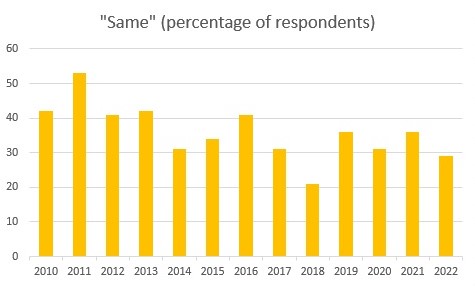
As for the survey respondents who said 2023 will be “About the Same” as 2022, the figure was 29%, or far below the 36% figure last year and the lowest number ever recorded in the survey.
“Residential development activity significantly reduced; public works increasing but not adequate to offset,” one consultant wrote, predicting next year will be worse. Added a prominent paving contractor, who also voted for Worse: “Not a lot of projects to bid on. When there is a bid, 12-14 bidders. Work is bidding cheap.” A supplier of asphalt commented, “2022 was up and down all year. We are hoping for a more consistent year.” The supplier selected the “About the Same” option on the survey.
Logistical issues and inflation was on the minds of many who responded to the survey. “Bad economy, oil costs and shortages,” wrote one prominent asphalt producer. Another vertically integrated producer and paving contractor wrote, “It seems like despite SB1 we have seen less jobs bidding.” Another vertically integrated company representative wrote, “We see the private market slowing even more as we go into 2023 and we haven’t seen the Caltrans work that was expected. The bright side is work being let from local cities and counties. We also believe water could be a big issue in shutting down projects.”
For the first time since 2020, COVID-19-related issues did not dominate the survey responses. Occasionally comments referred to reduced productivity One paving contractor saw it this way: “Too many businesses are still using the COVID crutch?” According to the California Department of Public Health, as of Nov. 23, there have been 10.6 million confirmed cases of COVID-19 in California since the pandemic began spreading widely in 2020, contributing to 96,701 deaths.
As for logistics, disrupted by COVID, high energy costs influenced by the war in Ukraine and other factors, once equipment manufacturer who voted for “Worse” put it this way: “Supply chain issues are not getting better. I anticipate the war will expand and impact more businesses.”
One employee from a prominent vertically integrated company, who also was in the “Worse” camp, viewed the unfolding situation this way: “State, county and city funding is not hitting the street. The agencies don’t have enough people to design the work and deliver it to bid. Then they can’t manage it after bid.”
Most comments about transportation funding tended to be dour. SB1, the $50 billion Road Repair & Accountability Act of 2017, has reached Year 5 of its 10-year implementation horizon, and a new $1 trillion federal infrastructure bill passed late last year also promised to infuse more money to pavement repair. Nevertheless, there have been consistent complaints that the funds are not making their way to pavement repairs. A CalAPA analysis of Caltrans data, distributed to members earlier this month, validated those anecdotal reports.
“Things seem pretty static,” one asphalt producer wrote. “Public agencies are really slow in delivering the work, and this will probably continue.”
For the seventh year in a row, the survey added an optional question, “What is the No. 1 challenge where you work?” That question elicited 45 written responses. As it has in recent years, work force issues continued to dominate the comments. Next were supply chain issues, logistics, trucking, the regulatory environment, price inflation and competition.
“We have a little backlog going into next year,” one asphalt producer wrote, “We are assuming we should see a substantial increase in public work bidding next year.” Nevertheless, he hedged his bets, voting that 2023 would be “About the Same” as 2022. A local public works official, who also voted for “About the Same,” said: “Budget for upcoming projects have been approved for 2023. Most of the projects have been bid towards the new year. It’s just a matter of executing the construction phases when projects proceed as scheduled.”
As the workforce ages and enters retirement or moves to other fields, the survey suggests, the churn in personnel continues to create conflicts between industry and agency personnel. One Caltrans respondent described their biggest challenge this way: “Hiring, training and maintaining staff. The silver tsunami is real!” A paving contractor said the challenge was “finding younger qualified people that want to work.”
Several other respondents, both industry and agency, cited the increasingly complex regulatory environment as a top challenge heading into 2023. “Environmental regulations” were the biggest challenge at work, one county public official stated. A consultant described it similarly as “meeting sustainability goals and requirements.”
The main CalAPA survey question is purposefully vague: "For your company or organization, how do you think 2023 will compare to 2022?" However, most of the voluntary comments offered up by survey respondents to justify their opinion centered around how much work is expected in the coming year. The answer varied by company, agency and region, reflecting the size and diversity of California's massive economy and the economic micro-climates that are spread across the state.
As in previous surveys, the weather largely depends upon where you are standing. Some respondents commented that work was brisk, while others were disappointed, particularly in rural areas of California. One asphalt producer from a rural part of the state said 2022 was the worst he had experienced in 30 years in the business.
A total of 156 people took part in the voluntary on-line survey, which was conducted from Oct. 20 to Nov. 8. To read the story about last year's survey results, click HERE. In December, CalAPA members will be sent an exclusive comprehensive analysis, “2023 Asphalt Market Forecast for California” filled with data and insight available nowhere else. Additional forward-looking information will be featured in the 2023 Forecast Issue of CalAPA's official magazine, California Asphalt, which will hit mailboxes in January.