Send a Strong Message on
Boosting State Education Funding | | |
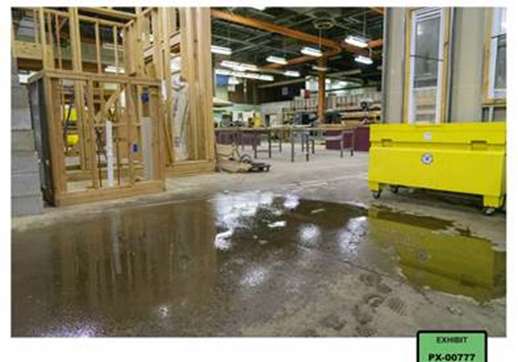
This exhibit illustrating facilities needs from the school funding trial in 2022 shows a Philadelphia CTE high school where rain fell directly into a classroom.
Pennsylvania officials made an important acknowledgement in July 2024 that 348 school districts are being shortchanged on state education funding by $4.5 billion annually.
Ever since Gov. Shapiro introduced his 2025-26 budget proposal in February, which includes a second installment of a half-billion dollars in funding increases for these 348 underfunded school districts through the adequacy line item, our message has been that his proposal is a positive starting point. And we need state legislators to accelerate the timeline to get every school district the resources they need.
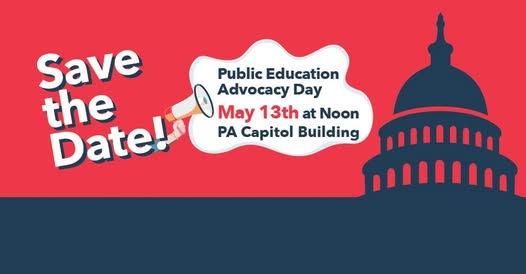
To that end, Education Law Center and our PA Schools Work coalition allies will be going to Harrisburg for a May 13 advocacy day. The event will include a rally and meetings with legislators to reinforce our message. Sign up here! Strong turnout will help communicate that legislators cannot disregard their constitutional obligation to ensure adequate funding. Read more about the funding we need our state elected officials to allocate.
| | Whether or not you can go to Harrisburg on May 13, please keep contacting your state legislators. Let them know that increased state funding is making a difference already. Urge them to support the governor’s adequacy funding proposal and the rest of his education funding package, including his proposed cyber school funding reform and the additional increases that schools need to cover cost increases due to inflation. New district fact sheets from our PA Schools Work coalition provide data on how your district would benefit and what its needs are. And a new report from Teach Plus-PA provides powerful examples of how adequacy dollars are improving schools for students. | | As Brown v. Board Anniversary Approaches, ELC Works to Stop Erosion of Rights | | |
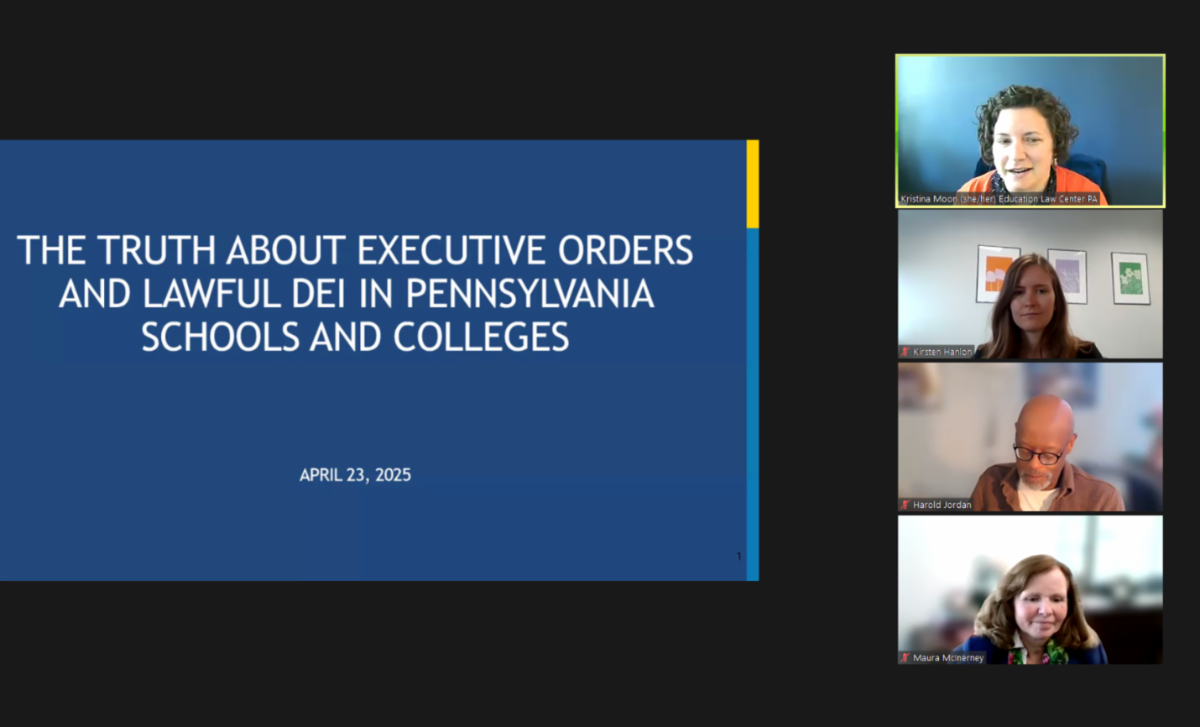
ELC’s Kristina Moon (top) and Maura McInerney (bottom) joined with staff of ACLU-PA to present this webinar.
Executive orders and guidance letters lack the force of law, and they have been challenged in multiple lawsuits. On April 24, three federal courts collectively blocked the U.S. Department of Education from enforcing its Feb. 14 Dear Colleague letter and its April 3 DEI certification requirement. Additionally, the Pennsylvania Department of Education responded to the certification requirement, reporting that all local education agencies comply with federal Title VI law.
We must stand together in opposition to unlawful executive actions and recommit ourselves to fulfilling Brown’s promise.
| | Webinar Details Transgender Students’ Rights; ELC Joins Amicus Brief | | |
ELC continues our advocacy for inclusive school environments that are affirming for LGBTQ+ students. We recently presented another webinar with partner ACLU-PA: The Truth About Executive Orders and PA Schools’ Continuing Obligations to Transgender Students. The presentation explained that executive orders do not have the force of law, and federal and state laws still require schools to protect trans students from discrimination. You can find the recording and additional resources here.
ELC also joined an amicus brief written by our partners Women’s Law Project and Community Justice Project that was submitted to the U.S. Supreme Court in the case Mahmoud v. Taylor, which was argued in April. The case presents the issue of whether parents must be provided advance notice and an opt-out option before a public school teacher can read books in the classroom that include gay or transgender characters. The amicus brief presents powerful research about the positive impact of inclusive books and curricula on school climate and argues that an inclusive policy advances the school board’s compelling interest in fostering a learning environment that protects the physical and psychological well-being of LGBTQ+ students. A decision is expected this summer.
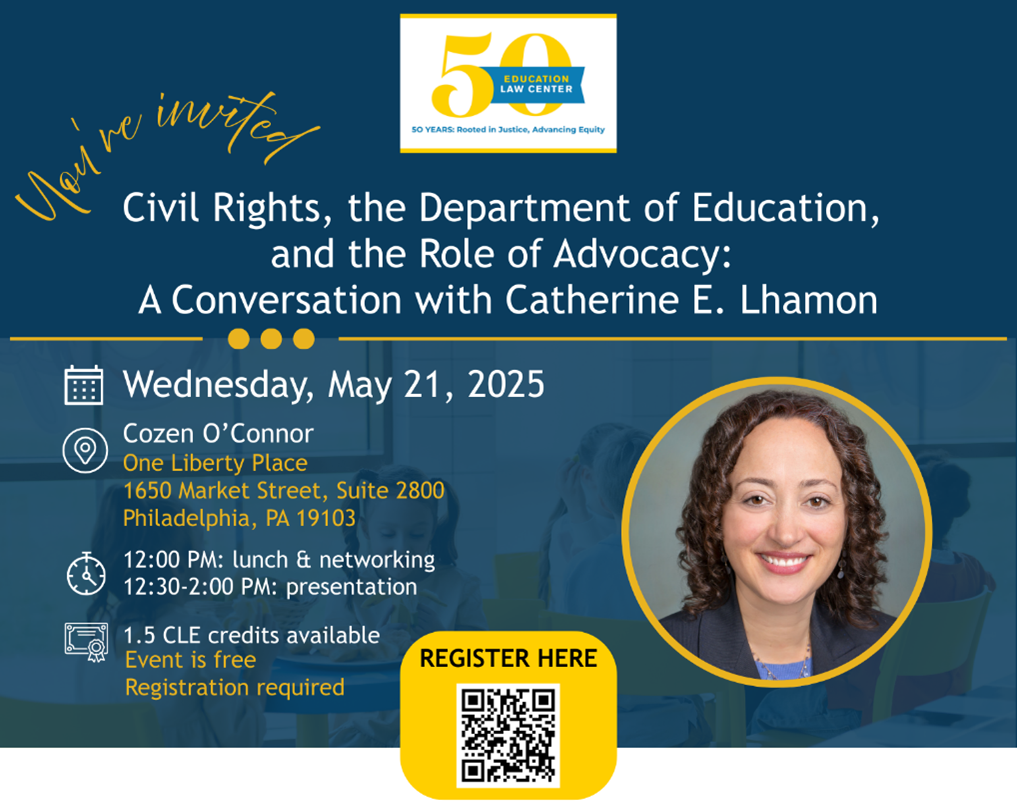
| | A Conversation with Catherine E. Lhamon | | As part of ELC’s yearlong 50th anniversary celebration, we are hosting Catherine E. Lhamon, the head of the U.S. Department of Education’s Office of Civil Rights under Presidents Obama and Biden, from 12 to 2 p.m. May 21 at Cozen O’Connor in Philadelphia (lunch at 12, CLE program at 12:30). Here is a link with all of the information for this free event. Join us live or via Zoom. You can register here. | | |
Make Plans to Join ELC
on Sept. 25 to Celebrate 50 Years
| | |
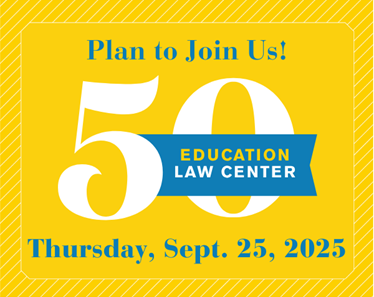
Mark your calendars today! We invite you to join us on Sept. 25, 2025, for the Education Law Center’s 50th anniversary celebration at the Switch House in Philadelphia.
Sponsorships are available now! ELC’s premier fundraiser serves as a unique opportunity to connect with key stakeholders in education advocacy and reform. Please contact Ariella Gregson to learn more about partnership benefits.
We hope you will celebrate this special milestone with us!
| | Support Funding Increases for Part C Early Intervention Serving Infants and Toddlers | | |
Nearly 50,000 infants and toddlers with developmental delays in Pennsylvania were served by the program called Part C Early Intervention (or Part C EI) during the 2023-24 school year, which is aimed at supporting the development of skills for improved health, educational success, and lifelong well-being. But we know that far more children are in need of these vital services.
In March, the state Office of Child Development and Early Learning (OCDEL) released the long-awaited Pennsylvania Early Intervention System Rate Study, which reported that the Part C EI program was underfunded by more than $71 million for the 2022-23 fiscal year. These major funding gaps prevent young children from receiving the services and supports that they need and to which they are legally entitled. The commonwealth must work to fill this gap, which grows each year.
Please join us in supporting Gov. Shapiro’s budgeted increase of $16.2 million for Part C EI. Although we know that significantly more dollars are needed, this proposal will address key challenges to the program, including shortages in crucial positions such as speech therapists and specialized instructors. These shortages result in the denial of services for children across Pennsylvania. The governor’s proposed increase is an important first step to fully funding this critical program serving our youngest learners.
To learn more about how you can get involved, visit Thriving PA. To learn more about Early Intervention, see this resource.
| | A Successful Challenge to
a Student’s Removal From School | | |
ELC recently settled a case for a middle school student, “Kevin,” whose mother connected with us through our Helpline.
Kevin is a talented student with a disability who wants to be an engineer. The school was attempting to transfer him to an alternative school as a punishment for behavior that is related to his disability. After we intervened on Kevin’s behalf, we learned that he had received years of illegal punishments and school exclusions and had been denied the special education services that he needed to participate in school and receive a free appropriate public education.
After filing a due process complaint, we were able to obtain a favorable resolution that will help Kevin receive appropriate school services in an appropriate and least restrictive environment where he will not be pushed out and forced to attend an alternative school. We also obtained compensatory education to make up for the deprivation of a free appropriate public education.
Unfortunately, Kevin’s story is not unique. We frequently receive calls to our Helpline about inappropriate and illegal school exclusions for students with and without disabilities. School exclusions include suspensions, expulsions, or transfers to alternative education programs.
It is well documented that Black and Brown students and students with disabilities are disproportionately targeted for and harmed by school exclusions. Research confirms that Black and Brown students do not engage in higher rates of misbehavior than their white peers, but rather adult decision-maker bias contributes to their disproportionate exclusion, along with culturally biased school practices, codes of conduct, and curricula. And research shows that students who experience even one out-of-school suspension are more likely to be pushed out of school before graduation, with detrimental long-term consequences.
Learn more in our fact sheets on suspension, expulsion, and alternative education for disruptive youth.
| | |
Thank you to Paul Socolar, ELC’s outstanding communications specialist, who retires this month after an extraordinary, inspiring, and impactful career. Having joined ELC in December 2017 after his work as the co-founder and longtime award-winning editor and publisher of The Philadelphia Public School Notebook (now Chalkbeat Philadelphia), Paul brought effective communication skills as well as his deep knowledge of education policy to our work at the Education Law Center.
His exceptional dedication, commitment to social justice, and strategic insights have played a vital role in amplifying our mission and message. From crafting compelling content, to managing outreach and media relations with professionalism and care, to centering the lived experiences of ELC’s clients, Paul’s contributions have made a meaningful and lasting impact. He ensured daily coverage of our fair funding trial and edited hundreds of advocacy resources (while championing the Oxford comma), raising the bar in every way.
For example, this newsletter’s content and quality improved immeasurably under Paul’s skilled pen (and keyboard), growing our subscriber list to 5,000. In addition to his outstanding professional accomplishments, on a personal level, Paul is thoughtful, sincere, and compassionate.
We are so grateful for all that Paul has done to elevate our communications at the Education Law Center. Thank you, Paul. We wish you all the best in retirement! We will miss you greatly!
| | 1994: LeGare Case Leads to New Admissions Process for Selective Public Schools | | |
Each month in 2025, we are highlighting an ELC milestone or success as we mark our 50th anniversary. Our timeline of ELC milestones is here.
In the early 1990s, frustrated parents in Philadelphia complained to the Education Law Center that their children, who had been identified as having disabilities, missed out on serious consideration for admission to the city’s selective schools.
As a result, ELC filed Lamar LeGare et al. v. School District of Philadelphia in 1994. It led to a consent decree in 1995 that established new policies and procedures for students with disabilities seeking admission to Philadelphia’s many specialized and magnet high schools.
The district agreed to take steps to ensure students with disabilities were not excluded from selective high schools if making reasonable accommodations would allow a student to participate successfully. As a result of our advocacy, the agreement was extended to English learners a few years later.
The LeGare process, now known as Individualized Review, remains in force. For instance, the district recently extended Individualized Review to all students applying for special-admission middle schools to ensure that discrimination does not occur during those pivotal years, according to ELC senior attorney Margie Wakelin.
Still, she said, the district should conduct a meaningful analysis of current school selection data to address any “lasting barriers that impermissibly deny access to schools solely based on disability, language, or national origin.”
Learn more about our LeGare case here.
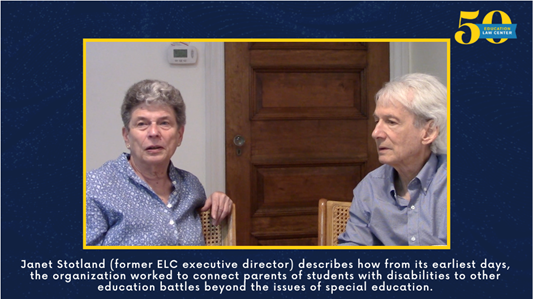
| | From Our Video Library: Building Upon the Strength of the Disability Rights Movement | | Janet Stotland, former ELC executive director, describes how, from the organization’s earliest days, ELC worked to connect parents who were advocating for students with disabilities to other education battles beyond the issues of special education. | | School Law Update on May 14
Looks at Federal Changes | | This spring’s Pennsylvania Bar Institute School Law Update — Key Insights on Federal Changes and Their Impact on Pennsylvania Schools — on Wednesday, May 14 at 9 a.m., will feature ELC attorneys and provide an in-depth look at the rapidly evolving landscape of education law. It will explore how dramatic changes at the federal level — from new executive orders to potential shifts in Education Department staffing, funding cuts, and policy changes — intersect with existing federal and state case law and statutes. | | ELC Celebrates National Foster Care Month | | |
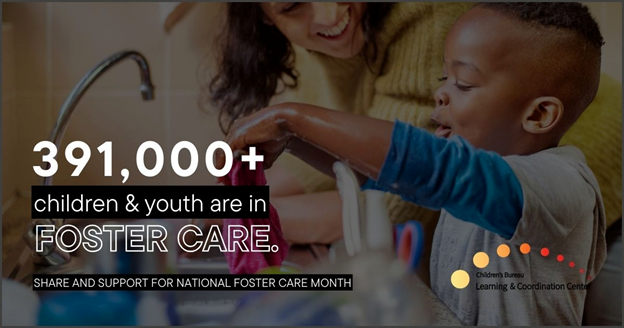
May is National Foster Care Month, and ELC will soon be releasing a new report with Pennsylvania Partnerships for Children that analyzes the educational outcomes of students in foster care statewide. ELC also continues its long tradition of advocating for children in the foster care system through impact litigation, individual representation, and legislative reforms such as Act 1 of 2022, which provides support for K-12 students in care who experience education instability. Learn more about Act 1 from ELC’s fact sheets and tools here.
ELC is committed to eliminating the individual and systemic racial bias that drives a disproportionate number of Black and Hispanic/Latino children into the foster care system, where they remain in care longer, upending their lives. Studies show that Black and Brown youth are more likely to exit the foster care system lacking a permanent living situation compared to their white peers due to racial bias and systemic racism in the child welfare system.
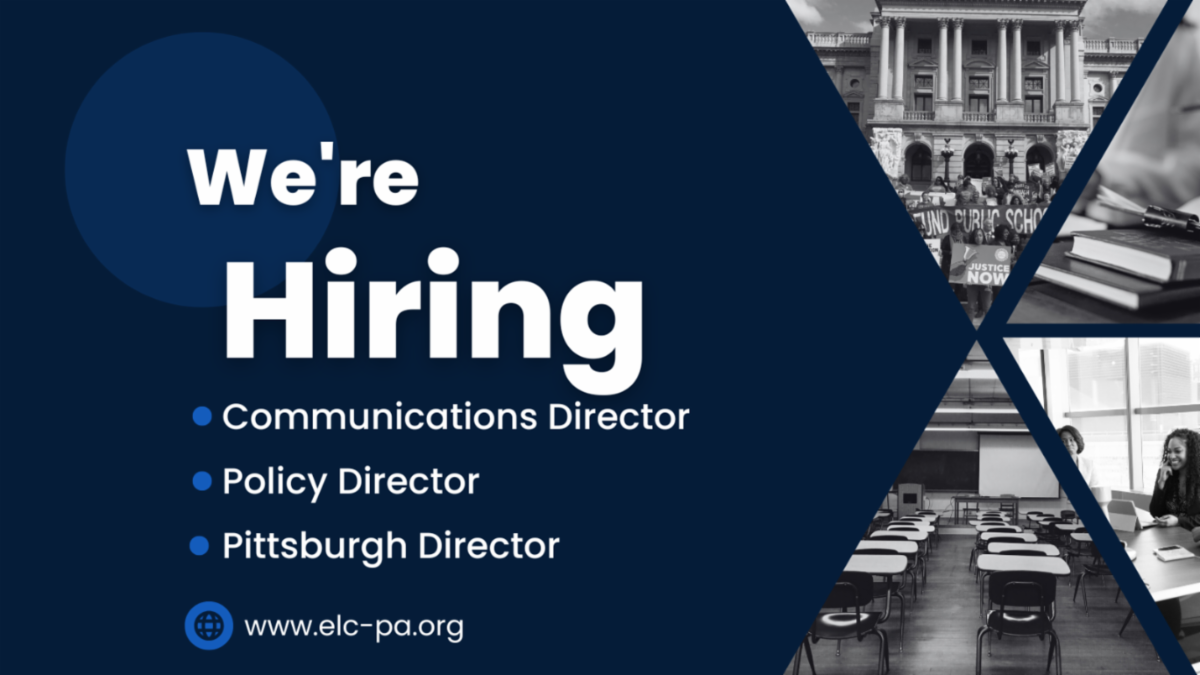
| | Check Out Our Job Postings! | | 50 YEARS: Rooted in Justice, Advancing Equity | |
Education Law Center | 215-238-6970 (Philadelphia) | 412-258-2120 (Pittsburgh)
| | A copy of the official registration and financial information of the Education Law Center may be obtained from the Department of State by calling toll-free, within Pennsylvania, 1-880-732-0999. Registration does not imply endorsement. | | | | |