Vol. 34 | June 2025 3 - minute read

 
CRU banner.jpg

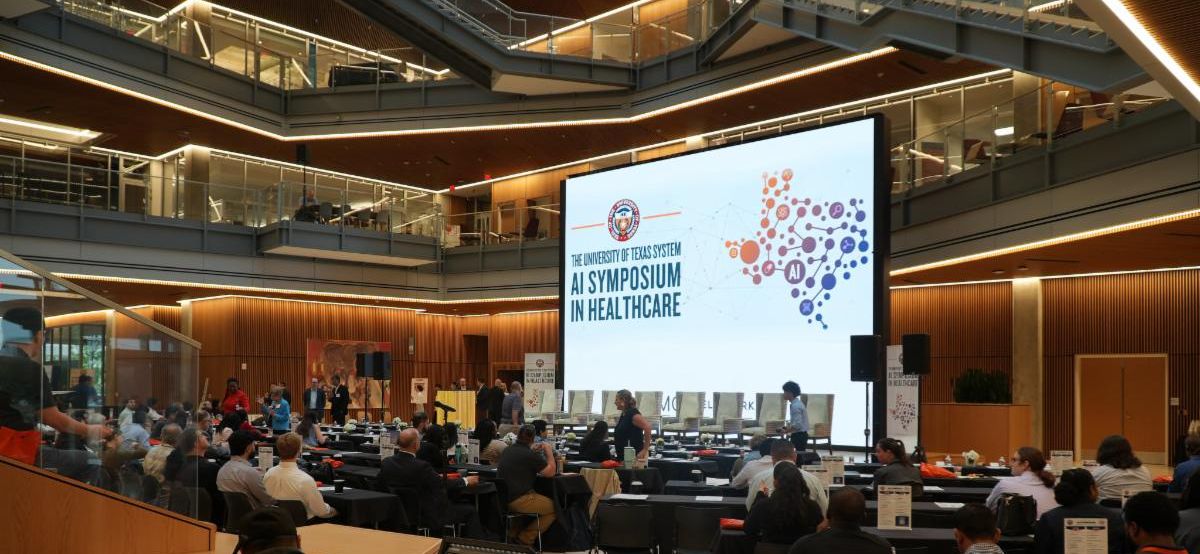
2025 AI Symposium: The Future of Health Care Is in Texas

The 2025 UT System AI Symposium in Healthcare, hosted by UTHealth Houston, MD Anderson Cancer Center, and UTMB Health, welcomed attendees to envision a brighter future for Texas.


Four speakers from UT Southwestern, including, Yang Xie, Ph.D., DuWayne Willett, M.D., Jing Wang, PH.D., and Eric Peterson, M.D., M.P.H., alongside 11 posters from our faculty and students were shared at the event. Their work ranged from AI-powered predictive clinical interventions for stroke and cancer, to new and innovative training methods to prepare clinicians and students to work in an AI-integrated system.


“The UT System AI Symposium was an invaluable opportunity to connect in person with leaders from across our sister institutions. The depth of conversation and spirit of collaboration made clear that, together, we can help shape a thoughtful, innovative future for health care AI across Texas,” said Dr. Willett about the symposium.


“I was impressed by the innovative AI research showcased across the UT system and its applications in biomedical research and clinical care,” said Dr. Xie. “The symposium highlighted the strong collaboration among UT institutes and emphasized the need for national collaboration for responsible AI development. Industry partners demonstrated important pathways for scaling AI impact in health care. I think this was a successful event promoting AI research, technology, and applications in health care in Texas.”


This year’s symposium made clear that AI is already transforming health care, boosting diagnostics, personalizing treatments, streamlining operations, and reimagining how we teach the next generation of medical professionals. Through uniting perspectives from industry, research, and patient care, this year’s event proved that Texas isn’t just preparing for the future of AI in health care – we’re actively building it.


Dallas Heart Study Marks 25 Years of Discovery

Congratulations to everyone connected with the Dallas Heart Study (DHS), which has reached the quarter-century mark. Recognized as one of the leading population-based studies of heart health in the U.S., the DHS has spawned more than 230 research papers that have guided advancements in the diagnosis and treatment of cardiovascular disease, hypertension, and heart failure. At UT Southwestern, the DHS helped to accelerate the growth of clinical research and transform our Division of Cardiology.


Launched in 2000 by a team led by Helen Hobbs, M.D., with a grant from the Donald W. Reynolds Foundation, the study’s initial cohort included more than 6,000 Dallas County residents, with a broad representation of African American participants to reflect the genetic diversity of the community. About 3,500 participants received MRIs and CT scans, abdominal imaging, and bone density scans, establishing a wealth of data for researchers. A second round of imaging was conducted in 2008. And now the third phase of the study, known as the Dallas Hearts and Minds Study under the leadership of Amil Shah, M.D., is expanding its scope to examine the impact of aging on the cohort, including effects on the brain. The first studies from the new cohort are expected to be published over the next year.


A New Generation of Theranostics Is On the Way

Theranostics is a powerful tool against metastatic cancer that allows clinicians to seek and destroy cancer cells hiding within a patient’s healthy tissues. This leading-edge technology offers tailored treatments using radioactive compounds that both visualize and attack cancer cells. This approach is especially impactful in prostate cancer, where PSMA-targeted therapies like Pluvicto have improved survival rates and quality of life for patients.


UT Southwestern researchers are playing a key role in pushing this science forward. Among other research, new compounds, called [211At]YF2 and [211At]L3-Lu, have shown promise for their ability to kill prostate cancer cells through alpha particle therapy. In preclinical studies, the compounds were more effective than previous beta particle-emitting radionucleotides in tumor uptake, cytotoxicity, and the ability to avoid collateral damage to healthy tissues.


The study also detailed a streamlined, scalable production method that can be done within an hour to facilitate clinical translation. With the steps laid out for clinical evaluation, the research group is moving these agents to clinical testing.


Interested collaborators should contact martin.pomper@utsouthwestern.edu to learn more about theranostic applications for your research.


Funding Opportunities

Open Call for Generative AI Research Proposals

The NVIDIA Academic Grant Program advances academic research by providing world-class computing access and resources to researchers. Full-time faculty members who are working in generative AI training and development, alignment and inference, or simulation and modeling are encouraged to apply.


Faculty Research Mentor Training Program*

Alyssa Hasty, Ph.D., Vice Provost and Senior Associate Dean of the Office of Faculty Affairs and Career Development has launched a new interactive UT Southwestern Research Mentor Training Program. This program is a collaboration between the Graduate School of Biomedical Sciences, the NCATS CTSA KL2/K12 Program, and the Office of Faculty Development. Join our upcoming workshop:


Important Dates and Upcoming Events

Closing the Loop: Disseminating Results to Community Partners*

Heather Kitzman, Ph.D., will cover strategies for disseminating results to community members and building long-lasting community partnerships.


Nominations open for the 2025 Leaders in Clinical Excellence Awards

The Leaders in Clinical Excellence Awards were established in 2018 to recognize clinical faculty for their exceptional contributions to the care of our patients, to the education and training of the next generation of health care professionals, and to UT Southwestern overall.


Ethics in Artificial Intelligence Symposium

The Ethics in AI group at UTSW would like your thoughts on a virtual Ethics in Artificial Intelligence Symposium to be held this fall. Please provide your ideas for what you would like to discuss at the symposium through this form.

Sign Up for the Writing Accountability Group*

Join a community of writers who are all committed to success. It's the perfect way to stay accountable, make consistent progress, and push through writer’s block. Sign up here.

*Sponsored by the UT Southwestern CTSA Program

Facebook  LinkedIn  X