August 2025 Markets Newsletter | | |
In this issue:
- "Know Your Worth, Prioritize that Project" by Sue Bradford Edwards
- "In Conversation with JoAnne Tucker, Dancer, Writer, Painter, and Casa Uno Residency Director" interview by Ann Kathryn Kelly
- Calls for Pitches
- August Deadlines: Poetry, Fiction, Nonfiction, Multigenre, Just for Fun
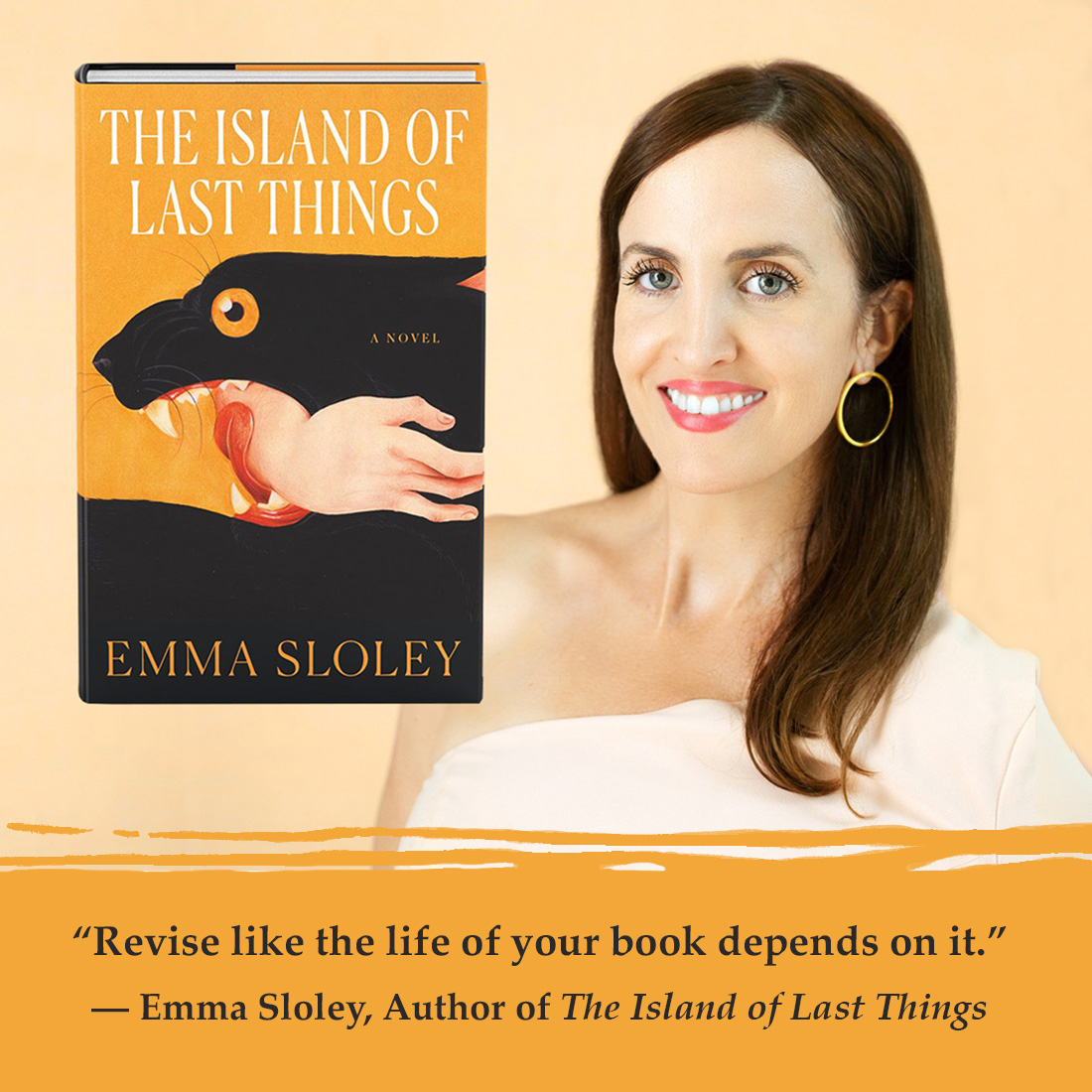
- Inspiration: "Revise like the Life of Your Book Depends on It: An Interview with Emma Sloley, Author of The Island of Last Things" interview by Kelly Sgroi
- Craft Corner: "Landing Your Dream Interview: Making Friends with the Gatekeepers" by Jodi M. Webb
- Recent WOW! Features and Posts from The Muffin
- Success Stories from the WOW! Community
| | |
Writers!
For years, I’ve watched writing friends chase after money. Some pursue trends, hoping to make it big with what is selling now, whether it is romance or cozy mysteries. But trends seldom involve topics we love. Writing a book you don’t even like is torture. Easy money seldom materializes.
I don’t tend to chase trends, but I have so many ideas. There are numerous types of writing I want to try. That makes WOW webinars and classes tempting, despite my numerous deadlines.
Fortunately, I’ve found an amazing community of writers through WOW. I’m in an accountability group with both Kelly Sgroi and Angela Mackintosh. Kelly recently gave me an excellent piece of advice. I was debating whether I should sign up for a WOW class in a new-to-me field or work on the pair of books I am self-publishing.
I admitted to our group that I need to do the smart thing and focus on the self-publishing project. One book is largely written, and I plan to draw the other from an existing content. The webinar was tempting, but it didn’t make sense to overextend myself.
Admitting this made me sad, probably because I hadn’t decided on a topic for the second book. But Kelly’s response buoyed me up. “You certainly have the content. I think we all need to know our worth and start prioritizing the projects that will make us money.”
On one hand, I know this. My educational work-for-hire takes priority over other writing. It’s what keeps the lights on.
| | |
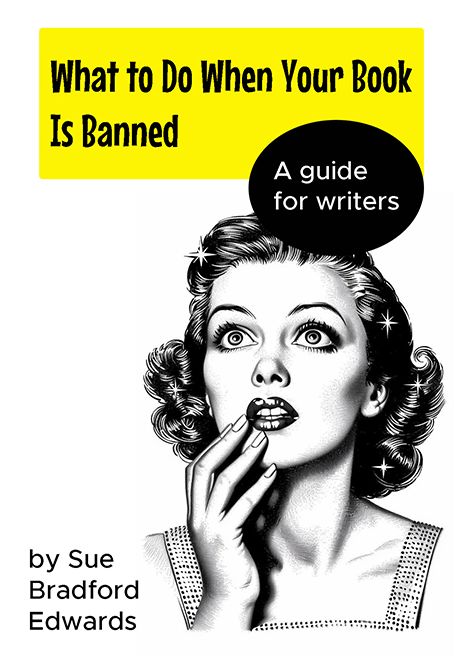
On the other hand, I don’t always prioritize my other writing in a similar way. My first self-published book is about what to do if your book is banned. I will be giving it away, but Angela is one savvy businesswoman. She suggested I self-publish another book for sale.
Smart, right? I just needed to decide on the second topic. I created a poll for my newsletter readers. What should my second self-published book be? Choices included a book of character generation exercises, a book of 5-minute writing exercises, a book created with updated content previously published in Children’s Writer newsletter, and a book on how to write with all five senses.
| | |
(Coming soon! Sue had one of her books banned and learned a lot from the experience, so she will be self-publishing this book to help fellow writers.)
| | |
The clear winner was the last choice. I threw that one in just to have a four-item poll. It is the only one for which I have no content.
I was bemoaning this to Angela when she told me she had voted for the updated Children’s Writer articles because it would be less work. She had another idea. I should publish three books based on my WOW classes. They would be on brand since I’m a nonfiction author who teaches about writing.
Once Angela pointed it out, the choice was obvious. I already use much of the content when I teach my classes, so a large part of the work is done. Sometimes it takes a pair of writing friends to help us find the project that prioritizes our brand and our worth!
| | In Conversation With... JoAnne Tucker | | |
I came upon a listing last August for a writing residency in Costa Rica and immediately started daydreaming. Maybe I could earn a spot there by winter 2025—which would get me out of cold, dark New England. I pulled up the website, drooling over lush tropical photos. And that’s when I saw the last-minute opening. A writer had canceled! There was a three-week residency available from mid-October to early November. Only six weeks away—but—Costa Rica! How could I not apply?
My work schedule affords me travel flexibility, so I pulled materials together and sent it off. That’s when I met JoAnne Tucker, our guest this month and the owner and residency director of Casa Uno. JoAnne reviewed my samples, asked for two references, and we scheduled a Zoom call. Inside of a week, I was offered the residency. Six weeks later, I was on the ground in Atenas, Costa Rica.
JoAnne has been committed to the arts throughout her life, studying dance at Juilliard and holding a Ph.D. in theatre. She founded and for more than 30 years directed the Avodah Dance Ensemble. JoAnne also founded the documentary film company Healing Voices – Personal Stories that shares domestic violence survivor stories. She paints and more recently, she hosts a writers group for English speakers that meets weekly at her home. All this, on top of interviewing, selecting, and hosting artists throughout the year.
We’ve got a great interview teed up, plus more information on how you might be able to land a residency spot in Costa Rica with JoAnne. Stay with us, as we dive in!
| | |
WOW: Hello, JoAnne! It’s wonderful to chat with you again after spending three wonderful and productive weeks as a guest in your home at Casa Uno in the tranquil Central Valley of Costa Rica.
JoAnne: Thanks, Ann. I’m delighted to be sharing with the readers of WOW! Women on Writing. It’s fun to chat with you and meaningful to have you doing this interview since you were an artist in residence here.
WOW: First things first. What prompted your move to Costa Rica from the U.S, and when did you buy your home? And then, what inspired you to start an artists residency program?
JoAnne: My husband and I were living in Santa Fe, which we both loved. In 2018, my husband’s health began declining and he was having problems breathing because of the altitude in Santa Fe. We began thinking of where we might live, and there was nowhere in the U.S. that appealed to us. We were also not happy with the direction the U.S. was moving in, and so we began looking outside of the States. We considered several places, and Costa Rica checked the most boxes. It is a short flight to and from the U.S., which meant it would be easy for our kids to travel here. We had spent time in Costa Rica and our experiences were positive. We did lots of research, reading blogs and books related to people who had adopted Costa Rica as their place of residence and even quite a few accounts of why people had returned to the U.S. We also liked the philosophy that Costa Rica does not have an army and that taxes go toward education and healthcare.
We spent three weeks in the fall of 2019 in Atenas, as that place stood out to us. It is close to the airport and good hospitals, it’s not a tourist town, it has a relaxed feeling, and yet has all the basic services for comfortable living.
My husband’s health continued to decline. He passed away after we lived here for nine months. It was during COVID and this was an ideal place for me to continue living for the time being. Each day, my desire to make this my permanent home became stronger. The arts have always been such an important part of my life. The idea of sharing this beautiful property with other artists appealed to me. As I researched artists residencies around the world, my enthusiasm built and the research also helped me define how I would run Casa Uno’s residencies.
WOW: Your property in Atenas can host up to three artists, with private rooms and baths. Two rooms are in the main house, and a separate casita has a bedroom, bath, and kitchen where residents prepare meals together. My birthday fell near the end of the residency and Melisa, an opera librettist who just happens to be a trained chef, baked a Tres Leches cake for me—in homage to the cake’s roots in Latin America. She also whipped up a delicious ratatouille made with fresh vegetables from our trip to the farmer’s market that we enjoyed with fellow resident Katreana (Kat).
You’ve had artists from around the world stay with you, is that right? From prose writers and poets, to dancers, screenwriters, visual artists, photographers, and more. What do you appreciate about meeting people from all over? And how have these relationships with residents deepened your own artistic pursuits or piqued your curiosity and learning?
JoAnne: Yes, artists are coming from all over the world, although the majority are from the U.S. I am constantly learning from each residency, especially how to “hold space” so each person can gain the most from their time here. I’m fascinated by each person’s approach to what they are working on. It has expanded my knowledge on lots of new subjects and I see my surroundings in new ways. I love how a recent resident became fascinated with the seed pods from the Guanacaste tree on the neighboring property and wove them into her poetry.
Having creative energy around is just plain fun. I’m not sure it motivates my own creative endeavors, as that is just who I am. In fact, it may take time away from my painting and writing, as there is a lot of administrative work that goes with running Casa Uno. I am OK with that at this point in my life.
| | |
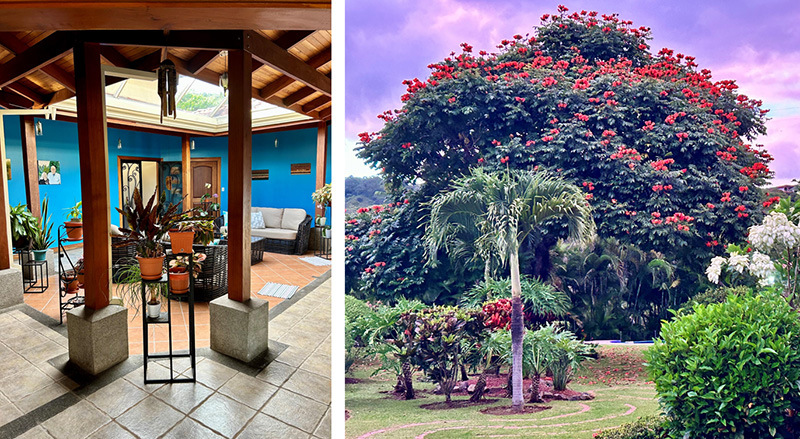
Casa Uno living room and the majestic African tulip tree
Photos by Ann Kathryn Kelly
| | |
WOW: What do you look for in compelling residency applications? Does a “yes” jump out at you? How do you know?
JoAnne: A “no” jumps out more quickly than a “yes” because those applications tend to be incomplete. The project may not be well described, or the sample of work does not resonate with me. There are lots of good applications and part of my challenge is putting the right group together for the right dates. I encourage each person to fully answer the questions and send a good example of their work. I do check references and pay attention to who has written it. When it comes from a professor, an editor, or a past Casa Uno resident, it carries more weight than a friend of the applicant. I also prefer to have different artists here at the same time. A poet, a musician, and a visual artist, for example. Or a librettist, a writer penning a murder mystery, and an essayist. Sometimes a person isn’t invited not because the application isn’t good but there are just too many similar artists applying at that time with a preference for specific dates.
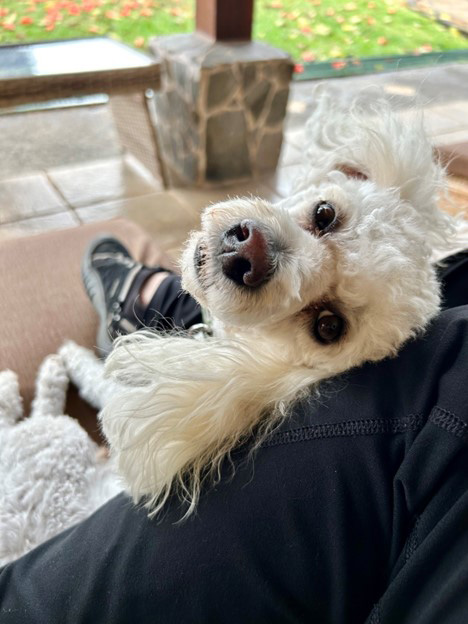
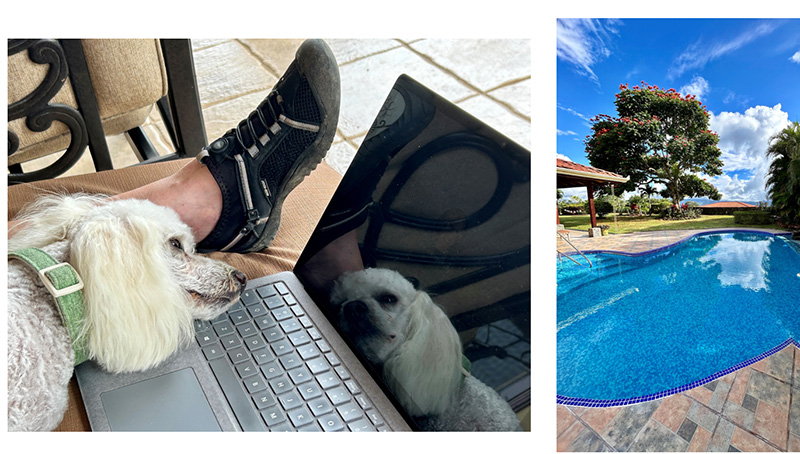
WOW: I can’t get too far in this interview without introducing a VIP—Very Important Pooch—at Casa Uno: Oscar, your miniature poodle. Oscar is the undisputed mayor and Chief Lap Sitter at the property. How do you think Oscar complements the residency experience?
| | |
Oscar, Chief Lap Sitter
Photo by Ann Kathryn Kelly
| | |
JoAnne: Oscar loves people and adjusts quickly to new residents. Unless he is chasing the black birds he doesn’t like, or iguanas, he is very calm. For me, the important thing is that he is comfortable with people coming and going. I don’t know how he complements the residency for people. That is a question that maybe you can answer.
WOW: Oscar was a ray of sunshine each day! He was my constant companion on the patio, content to just stretch out on my legs and nap while I wrote, looking out at your majestic African tulip tree. Dog lovers, I think, will surely appreciate his company.
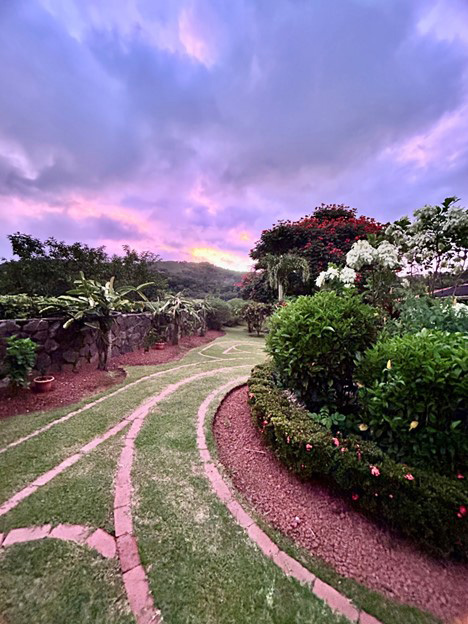
And, your property has a labyrinth! Tell our readers more about this unique feature that you added after you moved in. You call it Camino del Artista. What makes it special?
JoAnne: It was created especially for Casa Uno’s property based on the land and the purpose I wanted for the residency program. I think of it as being a mirror of the creative process. Ronald Esquivel, a Costa Rican architect who has created over 27 labyrinths, collaborated with me. For more detail, I suggest readers visit my blog.
| | |
Camino del Artista Labyrinth
Photo by Ann Kathryn Kelly
| | |
WOW: An intriguing read from your blog about your discussions with Ronald. And I love the aerial diagram and reading about the five buried crystals on the path. It was wonderful to walk it while I was there!
You also encourage residents to consider participating in your weekly writers group. Tell us more about this group: why it was formed and how you structure weekly meetings.
JoAnne: The writers group grew out of a residency in 2022. The residency program was new and there was only one writer here: Jennifer Paquette. Jennifer suggested, after reading some of what she was working on, that she could give attendees writing prompts. I thought it was a good idea. People enjoyed it so much that we decided to start a regular writing group afterwards.
I offered to host it and suggested that we base it on the format Jennifer had introduced, as well as guidelines that the Steamboat Springs Writers Group follows. Both Jennifer and my late husband were part of the Steamboat group that is now over 30 years old.
Our group’s structure is that each person who wants to read has 10 minutes to share, followed by five minutes of critique from participants that is focused on what is working and what the listener might be curious to hear more about. When a large group is expected, we use a sign-up sheet. When there is time left over and everyone who wanted to read has, then we do a writing prompt.
I strongly encourage artists-in-residence to participate, so regular attendees can hear new voices. I think it also helps residents learn about the people making Atenas their home.
| | |
“I am constantly learning from each residency, especially how to ‘hold space’ so each person can gain the most from their time here. I’m fascinated by each person’s approach to what they are working on. It has expanded my knowledge on lots of new subjects and I see my surroundings in new ways.”
| | |
WOW: What do you think the writers group gives back to regular attendees (many of whom started out as your neighbors and are now your friends)? Can you share a few examples of how the group has helped a member move a project forward?
JoAnne: The main thing I’ve heard from them is that they feel encouraged to keep writing. Many have expressed they like having a weekly meeting, as it keeps them progressing on their project. The group is open to all forms of writing, from a murder mystery to poetry. Because the topics are so diverse, no session has even gotten boring. At times, a writer may share something very personal and a level of confidentiality is required. That is in our guidelines and the group respects this. And yes, friendships have developed in the group and sometimes when it is noon, people will hang around for a while or go out to lunch together. It has provided opportunities to meet new people with shared creative interests.
WOW: What do you think your writers group gives back to the Atenas community, in terms of promoting the arts among locals?
JoAnne: It is too soon to tell. We are doing our first public reading at Art House, which is located in the center of Atenas, and so it will be interesting to see if it builds more interest. Right now, I would just say it provides an opportunity for people with shared interests to get together.
WOW: On the last Saturday of each three-week residency, artists are expected to share what they have been working on with the community. My reading validated what sections of my memoir-in-progress resonated with impartial listeners, and helped me see where I might need to dig deeper on any passages that felt vague to them.
What general feedback have you received from the community on these presentations from various artists? And how do you think the presentations prove, in a way, the value your residency program brings to the larger community?
JoAnne: The general feedback has been extremely positive. What I miss most living in Costa Rica—and others do too—is access to live experiences in theatre, dance, and visual arts. Yes, some things happen in San Jose, but it is a big deal to go back and forth to the capital. We are slowly developing some local options and each residency cohort’s presentations are examples of that. Information about the artists’ presentations is spreading by word of mouth and my list of people who want to attend is getting longer and longer, so that is saying something about how much it is appreciated.
| | |
Oscar, exhausted by a long day of writing, and the Casa Uno pool
Photos by Ann Kathryn Kelly
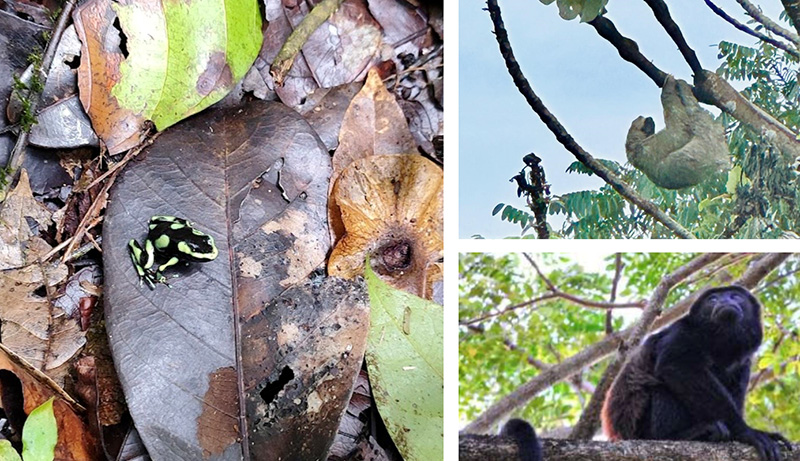
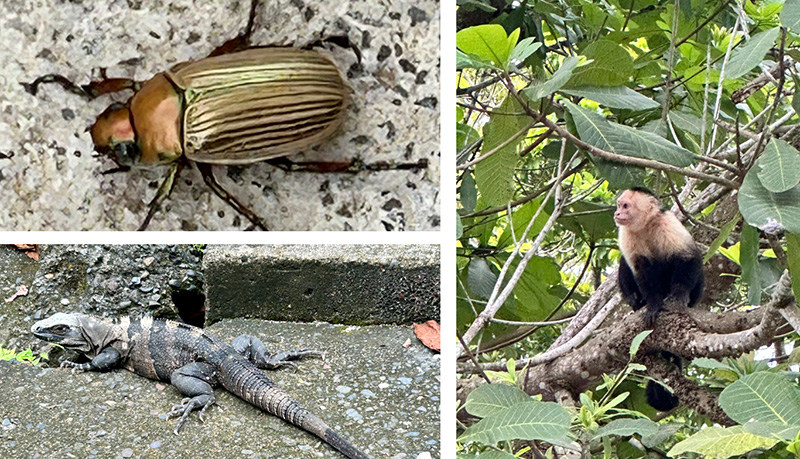
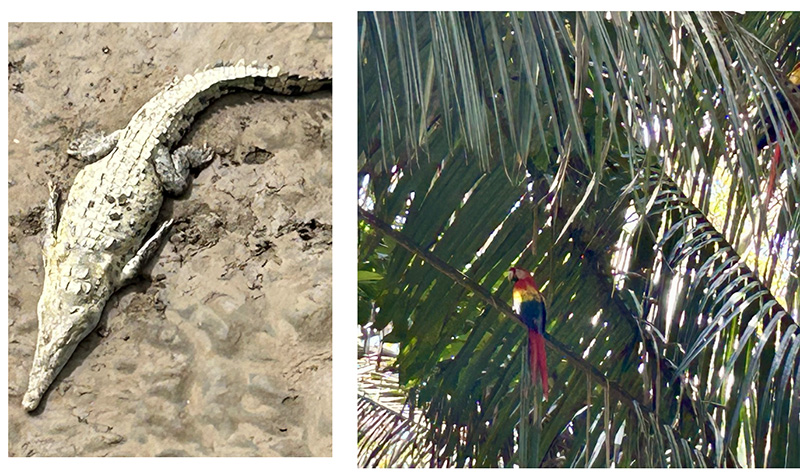
| | WOW: Downtime can be an important element to any residency. I took advantage of a day trip into the rainforest with my fellow residents and a local guide. I’m happy to report that we spotted a three-toed sloth high in the trees! The biodiversity was thrilling: we saw tiny—and deadly!—poison dart frogs no bigger than one’s thumb, crocodiles sunning on a mud flat, capuchin and howler monkeys swinging through the canopy, colorful macaws bickering on branches, leaf cutter ants marching through the rainforest, beetles almost the size of one’s palm, butterflies of course, and too many more exotic animals, insects, and plants to list. | | |
Poison dart frog, sloth, and howler monkey
Photos by Ann Kathryn Kelly
| | |
Yet, I recall reading during my application process that you don’t want applicants to view this opportunity to stay in your home as a free, three-week vacation. Absolutely valid; the art needs to remain the focus. I’m curious, though, to hear how you think the beautiful natural surroundings contribute to residents finding their flow? How have you seen (or heard about) a change in residents in their brief stay at Casa Uno? Do you have an example of someone becoming unblocked?
JoAnne: I don’t have any real examples of people becoming unblocked. I do see a general pattern in how they unwind once they are here, that seems to repeat with each new residency. The first week is about settling in and figuring out one’s rhythm and schedule. The second week is where most focus and work gets done. That is also the time for a day off excursion, such as you describe. The third week seems to go in two different directions. For some people, they work even harder realizing they may be going back to a very busy schedule and they want to get as much done here as they can. Others relax and polish work, glad to see what they’ve accomplished. And often, the last two days are about working on upcoming individual presentations to the community.
| | Gigantic beetle, iguana, and capuchin monkey | | |
Crocodile and macaw
Photos by Ann Kathryn Kelly
| | |
WOW: Let’s turn to your lifelong involvement in the arts. You studied dance at Juilliard and you hold a Ph.D. in theatre. We’d love to hear more about each of these passions.
JoAnne: Since I was a toddler, dance has played an important part in my life. I used to love dancing when my grandmother played the piano. I still enjoy dancing, especially in the swimming pool. When residents aren’t here, I often put on music and improvise in the pool. I am fortunate to have studied with some outstanding teachers, both as I was growing up in Pittsburgh attending summer programs, and then at Juilliard. Most meaningful for me was studying dance composition at Juilliard under Louis Horst and the excellent faculty teaching the Martha Graham technique. I’ve written about that in my blog.
I ended up getting a Ph.D. in theatre because my husband accepted a job at the University of Wisconsin and the theatre department offered me a teaching assistantship. I was also pregnant at the time and was very lucky to continue to study while pregnant and then with a newborn.
WOW: You founded and for more than thirty years directed the Avodah Dance Ensemble in New York City. Tell us more about that. What did you most enjoy about it?
JoAnne: The Avodah Dance Ensemble started out exploring Jewish text through dance, particularly focusing on interpreting liturgy and finding women’s voices through a process called midrash. I co-authored a book Torah in Motion: Creating Dance Midrash which is used by Jewish educators. As the company developed, we moved into multicultural work and worked with women in prison. I’ve written about these experiences and your readers can learn more, if they are interested, here and here.
WOW: This is a great segue to ask about the documentary film company you founded, Healing Voices – Personal Stories. Tell us more.
JoAnne: The film company grew out of the work I had done with women in prison. I met women who had murdered their abusers because they did not know how to get out of an abusive relationship/marriage. Their stories haunted me and I wanted to showcase stories of women who have been able to rebuild their lives. We did six short films about women and one relating to men who are abused in relationships. One other film looked at how movement and meditation can be healing tools for recovery from an abusive relationship. I enjoyed each project very much, the collaboration with David Lindblom, co-director, cinematographer and editor, and Lynn Wimmer, dance videographer, as well as board members who became very involved in the filming process. Our films are available to stream here.
WOW: And now, you paint. I admired many of your paintings in various rooms in Casa Uno. When did you pick up painting, and how does it complement your lifetime of dancing and more recent pursuit of writing?
JoAnne: I treated myself to classes at The Art Students League in New York City for my 60th birthday. I knew we would soon be leaving the city and my main creative expression would not be dance, and so I wanted to take some classes in art. I attended a life drawing class for two years and loved it. It gave me a good grounding. Sometimes I feel like I am dancing on paper, especially when I was doing abstract art, although I didn’t bring any of those oils to Costa Rica and I am now focusing on my natural surroundings.
Related to writing, for a while I was writing haiku and then doing an accompanying watercolor. You can see an example on my blog. Right now, I love painting images from the garden. I am not sure where I am going with my own writing, other than committed to doing my blog on a regular basis.
WOW: JoAnne, your haiku and accompanying watercolor paintings are delightful! Thanks for sharing them. And I love your phrase “dancing on paper” above. Great imagery.
We’re happy here at WOW! to help you get the word out about your residency program, but in what additional ways are you promoting this great opportunity? I recall coming across a listing for it last year in The Practicing Writer newsletter that Erika Dreifus pulls together. Are you listed on any writing or residency websites that collate opportunities?
JoAnne: At this time of year I send notices to several newsletters, like the one from Erika Dreifus, and I appreciate when my residency listing is included. I also have an extensive email list made up of residency alumni as well as dancers, artists, filmmakers and others I have worked with through the years.
| | |
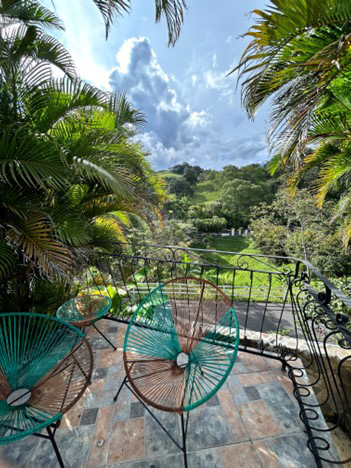
The pool balcony
Photo by Ann Kathryn Kelly
| | WOW: Your application window for 2026 residencies is currently open. Readers, find details here and send your material to JoAnne for consideration. Who knows, a Costa Rican retreat may just land on your calendar sometime next year! | | |
“I attended a life drawing class for two years and loved it. It gave me a good grounding. Sometimes I feel like I am dancing on paper, especially when I was doing abstract art. I am now focusing on my natural surroundings.”
| |
So, what’s next for you personally, JoAnne, and for Casa Uno more broadly in the coming year?
JoAnne: I continue to like holding space in the form of the residencies and hosting the writers group, so I can mentor and encourage people by supporting their creative voices. While I continue to paint and write, I am finding I am more focused on holding space for others, along with spending quality time with my family. They come to visit me and I go to the U.S. for quick trips, especially with the recent arrival of a great-grandson.
Ann, it has been a pleasure to do this interview with you and I look forward to hearing from and seeing applications from WOW! readers.
| | |
My thanks to JoAnne Tucker for chatting with me. The Costa Rican way of life, “Pura Vida,” emphasizes enjoyment of the simple things. Savoring the moment. I found all that, and more, during my residency at Casa Uno: plenty of lush natural beauty, peace, and inspiration to create in Costa Rica’s serene Central Valley. I have no doubt you’d love it, too—so pull your material together and throw your hat in the ring!
Until next time, readers!
| | |
Ann Kathryn Kelly is a memoirist and essayist living in New Hampshire’s Seacoast region. Her prize-winning writing has been published in dozens of literary journals and anthologies, and she has been awarded writing residencies around the world. Ann is a columnist with WOW! Women on Writing and she volunteers as a writing workshop leader. Visit her creative writing website. Ann also writes professionally for technology companies through her LLC, Pen on Demand.
| | |
Iterant
Deadline: Until filled
Iterant is a journal of poetry and art. They are seeking submissions for their next issue. Please submit up to 8 poems, previously unpublished, for consideration. Pay: $50 per poet. No fee.
https://iterant.org/submit/
Linda Nemec Foster First Book Award for Poetry
Deadline: August 1
Cornerstone Press, the university press of the University of Wisconsin-Stevens Point, is accepting submissions for the Linda Nemec Foster First Book Award for Poetry. Prize: $1,000 advance to the winner, publication, and ten copies of the book. Submit a full manuscript (60-70 pages of poetry), with title page and (when appropriate) acknowledgments page. Fee: $15
https://cornerstonepress.submittable.com/submit/326932/linda-nemec-foster-first-book-award-for-poetry
The Coniston Prize for Women Poets
Deadline: August 1
The Coniston Prize is awarded to women poets. Any poet who identifies as a woman is eligible. Submit 3-5 previously unpublished poems in a single document, totaling no more than 10 pages. The winner of the Coniston Prize will receive $1,000 and publication. Up to 10 finalists will also be awarded $175 and publication. Fee: $20
https://radarpoetry.submittable.com/submit/24613/the-coniston-prize
Poetry - Robert Watson Literary Awards 2025
Deadline: August 1
The Greensboro Review seeks new writing from authors representing a wide range of identities and love featuring the work of previously unpublished writers. They recommend 3 to 5 poems per submission, with a maximum of 10 total pages of poetry. Prize: $1000 cash award and publication in The Greensboro Review. Entry is free for new or current subscribers; writers must be active subscribers to be eligible for publication and for the prize money.
https://greensbororeview.submittable.com/submit/328975/poetry-robert-watson-literary-awards-2025
2025 Inverted Syntax Sublingua Prize for Women's Poetry
Deadline: August 15
The Sublingua prize is dedicated to the discovery of an exceptional debut poetry collection written in English by a female-identifying writer of any citizenship residing in the United States who has not yet published or self-published a full-length manuscript in any genre nor a chapbook exceeding 30 pages. Prize: $500 plus publication. Please send a manuscript that is between 48-80 pages, not including front matter. Fee: $20
https://invertedsyntax.submittable.com/submit/329348/2025-inverted-syntax-sublingua-prize-for-poetry-1st-book-award
Waterford Poetry Prize 2025
Deadline: August 15
The Waterford Poetry Prize is open to all writers currently living on the island of Ireland. First prize is €500 plus attendance at a designated writing course under the auspices of the Molly Keane Writers Retreat, Ardmore in 2026. Second prize is €400 and third prize is €300. Submit poetry up to 40 lines. No fee.
https://waterford.submit.com/show/296
2025 Omnidawn Poetry Open Book Contest
Deadline: August 16
The winner of each of Omnidawn’s poetry book and chapbook contests wins a cash prize ($3,000 for the 1st/2nd Book and Open Contest, $1,000 for the Chapbook Contest), publication of the book by Omnidawn with a full color cover (unless the author prefers black and white), 20 free copies of the winning book, and publicity through their newsletters and social media channels. Submit approximately 40 pgs to 90 pgs for submitting in an 8.5 x 11 size page. Approximately 60 pgs to 110 pgs for submitting in a 6 x 9 size page. Fee: $30
https://omnidawn.submittable.com/submit/316483/2025-omnidawn-poetry-open-book-contest-judged-by-jose-luis-moctezuma
Speckled Trout Review
Deadline: August 20
Editors of Speckled Trout Review welcome submissions of unpublished poetry (nothing previously published in an electronic publication of any kind or print) for its Summer 2025 issue. Poets can paste up to 4 poems, followed by a 50-75 word writer’s biography at the end, in the body of an e-mail to speckledtroutreview@hotmail.com. No fee.
https://speckledtroutreview.com/2025/06/10/submission-guidelines/
The Off the Grid Poetry Contest - Poets Over 60
Deadline: August 31
The Off the Grid Prize recognizes the work of older poets and highlights important contemporary voices in poetry. Winners receive $1,000 and publication, promotion, and distribution of their book in print and audio formats. They are looking for work by poets over 60, whose writing practice is ongoing and whose vision is fresh while drawing from six or more decades of lived experience. Manuscripts must be typed, paginated, and at least 50 pages in length. Fee: $25
https://www.grid-books.org/off-the-grid-press/
International "Kusamakura" Haiku Competition
Deadline: August 31
Open internationally, the competition started in 1996 as a memory of the first centennial anniversary of Natsume Soseki’s arrival in Kumamoto as an English teacher of the Fifth High School. This year is the 30th anniversary, and the grand prize winner of the foreign language section will be invited to Kumamoto within the limited amount of ¥500,000 with presenting Fukuda-Reiju Prize. Submit up to two haiku poems. No fee.
https://kusamakura-haiku.jp/index_e.html
Poetry Archive Now! WordView 2025 Contest
Deadline: August 31
This year, the winner will receive a £1,000 cash prize. The top 20 shortlisted poets will still be featured in the Winner's Collection and become a permanent part of the Poetry Archive. Record a video/film of yourself reading or reciting a single poem which you have written this year. No fee.
https://poetryarchive.org/poetry-archive-now/
Gyroscope Review: Crone Power Issue (Women Over 50)
Deadline: September 1
The Fall 2025 Issue is their annual Crone Power Issue. Submissions will be limited to poets over the age of 50 who identify as female. For this special issue, the editors seek work that examines what it means to be a woman over 50. Send them your best poems, the ones you are dying to show the world. Let everyone know what you are thinking, from nature to politics to relationships. There are no length restrictions on individual poems. No fee.
https://gyroscopereview.submittable.com/submit/330872/2025-fall-crone-power-issue
| | |
Writing Battle
Deadline: August 1
The Battle begins with prompts being dealt to you. The prompts must be incorporated into your story. Once the top stories from each of the four genres have been selected, the industry judges take over and pick the four winners. The cash prize pool is split amongst the genre finalists and semi-finalists. 2025 has a total cash prize pool of $112,000 USD. Judges include bestselling authors Mary Higgins Clark and Shelby Van Pelt! Fee: $20-$30
https://writingbattle.com/
The Blue Mountain Novel Award
Deadline: August 1
Hidden River™ Arts is the independent literary, visual and performing arts organization based in Philadelphia dedicated to the service, support and celebration of all artists. Original, unpublished novel, novel-in-stories, or short story collection of any length or style, including historical fiction, speculative fiction, and literary fiction. Hidden River Arts offers $1,000 and publication on their Hidden River Press imprint of Hidden River Publishing. Fee: $30
https://hiddenriverartssubmissions.submittable.com/submit/95999/the-blue-mountain-novel-award
The 22nd Annual Gival Press Short Story Award-2025
Deadline: August 8
The 22nd Annual Gival Press Short Story Award is an annual competition recognizing excellence in short fiction. Prize: $1,000 for the best stand-alone story plus publication in Gival Press online publications. Fee: $25
https://www.givalpress.com/post/writing-contests-poetry-short-story
Ligonier Valley Writers Flash Fiction Contest – Theme: AI and/or Robots
Deadline: August 15
LVW’s 20th annual flash fiction contest is open, and this year’s topic explores the dark side of AI and/or robots, or the light side if you prefer. The first prize winner will receive $50, second prize $25, and third prize $15. Three honorable mentions will not receive cash prizes but will be published with the other winners at LVW’s website. All six winning stories will be edited by a professional editor. Their authors will also receive a one-year complimentary membership to Ligonier Valley Writers. Submit a flash fiction of 1,000 words or fewer. No fee.
https://www.lvwonline.org/flash-fiction
Mmeory – Theme: Memory Manipulation
Deadline: August 15
Air and Nothingness Press is seeking stories for an anthology to be titled Mmeory which will collect stories of memory manipulation to be published in late autumn of 2025. Examples include magic spells, cyborg memory edits, very unreliable narrators, time travel gone horribly wrong. They are open to all genres of fiction. All stories requested to be 2000 words or less. Pay: $0.08 per word. No fee.
https://aanpress.com/submissions.html
Luna Station Quarterly
Deadline: August 15
Luna Station Quarterly publishes short fiction by women-identifying writers. They are seeking new fairy tales (not retellings), fantasy, sci-fi, and space opera. They also accept reprints. Stories should be 500 to 7000 words. Pay: $10 per story. No fee.
https://lunastationquarterly.com/submissions/
V.S. Pritchett Short Story Prize
Deadline: August 28
Open to residents of the UK, Republic of Ireland or Commonwealth, the contest awards a £1,000 Prize for the best unpublished short story of the year. Stories must be between 2,000 and 4,000 words. Fee: £8.00 per entry. No fee for low-income writers.
https://rsliterature.org/vs-pritchett-short-story-prize/
Edinburgh Flash Fiction Award
Deadline: August 31
The Edinburgh Flash Fiction Award is open to all writers worldwide, published and unpublished, who are over 16 years by September 1, 2025. Word limit 250 words. First prize: £2,000 plus a trophy and one-year free membership of the Scottish Arts Club. Fee: £10
https://scottishartstrust.submittable.com/submit/326690/edinburgh-flash-fiction-award
Miami University Press 2026 Novella Prize
Deadline: August 31
The MUPress Novella Prize is awarded to a novella-length manuscript of original fiction. The winner receives $1,000 against royalties, a standard contract, publication by Miami University Press and 20 copies of the book. Fee: $25, which includes a copy of the winning novella.
https://mupress.submittable.com/submit/329857/2026-novella-prize
Time After Time
Deadline: August 31
Thalia Press is seeking short stories for their anthology targeted toward lovers of mysteries set in specific historical eras. Short stories should be no more than 7,500 words and have a strong crime or mystery element and take place in a time period other than the present. Both cozy and dark stories are welcome. Pay: $25 per story. No fee.
https://thaliapress.com/now-accepting-submissions-for/
The Iowa Short Fiction Award & John Simmons Short Fiction Award
Deadline: August 31
These awards offer publication for two short story collections. Manuscripts must be at least 150 pages. They offer a standard publishing contract. Both winning manuscripts get publication under a standard University of Iowa Press contract. The prize is open for writers who have not published a volume of prose fiction. This year’s judge is author Jess Walter. No fee.
https://uipress.uiowa.edu/resources/prospective-authors/iowa-short-fiction-award
| | |
The Rumpus - Essays
Deadline: Rolling
They are seeking essays up to 5,000 words. In addition to personal voice-driven essays, they are interested in non-traditional forms of nonfiction. Essays should explore issues and ideas with depth and breadth, illuminating a larger cultural context or human struggle. Regardless of topic, they are looking for well-crafted sentences, a distinct narrative voice, compelling scenes, and thoughtful reflection. Pay: $100 per essay. No fee.
https://therumpus.submittable.com/submit/3882/essays
Redacted: What Divorced Women Aren’t Telling You
Deadline: July 31
Redacted will feature anonymous personal essays about the author’s experience with divorce. Write about the day you left. Write about your mediation over Zoom, what it cost you to move or stay, how it feels to co-parent with your ex-husband, how you threw his toothbrush into the trash. Write about the moment you knew; write about the first anniversary; write about the audacity of his attorney or the passive aggressiveness of his mother. Tell them about his affair, or yours. Write about what it feels like to have "50/50" custody when you are parenting project manager. Pour onto the page your rage, your shame, your grief, your glee, your ambivalence. Pay: $125 per essay around 1000-3000 words for the anthology. No fee.
https://redacted.moksha.io/publication/redacted
Prairie Schooner Creative Nonfiction Essay Contest
Deadline: August 1
Prairie Schooner's annual summer nonfiction contest is open to all types of creative nonfiction essays up to 5,000 words. The winner will receive $1,000 and publication in their Spring 2026 issue. This year's guest judge is Aimee Nezhukumatathil. Fee: $20, which includes a copy of the Spring 2025 issue of the Schooner.
https://prairieschooner.submittable.com/submit/12826/creative-nonfiction-essay-contest
Barrel House: For What It's Worth (CNF)
Deadline: August 9
They are accepting pitches for a new book series, For What It's Worth: short (25-30K words) works of creative nonfiction that have some pop-cultural "thing" at their center and combine elements of memoir and cultural criticism. Essentially, they want you to write about your pop-cultural obsession, but in a way that ultimately helps to illuminate something about your own life experience. They define "pop culture" pretty broadly to include things like movies, music, art, music, but also topics like suburban mall culture of the 1990s or weird Facebook groups about GenX nostalgia. Pay: royalties. Submit a 1-2 paragraph description of the proposed book and a sample of about 1,000 words. No fee.
https://barrelhouse.submittable.com/submit/330253/book-pitches-for-what-its-worth-cnf
Peter Blazey Fellowship
Deadline: August 11
Open to residents of Australia, the Peter Blazey Fellowship is awarded annually to further a work-in-progress for those writers in the non-fiction fields of biography, autobiography, and life writing. Up to $20,000 is available and only one award will be offered from this amount. Apply online with a one-page synopsis of the proposed work, an extract of 5,000 words, a two-page resume, and proof of an Australian residential address. No fee.
https://arts.unimelb.edu.au/scholarships/prizes-and-scholarships/peter-blazey-fellowship
The Forum Essay Prize – Theme: Anniversaries
Deadline: August 15
Entries are invited for the 2025 Forum Essay Prize, on the subject of: ‘Anniversaries’. Possible approaches to the subject include, but are not limited to: Commemorations, commemoration genres, public and private remembrance; memory and the relevance of memory studies, works of art and activities produced to celebrate, mark or react to anniversaries of significant milestone events, or public figures; and more. The competition is open to all and the winner will receive a prize of £500 and publication of the winning essay in Forum for Modern Language Studies. No fee.
https://academic.oup.com/fmls/pages/The_Forum_Prize
Storyhouse Biographical Nonfiction Contest
Deadline: August 31
A biographical entry must be a true story of an individual(s) known to the author personally, not a fictional or historical character. Autobiography, of course, must be a true story about the author's life, the whole or an episode. Biographical stories, especially those from older people, or about them by children and grandchildren, are especially appropriate for their mission—to "preserve the extraordinary stories of 'ordinary' people." Stories must be between 1000 - 5,000 words in length. Open internationally. Language in the stories should be free of words or scenes not suitable for children, since many children read the stories and some actually post their stories. First prize is $200. The runner-up will receive $100. No fee.
https://www.storyhouse.org/contest2025.html
The Diana Woods Memorial Award in Creative Nonfiction
Deadline: August 31 (Opens August 1)
Creative nonfiction authors are invited to submit an essay of up to 3,500 words on the subject of their choice to be considered for the Diana Woods Memorial Award in creative nonfiction. Winners will receive $250 and their work will be featured in the next issue of Lunch Ticket. No fee.
https://lunchticket.org/contests/dwm/
Intrepid Times CNF Travel Writing Competition – Theme: A Book Led Me There
Deadline: August 31
A good book can change your life; it can rewrite your personality, and it can send you packing your bags and heading to the airport. It could be a straightforward literary pilgrimage, like the many writers who sought out, for example, Paul Bowles in Morocco. Or it could be a subtler kind of inspiration; seeking the soul of Hemingway in Paris, or in pursuit of a certain feeling, depth, or sensibility, impelled by a writer who changed your experience of the world. Submit a creative nonfiction up to 2,000 words. The winner receives $300 and publication in Intrepid Times. Up to four runners-up will also be selected for paid publication. No fee.
https://intrepidtimes.com/writing-competition-a-book-led-me-there/
The Hinternet Essay Prize
Deadline: September 1
Write an essay that answers the question: How might new and emerging technologies best be mobilized to secure perpetual peace? The contest invites bold, independent, and engaging ideas from specialists and non-specialists alike. While acknowledging the historical connection between technological progress and warfare, the contest seeks proposals that explore how such advancements might instead contribute to lasting peace without excessive compromises to human freedom. Essays must be of 2,000-10,000 words. The winner receives $10,000. No fee.
https://www.the-hinternet.com/p/essay-prize
| | |
Granum Foundation Prizes
Deadline: August 1
The Granum Foundation Prize will be awarded annually to help U.S.-based writers complete substantive literary works—such as poetry books, essay or short story collections, novels, and memoirs—or to help launch these works. Prize: One winner will be awarded $5,000. Up to three finalists will be awarded $500 or more. Granum Foundation Translation Prize: One winner will receive $1,500 or more. Apply with a description of your project and a sample of your work-in-progress. No fee.
https://www.granumfoundation.org/granum-prize
Nomad Review Contest – Theme: “Fragility”
Deadline: August 1
NOMAD Review considers and curates fresh voices in arts and literature. Their current contest seeks submissions on the theme of “fragility.” One winner in each of these six categories will be selected for a $75 prize: poetry, fiction, nonfiction, visual art, industry specials, and criticism/reviews/interviews. Submit work of any length, but they are more likely to publish pieces under 5,000 words. No fee.
https://nomadreview.org/submissions
Saddlebag Dispatches
Deadline: August 1
Saddlebag Dispatches is seeking short stories, poetry, and non-fiction articles about the West. These will have themes of open country, unforgiving nature, struggles to survive and settle the land, freedom from authority, cooperation with fellow adventurers, and other experiences that human beings encounter on the frontier. Short fiction: 2,000 – 4,000 words. Nonfiction articles: 1,500 – 2,500 words. Poetry: no more than one page (approximately 30 lines). Pay: $10-$20 per piece. No fee.
https://saddlebagdispatches.com/wanted/
We'Moon Lunar Calendar
Deadline: August 1
We'Moon is a combination literary journal, art magazine, and poetry digest all rolled into one. They publish a lunar calendar, a handbook in natural cycles and most importantly a collaboration of women. Poetry: should not exceed 35 lines. Prose: six pieces of writing maximum, limited to 350 words. They also accept artwork and photography. Small honorarium offered; art up to $500. No fee.
https://wemoon.ws/pages/submissions#write
Geist – Theme: ’90s
Deadline: August 1
Geist is a Canadian magazine that publishes writers who are Canadian or permanent residents of Canada, and international writers whose work has a strong connection to Canada or would be relevant to a Canadian audience. They are seeking submissions inspired by the ’90s—a decade caught between analog and digital worlds, rom-com optimism and millennial anxiety. What survives from that era in our attention spans, dreams, aesthetics, or modes of resistance? They want work that reflects, reimagines, repairs—or revels in the glittering angst of it all. Short Nonfiction: under 2,000 words (pays $300-$500). Longer Nonfiction: up to 5,000 words (pays up to $1,000). Comics: max. 8 pages (pays $120 per page). Fiction: up to 5,000 words (pays up to $1,000). Poetry: send a maximum of 5 poems (pays $100 per page). Fee: $3; no fee for BIPOC writers.
https://www.geist.com/submission/submit
That First Line - "Her truck took the sharp turns of the mountain road with ease."
Deadline: August 1
Stories must be written with the first line: Her truck took the sharp turns of the mountain road with ease. The line cannot be altered in any way, unless otherwise noted by the editors. The story should be between 300 and 5,000 words and can be in any genre. Pay: $25-$50 for fiction, $10 for poetry, and $25 for nonfiction. No fee.
https://www.thefirstline.com/submission.htm
Puerto del Sol Contests
Deadline: August 1
Since 2017, Puerto del Sol has named one poetry and one prose piece as the winners of their annual contest. Contest winners receive publication in the next Spring issue of Puerto del Sol as well as $750 cash prize, and runner-ups will receive $250. They accept both fiction and creative nonfiction. Submit up to three poems. Fee: $15
https://puertodelsol.submittable.com/submit
Robert Watson Literary Prize
Deadline: August 1
Winners of the Fiction and Poetry Prizes will each receive a $1000 award and publication in The Greensboro Review. Please include no more than 7,500 words or 25 typed, double-spaced pages for fiction. Each story counts as one entry. Poetry entries can include any number of poems up to 10 pages, but they recommend 5 to 7 poems per submission. Fee: No fee for subscribers; must subscribe to enter.
http://greensbororeview.org/contest/
West Trade Review
Deadline: August 1
They want stories, creative nonfiction, and poems that make the reader think and feel, work that humbles us with its joy, humor, embarrassment, anger, hope, grief, or all of the above, and gravitate toward writing that has something important to teach us. Submit your works of fiction up to 5,000 words, creative nonfiction up to 6,000 words, and up to five poems. Fee: $3 (no fee the first week of the month).
https://westtradereview.submittable.com/submit
Swamp Ape Review
Deadline: August 1
They encourage pieces that echo the hybrid nature of the Swamp Ape. They are especially interested in publishing the work of writers from under-represented backgrounds and identities. Submit up to five poems or ≤ 6,000 words for fiction, nonfiction, and hybrid prose. No fee.
https://swampapereview.submittable.com/submit
Plants & Poetry Journal – Theme: Plant People
Deadline: August 1
This journal explores our experiences as active, moving parts of this ecosystem from what we write, what we create, and what we share among one another. Every submission they receive for the journal, they plant a tree or type of vegetation in and around our neighborhoods. They are seeking submissions for their fifth anthology that features poets, writers, and artists from around the world. Anthology Theme: Plant People. You can narrate a plant's perspective or describe your relationship with a specific plant. Submit poems, prose, creative nonfiction, art, photography, & mixed media. No fee.
https://plantspoetryjournal.submittable.com/submit
About Place Journal: Issue IV - On Freedom
Deadline: August 1
About Place Journal invites submissions for Volume VIII, Issue IV, “On Freedom.” Poetry: up to 3 pieces which do not exceed 50 lines each. Fiction, essays, creative nonfiction and other prose: up to 3 pieces which do not exceed 4000 words each. They also seek visual art, video, and hybrid works that questions, reimagines, and embodies what freedom and unfreedom mean in our complex world. No fee.
https://aboutplacejournal.org/submissions/
Splinter: First Nations Issue
Deadline: August 3
Splinter is a new literary journal that is interested in the gaps between perception and reality and what happens when we get stuck in those gaps. For their First Nations issue, they are looking for writing that speaks to the weight and wonder of living as First Nations people — where past, present and future aren’t separate but walk together. Whether you’re Aboriginal, Torres Strait Islander, Māori, Sámi or belong to another first peoples community, they want to hear your voice. Pay: Profiles: $900; Essays: $900; Memoir: $600; Criticism: $700; Fiction: $900; Poetry: $250/poem; Poetry collection: $450/collection; Writing about writing: $500. Writers can submit up to two submissions for prose, and for poetry, up to three stand-alone poems per writer, or one poetry collection comprising up to four poems. No fee.
https://splinterjournal.com/#submissions
Witch House: Issue 5
Deadline: August 3
Witch House is a magazine of cosmic horror. They are seeking submissions for their next issue. Fiction: 1500-2500 words. They prefer first person perspectives and atmospheric horror that emphasizes disturbing and suggestive settings. They prefer renderings of supernatural horror to be artfully sketchy and sublime. They are open to experimental narrative techniques. Poetry: submit up to three short poems, no more than 500 words of verse total. We are open to both formal and free verse poetry. They have a soft spot for sonnets. Pay: $10 honorarium. No fee.
https://witchhousemag.blogspot.com/
The Suburban Review: Issue 39: Climate
Deadline: August 3
The Suburban Review is heating up for issue #39: CLIMATE. Send them your glacial essays, hot and humid fiction, scorching arid poetry and art and comics that radiate long after reading. They only allow one submission per person (that means you need to choose if you want to submit fiction, non-fiction, poetry, comics, or art). To submit poetry (that’s a maximum of 3 poems), make sure all the poems are in a single document. For fiction, submit no more than 2500 words. For CNF, submit no more than 2,000 words. Pay: fiction: $300-$450; creative nonfiction: $400; poetry: $300-$550; comics and art: $200-$300. No fee.
https://thesuburbanreview.com/submit/
Old Moon
Deadline: August 7
Old Moon publishes character-focused, weird sword-and-sorcery: stories dark and tragic, set in a secondary or historical-paranormal (“our” reality, but with a twist, if you will) world, with a focus on rounded characters undergoing some sort of conflict, resolved (though not always successfully!) by the might of their main or mind. Fiction: 1,000-10,000 words. Poetry: submit up to 5 poems, each fifty lines or less. They prefer poems to deal with the same subjects as their fiction: tales of eldritch war, images of strange melancholy, and moments of bloody reflection, among other things. Pay: $0.08 per word for prose; $50 per poem. No fee.
https://www.oldmoonpublishing.com/submissions
Oregon Literary Fellowships 2026
Deadline: August 8
Oregon Literary Fellowships are intended to help Oregon writers at all stages of their career initiate, develop, or complete literary projects in poetry, fiction, literary nonfiction, drama, and young readers’ literature. Literary Arts will award 8 fellowships in the amount of $4,000. One of these fellowships is specifically for a writer of color. Submit an application form, any addendums for specifically named fellowships, and a writing sample. No fee.
https://literary-arts.org/2026-oregon-literary-fellowship-guidelines-and-application/
Stories That Need to Be Told: The Contest
Deadline: August 9
What if the only way to save yourself from this reality is to write yourself a new one? The story you choose to tell is everything. There is still only one category: the Story. That means fiction, nonfiction, or poetry—as long as it tells a story, it fits. Grand Prize: $1,000 and a 2-year ($100) gift certificate to Duotrope. Five additional prizes of $200 will be given for stories that excel in the merits of Humor, Passion, Depth, and (any form of) Love. An additional $200 prize will be awarded in a wild card category, to be determined by the entries. Fee: $20
https://www.tuliptreepub.com/contest.html
Carte Blanche: Issue 52 - Transformation
Deadline: August 11
For this issue, they are looking for works that expand beyond fixed identities and toward more expansive ways of being. Creators are invited to submit previously unpublished pieces in the following genres: fiction, poetry, creative nonfiction, translations (French to English), photography, and comics. Carte Blanche pays an honorarium of $75 for each published piece. Submit fiction and nonfiction under 3,500 words. Submit a maximum of 3 poems. No fee.
https://carteblanchemagazine.com/submissions
Artist-in-Residence: Jalama Canyon Ranch
Deadline: August 15
Based at a 1,000-acre Center for Regenerative Agriculture at Jalama Canyon Ranch, California, the program invites artists to engage with the landscape as muse, collaborator, and teacher. Open to artists across all mediums—illustration, painting, architecture, sculpture, fiber arts, ceramics, photography, music, dance, creative writing, poetry, and beyond. Residents will stay in a cozy onsite cabin with an outdoor kitchen, have a food and materials stipend, travel reimbursement, and access to working landscapes and creative spaces. Apply with your project idea and ideas for public engagement. No fee.
https://www.whitebuffalolandtrust.org/artist-in-residence
The Arkansas International: Arkansas Theme
Deadline: August 15
They accept imaginative writing across genre, including works of literary translation. They are especially interested in writing that builds interconnection through invention. Prose submissions should be less than 8,000 words. Poetry submissions should include five pages of poetry or less. Poets will be paid $25 per page, with payments capped at $200. Fiction contributors will be paid $25 per 500-word page, with payments capped at $200. Fee: $4
https://acwlp.submittable.com/submit
Qu: A Literary Magazine
Deadline: August 15
Qu is a literary journal, published by the MFA program at Queens University of Charlotte. The Qu editorial staff is comprised of current students. They publish fiction, poetry, essays and script excerpts of outstanding quality. For fiction and nonfiction, submit a maximum of 8,000 words. Poetry: up to 3 poems. Pay: $100 per prose piece or visual art, $50 per poem. Contributors will also receive one copy of magazine. No fee.
https://quliteraryjournal.submittable.com/submit
The Raven Review
Deadline: August 15
The Raven Review is a quarterly literary magazine that publishes extraordinary poetry and short fiction centered around the deep, dark, and emotional. They will consider most forms of structured poetry, including rhyming couplets, haikus, sonnets, odes, etc. Please do not submit prose poetry. They’re looking for exceptional short fiction that is thought-provoking, engaging, and of a high literary standard. Do not surpass 2,000 words. Fee: $3
https://www.theravenreview.org/submit.html
The McNeese Review
Deadline: August 15
Submissions for Volume 63 of The McNeese Review are open. All print contributors receive one contributor copy and a $50 honorarium. Contributors outside of the U.S. will receive an additional contributor copy in lieu of honorarium. Fiction: share a single story of up to 6,000 words, or up to three flash pieces no more than 1,500 words each. Poetry: share up to 5 pages (maximum), formatted so that each poem begins on its own page. Nonfiction: share up to 3,000 words or up to three flash pieces (400–1,000 words each) in a single document. Fee: $3
https://www.mcneese.edu/thereview/post-2/submissions/
subTerrain Literary Magazine
Deadline: August 15
subTerrain is accepting submissions for its winter issue. This issue will be a general issue featuring fiction, commentary, and creative nonfiction, the winning entries in our 2024 Lush Triumphant Literary Awards, as well as excerpts from forthcoming releases from Canadian indie presses. Fiction: a maximum of 3,000 words. Creative Nonfiction: a maximum of 4,000 words. Prose: $0.10 per word (to a maximum of $500.). Fee: $3
https://www.subterrain.ca/writers-guide-submissions
Meridian Short Prose Prize
Deadline: August 15
Send your micro fiction, hybrid bits, lyric essaylets, prose poems, short-short stories...whatever you call it, they want to read your vibrant, electric writing. The winner of the Meridian Short Prose Prize will receive $250 and publication in the print magazine. Submit as many times as you like, but please only include one unpublished work of 1,000 words or fewer per submission. Fee: $6
https://meridian.submittable.com/submit/272352/meridian-short-prose-prize
South 85 Journal – Theme: Deluge | Drought
Deadline: August 15
South 85 Journal is looking for submissions within their theme of: deluge | drought. Fiction submissions should be between 800 and 4000-ish words. Nonfiction submissions should be no longer than 4000ish words. Poetry submissions should contain no more than 3 poems, up to 6 total pages, one poem per page. Fee: $3
https://www.south85journal.com/submissions/
Lucky Jefferson Poetry and Prose Summer Contest
Deadline: August 17
Anyone over the age of 10 is free to submit. Send no more than 5 poems or prose pieces in a submission. Poetry up to 14 lines or prose up to 1,500 words. There will be two winners, one for poetry and one for prose, and the prizes are $100 each and publication. No fee.
https://luckyjefferson.submittable.com/submit/328229/poetry-prose-summer-contest-2025
Fairy Tale Magazine – Theme: Trolls
Deadline: August 21 (Opens August 15)
What compels trolls to guard bridges? Are bridge trolls keepers of wisdom, curses, or safe passage? Perhaps you have a troll song to share, the story of a fiddling troll, or maybe a new tune for escaping the Hall of the Mountain King. Or tell them the tale of the troll who tends the hearth, the garden, brews a soup that keeps the forests in balance. Give them the story of someone who has troll ancestry; tell them about their sense of self, their magic, their place in the world. Or maybe a trickster and troll become allies. What if the troll has the last laugh? What it’s like to be cast as the villain? Short Stories: 900-1200 words. Poetry: 500 word limit. Pay: $25 per piece. No fee.
https://www.fairytalemagazine.com/submissions
Blue Earth Review Contests
Deadline: August 21
Blue Earth Review is accepting entries into its contests, including categories in flash fiction, flash CNF, and poetry. Submit up to two flash creative nonfiction pieces of no more than 750 words each, two flash fiction pieces of no more than 750 words each, or up to three poems per submission in a single file. The winners in each category will receive $500 plus publication in an upcoming issue of Blue Earth Review. Fee: $5
https://blueearthreview.submittable.com/submit
Pen & Quill Literary Magazine – Theme: Afterlight/Afterglow
Deadline: August 21
Writers aged 12-21 are invited to submit their best work for a chance to win monetary prizes and more. Their theme is afterlight/afterglow. Submit poetry or prose. Prizes: 1st Place: $200; 2nd Place: $100; 3rd Place: $50; Middle School Standout: $20. The word limit for each individual piece regardless of genre is 1,500 words. You may submit up to three pieces of work in total. No fee.
https://www.pennquill.com/summercompetition
Exist Otherwise
Deadline: August 24
A quarterly online journal of creative writing and photography. The muse and inspiration is the gender-non-conforming writer, photographer, actor, and activist, Claude Cahun. They seek work that is personal and willing to challenge. They accept any kind of written work: poetry, prose, essays, fiction, creative non-fiction, scripts, hybrid, experimental writing, whatever – up to 1000 words. Pay: $15 per written work; $20 per photograph. No fee.
https://www.existotherwise.com/submit/
Jan Michalski Residencies for Writers
Deadline: August 27
The residencies are at the foot of the Jura mountains in Montricher, Switzerland. They are seeking all types of writers engaged in literary creation. While they give priority to writers and translators, they are also open to any other discipline as long as writing is at the heart of the project. A percentage of the residencies are dedicated to nature writing, a form of fiction or creative non-fiction that raises awareness of nature, prepares for a sustainable future, and helps to better understand socio-environmental interconnections and the impact of human actions on nature. Open internationally to all ages. Writers working on a project with a collaborator can apply in pairs. Residents are granted a weekly allowance of CHF 400, and travel expenses will be covered by the Foundation. Apply with a description of your project and sample work. No fee.
https://fondation-janmichalski.com/en/residences
Aesthetica Writing Award
Deadline: August 31
Aesthetica is looking for the best new writing talent. The international literary prize is open to poetry and short fiction submissions on any theme, celebrating innovation in content, form and technique. Poetry entries should be no more than 40 lines; fiction entries should be no more than 2,000 words. One winner is selected for poetry, and one for fiction, each awarded £2,500. 60 longlisted writers, including the two winning entries, will be published in the Aesthetica Creative Writing Award Anthology. Fee: £12 (poetry); £18 (fiction)
https://aestheticamagazine.com/creative-writing-award/how-to-enter/
3Elements Review – Theme: Cherry Tree, Surveillance, Menu
Deadline: August 31
They especially like edgy writing that offers insight into darkness, and prefer character-driven stories as opposed to plot-driven ones. 3Elements Literary Review is a themed literary journal, and all THREE elements (the specific words, Cherry Tree, Surveillance, Menu) must be included in your story or poem for your work to be considered for publication. There is no minimum word count, but please keep your fiction and nonfiction submissions under 3,500 words. Poetry must be under two typed pages. No fee.
https://3elementsreview.com/submission-guidelines
The Closed Eye Open
Deadline: August 31
The Closed Eye Open is an art & literature website that was started as an exploration of the many forms of self-expression. Submit: 1-6 poems (send in a single file, .doc/.docx preferred); 1-3 pieces of short fiction or flash fiction (10 page/3,000-word maximum as a total length of submission); 1-3 pieces of creative non-fiction/essay (10 page/3,000 word maximum as a total length of submission). Fee: $4.50
https://theclosedeyeopen.submittable.com/submit
Val Wood Prize 2025 – Theme: Secrets
Deadline: August 31
This year, the Val Wood Prize invites writers to explore the powerful theme of Secrets. The judging panel wants to uncover the hidden truths, untold histories, private thoughts, and concealed moments that shape lives. Whether it’s a shocking revelation, a personal confession, a historical cover-up, or a truth no one dares to speak—they’re looking for stories that show the emotional weight and human impact of secrets. Writers are free to interpret the theme in any way they choose, in any genre, as long as the idea of a secret is central to the story. First prize: £100 and a signed copy of Val Wood’s upcoming novel. Two runners up will receive a signed copy of Val Wood’s new release. Submit a story of any genre (except for poetry) up to 1,500 words. No fee.
https://www.valwood.co.uk/val-wood-prize
Memo
Deadline: August 31
Memo is a print-only literary journal from Haskell Industries dedicated to continuing the aesthetic literary tradition of journals like The Quarterly, NOON, New York Tyrant, and Open City. They are seeking submissions for their next issue. Submit poetry, fiction, and nonfiction (no word count specified). Pay: $1-$50 per piece. Send work to haskellindustriesbooks@gmail.com. No fee.
https://www.haskellindustries.com/memo/
Food & Feeling Zine: Issue III – Drinking & Gathering
Deadline: August 31
For their third issue, Food & Feeling is thinking about “Drink & Gathering”: the drinks that anchor our rituals, inspire our stories, and shape our connections. Drinks can celebrate beginnings and soften endings, toast successes and mend heartaches. They can be communal or solitary, comforting or chaotic. Sometimes, it’s less about the drink itself and more about what it brings out—the memories, the stories, the conversations. Poetry: 1-5 poems. Prose: up to 2,500 words. Flash Fiction: 700-1500 words. Literary translation: with original author’s consent - poetry 1-5 poems; prose & fiction up to 2,500 words (maximum 2 works). Screenplays: up to 5 pages. Pay: $20 per interview, essay, review, or work of fiction; $10 per poem; $20 per literary translation; $20 per artwork; $5 per recipe. Send your submission to writefoodandfeelings@gmail.com. No fee.
https://foodandfeelingzine.substack.com/p/call-for-submission-issue-iii-drink
| | |
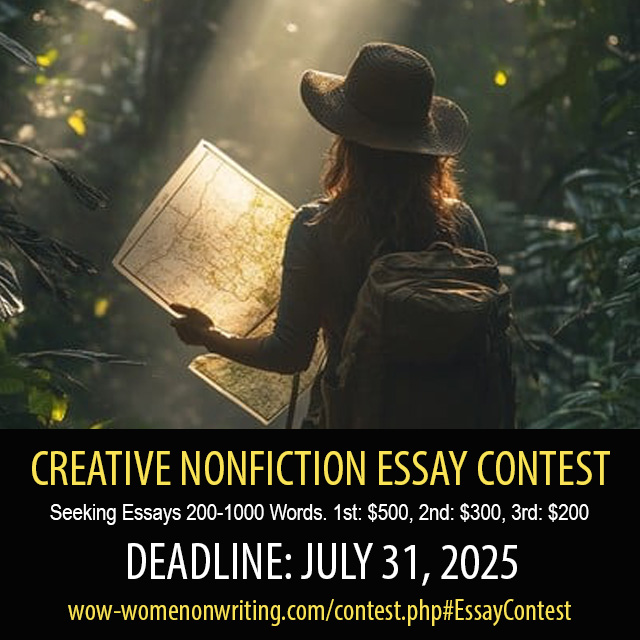
WOW! Women on Writing Quarterly Flash Fiction and Creative Nonfiction Contests
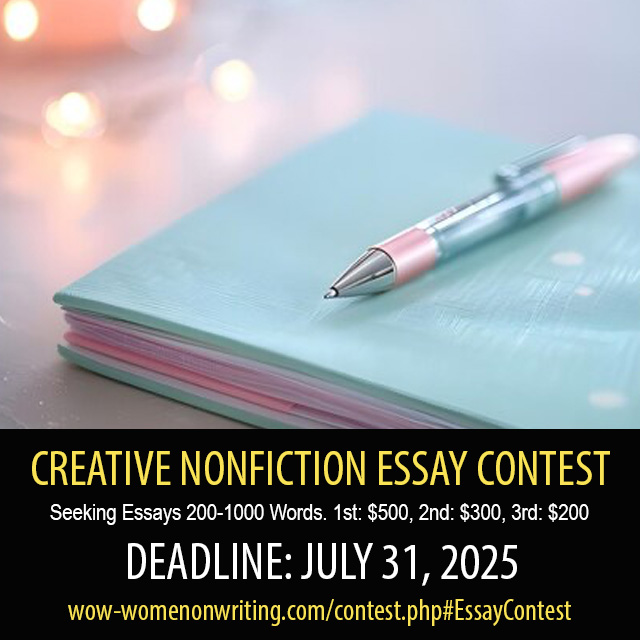
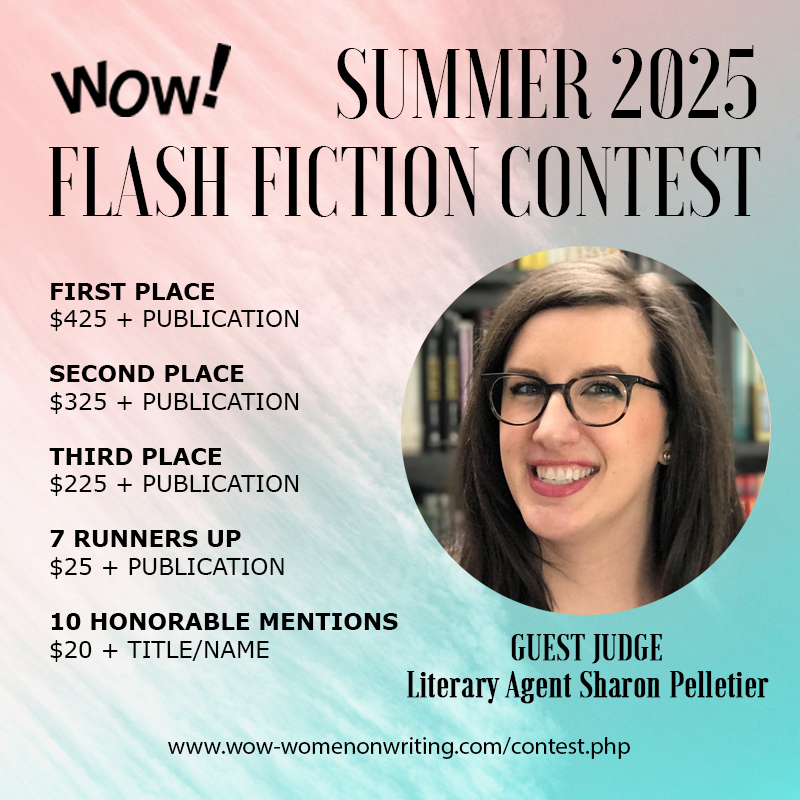
Deadlines: July 31 (nonfiction) and August 31 (fiction). Our favorite writing community offers quarterly contests judged blindly with multiple cash prizes and more for 20 winners, up to $1,350 (fiction) and $1,175 plus a gift certificate to CreateWriteNow (nonfiction), an affordable critique option, and a 300-entry limit on each contest. Previously published work is accepted! What’s not to love? This season's guest judge is Literary Agent Sharon Pelletier with DG&B. Fee: $10 (Flash Fiction) and $12 (Nonfiction).
https://www.wow-womenonwriting.com/contest.php
| | |
August is National Romance Awareness Month! Celebrate by submitting to Dreams Divine and Of Swords & Roses – Romantasy Series. Deadline: August 24. Flame Tree Publishing is seeking short stories for their brand-new Romantic Fantasy series, a paid market for new and established writers. They're looking for tales featuring strong-willed, independent leads who are resilient, perhaps flawed or possess hidden powers, secrets or royal bloodlines. Such protagonists would not be defined solely by their love interests but grow through emotionally charged journeys. Friendships and love interests might be brooding, mysterious or dangerously alluring. Relationships might emphasize deep emotional connections, with lyrical, romantic scenes central to each character’s arc. Submit stories of 2000-4000 words. Pay: $0.08 per word. No fee.
| | |
August 9 is National Book Lovers Day! Proclaim your love for your own book by submitting it to the Kindle Storyteller 2025 Award by August 31. First Prize is £20,000! The contest is open to writers publishing in English in any genre, who publish their work through Kindle Direct Publishing on Amazon UK. Readers play a significant role in selecting the winner, helped by a panel of judges including various book industry experts. You must make your book available for sale as an ebook and paperback through Amazon. To enter, add StorytellerUK2025 in your "keywords" metadata field when you publish your book on KDP Amazon UK. No fee.
| | An Inspirational Interview with Emma Sloley, Author of The Island of Last Things | | |
By Kelly Sgroi
Have you ever thought about where the world is heading? Sometimes, books seem to predict the future or come scarily close. Emma Sloley’s upcoming novel, The Island of Last Things (Flatiron Books, August 12), is one of those books, like 1984 or The Handmaid's Tale.
But what sets The Island of Last Things apart from the above-mentioned books is that humans are not the focus. In a not-so-distant future, when air quality is poor, money and power still reign, everything centers around animals. Camille is a keeper at the last zoo in the world—on Alcatraz Island. A glimpse of the last of a species is highly sought, and those who live to conserve and preserve the last animals are caged just the same—until a new zookeeper, Sailor, arrives from Paris. She might just bring hope or chaos to Camille’s “safety.” With prose constructed with care and heart, The Island of Last Things is a unique and unforgettable read!
So without further ado, let me introduce the author, Emma Sloley, who began her career as an editor at Harper’s BAZAAR Australia before moving to New York to become a freelance travel writer. Her short fiction and creative nonfiction have appeared in literary journals, such as Catapult, Literary Hub, The Common, Joyland, and The Masters Review Anthology. Her debut novel, Disaster’s Children (A Little Books, 2019), includes dystopian themes about a woman who must choose between her own survival and that of humankind. Emma’s short stories have received recognition in several contests, including a finalist in The Missouri Review’s Jeffrey E. Smith Editor’s Award.
Her travel writing has been read around the world in well-known, prestigious publications, such as Travel + Leisure, Conde Nast Traveler, Departures, Coastal Living, Gourmet Traveller, Virtuoso Life and New York magazine.
As an Australian, it gives me great pleasure to chat with such an accomplished Australian-born writer. Emma now divides her time between the United States, Mexico, and various airport lounges.
Please enjoy this interview—it’s inspiring!
| | |
WOW: Hi Emma, thanks for taking the time for this Q&A. I’m honored to interview you. The Island of Last Things is such a unique story. How did you come up with the premise?
Emma: Thanks so much, Kelly. I really appreciate your interest!
A couple of years ago, I jotted an idea down in my notes app: World’s last zoo? I didn’t do anything more with it right away. Much later, I was scrolling through the ideas list, and it caught my eye and lit my brain up with questions. Where would one locate the world’s last zoo? The obvious answer—to me at least—was an island. Somewhere difficult to reach, hard to breach, removed from the diseases and dangers of the mainland. Given the story already had the structure of a near-future world, I could have invented an island. But I wanted to make the story feel more grounded in reality, so I started thinking about islands in our world. Tahiti sprung to mind. Australia (more specifically, Tasmania). Some unpopulated Caribbean or South Pacific isle. It was inevitable I’d eventually consider one of the world’s most notorious islands, famous for keeping people in (and out)—Alcatraz.
I’d never visited before, and I made a point of doing so the next time I was in San Francisco. The moment I stepped foot on Alcatraz, I knew I had my setting. It’s such an atmospheric place, both sinister in purpose and spectacular in setting. It had already functioned as a prison for humans. How difficult would it be to imagine other species trapped there as well? I could feel it happening as I explored the spooky cell blocks, this dark alternate reality coming to life.
WOW: Tasmania would have been a cool choice, but I think Alcatraz is absolute perfection. The atmosphere your setting creates has the feel of Manderley from Rebecca with eyes that see all. You published your debut novel, Disaster’s Children, in 2019. Second novels are often said to be harder to write. How did you tackle writing The Island of Last Things?
Emma: In a way, I consider it a blessing that my debut largely flew under the radar, so I wasn’t burdened with unrealistic expectations around my sophomore novel! I know of authors whose debuts were a huge success and who felt paralyzed writing a worthy follow-up. I was also fortunate that between when Disaster’s Children came out and selling The Island of Last Things, genre blurring became very big. By that I mean, books that blend literary fiction and genre fiction–sci-fi, speculative, thrillers, etc. (I’ve also seen this sub-genre called “upmarket.”) I’ve been lucky to write books that publishers feel bridge that literary/commercial divide.
While the core idea—Alcatraz as the setting for the world’s last zoo and two keepers who attempt to smuggle an animal off the island—has always been there, the story went through many iterations over the course of the three years or so I was writing it. It started out as a fairly straightforward first-person narrative told from Camille’s point of view. The “Sailor” sections came later, and it was only when I began writing her part that the story fully came together for me.
| | “Because I’ve lived across several cities and countries and time zones and traveled a ton for work, my relationship to the idea of home is very complicated. That definitely seeps into my writing—I think every protagonist I’ve ever written has been searching for home in some way.” | | | |
WOW: Sailor is such an important character. It just goes to show how stories are clay, and edits are paramount. You began your career in Australia as an editor at Harper’s BAZAAR and went on to work as a travel journalist. How have these experiences and locations impacted you as a writer?
Emma: My experience at BAZAAR was so formative in my journey as a writer. Even though I ended up in fiction rather than fashion magazines, my time there was absolutely invaluable in honing my writing and editing skills. It taught me to self-edit, a skill I think is vital for writers in today’s challenging publishing landscape. (More on that later.) And it made me a maniac for meeting deadlines, which is why I’m all my editors’ favorite writer, lol.
As for travel writing, because I’ve lived across several cities and countries and time zones and traveled a ton for work, my relationship to the idea of home is very complicated. That definitely seeps into my writing—I think every protagonist I’ve ever written has been searching for home in some way.
WOW: I love the concept that every protagonist is searching for home. The word home holds as much weight as the word happiness—it’s importantly complicated. You’ve had some pretty huge literary wins, including placing short stories in well-known literary journals, receiving the MacDowell Fellowship, and attending the exclusive Bread Loaf Environmental Writers Conference. Can you talk me through these major stepping stones in your writing career?
Emma: Oh, that’s sweet. I feel incredibly fortunate to have been published quite widely in a variety of literary journals I greatly admire, as well as being awarded those prestigious fellowships. MacDowell, especially, was a turning point in my writing career. It gave me permission to take myself and my work seriously and to be in cohort with some of the most talented artists working today. I’m so grateful for these vital institutions, and I wish there were more of these opportunities, especially for emerging writers.
WOW: It would be amazing if there were more opportunities for emerging writers! Let’s talk about getting those all-important yeses. How did you become an author?
Emma: My publishing journey has been a bit of a Goldilocks tale. I’ve had three literary agents, all New York-based: the first, who went on to sell my first book, decided to leave publishing shortly before my book launched. I signed with a second agent with whom I parted amicably two years later without ever going on submission, and now I’m with my third agent, a dynamo and superstar who signed me and very quickly found the perfect home for The Island of Last Things. So, much like a (non-Grimm Brothers) fairy tale, it all ended happily!
I don’t have an MFA, and I didn’t have any industry contacts when I began querying. There really aren’t shortcuts in this business, despite what our AI-pushing overlords want people to believe. The best and almost only way to get traditionally published is to write the very best book you can and send out cold queries to agents until you find someone who loves your book and wants to represent you. That’s it—incredibly difficult and incredibly simple at the same time.
| | “I don’t have an MFA, and I didn’t have any industry contacts when I began querying. There really aren’t shortcuts in this business ... The best and almost only way to get traditionally published is to write the very best book you can and send out cold queries to agents until you find someone who loves your book and wants to represent you.” | | | |
WOW: This is so inspiring for someone who has learned the craft of writing on their kitchen table while raising kids. And I’m going to quote Chuck Palahniuk here, “My education consists of a kitchen-table MFA.” There’s nothing like celebrating a publishing win, but I believe it’s even more important to talk about what came before. Can you share a rejection story?
Emma: I mean, how much time do you have?! There’s a saying in this industry that the only difference between a successful writer and a failed writer is perseverance. I’ve been rejected countless times by journals, contests, literary agents, publishers, residencies, and fellowships, and even though a couple of those nos were devastating at the time, I dusted myself off and kept going.
I think it’s also important for more established writers to talk about how even once you’re in the room, as it were—getting published by a big traditional house, winning awards, racking up accolades—there is still a ton of rejection. Even when your career is thriving, there are fallow times when no one seems to be interested in what you have to say. Get used to writing into the silence, I say! That’s where the magic happens.
WOW: Yes! I wish more published authors talked about the ongoing rejections they face so that we may all find happiness in the magical right now. What does your typical day of writing look like now?
Emma: I work from home (which is in Southern California, currently). I’m fairly disciplined. I get up around 7 a.m., do yoga, have breakfast, talk nonsense with my delightful writer husband Adam, and then start work. I write at our dining table. We still travel a lot, and I’ve had to become adept at working anywhere and in any kind of jetlagged state, so nothing really phases me. At home, we both work a fairly standard workday, around 9 a.m. - 6 p.m. most days, with breaks for lunch and doomscrolling. All that time isn’t spent writing, of course. Depending what stage I’m at in a project, I might be working on an outline, doing copyedits, researching, or as is the case at the moment, dealing with publicity and marketing efforts for my upcoming release.
WOW: Working from home is the best! I’ve noted an abundant amount of great writing in The Island of Last Things. Did you make a conscious effort to, for example, pick impactful verbs, and if so, at what point of the process did you craft those noteworthy sentences?
Emma: Thank you, that’s lovely to hear. Language is so important to me, as both a writer and a reader. Beyond a compelling story, it’s probably the single most important factor in whether I end up loving a book. I don’t mean just beautiful sentence-level writing, but writing that deploys description and metaphor and interiority in ways that resonate deeply with the reader. Not to get all Hemingway about it, but the insights should feel true—like I should understand more about the world after having read a great scene—not just the world of the story, but the world as we live in it and experience it. If I have a North Star in my process, that would be it.
| | “Revise like the life of your book depends on it. (Because it does.) Get feedback from trusted beta readers, find a writer’s group where you can critique one another’s work, and seek out a literary community. When you think you’ve gone as far as you can with your book, do another pass.” | | | |
WOW: What you have achieved with this novel affects the reader deeply. What’s your top tip for aspiring authors?
Emma: Make sure your manuscript is in the most polished state possible before sending it out. Agents and editors are really overworked, and these days, they tend to be looking for manuscripts that are already in great shape. Revise like the life of your book depends on it. (Because it does.) Get feedback from trusted beta readers, find a writer’s group where you can critique one another’s work, and seek out a literary community. When you think you’ve gone as far as you can with your book, do another pass.
Also, I know a lot of new writers stress about having a platform and lots of followers, etc., but I’d definitely advise doing only what you’re comfortable with in the social media arena. It can be fun and occasionally even useful (I’ve made some great writing contacts on social media, and I think the Bookstagram/BookTok community has been a huge boon for authors in getting people excited about reading again), but as we all know, these platforms can also be extremely toxic and anxiety-inducing. The thing you have the most control over—maybe the only real control over—is the quality of your book.
WOW: Great advice! Okay, last question! Post-COVID, I’m seeing a lot more climate fiction being published. I feel like this novel is timely and dark, forcing us to consider some serious points such as, “There’s a lot of country between what you want to be true and how the world is.” What’s the most important message you hope readers will get from this novel?
Emma: I hope it sparks debate about our complicated relationship with animals and the natural world. Look, I don’t think this is a political book, but the fact remains we are alive in a time of dystopia, when our planet and the living beings that depend upon it are under attack in so many ways. We need to protect our wild spaces, our right to breathable air and drinkable water, and our right to live joyful and free lives. And if Camille and Sailor’s story helps people think about what role they want to play in fighting for those things, that would be humbling and wonderful.
WOW: Amazing! Thank you so much for taking the time to answer my questions.
Emma: Thanks so much for inviting me!
| | |
My thanks to Emma Sloley. It’s been an absolute pleasure to chat and talk about writing. I’m inspired to edit my manuscript into a thing of beauty and then get back in the query trenches, seeking a new agent!
To find out more about The Island of Last Things, visit the publisher’s website, or purchase a copy from Amazon or Bookshop.org. And follow Emma via socials.
| | |
Kelly Sgroi is based in Melbourne, Australia. While preparing her next manuscript for submission, Kelly regularly interviews authors, runs @WriteTillChristmas, and contributes to WOW! Women on Writing. To find out more about Kelly visit www.kellysgroi.com.
| | |
Landing Your Dream Interview:
Making Friends with the Gatekeepers
| | |
By Jodi M. Webb
After a marathon middle-of-the-night reading session of Jesse Q. Sutanto’s book Vera Wong’s Unsolicited Advice for Murderers, I was in love. In fangirl mode, I visited her website to sleuth out any other titles to add to my TBR list. While I was snooping around, I noticed her contact page included her publicist’s email and the words, “For media inquiries and interviews…”
I should interview her!
I even had the perfect market—the book’s main character owns a tea shop, and I write for a magazine called Tea Journey. It was a sign! Except I was, well...nobody. Would someone with a dozen books to their name agree to an interview with me? Ignoring my self-doubt, I got the okay from my Tea Journey editor, crafted an email, and sent it off. To my utter amazement, her publicist agreed to the interview, the article was written, and I started wondering, “How can writers improve their chances of landing that dream interview?”
I reached out to several publicists* for celebrities, politicians, scientists, CEOs, academics, and other industry leaders for tips on how writers can gain access to their dream subject!
| | |
“Show us why this story matters, why you’re reaching out to this celebrity, and what they’ll get out of it.” —Sarah Schmidt, president, Interdependence
| | |
Never forget that celebrities and experts want to share their stories. But they don’t want just any interview. A specific angle or topic is more attractive than a vague request to chat. Do you want to talk about a new development in their field? Their charitable foundation? Their love of gardening? Sarah Schmidt, president of the PR and strategic communications firm Interdependence, advises writers to “show us why this story matters, why you’re reaching out to this celebrity, and what they’ll get out of it.”
Another factor is where the interview will be published. Share information about the market’s reach. Even if your market doesn’t have name recognition or UVMs (unique views per month), some clients are willing to work with markets that have active social media. If your market isn’t well known or is not the subject’s usual audience, connect the dots to why the subject should be in this market. For instance, a publicist might think a Pennsylvania regional magazine isn’t a good fit for a Hollywood star who grew up in New Jersey—until you point out that a Pennsylvania town hosts a festival celebrating one of their movies.
Be sure to give specific, but achievable, deadlines as well as formats for the interview. It helps to be flexible to a subject’s preference for in person, telephone, virtual, or email.
| | |
“Transparency builds trust. And trust makes us far more likely to advocate for our client’s participation.” —Taylor Murray, account manager, Interdependence
| | |
It’s tempting to make your offer seem irresistible by promising publication in a well-known market, plumping up audience numbers, or making yourself seem more experienced. Resist the temptation. It helps to think of this as a job interview (which it is). Publicists will check you out before letting you anywhere near their clients. Lies or exaggerations guarantee that you won’t secure the interview. If you’re writing on spec or are still in the planning stages, tell the publicist. You’ll get points for honesty and possibly access to the person. “Transparency builds trust,” says Taylor Murray, account manager at Interdependence. “And trust makes us far more likely to advocate for our client’s participation.”
Also keep in mind that they expect you to stick to your promises. You can’t ask for a fifteen-minute interview and then try to expand it to two hours. You can’t promise to talk about the star’s latest movie and then switch to their latest romantic disaster. Publicists are like a guard for their clients and most likely will be at the interview, ready to jump in if you steer the discussion away from the agreed upon parameters.
| | |
First, a publicist wants to know about the type of article you’re planning. Second, they want to know about you! After all, they’re trusting you with their client’s reputation.
A connection can push you into the category of trusted journalist. Connections can take many forms: an interview with another one of their clients, a recommendation from a fellow publicist, or a track record of writing about the client’s field. Freelancers should include links to an online portfolio, social media, or website to familiarize the gatekeepers with their work.
Once you finalize that first interview and publish it, take steps to cultivate your relationship with the publicist. Follow up with links to the published work and if possible, a pitch for another client on their roster.
| | |
“Short and sweet. Get your point across fast.” —Kathleen Aldworth Foster
| | Tips for your first contact with a publicist: | |
- Remember the hundreds of pitches piling up in the publicist’s inbox, and show you value their time. Kathleen Aldworth Foster, who heads her own PR firm Kathleen Aldworth Foster Media, wants an initial email that is “Short and sweet. Get your point across fast.”
- Make sure to include specific details: hook, market, and deadline, and be prepared to offer more (like interview questions) immediately if asked.
- Instead of a formal business-like pitch, let your personality and enthusiasm for the topic shine. Publicists want a personal pitch written by you, not AI.
- Make it easy to say yes. Fifteen minutes or a written quote on a specific topic or question are easier to arrange than a request for a 45- minute interview.
- Find the correct contact person and the correct format. Preferences can be email, WhatsApp, or Signal.
Personally, the thing that always held me back from pitching “big names” was the infamous imposter syndrome. I’m trying to change my mindset after several publicists told me that even celebrities have some degree of imposter syndrome.
It’s time to stop thinking of celebrities and experts as doing us a favor and summon the confidence to recognize that writers also bring something to the table. “We’re not just looking for press. We’re looking for the right stories that help our clients build a meaningful narrative,” says Sarah Schmidt. “When you make it clear you’re thinking that way too, it’s no longer just a request. It’s a partnership.”
| | |
***
*For this article, I consulted Lindsey Chastain of The Writing Detective; Kathleen Aldworth Foster of Kathleen Aldworth Foster Media; Taylor Murray, Sarah Schmidt, and Julie Ferris-Tillman of Interdependence Public Relations; Annmarie Pisano of Pisano-Slater Enterprises; and Esabel Sadek of Indigo PR.
| | |
Jodi M. Webb writes from her home in the Pennsylvania mountains. She has bylines in Bob Vila, Pennsylvania Magazine, Tea Journey, Mental Floss, Business Insider, NPR, Woods Reader, and a WIP about her plant obsession. She's also a blog tour manager for WOW! Women on Writing. Visit her website at jodiwebbwriter.com.
| | |
Is it Time to Reevaluate Your Goals?
By Sue Bradford Edwards
“I’ve been in a writing funk.”
“I just can’t get anywhere with my fiction.”
“I haven’t written in weeks.”
Writing friends and writers on social media have been making statements like these. Everyone seems to be in the doldrums. I know that I haven’t made any progress on the nonfiction proposal that was my primary writing goal for the year.
What’s the reason? It is easy to blame politics. Or the economy. But any change can be unbalancing. We have a family wedding in less than a month. I’m not the principal organizer but I am working on several wedding-related projects. And updating the kitchen. And digitizing a library catalogue. And I’ve got contracted projects.
READ MORE
| | |
Bring Forward the Bits and Pieces of Your Creative Nonfiction
By Nicole Pyles
Over the weekend, I had an opportunity to sit down and read through a short story draft of mine. It had lingered in the archives of my Google Drive folder for a couple of years before I retrieved it. Only recently, in an attempt to get myself digitally organized, did I even find it.
At first, when I read through it, I thought, "Well, it needs work."
I'm no stranger to the revision process. Once you get started, you can begin to get into the groove and make improvements.
For this story, though, I couldn't get myself going. Finally, I asked myself, "What about this story do I not like?"
READ MORE
| | |
Getting the Words on the Page
By Renee Roberson
While attending a cookout a few weekends ago, a friend introduced me to one of her acquaintances. When this woman found out I was a writer, her eyes opened wide.
“I would love to do that!” she said. “I have so many ideas . . .”
We chatted for a few more minutes about what types of writing I do. She mentioned trying to join a local writing group she found years ago online. But when she got to the restaurant where they were all meeting, she said all the women there worked in the industry, either in a freelance capacity or working on staff at local news outlets. She said she felt intimidated because she hadn’t published anything and slunk away that evening, vowing never to return. She mentioned all the Post-It notes she has scattered around her house, thoughts that tumble out of her head and onto the tiny pieces of paper.
But from what I gathered, this woman (who is several years older than me) hasn’t completed anything. She didn’t mention any essays, poems, or short stories. Just her ideas.
READ MORE
| | |
The 15 Minute Plan
By Jodi Webb
Need some inspirational words to help prod you along in your writing career? I know them! Not only do I know them but I’m willing to share them with you today. So, hold on to your hat!
You. Will. Not. Live. Forever.
It’s true. No matter if you’re 25 or 75, somewhere in the back of your brain you're saying, “It’s OK, I have time.” It’s time to start answering back, “Yes, but not an infinite amount of time.” This revelation came to me when, while interviewing a small publisher for an article, she prodded me to send my manuscript and I shrugged her off until she said, "Are you going to wait fifteen years to send it out?"
READ MORE
| | |
By Margo L. Dill
It’s very hard for creative people to define success. I’ve written about this concept in blog posts and in this column. Success means different things to different people, but creatives, especially writers, have a difficult time stating, “I’ve had success!” Even if their bios are full of publications, contest wins, blogs and speaking gigs. Putting this column together a few times a year made me realize that writers want to share what they’re working on. They want to share publications and contest wins—but not if they’re asked: “What is your success story?”
So I’ve started asking the question on social media in a different way. This month I asked various forms of: What have you been up to? What’s going on in your #writinglife? The answers are below, including a traditional success story emailed to me. (Please—email margolynndill@gmail.com and cc margo@wow-womenonwriting.com with Success Story in the subject line.) You’ll notice that every single one of these answers to the question of “What’s going on?” is a success. People are writing. They are submitting. They are winning contests. They are finding publishers.
It's often crickets when I ask the WOW! community to share their success stories. We celebrate every single success here—however you define it. If you’re managing to submit a flash fiction piece while you’re also raising your three children under the age of five at home—every single person on here (parents or not) will tell you: THIS IS A SUCCESS! I could go through a million of these scenarios, and the WOW! community will agree these stores are to be celebrated—they’ll have your back. Celebrate with these writers below, and please share your own success on our posts and in email!
Email
Marcia Yudkin writes, "Flash Boulevard published two short and surprising creative nonfiction essays by me about my wanderings where I live in the woods of New England": https://flashboulevard.wordpress.com/2025/05/24/marcia-yudkin-now-you-see-it/
Facebook
Jenn Flynn Shon writes, “My next snarky essay collection! The first, titled You Classy Beach, came out last year (paperback only). It documents my life’s ridiculousness on various beaches around the world. The next is still untitled but is an accounting of how pop culture raised me to be the mouthy, sassy, witty delight I am today. Due out fall 2026.”
Andrea L. Kassner writes, “A character build-up of Civil War Sargent Gabriel Wharton. It's coming along nicely. Looks at the man, his views of the war, his family and one particular general.”
Elle Mott writes, “My next book! It’s in the publisher's hands and we will be releasing it early next year: Marie Conner, A Leading Lady. This historical biography is the true story of her life and civic leadership in a bygone era. I have been up to putting a book together for those who love reading historical stories, which bear a strong female leading character.
It is about a woman, Marie Conner, who in the mid-twentieth century was well known in her small American town for the many causes she spearheaded to help others. She wants nothing in return other than her father's acceptance as a worthy woman, and yet, she gains much in return, even if it is not her father's praise. This book is Marie’s story—of a rise from her girlhood angsts to become a leading lady—and much more.”
Lynn Nicholas writes, “Reviving and revising a piece of flash fiction from a couple of years ago. Inspired by a Zoom class sponsored by Flash Fiction Magazine.”
Instagram
@bernadettegeyer writes, “An application for a residency!”
@1writerslife writes, “I'm editing the third book in my Caines Island series. Release expected mid-September.”
@theunicornwriter93 writes, “I don’t know how to pick just one! I have a YA noblebright fantasy, The Goodness of Unicorns, releasing in October, and I also have a children’s picture book releasing in the next few months (exact day TBA, but likely early 2026). And I have a short story releasing with @twenty_hills in November, another novel with an editor, and I have two middle-grae WIPs and one YA WIP.”
@mytop5ofeverything writes, “Being 65 - a year in my life!”
@gwalanilata writes, “Hello! I am doing the final touches to my memoir-cookbook that has already found a home with a publisher. It's my fifth published work, and I am super excited. Meanwhile, I am nearing the completion of the first draft of Book One of a trilogy. Loads of work!
@winslow_writing writes, “I had an essay, ‘Collage,’ published in the Summer 2025 issue of @thimblelitmag.”
| | | | |