Rail & Labor News from RWU
| | Weekly Digest Number 41 - October 13, 2026 | | Welcome to the RWU Rail & Labor News! This news bulletin is produced and emailed out each Tuesday morning. We hope you find each week's news and information useful. If so, please share with co-workers, friends, and colleagues. If you like, you can sign them up to get all the news from RWU HERE. Or forward them the link. Got a hot tip? Please forward the article and a link to raillabornews@gmail.com. Note: If you read over this news bulletin each week, you will be sure to never miss the important news of what is going on in the railroad world from a worker's perspective! | | THIS WEEK'S RAIL AND LABOR NEWS | | Editor's Note: For those keeping score, we now have 7 unions - BLET, BMWED, IAM, BRS, TWU, TCU and IBEW - opposing the UP-NS merger and 5 unions - SMART-TD and MD, ATDA, NCFO, IBBO, and BRC "in support." The unions allied against the merger however represent about 70% of rail labor while those in support represent just 30%, the lion's share of this held by one union, SMART-TD. Whatever the case, how absurd that rail labor cannot ever speak with one voice. divided as it is and always weakened by the outdated archaic craft union system. Obviously, it is high time for a single, united, and powerful railroad workers union! | | |
Progressive Railroading / October 7th
The International Brotherhood of Electrical Workers (IBEW) has stated its opposition to the proposed Union Pacific Railroad-Norfolk Southern Railway merger following unsuccessful conversations with UP about worker protections.
"The IBEW engaged Union Pacific in good-faith discussions designed to protect IBEW members, preserve craft jurisdiction, prevent forced relocations, address contracting and subcontracting and provide stability for workers who have dedicated their careers to the railroad industry," IBEW officials said in a statement, adding that UP "declined to make meaningful commitments," on significant issues.
The union represents more than 10,000 members who install, maintain, inspect and repair electrical aspects of the U.S. railroad industry, including locomotives, communication networks, train control technology and other infrastructure.
| | Editor's Note: A conductor was killed doing ordinary railroad work in a place the NTSB said was so constrained that accidentally fouling the main track was a foreseeable danger. He did not need another slogan about situational awareness; he needed a rule that protected him from a live track while he did the work the railroad required of him. The industry has spent generations teaching workers that every injury begins with something they should have done differently, yet here the NTSB found the missing protection in the system itself. When a worker dies because the safeguards were never required, calling railroad work “inherently dangerous” is not an explanation. It is an excuse. | |
|
Trains Magazine / October 6th
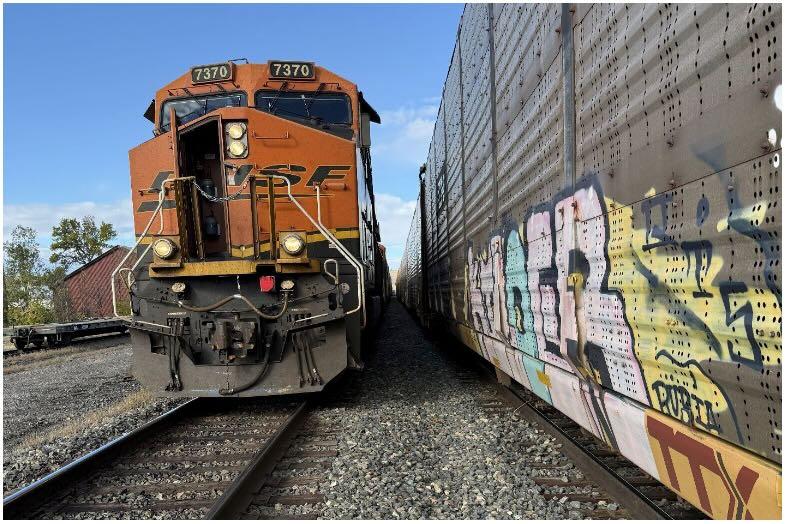
A lack of a requirement to establish on-track safety while releasing brakes on a parked train, coupled with an inadequate safety briefing about the hazards of the work location, played a part in the October 2025 death of a BNSF conductor, the National Transportation Safety Board said in its final investigation report.
The conductor was struck by a passing train on Oct. 19, 2025, at a location in Columbus, Mont., where the NTSB said “it would be difficult to work without accidentally fouling the main track.”
The conductor and an engineer had been assigned to operate a westbound manifest freight parked in the siding at Columbus. At about 9:32 a.m., while the conductor was in the process of releasing hand brakes, he stepped into the adjacent main track and was struck by an eastbound empty grain train. The engineer of the approaching grain train saw the conductor as he approached, sounded his horn, and initiated an emergency brake application, while also trying to reach the conductor on his radio.
| |
| Editor's Note: A railroad worker should not have to choose between telling the government the truth and protecting the job that feeds their family. Yet when workers believe their names attached to a public filing may invite retaliation, silence becomes another advantage enjoyed by the corporations whose conduct is supposedly under review. A merger proceeding cannot claim to measure the public interest while the people who know the railroad best are afraid to speak plainly about what they have seen. If anonymity is what it takes to get the truth into the record, then the greater scandal is that railroaders believe they need it. | |
|
Public Rail Now
We understand that some railroaders may need or want to submit their comment confidentially and with anonymity during the public comments process to the STB. Trust in government agencies has been shattered. While the STB website offers a contact within the Department of Justice to receive anonymous comments, we cannot assume names would remain confidential.
As a Party of Record, Public Rail Now will submit comments on behalf of railroaders that wish to remain anonymous. Please submit your comment, questions or concerns to info@publicrailnow.org.
With the advancement of AI being used to comb through comments, we suggest using the comment prompts below as a starting point to draft a more personalized comment about how this merger will impact you and your community. The most useful comments are specific, not general statements of support or opposition. Where possible, include: (1) the specific rail line, corridor, or facility affected; (2) how you or your community interact with it today (shipping volume, commute, proximity to tracks, emergency access); (3) what you expect to change and why; (4) any direct experience with service quality, delays, or safety issues. Please write in your own words — comments that closely mirror each other carry less weight with the Board.
| |
| The Rail Story / September 16th | | Editor's Note: This is a giant step forward for Amtrak. Not only will these trains replace aging equipment that is long past its prime, the trains will be equipped to run under catenary as well as diesel propulsion. While Amtrak continues to face endless problems - particularly the hostility of its "host" Class One freight carriers, these new passenger cars will usher in a new era of passenger comfort, space and new demand, contributing to the call for ew routes, more frequencies, and by extension, good union jobs. | |
Railway Age / September 30th
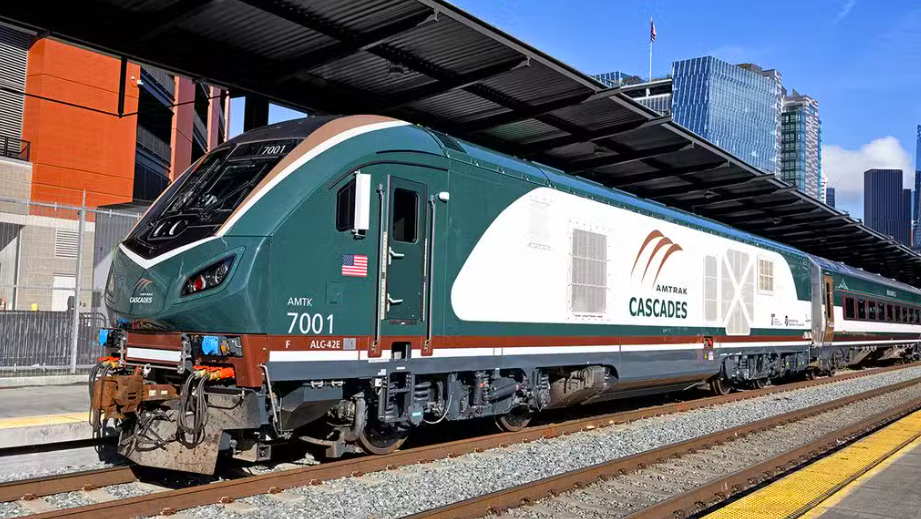
On Sept. 30, two Airo trainsets are expected to enter regular service operating four daily trips between Eugene, Ore., and Vancouver, B.C., and in the coming year, six additional trainsets will be added to the route. Starting in 2027, the Airo trainsets will also begin operating in the East, eventually running on regional routes from Maine to Georgia.
While the trainsets entering service on the Cascades are diesel-powered, future Airo trainsets will also run off AC catenary or batteries, depending on the service. The bi-directional Cascades trains operate with a locomotive on one end (a Siemens ALC-42E) and a cab car on the other. Siemens is manufacturing the equipment in California and North Carolina, with components coming from nearly 100 suppliers in 31 different U.S. states.
The weekend before the trains entered regular service, Amtrak hosted a preview run on Sept. 26 for the media and VIPs between Everett, Wash., and Eugene, Ore., and held public displays in Portland and Seattle on Sept. 27. “This is all part of a transformation at Amtrak,” Interim Amtrak President Byl Herrmann said during a press conference at Seattle’s King Street Station on Sept. 26. “We want to create a more modern and comfortable experience for our passengers, from the moment they open our app to buy a ticket until they reach their final destination.”
| | Editor's Note: One cannot help but see the irony here. When Amtrak - national in scope, with perhaps 20,000 route miles and 500 stations - has to fight for its very existence, the private company Brightline (on the verge of bankruptcy, BTW) - with a few hundred route miles and a handful of stations - gets nearly half a billion! True, that the FRA regularly doles out grants to states to fix a handful of crossings. In this case, 910! Amtrak is public and Brightline private. Withdraw funds from a public rail effort in California and deliver them to a private effort in Florida. Could this seemingly strange generosity be ideologically and politically driven? | |
Progressive Railroading / October 7th
The Federal Railroad Administration (FRA) has designated $416 million in federal funds for grade-crossing safety upgrades and the construction of a new Brightline station in Florida.
The funding package consists of a $356 million award to the Florida Department of Transportation (FDOT) to deploy new signage, lighting and physical barriers at 910 grade crossings; and a $57 million award to the city of Cocoa, Florida, to build a new Brightline commuter-rail station, a multi-use access road and a new segment of double track. The state of Florida will provide $100 million to help fund the projects.
"This new station will make it easier for people to travel to and from the Space Coast while supporting our growing community," said U.S. Rep. Mike Haridopolos (R-Fla.). "It is expected to have up to a $350 million annual economic impact and support 3,500 jobs, bringing even more opportunity to our region."
| | Editor's Note: Sometimes the most damning witness against a system is the person it once paid to defend it, and Ryan Wilkins spent years defending Union Pacific against railroaders who claimed they were punished for speaking up about safety before alleging that the same machinery of retaliation was eventually turned on him. His claims remain for a court to decide, but there is something deeply rotten in a corporate culture where questioning unsafe practices can allegedly threaten the career of even the lawyer who knew the whistleblower law from the inside. Union Pacific is now asking the nation to entrust it with an even larger railroad, while a former member of its own law department is telling the public to look closely at what happened when PSR, safety metrics and human beings collided. Before this company is handed more power, the country has every right to examine what it did with the power it already had. | |
|
Public Rail Now / October 4th
Ryan Wilkins worked in Union Pacific’s law department from 2014 to 2019. He led the railroad’s Federal Railroad Safety Act (FRSA) team. Now he is the plaintiff in a federal whistleblower lawsuit in Nebraska, alleging UP retaliated against him for opposing practices he believed violated that same law, including practices tied to Precision Scheduled Railroading (PSR).
His account carries weight at a critical moment. UP’s proposed merger with Norfolk Southern would create what the company calls the first transcontinental railroad in the country, and the Surface Transportation Board has not yet ruled on it.
Wilkins’s statement describes what he saw as UP’s safety record before and after PSR, and what happened to the workers who paid for it. We are publishing it in full, with his permission. The views and claims in it are his.
| |
|
Stop The Rail Merger / October 5th
Union Pacific and Norfolk Southern are claiming a “majority of unions” representing their employees support their proposed merger. The facts show otherwise: unions representing nearly two-thirds of the unionized workforce oppose it.
As of August 2026, the six unions opposing the merger, BLET, BMWED, BRS, IAM, TCU/IAM and TWU, represent 26,402 of the 39,828 unionized workers, or 66.29 percent.
“Union Pacific and Norfolk Southern have repeatedly been caught attempting to mislead regulators, elected officials, and the public,” said Stop the Rail Merger Coalition. “First, they attempted to hide numbers showing job losses and mischaracterized the positions of farmers. Now, they are trumpeting ‘majority’ union support while leaving out the inconvenient fact that unions representing two-thirds of their unionized workforce oppose the merger.”
| |
|
Trains Magazine / October 7th
A state official has provided information on the cause of two Norfolk Southern derailments that occurred just hours apart on Oct. 1.
WBMA-TV reports that Amanda Sheehan, director of the Alabama Public Service Commission’s Transportation Division, provided details on the derailments in Springville and Maplesville, Ala., at a Tuesday, Oct. 6 commission meeting.
In the Springville incident, two locomotives and 34 cars derailed after a grade-crossing collision [see “Norfolk Southern derailment in Alabama …,” Trains.com, Oct. 1, 2026]. That led to an evacuation order for several hours, although no hazardous materials were released.
| | NEWS FROM AROUND THE LABOR MOVEMENT | | Each week, RWU includes a few articles about advances and developments in the larger labor movement that are of interest to railroad workers. Got an artcile to submit for possible inclusion next week? Email it along to raillabornews@gmail.com. Thank you! | | Editor's Note: Want to sharpen your communication skills? Want to win over co-workers to organize and fight back? This series of workshops sponsored by our good friends at Labor Notes is for you! | |
Labor Notes / Series starts on October 26th
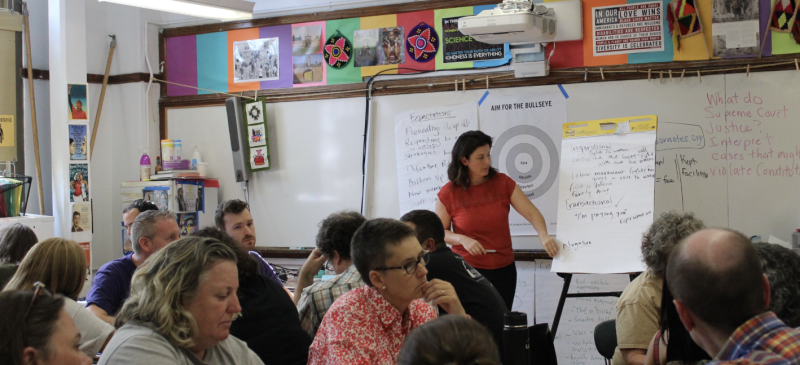
You've been talking to your co-workers, and they say they feel overworked, underpaid, and increasingly pressured by productivity quotas and the ever present threat of discipline. How do you fight for better?
Secrets of a Successful Organizer is Labor Notes' core organizing training, in three sessions full of lively participatory exercises. We welcome first-timers and repeat attendees looking to sharpen their skills.
These workshops are based on our widely acclaimed book Secrets of a Successful Organizer. These trainings will be held via Zoom.
When: Mondays, October 26, November 2 & 9
Time: 7 p.m. to 9 p.m. Eastern / 4 p.m. to 6 p.m. Pacific
Cost: $15 for the whole series. Includes access to all three sessions.
No one will be turned away due to lack of funds.
| |
Payday Report / October 6th
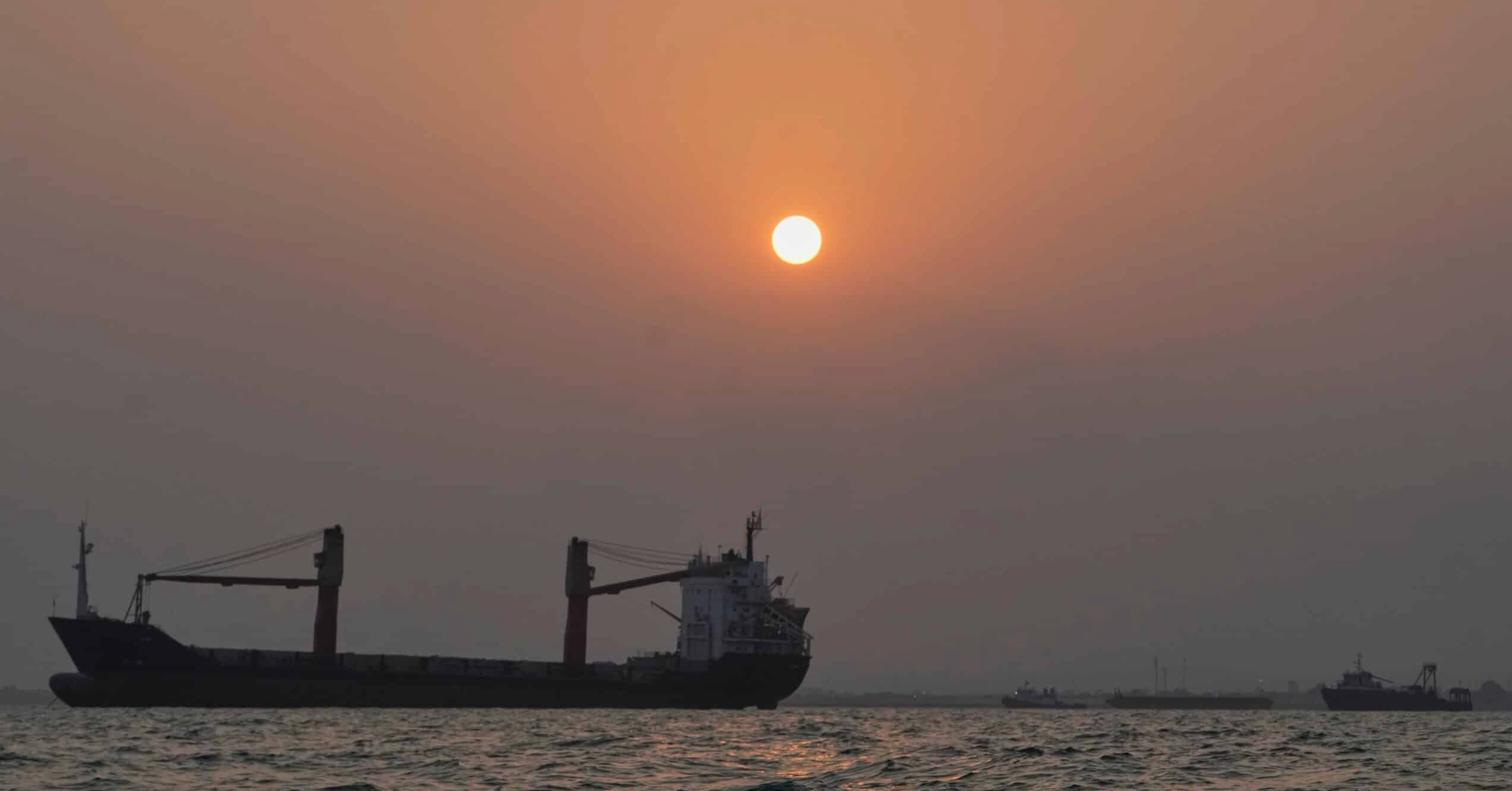
On Aug. 3, the Greek-owned, Liberian-flagged oil tanker Minoan Pioneer was hit by an Iranian drone 20 miles north of Oman in the Strait of Hormuz. As the ship’s crew struggled to put out a massive fire, the captain sent out calls for help, but none arrived and the sailors were forced to abandon ship. Three Indian crew members were killed, making it the deadliest shipping attack since the start of the U.S. war with Iran.
In total, at least 17 commercial sailors have been killed in the Strait of Hormuz since the U.S. began hostilities in February. Nearly half of the fatalities have been low-wage sailors from India whose contracts do not allow them the freedom to decline jobs that ply dangerous wartime routes.
“It is like putting somebody in prison and not giving them freedom to move,” Savio Ramos, general secretary of the Maritime Union of India, told The Guardian in August.
| | WEEKLY DERAILMENT DEPARTMENT | | Each Tuesday in this news bulletin, RWU does our best to present a picture of what has been happening over the course of the previous week in terms of derailments in North America, and investigation determinations of previous accidents. NOTE: This list is by no means comprehensive. Smaller and less consequential mishaps are generally not reported here. If the wreck results in injury or fatality, or is especially damaging/extreme, a full article will appear as a feature in the dozen or so rail articles above. Know of a train wreck? Please feel free to forward a link to raillabornews@gmail.com for possible inclusion next week. Thanks! |
| | | |