|
|
Spotlight on
Jackey LaBossiere
|
|
Person living with myeloma, Support Group Leader, Advocate
(Winnipeg, MB)
|
|
Editor’s Note
:
In celebration of our 15
th
Anniversary, the Spotlight section of Myeloma Matters has changed slightly. This year, our Spotlight Stars have been asked to share their stories alongside their relationship and involvement with Myeloma Canada. We hope you enjoy meeting our 2020 Spotlight Stars and that the new format provides you with information you didn’t know before.
To all of you who have shared your stories in the past, and those of you who continue to do so today, we are indebted...you are an inspiration.
|
|
Jackey, how did Myeloma Canada come into your life?
|
|
|
|
I was diagnosed with myeloma in 2016 when I was 64 years old. I had feelings of solitude and that I was alone. I reached out to Myeloma Canada in April 2018 and we discussed the need for a support group in Winnipeg.
Myeloma Canada has a wonderful guide for Support Group leaders and we were able to form a group in April of 2018. It was quite successful and in May 2018, I soloed my first meeting.
|
|
How is myeloma impacting your life?
After my diagnosis in 2016, I had a stem cell transplant and that does impede your energy. There is no planning, you go day-by-day. I’m not a big bucket list person and 3 ½ years into my diagnosis, I still hesitate to do any long-term planning because it’s such an up and down road that you’re on.
[
Having myeloma] does come with some benefits because it shows you who and what things are important to you. The disease kind of gives you the freedom to choose. There are so many things that we do because we feel pressured to attend, or someone says you should, and now I don’t have that. I know my family is the most important, which of my friends mean the world to me, and what kind of happiness I get out of daily activities. I have realized that it’s all the small things in life that make the difference.
|
|
In what ways has Myeloma Canada helped you through your myeloma journey?
|
Myeloma Canada has been a beacon of light that we all need. Myeloma isn’t what I would classify as a “popular” cancer. I don’t mean that in a derogatory way, just that not many people know about it. Having an organization that is fully devoted to myeloma research, information, advocacy and medication, gives patients a sense of balance and hope that there is something out there that can help.
I feel that I’m in a lifeboat, hanging onto a rope, and that rope is attached to a big boat, and that boat is Myeloma Canada.
|
|
|
I have turned to them many times. My husband, with regard to his caregiver role, has turned to Myeloma Canada for information and how to seek out the latest treatment. They make him feel involved and engaged. Myeloma Canada makes you feel safe. I always sign off on my Support Group letters with, “Sending you strength, courage and hope”, because that’s what Myeloma Canada gives me.
|
|
How do you contribute to advancing the cause of those affected by myeloma?
|
|
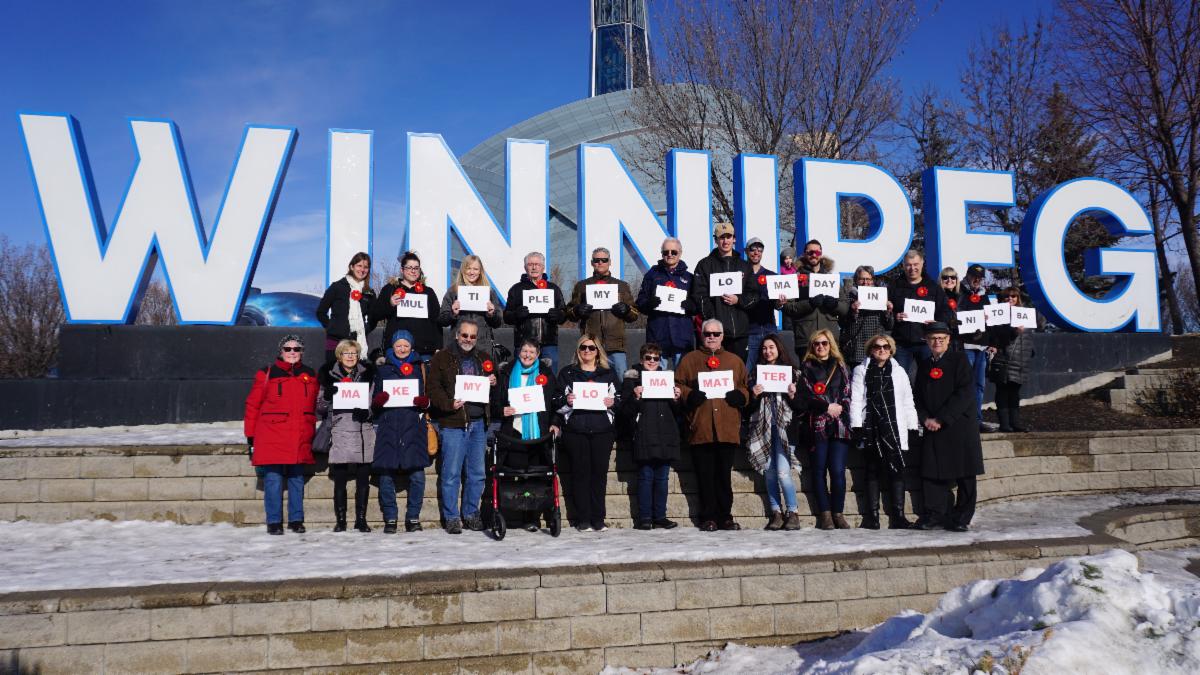
Multiple Myeloma Awareness Day 2020
|
|
Before I started the support group in Winnipeg, I was trying to create more awareness [for myeloma] by promoting March as myeloma awareness month.
I started a campaign of letter-writing, a solo campaign, writing to politicians, and it worked. In 2019, the provincial and city council acknowledged the day of March 1
st in Manitoba as Multiple Myeloma day. Each year, a new request needs to be made and I was very happy to hear that my request for 2020 was again accepted!
|
|
I also joined the Multiple Myeloma March in 2017, shortly after my stem cell transplant. I managed to do the Myeloma Walk with my family
. I didn’t tell anyone, or promote the fact that I was going to participate, because I wasn’t sure I would have the energy to finish. I managed, and successfully finished,
and have since co-organized 2018 and 2019 walks with Kim Krahn.
I have become much more determined to get the word out about myeloma. There is just not enough awareness about the disease, as some family doctors are not open to thinking that perhaps the bone pain and fatigue could be related to a cancer. This seems especially true for people in their 60’s; it’s often brushed off as arthritis or aging. I hope in my lifetime to see regular screening for myeloma by physicians at yearly check-ups. I also have a brother with myeloma. He was diagnosed a year before me, so I was one of the rare patients that actually knew what myeloma was at the time of diagnosis. I knew what treatments, including a stem cell transplant, I would likely receive.
|
|
Why do you feel Myeloma Canada is the best "medium" through which to advocate for those affected by myeloma?
Myeloma Canada represents every province in Canada. They can be supportive at the national level with regard to funding and new medications.
Adding our voice, my voice, to the big voice of Myeloma Canada has a much larger impact for getting things moving. They are the lion that is roaring for us, and who we can all get behind. Anytime a national organization addresses the government, the reaction is much better. They open the doors that we can all then walk through.
|
|
If you had one wish for patients and their loves ones, what would it be?
Of course, a cure, that is obvious! But after that, I would wish that all treatments that are available worldwide, be also available in Canada.
|
|
Thank you for your time and insights Jackey, and all you do alongside Myeloma Canada.
Thank you!
|
|
Editor’s Note:
To donate to Myeloma Canada, please visit
www.myeloma.ca
or call us toll-free at
1-888-798-5771
.
|
|
Follow us on social media for the most up-to-date information and resources:
|
|
|
|
|
|
|