"Investigative journalism is more important than ever today," said Angela Greiling Keane, managing editor, states and Canada for POLITICO. "And also today more than ever, powerful forces around the world are seeking to prevent journalists’ access to information."
|
|
Advice from Jill Geisler, Bill Plante Chair in Leadership & Media Integrity, Loyola University Chicago, Freedom Forum Fellow in Women’s Leadership.
- Our “gives” are very clear to us. We keep track of what we’ve done, the degree of difficulty, the extra effort and sacrifice.
- Our “give” side also contains our good intentions. We judge ourselves by those, even when we make mistakes. As in “Oh, I meant to call you but I got busy.” or “I didn’t mean to offend you with the suggestion, I was trying to be helpful.”
- Our “give” side is key to our sense of self-worth and self-image.
That’s why it’s so important for every manager to see their team members as people – not just producers. Every person keeps a different ledger. When I, the supervisor, know you well enough, I have insights into your bookkeeping and how to make sure that both of our “give” and “get” perceptions are in sync. Sometimes, I have to show you what I hope you’re getting from me.
Feedback is the best tool for this and cannot become a casualty of the coronavirus crush. It’s more important than ever — when people are working under extreme stress — to let them know that you see what they’re giving and the conditions under which they’re working. Praise what’s working and carefully address what needs to be better by providing guidance that’s realistic and respectful.
If not, you will create a “tipping point” moment when they think the ledger just blew up. They may not quit, but they sure as heck won’t throw themselves into their work. They may hold back when they could have volunteered ideas. They may do “just enough” and no more. They may complain to others. If they’re influential, their negativity becomes contagious.
What are some tipping point moments?
-
Tone-deaf messages, especially delivered in management-speak. Example: “Refrain from engaging in personal activities during work hours. Exceptions should be arranged with your supervisor.” Is the message necessary in the first place? If you really fear that people don’t know the organization’s expectations and may stray from them, at least be human about it. “We know you’re juggling many responsibilities in your home work space. We encourage you to take care of your family and continue your good work for us. If you run into problems, check in with your manager.”
-
Silence. You’re cranking out great work under duress and hear nothing. Day after day.
-
Requests that reveal a manager’s ignorance of what it takes to do your work: If managers don’t know the time or tools it takes an employee to do something, their blue sky requests trigger red hot reactions.
-
Managers who let some people play by different rules. When some employees are uncollaborative, underproductive or unkind to others and nothing happens, it’s demotivating to others. And they may be sitting and stewing about it, at a distance – and you don’t even know it.
Here’s to all the managers out there who are ledger-balancing experts – or trying to be. Because of you, your teams are more likely to be happier, healthier and more highly motivated as they do great journalism.
This article was previously published on April 2. Click here to read Jill’s previous posts.
|
|
|
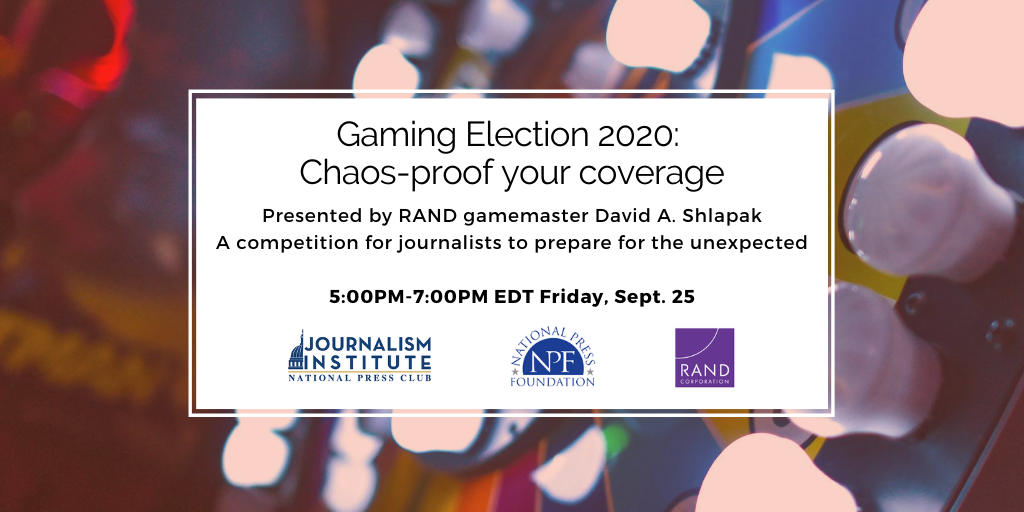
The National Press Club Journalism Institute, the National Press Foundation, and the RAND corporation are offering journalists a new way to prepare for the unexpected in Election 2020 news: Gaming your coverage plan.
Registration is open for this free program, which will be held on Friday, Sept. 25 from 5-7 p.m. ET.
RAND gamemaster David A. Shlapak will present players with scenarios based on current and likely events, and each team will make coverage decisions, not knowing what the next roll of the dice will bring.
The game will surface journalists’ assumptions and test decisions as reporters and editors balance competing goals, commit limited resources, and assess tradeoffs. The game’s timeline will begin in September, continue through Election Day, and end on Inauguration Day.
|
|
When the question marks begin to add up, consider the following:
What self-care habits are you practicing? Email us to share what has worked for you.
This item originally published in the June 11, 2020, edition of our Covering Coronavirus newsletter.
|
|
This newsletter is written & edited by the National Press Club Journalism Institute staff: Beth Francesco, Holly Butcher Grant, and Julie Moos. Send us your questions and suggestions for topics to cover.
|
|
|
|
|
|
|