American Indian Elders Conference: August 1-6, 2021, Reno, Nevada |
You are invited to attend the National Indian Council on Aging’s (NICOA) 23rd conference on aging in Indian Country. “Resilience for Tomorrow…Together” is the theme of the American Indian Elders Conference, which has been postponed to August 1-6, 2021. The conference will still take place in Reno, Nevada, at the Nugget Casino Resort, alongside the 2021 National Title VI Training & Technical Assistance Conference. |
NICOA’s conference is the only national aging conference in the country focusing exclusively on the needs of American Indian and Alaska Native elders. It will offer the opportunity to elevate issues in American Indian politics and legislation, and focus on issues such as health, safety, financial management, elder abuse, caregiving, employment, retirement and the Older Americans Act. |
|
|
|
Job Opportunities in Tribal Long-Term Services and Supports |
NICOA is seeking committed and experienced individuals to help coordinate on current projects and initiatives. We have three open consultant positions. We are seeking a Consultant for Program Management, a Consultant for Assisted Living, and a Consultant for Home Health Care.
The Consultant for Program Management will focus on providing guidance to tribes, community leaders, etc., on how to create and manage a long-term services and supports (LTSS) program on tribal land; the Consultant for Assisted Living will focus on how to create and maintain an assisted living infrastructure on tribal land; and the Consultant for Home Health Care will focus on creating and maintaining a home health care program on tribal land.
|
|
|
|
Age Friendly Care in the Great Plains |
In partnership with NICOA, the Center for Rural Health at the University of North Dakota, and Quality Health Associates of North Dakota, Dakota Geriatrics presents “Age Friendly Care in the Great Plains,” March 30-31, via zoom webinar.
This two-half day symposium will bring regional experts to discuss the “Geriatric 4Ms” (What Matters, Mentation, Medication and Mobility) in patient care specific for American Indian populations in the Great Plains. Day 1 (March 30) will address healthcare issues confronting elders and community workers (three social worker contact hours provided). Day 2 (March 31) will focus on how providers and healthcare professionals can better assess and manage elder patients (up to five free educational credits).
Objectives of the symposium are to describe how to transform clinical operations into age-friendly healthcare, reliably apply Geriatric 4M assessments, and implement action plans for geriatric syndromes.
|
|
|
|
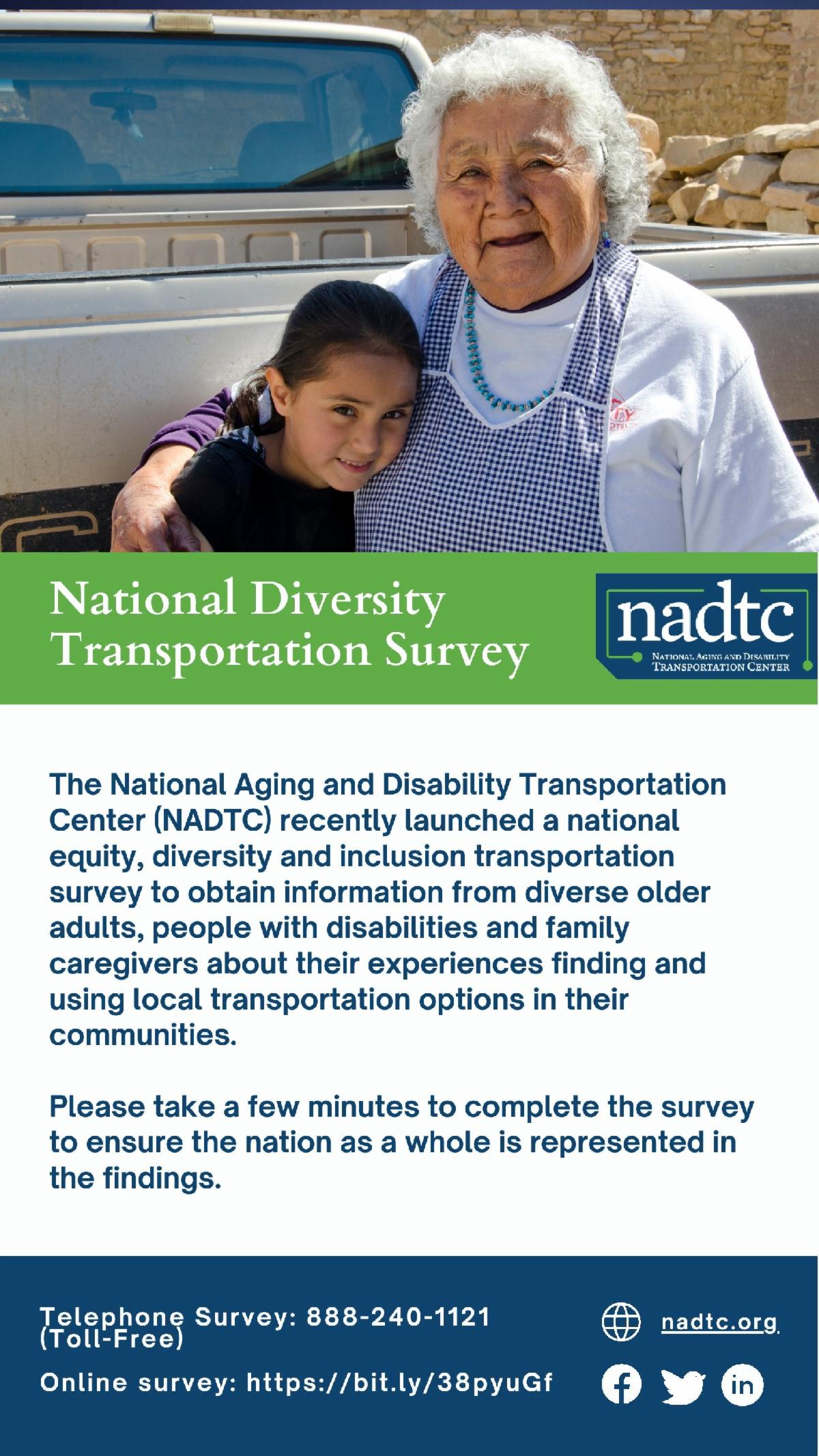
Help NADTC Learn About Transportation Equity, Diversity and Inclusion |
The survey will gauge opinions and obtain information from a representative sample of racially, ethnically and culturally diverse elders, people with disabilities and family caregivers about their experiences accessing and using local transportation options in the United States.
The feedback and experiences of riders and potential users of transportation services are vitally important. NADTC encourages participation to ensure the nation as a whole is represented in the findings.
Please take a few minutes to share this survey with other organizations that serve diverse elders, people with disabilities and caregivers, as well as partners, stakeholders and community members you are working with in this arena! Call the toll-free number at 866.983.3222 for more information.
|
|
|
|
National Survey on Person-Centered, Trauma-Informed Care |
The Center on Aging and Trauma is a grantee of the Administration for Community Living and is working to build the capacity of aging service providers to provide PCTI care to elders with a history of trauma and their family caregivers. In working towards this goal, they are collecting information about the capacity of organizations that work with elders and family caregivers to provide PCTI care – critical information your organization can provide.
|
|
|
|
2020-2021 Membership Available Online |
|
Membership with NICOA offers many valuable benefits. As a paid member you will receive NICOA’s online bimonthly newsletter, legislative updates on important issues and resolutions affecting elders, voting privileges for qualified members and discounted registration fees for qualified members to attend our biennial conferences.
Be an important part of a national membership network and become a NICOA member by applying online or by mail. |
|
|
|
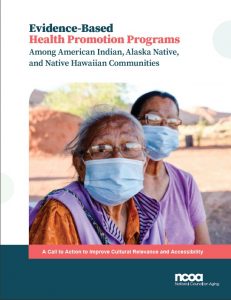
NEW REPORT: Evidence-Based Health Promotion Programs Among Native Communities |
“Evidence-Based Health Promotion Programs Among American Indian, Alaska Native, and Native Hawaiian Communities: A Call to Action to Improve Cultural Relevance and Accessibility” provides important information about evidence-based health promotion and disease prevention programs in American Indian, Alaska Native, and Native Hawaiian (AI/ AN/NH) communities.
This report highlights the:
- Unique disparities in health care access that AI/AN/NH communities face;
- Diversity of services supported by the Older American Act in AI/AN/NH communities, such as nutrition, transportation, caregiver programs, information and referral, and health promotion;
- Current evidence-base for, availability, and acceptability of health promotion programs in AI/AN/NH communities;
- Experience of program administrators in AI/AN/NH communities, and perspectives from elders about what aging well means to them and the extent to which they are aware of and/or have been involved with health promotion and disease prevention programs;
- Results from a survey of Older Americans Act Title VI Directors and Staff, providing information about their experience with health promotion and disease prevention programs, the unique challenges they face in serving their communities, and what resources they think might help; and
- Potential next steps to advance the health and well-being of AI/AN/NH elders.
Through the aging network, Administration for Community Living (ACL) funds programs that support nutrition, supportive services, and caregiver services in AI/AN/NH communities, such as congregate and home delivered meals, information and referral, transportation, person care, chore services, and health promotion programs. These services help ensure that AI/AN/NH elders can live independently in the communities of their choice for as long as possible.
|
|
|
|
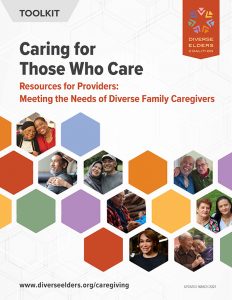
Caring For Those Who Care: Meeting the Needs of Native Caregivers |
Whether you’ve already attended one or more of our trainings, or this is your first time looking into what’s available to help you support diverse family caregivers, we think you’ll find these resources to be invaluable in building a more welcoming, supportive practice.
The curriculum, as well as the toolkit, were created by the six member organizations of the Diverse Elders Coalition — of which the National Indian Council on Aging is one — with generous funding from The John A. Hartford Foundation.
|
|
|
|
April Alzheimer’s Disease Webinars |
The month of April will have two important free webinars by the Banner Alzheimer’s Institute: “A New Approach to Caregiver Stress: Managing Ambiguous Loss” and a Native American Circle Group (reoccurring) dedicated to discussions about Alzheimer’s disease.
Banner Alzheimer’s Institute developed an evidenced-based group model called Steps to H.O.P.E. (Health, Optimism, Purpose & Endurance), providing family caregivers a model to name and define ambiguous loss while learning concrete strategies to promote self-care and improve wellness.
“A New Approach to Caregiver Stress: Managing Ambiguous Loss” will take place April 14 at 1-3:30 p.m. (MST) via Zoom. Space is limited so register by April 9. To register, call 602-230-2273 or register online.
The Native American Circle Group will take place April 8 at 10-10:30 a.m. (MST). They will be discussing an Alzheimer’s disease topic that will provide strategies for caregivers of people with memory loss. Call 1-480-378-7231, enter conference ID number 170212629# to join the meeting. If you miss the meeting, catch the next one on the second Thursday of each month. |
|
|
|
Fighting for the Right to Hunt and Gather |
In February, the state of Washington argued in court that, despite the guarantees in the 1855 Treaty of Point Elliott, the Snoqualmie Indian Tribe have no right to hunt and gather traditional food on the land they ceded. According to Article V of the Treaty of Point Elliott: “The right of taking fish at usual and accustomed grounds and stations is further secured to said Indians in common with all citizens of the Territory, and of erecting temporary houses for the purpose of curing, together with the privilege of hunting and gathering roots and berries on open and unclaimed lands.”
These rights were heavily and sometimes violently contested until 1974, when U.S. District Judge George Boldt issued a landmark decision finding the government bound by Article V. But in 2019, Washington state reversed course. As part of a state overhaul of the process for designating the traditional territories where treaty tribes can hunt and fish without a license, Washington Department of Fish & Wildlife Director Kelly Susewind declared that the Snoqualmie had no such right. The judges did not indicate when they would issue a ruling in the case.
|
|
|
|
Last week, the Biden administration restored tribal mineral rights that the Trump administration took away. The Interior Department returned a portion of the Missouri River to the jurisdiction of the Fort Berthold Indian Reservation. In 2020, the Trump administration had deemed the section of the river to be under the jurisdiction of the state of North Dakota instead of the Mandan, Hidatsa, and Arikara Nation, also known as the MHA Nation.
The tribes had challenged the Trump administration’s opinion, which granted a stay to the Interior Department to review the decision. Meanwhile, the state of North Dakota maintains that it has mineral rights on the tribal lands.
|
|
|
|
The United States Court of Appeals for the District of Columbia affirmed the dismissal of a lawsuit recently brought by Oregon ranchers which would have prevented the Klamath Tribes from exercising their water rights when they interfere with Oregon ranchers’ irrigation.
The district court originally dismissed the ranchers’ lawsuit for lack of standing under Article III of the U.S. Constitution and ruled that the Klamath Tribes’ water rights, pursuant to a treaty made in 1864, superseded the water rights of the ranchers. In the treaty, the Klamath Tribes ceded the majority of their land to the U.S., but reserved the right to the Klamath Reservation, where they possessed the exclusive ability to fish and gather. These rights were taken in 1887 but were restored nearly 100 years later.
The court found that because the Klamath tribes had the right to enforce their water rights superior to those of the ranchers, regardless of any action of the federal government, there was no causation between the federal government and the injuries the ranchers claimed to have suffered.
|
|
|
|
Tribal Law Enforcement Authority |
Does a tribal officer have the authority to detain a non-Indian on tribal land? Earlier this month the Supreme Court heard oral argument in United States v. Cooley. At issue is in this case is whether the court should exclude evidence that a tribal police officer collected while detaining and searching a non-Indian driver stopped alongside a federal highway that runs through the reservation. United States v. Cooley is a long overdue case that could potentially clarify what Indian tribal governments’ lack of criminal jurisdiction over non-Indians means for tribal policing.
If it had been a “normal” police stop-and-search case, the question would only be whether the officer had reasonable suspicion of criminal activity. But because the highway involved is within the boundaries of an Indian reservation, the officer is a tribal police officer and the defendant is a non-Indian, Cooley is a complex case. The Supreme Court is expected to make a ruling by the end of the current term in June. |
|
|
|
|
|
The National Indian Council on Aging, Inc. (NICOA) is a not-for-profit 501 (c)(3) charitable organization. Please consider adding NICOA to the charities you support.
NICOA needs your financial support as the advocacy and political work we do for our elders is not free. Grants that have helped fund NICOA are under threat in Washington, D.C., but you can help.
Your financial support will go directly to support our mission to improve health, social services and economic wellbeing for all American Indian and Alaska Native elders. Donations are tax deductible.
|
|
|
The National Indian Council on Aging | 8500 Menaul Blvd. NE, Suite B-470, Albuquerque, NM 87112 | 505-292-2001 | www.nicoa.org
|
|
|
|
|
|
|