Volume 7 Issue 4 | April 2026 | | April's all about the wetter side of things. | | The Root of It newsletter ends with our monthly quotation. If you find your newsletter has been clipped by your email provider please click HERE for a webpage version of the newsletter. | | |
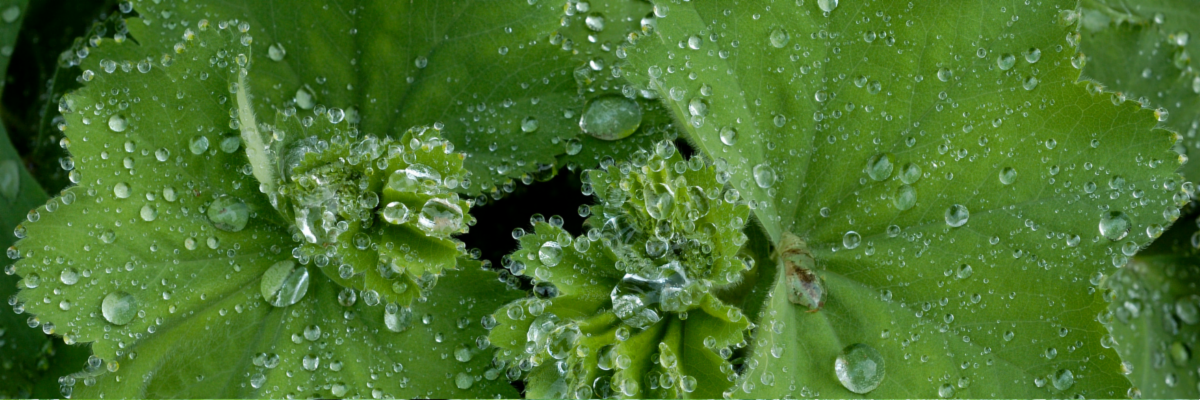
A lady's mantle (Alchemilla mollis) struts her stuff
photo by E Barth-Elias
| | |
At last! April showers—harbingers of spring. Let’s turn the spotlight on those beautiful drops of water atop unfurling leaves.
Check out a cabbage or tulip leaf during a spring shower, and watch the water bead up, form perfect pearlescent spheres, and then roll off, collecting dust and dirt on the way. A waxy, hydrophobic (water repellent) surface prevents water adherence, and allows the plant to remain clean and dry, resisting bacteria and fungi, even in humid environments. This self-cleaning property is called the lotus effect, named after the hydrophobic lotus plant.
A hairy leaf exterior is another hydrophobic plant adaptation—hairy structures minimize water contact with the leaf surface, and prevent water adherence. The leaves of lady’s mantle (Alchemilla mollis) are highly hydrophobic, in fact they’re called superhydrophobic. The lady's mantle's dense, fine leaf hairs prevent water from spreading, causing it to bead up into droplets. Lamb’s ear (Stachys byzantine) and ornamental grasses sport these hairy, superhydrophobic surfaces.
Can water droplets on leaves be a bad thing? Do they act as tiny magnifying glasses, intensifying the sun’s rays and burning leaves, as is widely believed? Studies have shown that water evaporates too quickly to cause this damage. Plants with hairy leaves, such as ferns, may provide an exception. Their leaf hairs hold on to water, and in some cases scorching can occur. High noon watering should be avoided, not because it leads to leaf scorch, but to prevent its evaporative loss.
Sometimes leaves display water drops without a rain cloud in sight. These plants use a process called guttation to eliminate excess water from their systems. Water droplets are released by the leaves at the leaf margins, usually at night, and can be a sign of overwatering or high soil moisture. Look for guttation on houseplants such as pothos, elephant ears, colocasias, and monsteras. Many outdoor plants—tomatoes, grasses, strawberries, roses—manage excess water with guttation.
Before our spotlight dims, let’s take a moment to appreciate the beauty of raindrops on leaves. The contrast between fuzzy or waxy leaf surfaces and raindrops is striking. The magical sparkle of water droplets on a jewelweed leaf* or crystalline raindrops on lady’s mantle, persisting long into the day, are mesmerizing. Stop the bus!!! Look Around!
*The name ‘Jewelweed’ (Impatiens capensis) pays tribute to the beauty of raindrops on its leaves.
K Edgington
| | |
LEAF BRIEF: Bald Cypress
Water is All You Kneed
| | |
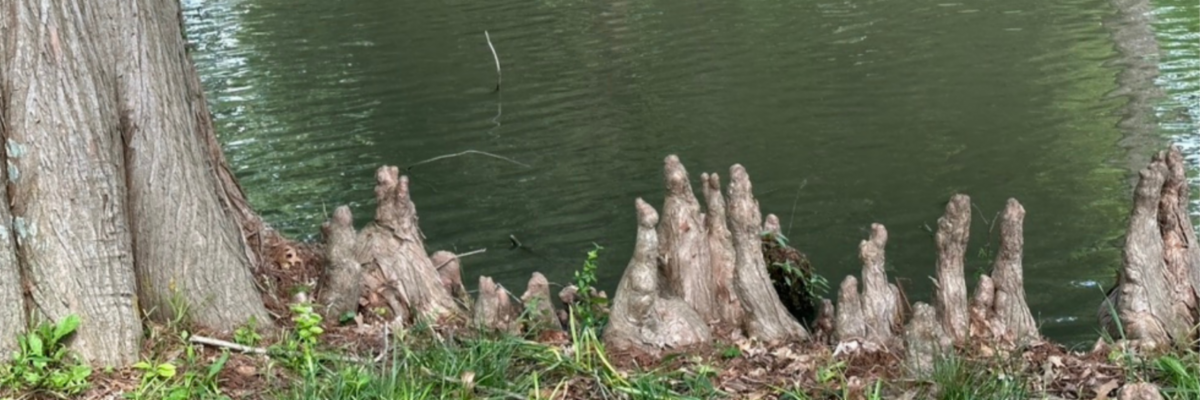
Bald Cypress Knees, Conrad Formal Gardens, Oxford Ohio
photo by E Barth-Elias
| | |
For many of us, the bald cypress conjures up images of desolate swamps of the Deep South and trees dripping with Spanish moss. These ancient and long-lived trees are impressive survivalists and adapt to many environments. Their imposing beauty and unusual “knees” never fail to capture attention.
The bald cypress (Taxodium distichum) is one of a small group of unusual conifer species that drops its needles in the autumn, earning its the nickname “bald.” It is related to the equally grand redwood, for which it is often mistaken in Ohio. Although native primarily to the coastal southeastern United States and Mississippi River basin, bald cypress grows very well in Ohio and can be found in parks, arboretums, and landscapes. These trees are surprisingly drought tolerant and will grow in landlocked areas too.
The bald cypress is a large, slow-growing tree, frequently reaching 100 to 120 feet in height with a trunk 3 to 6 feet in diameter. It thrives in full sun and naturally favors lowland areas. The thin, wispy leaves of this deciduous conifer turn a vibrant copper-red in the fall. It has adapted to very wet conditions and thrives in muck, clay, or fine sandy soils. The tree tolerates continuous standing water and develops distinctive “knees” that grow above water. Its horizontal roots may spread 20-50 feet before turning downward.
Its knees are one of the tree’s most intriguing features. They are woody outgrowths of the shallow horizontal root system and can appear on trees as young as twelve years old. Knees are commonly 1 to 3 feet in height and many researchers agree that average water depth and the lightness of soils determines their height.
Exactly why the bald cypress grows knees is not fully understood. The most popular theory is they aid in aeration, allowing the plant to absorb air in water-saturated soils. The knees may also provide mechanical support, anchoring it in wet soil. Others theorize the knees act as “drift catchers” trapping accumulated organic debris and nutrients during periods of water movement. They may also facilitate the release of methane from rotting materials (swamp gas) and even function as carbohydrate storage structures.
The bald cypress has proven useful in mining reclamation, improving water quality and recharging groundwater. It can reduce damage from floods, trapping sediment and pollutants. Cypress wood is used extensively in the building trades. It contains a natural oil called cypressene that resists decay, making it ideal for decking, roofing, pilings, caskets, and marine construction. Native Americans used the wood extensively for canoes, hollowing out whole tree trunks.
An integral part of the ecosystem, bald cypress cones are part of the food chain for many birds and small animals. Its surroundings provide breeding grounds for salamanders, fish, frogs, and toads to name a few while the canopy hosts nests for bald eagles, ospreys, herons and egrets.
Though a swamp may appear desolate at first glance, it is actually teeming with life—and the bald cypress stands at the center of that world. Whether growing in a southern bayou or a parkland planting here in Ohio, this remarkable tree reminds us that some of nature’s most intriguing plants thrive in the most unexpected places.
CYPRESS KNEES: AN ENDURING ENIGMA: Arnold Arboretum
J Gramlich
| |
|
CREATURE FEATURE
TAD Talk
| |
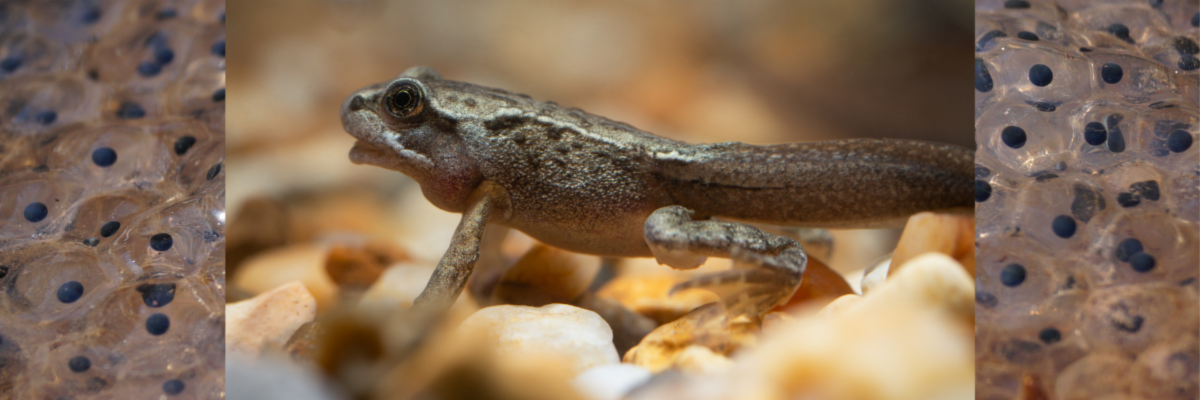
Tadpole in a later stage of metamorphosis with background of frog eggs in their jelly mass
photos by Paul Cooper
| |
Tadpoles are impressive. Frogs are a bit slimy and jumpy for my taste, but their larval stage—morphing from aquatic herbivore to terrestrial carnivore with timing influenced by environmental conditions—is pretty incredible. April showers bring May flowers and tadpoles, so now’s a good time for a little TAD talk.
‘Frogspawn’ may sound like a tech start-up, but it’s actually a classic harbinger of spring. These clusters of tiny black eggs, encased in a jelly-like coating, are found floating in vernal pools or shallow waters throughout Ohio from March to August. A single clutch generally contains 1,000-5,000 eggs, depending on the species—the American Bullfrog can produce up to 25,000!
(A quick review: Toads lay eggs in long strands or ribbons, not clusters. All toads are frogs. The class Amphibia (amphibians) contains the order Anura (frogs and toads), which is divided into 4 families—3 frog families and one toad.)
That huge number of eggs is a survival strategy. Frogspawn is gobbled up by fish, birds, insects, reptiles and other frogs. The coating provides some protection—it tastes bad, may contain toxins and makes eggs difficult to grab. Even so, only one of 50 eggs survive to hatch.
Remember the Incredible Hulk, and how he changed from human to, well, whatever he was? A frog’s metamorphosis is even more incredible, although it takes longer (12-16 weeks) and doesn’t involve screaming or wardrobe malfunctions.
It all starts with the egg, which elongates from dot to comma as the embryo develops a tail. Within 2 to 3 weeks the baby hatches. Let’s call him Tad.
Tad first chows down the remainder of his egg, excellent protein for growth. Now an aquatic herbivore, he uses his tail for swimming and feeds on algae and plant material with his soft cartilage beak and tiny teeth. Feathery gills on the sides of his head help Tad breath (like all amphibians, he can absorb oxygen through his skin).
Tad is probably quite content with life underwater. But Nature has other plans.
At about one month old, Tad’s skin begins to grow over his gills. He starts ingesting water through his mouth, extracting oxygen through his now internal gills, and expelling the water through a small hole on his body (spiracle).
He also begins to develop lungs. Tiny Tad swims to the surface to practice filling his new lungs with air, but may be too small to break the water’s surface. No worries—Tad uses a technique called ‘bubble sucking’, attaching his mouth to the underside of the water’s surface, sucking in an air bubble and forcing it into his lungs. Once he can, Tad will break the water’s surface to gulp in air. Tad can take in 25% of his oxygen with his lungs.
Between his first and second months, hind legs appear at the base of Tad’s tail, while his future front legs grow inside his body, eventually emerging through the skin near his gills. Talk about an awkward adolescence…
At about three months, Tad is now a froglet—a tiny frog with a tail. Tad develops the characteristic wide jaw, teeth and strong tongue he needs to catch prey. During this final part of his metamorphosis Tad may stop eating for days—a froggy version of a cleanse. But Nature, as always, provides, and Tad’s tail is absorbed into his body, fuel for his final growth.
Tad’s diet shifts throughout metamorphosis from plants to protein, requiring major bodily overhaul. At age one month Tad begins adding insect larvae and other protein sources like bugs, worms and water fleas to his diet. Plant material takes longer to digest than protein, so Tad’s long intestine will shorten (up to 75%) to accommodate his new diet. Other corresponding changes to his digestive system occur.
At four months, Tad’s tail and gills are gone, and his lungs are fully operational. Tad Pole has fully morphed into Tad Frog.
The timing of this amazing process can depend upon temperature, pond conditions and species (not gamma rays LOL). If Tad’s pond has lots of predators and little food, he’ll transform more quickly. The warmer, shallow waters of vernal pools also accelerate development—transformation must happen before the pool disappears. If the pond is a safe place with plenty of food, and temperatures are cooler, Tad will take his time.
Check out these two videos of Tad's incredible metamorphosis. I think you’ll agree—Tad over Hulk any day…:
THIS IS HOW A TADPOLE TRANSFORMS INTO A FROG
THE LIFE CYCLE OF A FROG
C Christian
| | |
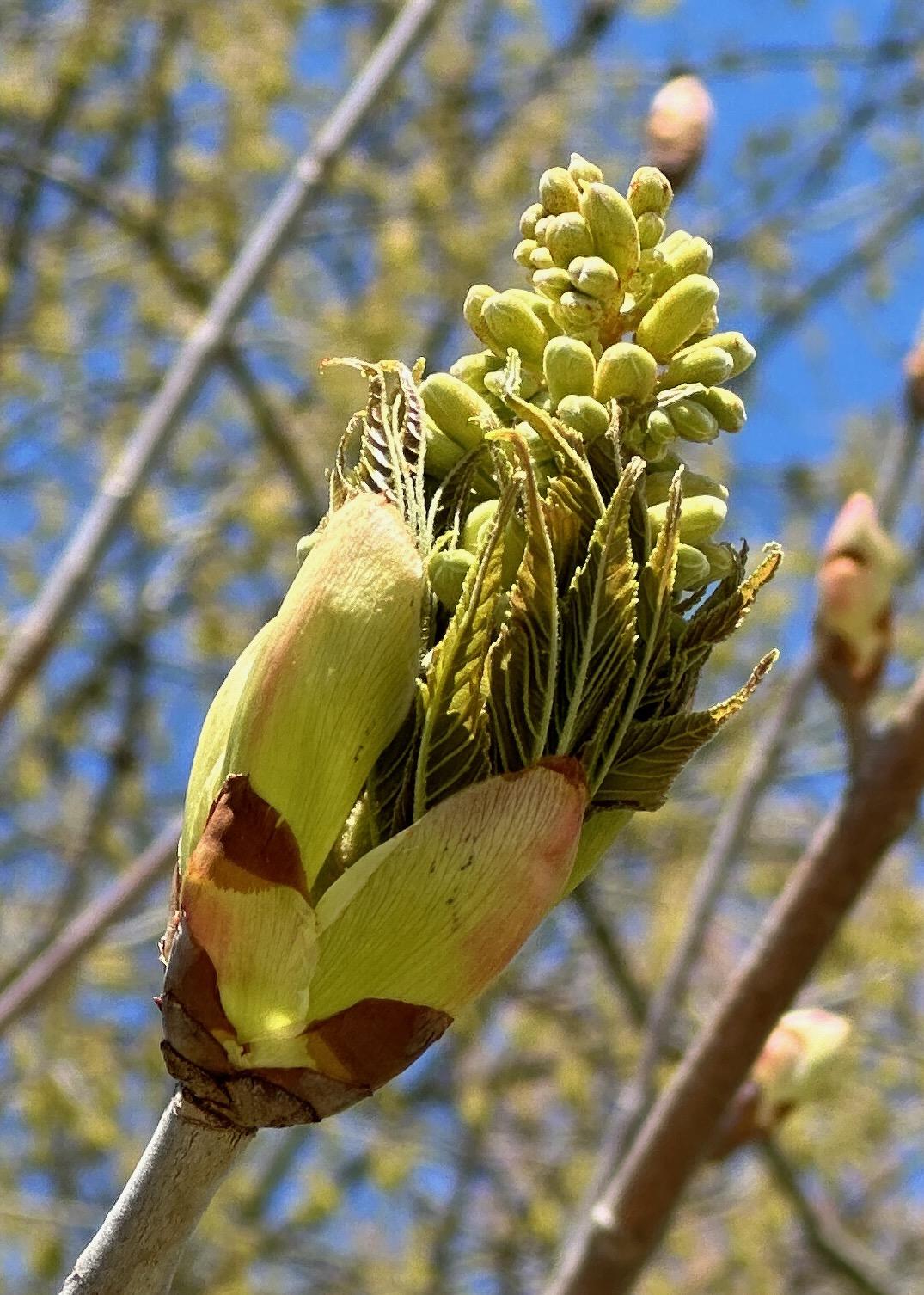
This Buckeye bud (Aesculus glabra) holds not only its flower but also the leaves which will surround it.
photo by E Barth-Elias
| | COME ON IN—THE WATER'S FINE | | |
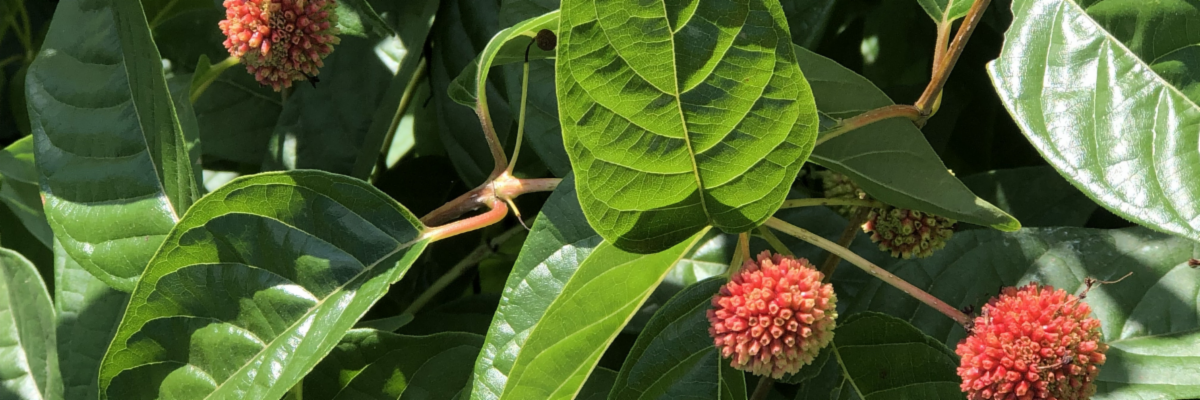
Button Bush (Cephalanthus occidentalis) is happiest with wet feet.
photo by E Barth-Elias
| | |
What a pleasure to find that my new home’s landscape has a wet spot! We’ve owned many homes, some in arid locales, some with average rainfall, all with challenging clay soils. But this is the first with a spot for plants that thrive in water-saturated soil. My garden friend and I call this an “opportunity” spot—a place to learn about and incorporate new plants. I got to work determining which plants I could add to my repertoire. These are the plants that don’t have the “requires well-drained soils” in their description. Some tolerate wet soils, and some require them. Here are a few I’ve discovered:
As its name suggests, river birch (Betula nigra) grows well in wet soils. This tall beauty prefers soils on the acidic side, though. Not only does American hornbeam (Carpinus caroliniana) grow well in soggy soils, it also tolerates shade—a twofer that ups its appeal. Other wet-feet tolerant trees include swamp white oak (Quercus bicolor), and black tupelo (Nyssa sylvatica). The beautiful sweet bay magnolia (Magnolia virginiana) tolerates soggy, even boggy soils, and is native to the US.
There are a number of shrubs on the “grows in wet soils” list. Red chokeberry (Aronia abutifolia) is a tall native that sports flowers, red fruits, and fall color. New cultivars add medium and small size options. Buttonbush (Cephalanthus occidentalis) is a plant that prefers wet soils. When happy, it suckers and forms thickets. Natives winterberry (Ilex verticillata) and redosier dogwood (Cornus sericea) are well-suited to soggy soils. Of course, anything with the word willow (Salix) in its name is a good choice for a water-logged spot. Add pussy willows, corkscrew willows and others to the list. Summersweet (Clethra alnifolia) enjoys wet feet, and may need coddling during the occasional drought.
Perennials that grow in saturated soils include goatsbeard (Aruncus dioicus), black snakeroot (Actaea racemosa), and Japanese iris (Iris ensata). Queen of the prairie (Filipendula rubra) is a striking addition, with its 6-8’ tall pink flower display, but note that it prefers part shade. Swamp milkweed (Asclepias incarnata) lives true to its name. Shady, wet sites can include astilbes and ferns, including lady fern (Athyrium filix-femina), ostrich fern (Matteuccia struthiopteris), and Japanese painted fern (Athyrium niponicum).
Many grasses are water lovers: switchgrass (Panicum virgatum), maidenhair grass (Miscanthus sinensis), feather reed grass (Calamagrostis acutiflora). Grass-like sedges (Carex spp.) are also good candidates.
Unfortunately, most conifers are intolerant of wet feet. Notable exceptions include dawn redwood (Metasequoia glyptostroboides), bald cypress (Taxodium distichum), American arborvitae (Thuja occidentalis), and Atlantic white cedar (Chamaecyparis thyoides).
I am watching my boggy area develop. The plants there have soil that is water-logged, but dries out when the rains don’t come. I’ll be out there, meting out encouragement during dry periods, and perhaps doing a little hose-holding. Welcome, water-loving friends!
TREES AND SHRUBS FOR WET SOILS: Iowa State University Extension
PERENNIALS FOR MOIST TO WET SOILS: Iowa State University Extension
K Edgington
| | |
April Checklist:
- Add organic matter, such as compost or manure, to your vegetable beds .
- Plant cool-season vegetables like Brussels sprouts, cauliflower, kale, and broccoli outdoors and summer vegetables indoors (six weeks before the last frost).
- Plant beets, carrots, radishes and leaf lettuce seeds outdoors.
-
Plant, prune, and fertilize roses and raspberry plants. SPRING ROSE CARE: Blooming Backyard
-
Divide perennials for more blooms this summer. HOW AND WHEN TO DIVIDE PERENNIALS: University of Minnesota Extension
- Prune spring flowering shrubs (forsythia) after blooming.
- Plant pansies.
- Apply pre-emergent crab grass herbicide if desired.
J Gramlich
| | |
When despair for the world grows in me and I wake in the night at the least sound in fear of what my life and my children's lives may be, I go and lie down where the wood drake rests in his beauty on the water, and the great heron feeds. I come into the peace of wild things who do not tax their lives with forethought of grief. I come into the presence of still water. And I feel above me the day-blind stars waiting with their light. For a time I rest in the grace of the world, and am free.
Wendell Berry, 1968
| | |
More learning opportunities:
| | We invite you to share The Root of It with your friends and family. If you would like to subscribe to our mailing list please visit our website, scroll to the bottom, and follow the link under Join our email list. | | The Root of It staff: Karen Edgington (Editor), Emma Barth-Elias (Photo Editor), Carolyn Christian, Jennifer Gramlich, Sarah Vradenburg, and Geoff Kennedy (Technical Advisor) | |
We Would Like your Feedback
Contact us at: newsletterscmg@gmail.com
To discontinue receiving this newsletter please click on the UPDATE YOUR PROFILE link below. You may then choose what types of information you would like to receive from us.
| | | | |