|
Starting tomorrow, Wednesday, March 22, NACD members from across the country will convene in Washington, D.C. to meet with their congressional representatives as part of NACD’s 2023 Spring Fly-In. We encourage all NACD members to participate and look forward to seeing many of you soon!
The agenda, NACD’s 2023 issue papers, and frequently asked questions can all be found on NACD’s Spring Fly-In Webpage. If you have not already, please use this link to RSVP and share information about your scheduled meetings. You can also revisit NACD's virtual fly-in training session recordings here.
Attendees are also invited to join NACD tomorrow, March 22, at these events:
-
Breakfast Briefing at 7:30 - 9:00 a.m. in the Hart Senate Office Building - Room 216.
-
Reception at 5:30 - 7:00 p.m. in the Rayburn House Office Building - Room 2075.
If you have any questions, please contact NACD’s Director of Government Affairs, Chris Young at chris-young@nacdnet.org.
| U.S. FOREST SERVICE ANNOUNCES FUNDING, INCLUDING CONSERVATION DISTRICTS PROJECTS | 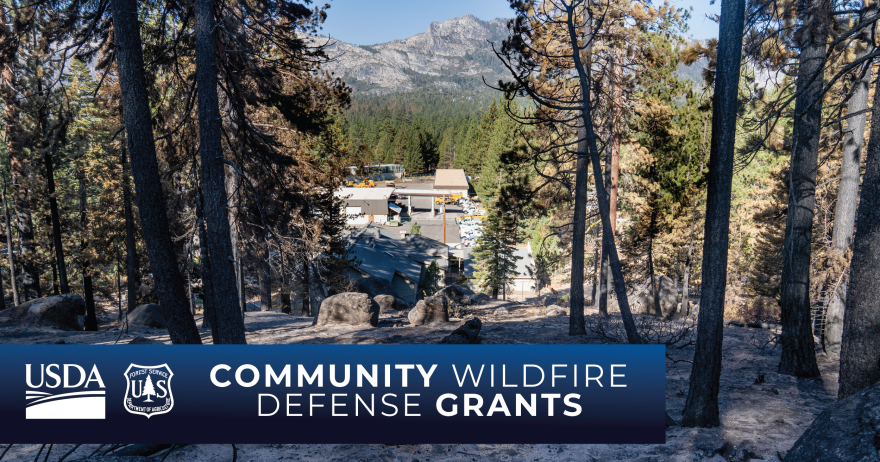 | |
Yesterday, Agriculture Secretary Tom Vilsack announced that the U.S. Department of Agriculture’s Forest Service is investing $197 million in 100 project proposals benefiting 22 states and seven tribes, as part of the Community Wildfire Defense Grant program. Among the project proposals selected for this round funding, 10 included conservation districts as the primary award recipient.
Conservation district project proposals to receive funding include:
- Humboldt County Resource Conservation District
- Nevada County Resource Conservation District
- Resource Conservation District of Tehama County
- Sierra Resource Conservation District
- Western Shasta Resource Conservation District
- Grant Soil and Water Conservation District
- Illinois Valley Soil and Water Conservation District
- Curry County Soil and Water Conservation District
- Kittitas County Conservation District
- Lincoln County Conservation District
The Community Wildfire Defense Grant program helps communities, tribes, non-profit organizations, state forestry agencies, and Alaska Native corporations, plan for and mitigate wildfire risks as the nation faces an ongoing wildfire crisis. The Forest Service will announce another round of funding later in 2023. Additional information about this grant program and the full list of selected projects can be found on USDA’s website.
| HIGH TUNNELS RESULT IN BLOSSOMING PARTNERSHIPS | |
By: Matthew Olson, Wild Rice Soil Conservation District, ND
In North Dakota, a state that lands in the top 10 production of many cash crops, it would be easy to overlook small-scale/specialty operations. However, the Natural Resources Conservation Service (NRCS) has worked diligently to foster relationships with groups to meet the resource needs of these producers. Nearly a decade ago NRCS added high tunnels to the list of practices available for cost-share through their Environmental Quality Incentive Program (EQIP) to assist these producers. For those who may not know; a high tunnel is an enclosed poly covered structure used to protect crops from the elements while extending the growing season.
North Dakotan’s are well known for having big gardens but have often struggled with the short, unpredictable growing seasons. Cold temperatures dragging into May and early frosts hinder crops that need longer growing seasons to truly maximize production. High tunnels not only help shield crops from the elements but also allow producers to utilize crops traditionally grown in warmer areas. The biggest roadblock was that nobody in North Dakota knew much about high tunnels so there seemed to be a bit of the fear of the unknown with local producers.
To increase awareness, NRCS partnered with the Burleigh and Wild Rice Soil Conservation District’s (SCD) in the early 2010’s to create a pair of demonstration sites where outreach events could be held to showcase working high tunnels. The results were nearly instantaneous with numerous high tunnels cost-shared in these areas through EQIP over the next several years. In 2017 NRCS expanded their high tunnel partnerships by collaborating with Dakota College of Bottineau (DCB) to host beginner & advanced high tunnel workshops across North Dakota to provide technical assistance for those who had adopted the practice but were still looking for help with some of the issues they were having. Throughout these workshops it was clear that producers were looking for more day-to-day operations assistance.
| 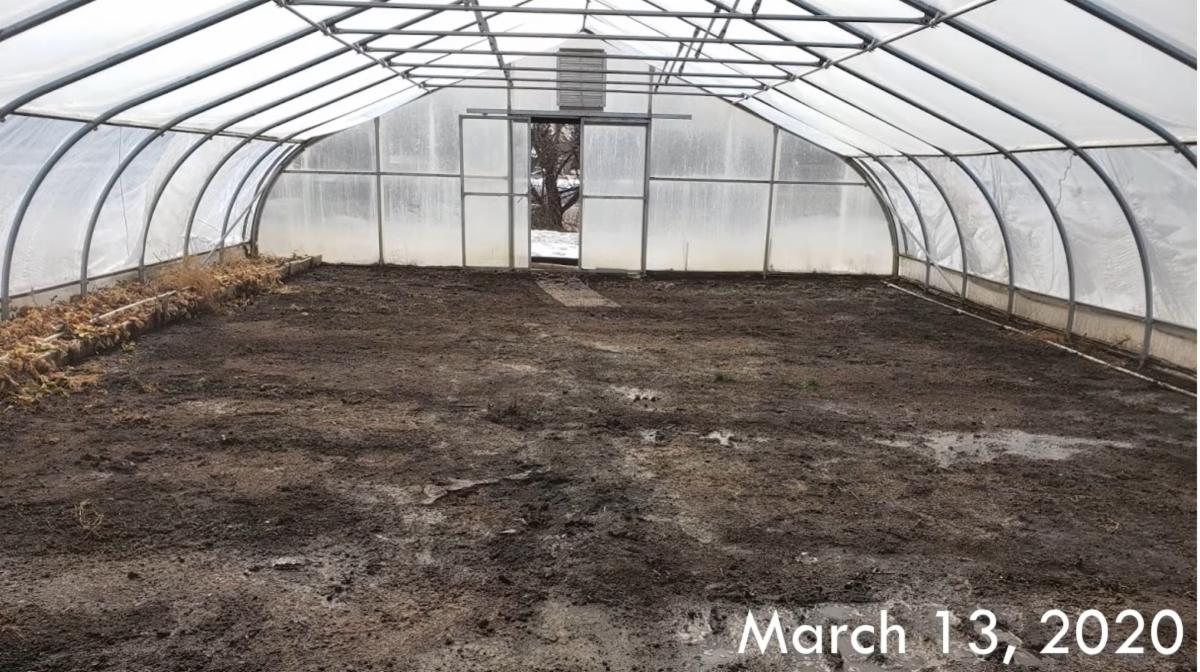 | 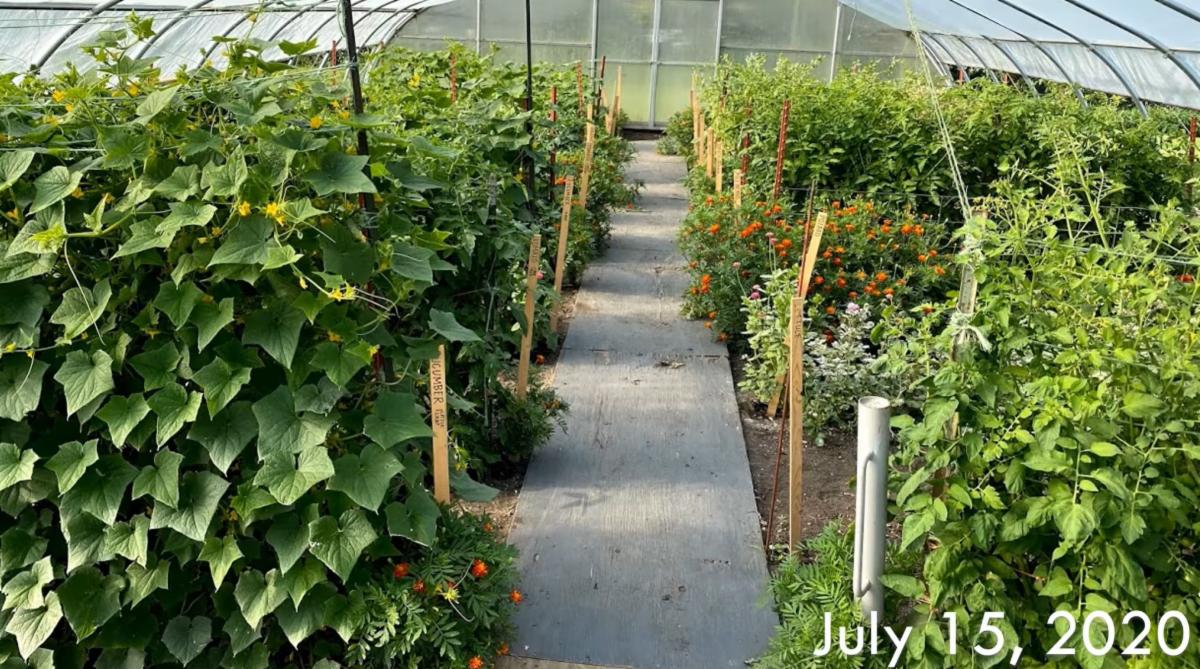 | |
DCB reached out to the Burleigh County & Wild Rice SCD’s to see if there was interest in collaborating on a project and with positive feedback from both; DCB applied for and received a grant from NRCS to create demonstration sites at each location to highlight conservation practices that could be applied to high tunnel operations. With salinity, pests, & compaction being frequent concerns in high tunnels; everyone felt like practices implemented should revolve around addressing these issues. Some of the practices adopted were cover crops, roof runoff structures, pest management, micro-irrigation, crop rotation, & nutrient management. Everyone also believed that outreach and education needed to be a big part of this grant as well, so field days were held at each location to highlight practices adopted and work completed during this grant to local professionals and producers.
Although this new grant was setup to focus on increasing technical assistance to high tunnel producers, we know and understand that financial assistance is crucial for those people looking to build a high tunnel. In the fall of 2021, NRCS sent out a request for proposal for priority projects in their Environmental Quality Incentives Program (EQIP). This process allows local entities an opportunity to highlight a resource concern to NRCS and layout technical and/or financial resources that the federal government could support through NRCS. With high tunnel interest increasing across the state and supply chain issues impacting our local supermarkets, we felt it was important to submit a proposal for funding for high tunnels across North Dakota so more produce could be locally grown. As we started the application process, we came to find out that others felt the same way. The Morton County SCD was also looking to submit a similar application. As a result, the “Farming the Frost” proposal was submitted with support by all 3 Soil Conservation District’s and Dakota College of Bottineau to request $60,000 of funding from NRCS for high tunnels and their supporting practices for the next year. The proposal was approved by NRCS, and all funding was utilized in 2022 across North Dakota.
Time is a funny thing; when a person can look back you gain so much more perspective. By themselves each one of the accomplishments above are impressive advancements in urban agriculture and furthering the mission of locally sourced produce. But when taken in their totality over the last 15 years, it tells an incredible journey that has delivered both technical and financial assistance as well as outreach and education across North Dakota by the partnering of local soil conservation districts, NRCS, and higher education. As this chapter comes to an end, I cannot wait to see what the next chapter brings. What new partners come to the table, new challenges faced, innovative ideas to be piloted……stay tuned.
| |
NACD Seeks Staff Accountant | |
NACD is seeking a Staff Accountant that will be responsible for managing general ledger accounting, financial reporting, grants management, and auditing. This position can be remote or based out of the NACD headquarters office in Washington, D.C. The full position description can be found here.
Interested candidates should send a cover letter and resume to the attention of NACD HR with ‘Staff Accountant’ in the subject line to hr@nacdnet.org no later than Friday, March 31, 2023, to receive priority consideration.
| New District Job Opportunities on NACD Job Board | |
The NACD District Job Board has multiple open positions across the U.S. for job opportunities with local districts and conservation organizations. Currently posted open positions include an Executive Director, Conservationists, Planners, Technicians, Program and Administrative Assistants, and more.
Check out the job board to learn more, and to share any open positions in your district.
| Join Conservation Drainage Network for Annual Meeting | The Conservation Drainage Network will hold its Annual Meeting from April 4-6, 2023, in Easton, Maryland. The 2023 meeting will focus on both improving and advancing the implementation of conservation drainage by raising awareness and sharing key obstacles and opportunities. Attendees can choose to participate either in-person or view sessions online. More information about this event can be found on the network’s website and anyone interested in attending is encouraged to register here. | USFS Requests Applications for Community Forest Program Grants | |
The U.S. Forest Service (USFS) has announced a request for applications for the Community Forest & Open Space Conservation Program.
The Community Forest Program (CFP) is a competitive grant program that provides financial assistance to tribal entities, local governments, and qualified conservation non-profit organizations to acquire and establish community forests that provide community benefits. Community benefits include economic benefits through active forest management, clean water, wildlife habitat, educational opportunities, and public access for recreation.
Applications are due to the Appropriate State Forester or equivalent Tribal official, depending on the applying entity, by March 31, 2023.
| Wallace Center Requests Applications for EPA Historically Underserved Farmers Grant | |
The Wallace Center recently launched a request for applications (RFA) for its subaward agreement with the Environmental Protection Agency’s (EPA) Gulf of Mexico Division. The Wallace Center’s EPA Historically Underserved Farmers Subaward Program is a competitive subaward for the Mississippi River Region that aims to address the diverse needs of historically underserved farming communities, center networking and co-learning among subawardees, and provide resources to underserved farmers so they can become conservation leaders. This program will work with an advisory group to support up to 20 organizations collaborating with underserved farmers on water quality, habitat, or forestry improvements, thus reducing phosphorus and nitrogen loss.
The application window for this subaward program will be open until May 1, 2023. More information can be found on the Wallace Center’s website.
|  |
Promote your conservation district or state association's tree sale, annual meeting, webinar, field day, or other events on NACD's Calendar of Events!
| |



