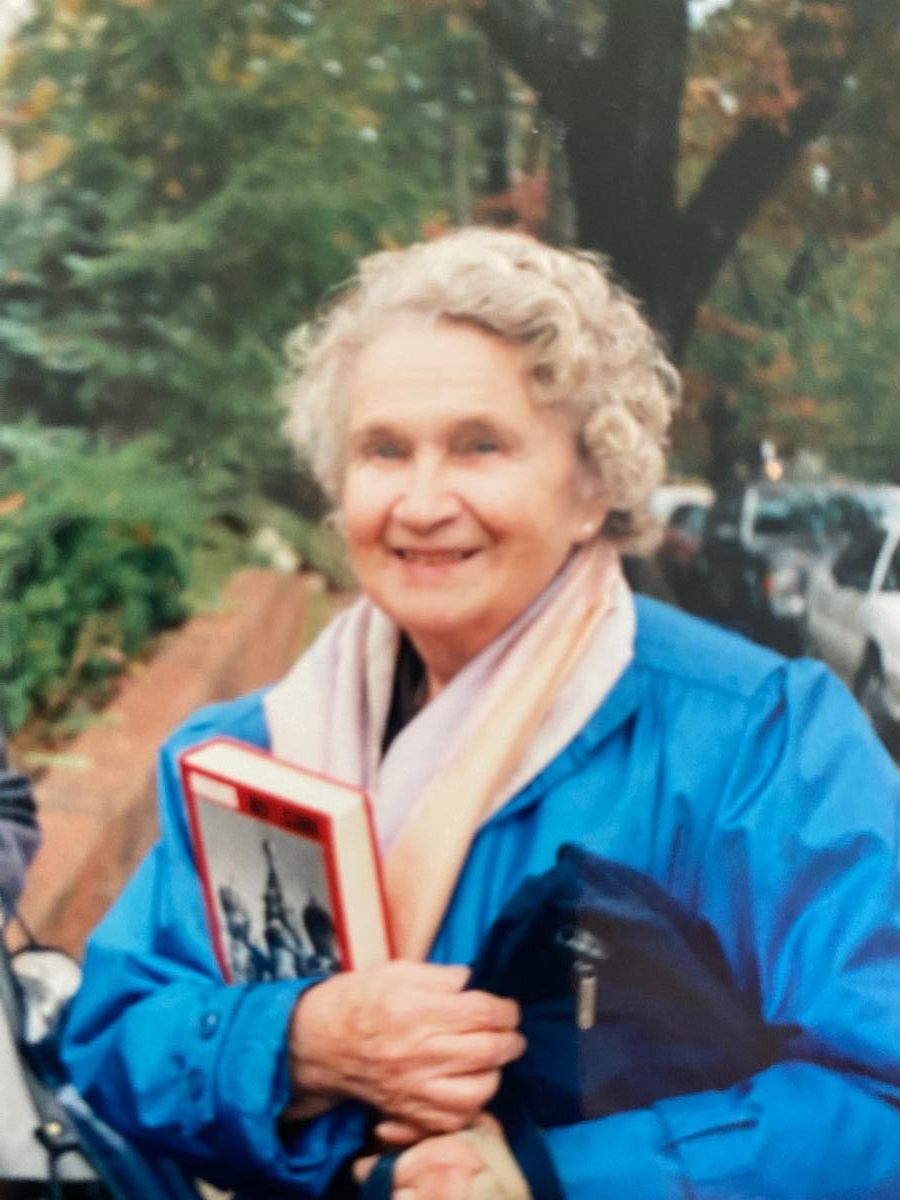
Nina Petrovna, or Kissi, as she was called by her grandchildren, was born February 24, 1914 in Vilnius, Russia (now Lithuania). Her parents were Nina Fedorovna Bouroff and General Petr Nikitich Bouroff, both from families of the Russian nobility and with a history of military service.
Nina’s childhood was tragically uprooted by the Russian Revolution and ensuing Civil War. Father General Bouroff was engaged in military campaigns of World War I in the Balkans and Mother Nina Fedorovna was arrested and imprisoned. Their children Nina and little brother Petya were left homeless and wandered seeking food, shelter and protection; sometimes distant family members or caring “White” Russians, helped these orphans or “bezprizornyie” children. Thousands of children and families were torn apart, and faced deprivation, illness, and execution by the Reds.
Little Nina felt the enormous responsibility for the survival and safety of her little brother and herself. According to Petya’s own words, she would never let him free from holding her hand and led him from war-torn houses to shelters. She acquired the moniker “komandeer” or “commander”, since at an early age she ordered everyone around. But, as her brother Petya asserted, with this attitude Nina saved their lives.
Miraculously, mother Nina Fedorovna escaped imprisonment and was reunited with Nina and Petya. They fled Russia under harrowing conditions to Poland. General Bouroff received news that his family had perished and even had memorial services held. Only much later did he learn that the news was false and that his family did survive.
In Grodno, Poland, Nina was able to attend a year of grammar school. Then in 1923 the Bouroff family emigrated to Paris, France where they were reunited with General Bouroff. Up to 800,000 Russian refugees and thousands of other Europeans faced stateless status from failed governments and the turmoil in the wake of World War I. The Bouroff family and also Nina’s future husband Ivan were recipients of Nansen passports granted by the League of Nations, which allowed a form of legal identification and documentation. (Masha, Nina’s daughter, has her parents’ original Nansen passports.)
Nina Petrovna’s education in France included Primary School in Paris, then the equivalent of high school in Thionville, France. Here she lived with her father who could only find employment in the local mines. The family faced many hardships and impoverished conditions. From 1933 to 1935, Nina attended the University of Paris, Sorbonne, with studies in the liberal arts.
Even in her teenage years Nina was a teacher and tutor of foreign languages – Russian and French. Firstly, she taught at a parochial school in Nilvange, France, then in Paris to members of the diplomatic corps, and in Maryland for the Adult Education Programs and FLES Public School Programs in Montgomery County. She taught evening Russian classes to many students for many years at St. Nicholas Cathedral.
Nina’s artistic talents included music. She studied at the Sergei Rachmaninoff Conservatory of Music in Paris, where well-known Russian émigré musicians, including Feodor Chaliapin, Alexander Glazunov, Alexander Grechaninov, Sergei Rachmaninoff, Nikolai Tcherepnin, Serge Lifar, and many others, taught. From 1935-1940 Nina studied piano, but primarily voice – her soprano voice was exquisite and flirtatious and her repertoire included opera, operettas, folk and popular songs. And she sang in many languages – Russian, French, German, Italian and English. Nina’s amateur and semi-professional musical career included many performances at the Conservatory, private venues and later in the US. She performed in concerts, for charity events, and for veterans hospitalized at Walter Reed Army Hospital. Nina imparted her love of music to her children Nikita, who played piano and French horn, and to Masha, who played violin and piano. The family often enjoyed social musical evenings with family and friends. Song and music were an integral part of the Soukhanov family. As a much older senior, Nina still remembered and sang Russian “chastushki” from her childhood and also some poignant, sometimes humorous songs of the travails and suffering during the Russian Revolution, Civil War, imprisonment, general hardships and of course, romances.
Nina’s other artistic talent was in the visual arts and floral arrangement. She was an avid drawer, sketcher, water-colorist and more her whole life. Before, during and after World War II, Nina ran a small atelier for fabric design and construction of ladies scarves, blouses, skirts, and other garments. She designed, dyed, and sewed everything by hand and sold to a well-to-do clientele. Designs were mostly floral or geometric on white silk. This business supplemented family income during difficult times.
Nina met her husband Ivan Mikhailovich Soukhanov (1903 – 1989) in Paris amid Russian émigré circles. They married at the Saint Alexandre Nevsky Russian Orthodox Church on Rue Daru during war time in November of 1941. Ivan was an aeronautical and mechanical engineer who received his doctorate in France and later worked for the Aerospace Technology Division of the Library of Congress. Nina & Ivan’s children Nikita and Maria (Masha) were born in France during World War II. The war years again presented hardships, difficult procurement of food, fear for safety from German occupation and from the deadly consequences of another war. Ivan was for a period of time deported to work in German work camps and fortunately survived and even escaped back to France.
The Soukhanov family immigrated to the US in 1948 and lived in New York, California, and Maryland. When they moved to Kensington, Maryland they searched out a Russian Orthodox Church and first attended services at St. Nicholas Church in a row house on Church Street, in DC, not far from Dupont Circle. As long-time parishioners, they witnessed and contributed to the purchase of land on Massachusetts Avenue, the first stage of building the foundation and basement of the new St. Nicholas Orthodox Church – a National War Memorial Shrine, the upper structure, the bell tower, and the
iconography.
Nina dedicated many years to working for the benefit of St. Nicholas Cathedral. Proceeds from her Russian classes were donated to the church for general operations, for the beautification of the grounds, and for the iconography.
Nina loved gardens, beautiful flowers, and well-kept grounds and was a staunch advocate for constant maintenance. She mobilized volunteers year after year to clean, plant, and trim the gardens. She planted an azalea garden, daffodils, tulip bulbs, and waved her finger if things weren’t done properly or to her liking. Nina loved her own garden and avidly arranged beautiful floral bouquets that adorned
her home. Many a bouquet of roses, camellias, hydrangeas, azaleas, and zinnias brought much joy to friends receiving them. Her home was surrounded by bountiful blooming azaleas in spring and actually brought tourists to view the corner garden.
Nina Petrovna Soukhanov was a very spiritual person. Prayers were her solace and her joy. She imparted her love for the Russian language, literature and religion to hundreds of people, including those who converted to Orthodoxy with her guidance. Her special circle of friends were the “Little Widows”, “Vdovochki” who had lost their husbands and with whom they shared teas, meals, music and great friendship.
Nina was predeceased by her beloved husband, Ivan Mikhailovich after 47 years of marriage and by her brother Peter Petrovich Bouroff.
Nina’s family includes son Nikita and his wife Anne, daughter Maria and her husband, Charles, grandchildren Alexander, Ivan, Michael and Anna, and great-grandchildren Andrei, Ekaterina, Adrian and Alexander. Nina Petrovna Soukhanov’s children and grandchildren were all baptized in the Orthodox faith.
Nina passed away July 6, 2011 in her sleep at the age of 97. Her funeral at St. Nicholas Cathedral was attended by her entire family, friends, and fellow parishioners, coming from far and near. Her special request was the singing of Rachmaninoff’s composition of “Otche Nash”, The Lord’s Prayer.
Maria “Masha” Soukhanova Watson
June 2022