Local Foods and School News from
Healthy Communities of the Capital Area
Spring 2015
|
|
Upcoming Events
|
| Farm to Institution New England Summit April 7-9, 2015 at UMass Amherst FMI & Registration: www.farmtoinstitution.org/summit Maine School Garden Network Regional Gatherings April 9, 2015 4:00-7:00pm at Maranacook Community High School Round table discussions, meet the experts, hands-on activities, seedling swap, local food. Share practices, offer support, and find opportunities for collaboration to get started or improve your Farm to School program. More gatherings happening across the state. FMI & Registration: www.msgn.org Local Foods Dinner & Meet Your Farmers of the Viles Arboretum Market April 22, 2015 6:00-8:00pm Viles Arboretum Conference Room $30/person, Kids 12 & under Free Appetizers, entrees, dessert, & drink Limited Seating; RSVP by April 16 Reserve tickets ahead by calling 207.626.7989 or purchase at Viles Arboretum Market, Fridays 2:00-5:00pm Food Issues Forum Healthy Communities of the Capital Area is convening a forum around food issues in southern Kennebec County on April 10, 2015 8:00-10:00am. Food issues include hunger, access to local foods, skills to prepare healthy foods, nutrition knowledge, access to healthy and affordable food, and more. We will be creating a snapshot of what is happening currently including gaps, identifying who the doers, leaders, and connectors are, and developing next steps around what needs to happen to collaborate on and coordinate efforts related to food issues. If you are interested in attending or learning more, contact Renee Page rpage@mcd.org Capital Area Food Council Third Thursdays 5:30-7:00pm Location: HCCA 36 Brunswick Avenue, Gardiner FMI: Renee Page rpage@mcd.org Save the Date Maine Farm to School Network 4th Annual Conference Friday, October 16, 2015 at Maine Academy of Natural Sciences/Good Will-Hinckley Save the Date Healthy Communities of the Capital Area's Annual Meeting June 1, 2015 Slow Money Maine Third Thursdays Odd Months 1:00-4:00pm Location: Christ Church 2 Dresden Avenue, Gardiner SNAP-Ed Cooking Matters at the Store Tours Look for store tour events coming to local Hannaford locations. Next Event: Cony Hannaford, Augusta March 26th 3:00-5:30 To arrange a tour for your SNAP-eligible group, contact Holly Kiidli at 207.588.5027 or hkiidli@mcd.org |
Local Farmers' Markets
|
| Kennebec County Augusta Farmers' Market at Mill Park 1 North Water Street, the old Edwards Mill site May-November Tuesdays 2-6pm December-April Tuesdays 12:30-2:00pm EBT, WIC, Credit & Debit Accepted http://www.mainefarmersmarkets.org/market/augusta-farmers-market-at-mill-park/ Viles Arboretum Farmers' Market 153 Hospital Street Year round Fridays 2:00-5:00pm Other Options: Crown o' Maine Organic Cooperative, for worksites looking to create their own mini farmers' market, buying clubs may be just what you need. To learn more visit
KLFI Online Marketplace, an online ordering system that allows shoppers to purchase a large variety of foods from Maine producers, in cooperation with the Gardiner Farmers' Market, Crown O' Maine Organic Cooperative, and local vendors. To get a username and password, please call 207.712.9734 or email klfi@gardinerfarmersmarket.org. To learn more visit www.klfi.buyingclubsoftware.org or klfi.org. Somerset County Skowhegan Skowhegan Farmers' Market Somerset Grist Mill May-October Saturdays 9:00am-1:00pm June-October Wednesdays 3:00pm-6:00pm Saturdays 9:00am-1:00pm November-April 1st & 3rd Saturdays 10:00am-1:00pm EBT, WIC, Debit & Credit Accepted www.skowheganfarmersmarket.com |
Links to Useful Resources
|
National Farm to School Network
NFSN enables every child to have access to nutritious food while simultaneously benefiting communities and local farmers.
FMI & Resources: farmtoschool.org
Maine Ag in the Classroom
MAITC provides information about agricultural concepts to teachers, students, and interested citizens.
FMI & Resources:
Maine School Garden Network
MSGN promotes and supports educational gardens for youth and encourages school programs that teach healthy eating and environmental stewardship.
Johns Hopkins Bloomberg School of Public Health Center for a Livable Future Food Policy Networks
Food policy council database and resources.
FMI & Resources:
2016 USDA Farm to School Grants Available
USDA Farm to School grants assist eligible entities in implementing farm to school programs that improve access to local foods in eligible schools. Competitive grants are available for training, supporting operations, planning, purchasing equipment, developing school gardens, developing partnerships, and implementing farm to school programs. Learn more at www.fns.usda.gov/farmtoschool/farm-school-grant-program
Application Deadline: May 20, 2015
Grants for Community Gardens & Not for Profit Farms
Harvard Pilgrim Health Care Foundation has grants for up to $5,000 to support community gardens and not for profit farms in Auburn, Augusta, Bath, Biddeford, Brunswick, Lewiston, Portland, Rockland, Saco, South Portland, and Westbrook as part of the Harvard Pilgrim Healthy Food Fund. Eligible projects will focus on increased access to fresh, healthy produce by individuals and communities on an ongoing basis. Applicant organizations must be not for profit 501(c)3 organizations.
Application Deadline: April 3, 2015 FMI:
Kayla_Measell@harvardpilgrim.org
Webinar: Funding Your Food Policy Council's Work - Lessons from the Field
Most food policy councils cite fundraising and a lack of resources as one of their biggest challenges. Join FoodPolicyNetworks.org for this webinar and hear from two funders and a food policy council about how to overcome these challenges. March 31, 2015 1:00-2:15 Click here for
FMI & Registration.
Action for Healthy Kids School Grants
Schools need resources to implement health and wellness practices that get students to eat better and be physically active. AFHK School Grants for Healthy Kids can help your school health team achieve its goal to make Every Kid Healthy and ready to learn. Check out available school grant opportunities at www.actionforhealthykids.org/tools-for-schools/apply-for-grants
Application Deadline: May 1, 2015
|
| HCCA Board of Directors |
| Mary Frances Bartlett
Local Health Officer, City of Augusta, Maine Dan Emery
Maine State Credit Union, Augusta, Maine Rob Gordon, Treasurer
United Way of Kennebec Valley, Augusta, Maine Virgel Hammonds
Superintendent, RSU2, Hallowell, Maine Kala Ladenheim, Secretary
Medical Care Development, Augusta, Maine Jane O'Rourke
Alzheimer's Care Center & FMI, Hallowell, Maine Barbara Moss, DO
Maine Dartmouth Family Medicine Residency & Family Medicine Institute, Augusta, Maine
Emilie van Eeghen
MaineGeneral Community Care, Waterville, Maine Tom Warren
Executive Director and CEO of the Kennebec Valley YMCA, Augusta, Maine Frederick A. White, Ph.D
Private practice psychologist, Augusta, Maine Jim Wood, Chair
KVCAP, Waterville, Maine
|
| Join Our List |
 |
|
|
You are receiving this newsletter because you subscribed or have been identified as a leader in your school or community around local foods and/or youth efforts.
I welcome any and all feedback on this newsletter's format and content and encourage others to submit local foods and youth articles, news, resources, and success stories that may be of interest or useful to others.
Help us spread the word! Feel free to lift articles from this newsletter for your own newsletters, facebook pages, and other communications.
Please forward this newsletter to others as appropriate and encourage them to subscribe. You may unsubscribe at any time you feel this newsletter is not germane to your work or interests.
Enjoy!
Renee Page,
HCCA Local Foods Projects & Roles:
Central District Maine Farm to School Network Representative
National Farm to School Network Regional Steering Committee, Maine Co-Lead
Maine Farm to School Network Co-Coordinator
FoodCorps Service Site Supervisor
USDA Farm to School Grantee
Capital Area Food Council, Convener & Sponsor
Winthrop Food & Ag Group, Sponsor
Maine Network of Community Food Councils, Member
SNAP-Ed Provider
|
| RSU 2 (Dresden, Hall-Dale, Monmouth, and Richmond Schools) Improves Tobacco Policy |
|
Healthy Communities of the Capital Area is a Resource for Schools Looking to Improve Tobacco Policies
|
|
| Partnership for a Tobacco Free Maine signage coming to all RSU 2 schools |
HCCA, in collaboration with RSU 2, worked to improve their tobacco use policy.
Maine state law prohibits tobacco use on school grounds at all times, but a model tobacco policy goes beyond this prohibition to include:
- Prohibition of tobacco advertising in school buildings, at school functions, in school publications, and on clothing worn to school or at school sponsored activities
- Stepwise enforcement procedure that addresses violations by students, staff, and community members
- Written communication procedure that reaches students, staff, and community members
The RSU received
FREE Partnership for a Tobacco Free Maine campus signage upon implementing the policy. Healthy Communities of the Capital Area and Healthy Maine Partnerships across the state are a resource for schools looking to improve tobacco polices. Contact Renee Page at
rpage@mcd.org for more information and to find out how your school can obtain campus signage.
 |
| Click on the image to view Partnership for a Tobacco Free Maine School Policy Guide |
|
| FoodCorps Happenings |
|
HCCA's FoodCorps Service Member Caroline Moore Introduces Students to New Flavors
FoodCorps at Gardiner Regional Middle School
Cook Plant Grow! is going strong, with members testing out different recipes and learning about nutrition in the process. The winners of nutrition jeopardy each took home an avocado pit - they will be researching how to grow it and
|
|
| Whole Wheat Apple Peanut Butter Wrap |
reporting back. Cook Plant Grow also took a "road trip" to visit sixth grade students during study hall, where they talked about the importance and components of healthy snacks, and then made Apple Wraps - see the FoodCorps section of the HCCA website for the recipe. One fun addition students enjoyed was a sprinkle of cinnamon for extra flavor. www.hccame.org/fc-recipes.html
FoodCorps at Cony
The Cony Garden will be expanding this spring! Three additional raised beds will be built along with a student-designed watering system for those dry summer months. How will we plant them? With the help of a beautiful, handmade seed stand built by a Cony 8th grader and his grandfather. A grant from the Flannel Shirt Foundation will also be u
sed to augment soils in existing raised beds. Here's to a spring full of growing!
 |
| Caroline Moore |
FoodCorps at Augusta After Care
Over February vacation, students at Augusta After Care learned that
we can eat all six parts of a plant - tha
t is the roots, stem, leaves, flowers, fruits, and seeds! We made and enjoyed a beautiful kale salad. It was a team effort to prepare, between making the dressing, massaging the bitterness out of the kale, and making sure our salad
included all the different plant parts. The verdict? Lots of requests for seconds! See the FoodCorps section of the HCCA website for the recipe.
www.hccame.org/fc-recipes.html
FoodCorps at Maranacook Schools
Planning is in full swing in the Maranacook Schools to
start seedlings indoors following April vacation. Through a district-wide collaborative project, supported by the Maranacook Education Foundation, elementary students will start seedlings in their classrooms for transplant into raised beds at the high school in early June. Come fall, produce from these very plants will be used in school meals and in special taste tests at all the schools, allowing students to see the process of growing (and eating!) their food come full circle. Stay tuned for volunteer opportunities, including assistance with indoor planting the week of April 27, as well as summer garden care.
~ submitted by Caroline Moore
If you are interested in supporting FoodCorps efforts in Augusta, Gardiner, and Maranacook area schools through material or cash donations, or by volunteering at a site, please contact Renee Page at rpage@mcd.org. |
| HCCA Hosts School Nutrition Staff Knife Skills & Student Engagement Training |
|
All RSU 38, Maranacook Area Schools, Nutrition Staff Participate in Professional Development Opportunity
|
|
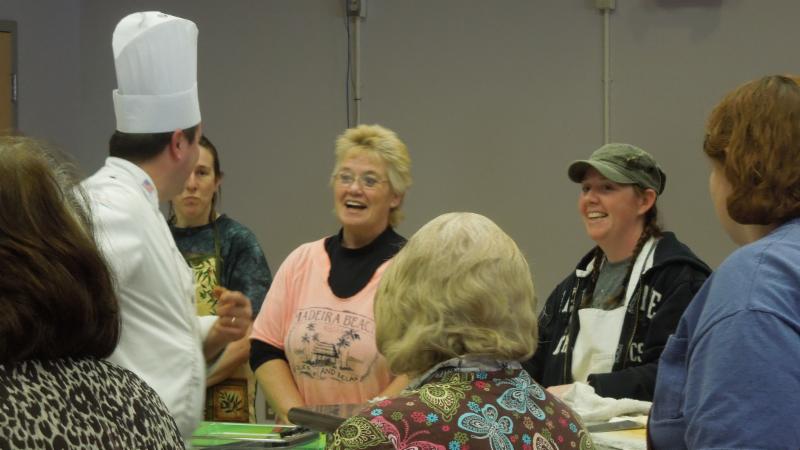
| Chef Flynn & RSU 38 Nutrition Staff |
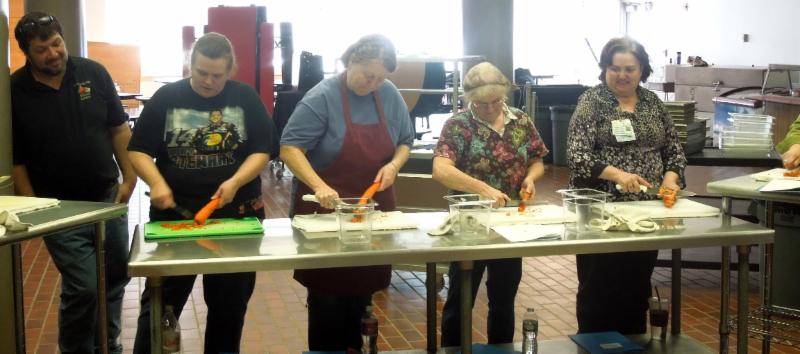
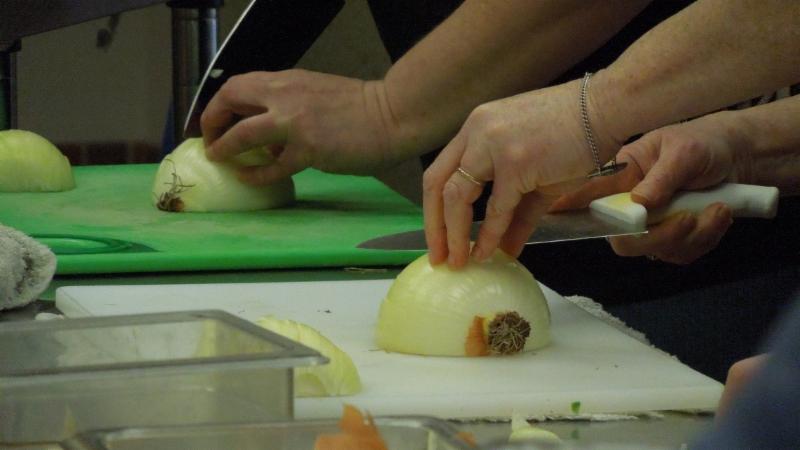
With support from a USDA Farm to School grant, Healthy Communities of the Capital Area hosted a professional development work shop for all RSU 38 Nutrition Program staff. Participants engaged in a hands on knife skills training led by Certified Executive Chef and Hyde School Nutrition Director, Mike Flynn, where they learned how to properly sharpen and care for kitchen knives as well as a variety of safe, efficient chopping and cutting techniques. These skills will support the district's move toward incorporating more fresh, local foods into school meals.
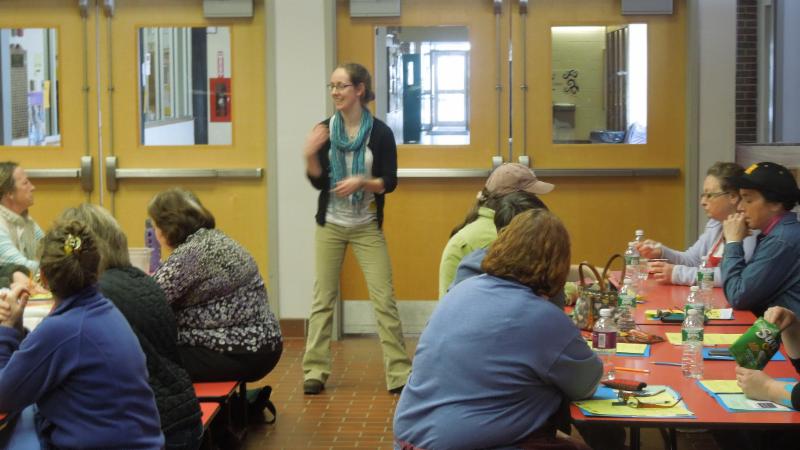
FoodCorps Service Member Caroline Moore led a session about engaging student customers. Caroline identified strategies to encourage diners to try new things as well as avoiding practices and language that may discourage students from participating in school lunch or trying new things.
HCCA is taking the training to MSAD11 Gardiner Area Schools and RSU 2 this spring.
|
|
| Learning Student Engagement Strategies |
|
| Community Food Councils |
|
Capital Area Food Council Raising Awareness About the Local Food System

The Capital Area Food Council is working to engage community members in prioritizing efforts to improve the local food system. CAFC, in collaboration with Gardiner's Solid Waste and Recycling Advisory Committee, is working to bring composting to the greater Gardiner area.
See related composting article below.
CAFC is co-sponsoring a screening of
Growing Local
followed by a panel discussion during Gardiner Main Street's week long
Spring Tonic Wellness Fair
event.
You can also visit CAFC's display table during the event on April 9th 4:30-7:00. Find and like CAFC on Facebook.
The Capital Area Food Council meets the 3rd Thursday of each month from 5:30-7:00pm at Healthy Communities of the Capital Area, 36 Brunswick Avenue, Gardiner.
Capital Area Food Council Mission: To affect positive change in the local food system.
Capital Area Food Council Vision: A food system that nurtures our bodies, our community, the local economy, and the earth.
Community Food Councils work to influence the local food system and can prioritize a range of activities from policy development to food security issues to specific food related projects. Once a need is identified, the group works collectively to address it. If you are interested in joining the Capital Area Food Council or forming a community food council in your area, please contact Renee Page at
rpage@mcd.org
|
| Getting Outside During the Depths of Winter |
|
|
Hall-Dale Middle School 7th Grade Advisor Gets Kids Outside and Moving
In mid-February, Hall-Dale Middle School 7th Grade Advisor, Scott Bell, decided enough was enough and invited his advisees for an afternoon of Soccer Hockey
fun at his family's homemade ice rink. Students wearing ice skates or boots spent some time playing a safer version of hockey with a soccer ball to get some fresh air and get moving, helping to break up t
his long stretch of winter that
has for the most part kept students inside due to freezing temperatures and bad weather. Kudos to Mr. Bell for thinking outside the box to give his advisees this wonderful opportunity!
|
|
| Mr. Bell on Hot Chocolate Duty |
|
| Kitchen Gardeners International Sow it Forward Grant Awarded to Support FoodCorps in Augusta Schools |
|
|
|
|
Click here to see all awardees
|
Growing Communities in th
e Capital Area is a network of school gardens in the greater Augusta area that are supported by FoodCorps programming. FoodCorps is a nationwide team of AmeriCorps leaders who connect kids to real food and help them grow up healthy. These gardens become centers around which communities form, as a number of stakeholders including students, teachers, youth development centers, community members, and the FoodCorps Service Member (FCSM) plan, plant, harvest, and teach lessons in and around the gardens.
Currently, gardens engage at-risk youth in Augusta at the Sylvio J. Gilbert Elementary and Cony Middle/High School, which have 69.7% and 46.4% of students eligible for free or reduced price lunch, respectively. FoodCorps also supports gardens at River View Community School in Gardiner, Gardiner Regional Middle School, Gardiner Area High School, and Maranacook Community School in Readfield.
In an effort to engage and support so many garden projects, this grant will fund tools, soil amenities, and garden-related
transportation costs. The FCSM is an indispensable garden resource especially during a garden project's first few years, and funding transportation allows for continued collaboration. Through planning, sharing resources and garden tips, and "teaching the teacher" sessions, the FCSM is a catalyst who jump starts school gardens and facilitates the necessary community support.
|
| Maine SNAP-Ed Recipe Challenge |
|
Take the $10 for 4 Challenge
 Do you have what it takes to make a healthy meal for a family of four spending just $10? Join the SNAP-Ed Healthy Recipe Challenge. No matter where you work in your community, whether you work in a restaurant, child care center, school, or hospital, show us how you would feed a family of four on $10. March is National Nutrition Month and Maine SNAP-Ed is celebrating by promoting healthy recipes that can be easily prepared and served without breaking the budget. The winning recipe and chef will be promoted to local media outlets, with the potential to share his or her recipes with viewers and readers across the state!
Recipe challenge deadline: March 31, 2015
For rules and recipe submission process go to
hccame.org
|
| Recipe for Success Winner! |
|
The Incredible Edible Soil
|
|
| FoodCorps Service Member Caroline Moore |
FoodCorps Service Member Caroline Moore submitted one of the
winning recipes for the Farm to Institution Online Recipes for Success Book contest. Farm to Institution New England (FINE) sponsored the contest that sought "recipes" for successful farm to school programs. They were not looking for traditional cooking recipes, but activities, lessons, strategies, and projects that improve food and farm education, school meal programs, farm to school connections, and more. The recipe book will be unveiled at the Farm to Institution Summit April 7-9 at UMass Amherst.
Caroline's recipe for success happens to include an actual food recipe.
Incredible Edible Soil is a lesson that teaches s
oil is made up of (among other things) sand, silt, and clay - 3 inorganic materials that differ in size. Of these three, sand is the largest particle, and creates air spaces within the soil. Clay is the smallest particle, known for packing together and water retention. In this recipe, use Chex Cereal to represent sand, Dried Cranberries for silt, and Sunflower Seeds for clay.
Loam is a soil composition ideal for growing and is composed of 40% sand, 40% silt, and 20% clay; the "edible loam" recipe follows these proportions!
Edible Soil (Loam) Trail Mix
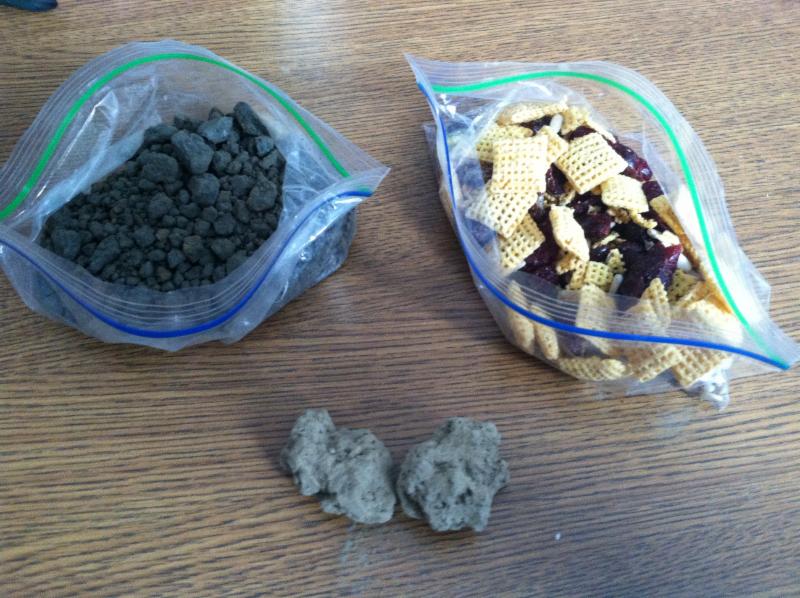
4 Tablespoons Chex Cereal (Sand)
4 Tablespoons Dried Cranberries (Silt)
2 Tablespoons Sunflower Seeds (Clay)
|
|
Gardiner Selling Backyard Compost Bins & Kitchen Waste Pails for Earth Day 2015
|
|

Tired of seeing all those kitchen leftovers from preparing meals and snacks get thrown out in the trash or eaten by critters in your makeshift composting bin the backyard? Here is your chance to turn those scraps into a rich soil amendment.
As part of Earth Day 2015 celebrations, Gardiner is participating in a statewide backyard composting equipment sale. Through
May 2, 2015
, a home compost bin and how-to guide with a combined retail value of $100 may be purchased for only $48 (tax included). The bin is black, has a 10-year warranty and is made of 100% recycled plastic. It is approximately 35" high and 33" wide, or large enough for a family of five.
The two-gallon Sure-Close kitchen scrap pail is also available for sale at $8. The vented lid deters odors and fruit flies. The city is also offering the Wingdigger compost turner for $18 and a 20-inch thermometer for checking the inside temperature of your compost bin for $20.
The Systern 55-gallon rain barrel for watering the garden and keeping the material in your compost bin moist is also for sale, at a reduced price of $65.
Printed order forms are available at City Hall, at various places around town, and on the City's website at GardinerMaine.com (there is a link to the form under "Where Do I Go For?"). Orders may also be placed online in the City's online "store". Click on "Online Payments" on the website, then click on "Gardiner Store". You will be charged a small credit card transaction fee.
Contact City Clerk Lisa Gilliam at 207.582.4460 or Judy Dorsey at 207.582.3298 for more information.
|
| HCCA Can Help You Update Your School Substance Use Policy |
|
New Substance Use Policy Guide Available
 |
| SAMHS School Substance Use Policy Guide |
Maine Substance Abuse and Mental Health Services updated its School Substance Use Policy Guide and Healthy Maine Partnership staff across the state are available to help schools update their substance use policies. Effective substance use policies are an essential part of creating a healthy, safe school environment for students, staff, and communities.
Key Components of a Model Policy:
- Philosophy Statement
- Community Involvement
- Communication of Policy
- Prevention Education
- Prohibitions
- Enforcement
- Consequences
- Intervention & Treatment
- Review & Revision
It is recommended that schools review and revise their policies at least once every two years. FMI: Contact Renee Page at rpage@mcd.org.
|
| HHFKA Brings New School Wellness Policy Criteria |
|
HCCA can help you make sure your school's local wellness policy complies with the Healthy Hunger Free Kids Act of 2010
In an effort to help combat childhood obesity, the 2004 Child Nutrition Reauthorization Act required all schools that participate in the National School Lunch Program to convene a team of stakeholders to put in place a Local Wellness Policy that defines goals for:
- nutrition education
- physical activity
- other wellness activities
- nutrition guidelines for all foods available on campus
The Healthy Hunger Free Kids Act of 2010 takes wellness policy requirements a step further by requiring:
- building level implementation plans
- policy communication plan
- goals for nutrition promotion
- policy enforcement & compliance plan
Contact Renee Page at rpage@mcd.org for help navigating the requirements to bring your district's policy up to date.
|
| Welcome Josephine! |
|
Wholesome Holmstead welcomes a new addition
|
|
| Wholesome Holmstead welcomes the newest addition to their herd |
Wholesome Holmstead diversified family farm in Winthrop offers fresh dairy and meat products. Visit them online at
wholesomeholmstead.com
, at the farm on Stanley Road in Winthrop, at Viles Arboretum Farmers' Market, and a number of other locations.
|
|
|
I hope you enjoyed learning more about local food and school happenings in southern Kennebec County. Please contact me if you are interested in learning more or becoming involved.
In Health,
Renee Page,
Assistant Director, Healthy Communities of the Capital Area Central District Maine Farm to School Network Representative National Farm to School Network Regional Steering Committee, State Co-Lead Maine Farm to School Network Co-Coordinator FoodCorps Service Site Supervisor USDA Farm to School Grantee |
|
|
|
|

|
Healthy Communities of the Capital Area (HCCA) is a coalition of local people who work locally to improve the health and quality of life in our communities. HCCA hosts the Central District Maine Farm to School Network Representative and a FoodCorps Service Member. HCCA is a USDA Farm to School, Maine Ag in the Classroom, and Maine Network of Community Food Councils grantee.
HCCA is one of 27 local Healthy Maine Partnerships and receives funds from the Fund for a Healthy Maine.
HCCA's mission is to convene people, organizations, and communities to collaborate on quality of life and public health issues.
HCCA serves the southern Kennebec County towns of Augusta, Chelsea, Farmingdale, Fayette, Gardiner, Hallowell, Litchfield, Manchester, Monmouth, Mount Vernon, Pittston, Randolph, Readfield, Vienna, West Gardiner, Wayne, Windsor, Winthrop, and Richmond in Sagadahoc County. |
|
|