News and information to help journalists serve the public and stay safe. |
|
As news organizations and the nation have responded to the coronavirus pandemic and the protests following the murder by police of George Floyd, journalists have increasingly confronted the need for newsroom equity and a truer relationship with the communities they serve.
The National Press Club Journalism Institute and PEN America will co-host a program on “Equity and community in local news: Lessons learned in 2020” to identify and share takeaways from pandemic and protest coverage and to look ahead toward election coverage.
|
|
Anna Pogarcic, editor-in-chief of The Daily Tar Heel, knew something wasn’t quite right with the paper’s previous election coverage: It was out of touch with the community.
Inspired by Jay Rosen’s Citizens Agenda, her newsroom partnered with other student publications in North Carolina to understand what students wanted to know about the 2020 election. The result is One Vote N.C., a news collaborative to empower students across the state to vote.
The Institute reached out to Pogarcic and her colleague Sonia Rao, The Daily Tar Heel’s city & state editor, to learn more about One Vote N.C.
What role does journalism play in your goal to empower students to vote?
Pogarcic: The big thing that I've noticed in my time as both a student and a journalist at UNC is that there's the idea that students are really passionate, into activism and social causes, but they don't necessarily have the same access to information about how all these processes work behind the scenes.
So for us, especially with college students in the UNC system, which is the governing body for our state public universities, there has been a lot of controversy over the past few years about the way that they're governing individual campuses. And I personally noticed a big disconnect between students being angry at the university administration and calling on a chancellor to get replaced, or something like that. I would be sitting here thinking, well, the same people who appointed this chancellor are going to appoint the next one, and the people who appoint the chancellor are appointed by our state representatives. And I was like, do these students know who their state representative is? Are they informed about state elections? That's a big part where I think journalism comes into play where we can really serve a role is helping people understand the connection between things that they care about in their daily lives and then how they can actually make an impact on that.
Rao: I think it's even more relevant now in COVID times, because students are already so confused about what the voting processes are. There's already so much voter suppression going on to suppress the students' vote, and it'll be even harder now with students going to school from home, and are maybe not going to vote in the counties that their school is in. We really want to be a resource to help answer these questions for students. To tell students they can vote, let them know how they can vote and also help them navigate who they want to vote for.
|
|
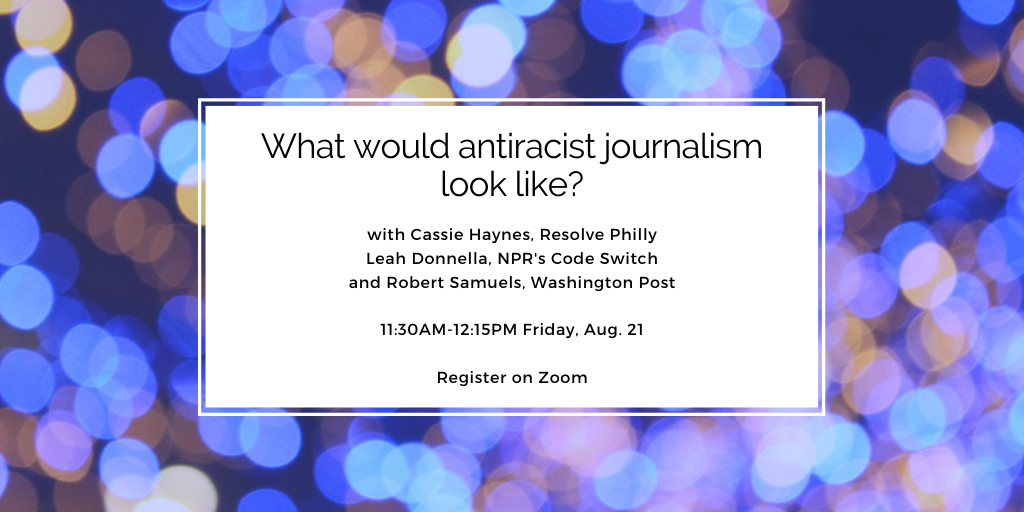
As racism and the treatment of people of color in and out of newsrooms has surged to the forefront of conversations, against the backdrop of a pandemic that disproportionately impacts people of color, journalists face many questions: When do ‘objectivity’ and ‘neutrality’ mask inequity? How do journalists move from covering protests to systemically telling stories that root out racist treatment in health care, education and other social spheres? And how can journalists practice antiracism in their everyday work?
|
|
Bill Plante Chair in Leadership & Media Integrity, Loyola University Chicago
Freedom Forum Fellow in Women’s Leadership
In the trenches.
That’s where some of our best work relationships were formed.
- On field assignments where we got to know each other’s beliefs, strengths and quirks.
- On big events and breaking news where our focus and purpose led to teamwork, not turf protection.
- On overnight or weekend shifts where our smaller crews were more self-directed and interdependent.
- On task forces or skunk work teams where we created something new and meaningful.
Those “in the trenches” experiences forced us to reveal more of ourselves while learning more about others. When we liked what we learned, we looked for more opportunities to work together. We built trust, which is the heartbeat of great work teams. We still tell stories about our shared adventures.
Today, as the pandemic has dispersed and separated us, the trenches aren’t the same. We may work the same shifts and on the same projects or programs, but it’s much easier to detach from each other. Our communication and connections are virtual, often scheduled.
We may default to commiserating with our old trench-mates and not develop new ones. Imagine how that will affect employees who are hired during the pandemic and how, if we’re not thoughtful, they may feel like outsiders.
Managers can create events and assignments that bring people together across the virtual space, but that’s just setting the scene. They can’t force people to tune in more closely to each other or to build personal backchannel conversations apart from scheduled meetings. That responsibility, that opportunity falls to all of us.
The pandemic has forced us all into a big socially distant trench. With intention and creativity, we can keep it from weakening our all-important working relationships.
Imagine the stories you’ll someday tell about this adventure. Who will be your co-stars?
|
|
|
We get it: When you cover this historic pandemic all day and night, turning your thoughts inward — and writing more — may not be at the top of your self-care checklist.
But journaling, or other expressive acts, do much to soothe and destress in the moment while providing meaningful reflection. Regardless of form — traditional pen and paper, blogs, photography, video — journaling allows for reflection and trend-spotting while offering a snapshot of the historic present for future generations.
If you’re stuck getting started, consider this:
- What has changed in your day-to-day life since COVID-19 began?
- Do you think you’ve changed over the last several weeks and months? If so, how?
- How are you maintaining connections to people and things that add to your joyfulness during the pandemic?
- What are you learning about yourself as a result of the coronavirus-related shifts in your life?
- Has this lockdown clarified anything for you about what you want in the future? Why?
|
|
This newsletter is written & edited by the National Press Club Journalism Institute staff: Beth Francesco, Holly Butcher Grant, and Julie Moos. Send us your questions and suggestions for topics to cover.
|
|
|
|
|
|
|