Understanding Library-Related

State Legislation

February 10, 2026


Proposed Library-Related State Legislation

The State Legislature is in session and several library-related bills were proposed. Here are a few of the ones we are keeping our eye on and how they could impact our services. There are a couple of other bills introduced this week that are not included here that we are reviewing; I will post updates as we learn more from the statehouse. The first deadline for bills to be considered and voted out of House/Senate committees is February 20th. 


Iowa City Public Library Director, Anne Mangano shares perspectives on Library-related bills below:

HSB636 Public Library--School District Agreements/Mobile Library Use of School Property


HSB636 would prohibit school districts (as well as charter innovation zone schools) from contracting with public libraries to allow the use of school IDs to access public library services. This bill would also prohibit schools from allowing bookmobiles or other mobile libraries to use school property to lend materials to the public.


ICPL currently partners with the Iowa City Community School District (ICCSD) to extend student access to informational and educational materials through public library collections. The Access to Information & Materials (AIM) card allows students to use their student ID at the Iowa City Public Library to borrow up to three books and access digital eBooks and audiobooks. This service is not granted automatically to every ICCSD student; parents must opt-in during the registration process to allow their child to use this service.


The Iowa City Public Library works with the ICCSD and Lone Tree District to utilize school parking lots as locations for our bookmobile. Our school visits take place after school hours and during the summer. By utilizing school properties, we better serve our community’s neighborhoods, bringing the library to Iowa City residents, especially to those with barriers to coming downtown. Our bookmobile also serves the Home School Assistance Program and rural county residents through school stops.


The purpose of the AIM card is to improve childhood literacy rates by increasing access to reading materials. Research shows that access to books is a strong predictor for success in school. Public libraries are open for more hours than school libraries, providing services during winter, spring, and summer school breaks. These partnerships also remove unnecessary duplication of services, such as subscriptions to digital collections, saving taxpayers a significant amount of money. By working together, public libraries and school districts bridge the reading gap for students who may not have direct access to reading materials at home.


The bill has passed out of the House Education committee and is ready for debate on the House Floor. It must pass the House, and then the Senate if it is to go to the governor to become law. 

HF2136 Library Record Confidentiality


Iowa Code Chapter 22.7(13) protects the confidentiality of library users by making records related to borrowing materials or information requests private. This protection applies to all patrons, regardless of age. The current exemption to library privacy is a court order connected to a criminal investigation. HF 2136 amends Iowa Code 22.7(13), proposing a new exemption that would allow parents or guardians to request and access the library records of a minor.


In practical terms, parents and guardians already have access to their children’s accounts in most situations. They can use their child’s library card, create and manage login information to view the account online, or have the child’s account linked to the guardian’s email. Additionally, if a child incurs charges for unreturned library materials, the parent or guardian is notified of the fees and the specific items involved.


However, the Iowa City Public Library takes privacy rights of minors seriously. Children’s library records have been at the center of custody disputes, and in some cases, parents requesting information are not the court-appointed guardians. While schools are informed of changes in custody or guardianship, public libraries are often not included in those communications and have no way to verify complex or contested family situations.


Most importantly, minors, especially those in their teens, may wish to access materials independently, and they should have the right to do so. Teenagers are navigating a complex world, and free access to reading materials helps them better understand themselves, others, and the broader society. Their choices may not always align with a parent’s comfort level, but gaining autonomy and independence is a critical part of preparing for adulthood. Books are a far better way to engage with complicated issues, far more than many other informational sources. Parents are encouraged to have open conversations with their children about what they are reading. Such dialogue strengthens family communication without compromising a young person’s access to information or their right to read.


You can read more about ICPL’s current privacy practices on our Confidentiality and Privacy webpage.

SF2119 Obscenity Exemption for Public Libraries


Since 2024, legislators have proposed bills to remove the public library obscenity exemption. This year, SF2119 strikes 728.7 from the Code of Iowa. This bill mirrors a 2025 House File (HF521). 


In Iowa Code Chapter 728, state laws on obscenity are addressed. It provides penalties for disseminating or exhibiting obscene materials to minors, puts limitations on the types of pornography that can be sold or rented, and defines indecent exposure. It also explains the term “obscene materials,” using language from the current legal definition from the United States Supreme Court (Miller v. California). To be considered obscene, a work must meet all the following criteria:


  • whether the “average person, applying contemporary community standards” would find the work, taken as a whole, appeals to the prurient interest
  • whether the work depicts or describes, in a patently offensive way, sexual conduct specifically defined by applicable state law
  • whether the work, taken as a whole, lacks serious literary, artistic, political, or scientific value


Because obscenity is not legally protected by the First Amendment, context is important when determining if something is obscene. The Miller test is burdensome because a court has to determine if a work is legally obscene. To shield institutions that are vulnerable to questions about obscenity, most states include exemptions for academic institutions, museums, and libraries. Otherwise, these agencies could be viewed as legally liable and would be pulled into court book by book, painting by painting, and anatomy lesson by anatomy lesson for a judge to determine if something is obscene or not. 


It is a perfectly reasonable argument that obscene materials do not belong in these settings, but opinions on what is obscene varies from person to person. It is important to note that the library does not have pornography or obscene materials in our collection when applying the Miller test. While the titles in our collection will stand up in court, the potential suits are the issue. These proposed changes to the obscenity law could lead to a significant amount of staff time at the library and the City Attorney’s Office, an increase in tort liability for the City, and fear in selecting and maintaining certain titles in the library.

Thank you for your support


Your gifts help us to support the Iowa City Public Library! Every gift helps ensure that the Library can continue to provide free access to learning, connection, creativity, and opportunity for everyone in our community—every single day.


Would you consider a gift in support of our work? A recurring gift of just $10 a month—or a one-time gift at any level—will help us strengthen the Library's collections, programs, and services!


Gifts can be made at supportICPL.org. Your support truly makes a difference.


With gratitude,


Katie Roche

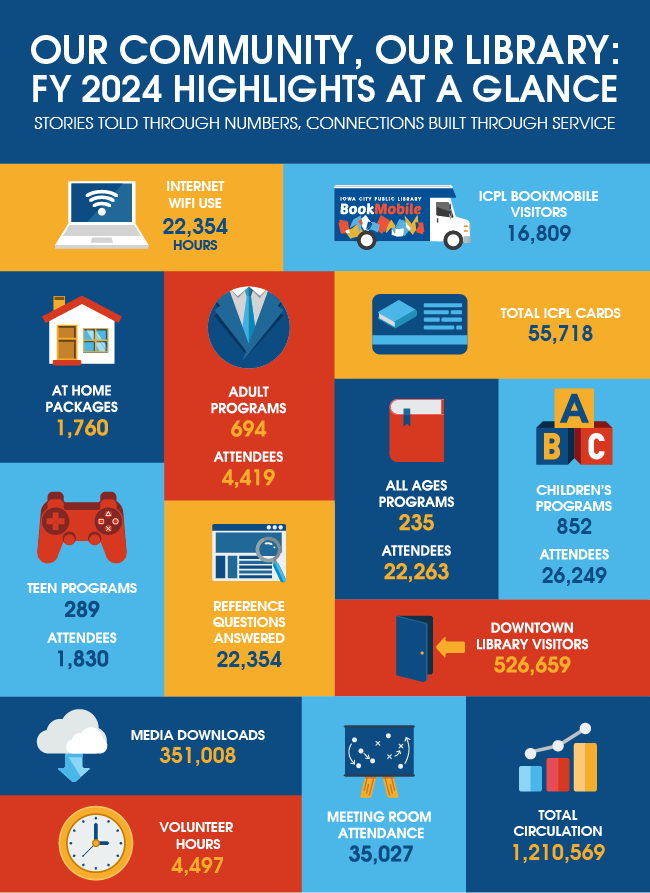
See the impact your generosity makes—explore our latest library stats.


Want More Ways to Support?


Join the Email list for the Iowa City Public Library Friends Foundation and be the first to know about fundraising opportunities, events, volunteering and more!

 
Facebook  Instagram