
Congress Out for Memorial Day Recess; FY 2025 Spending Bills a Priority
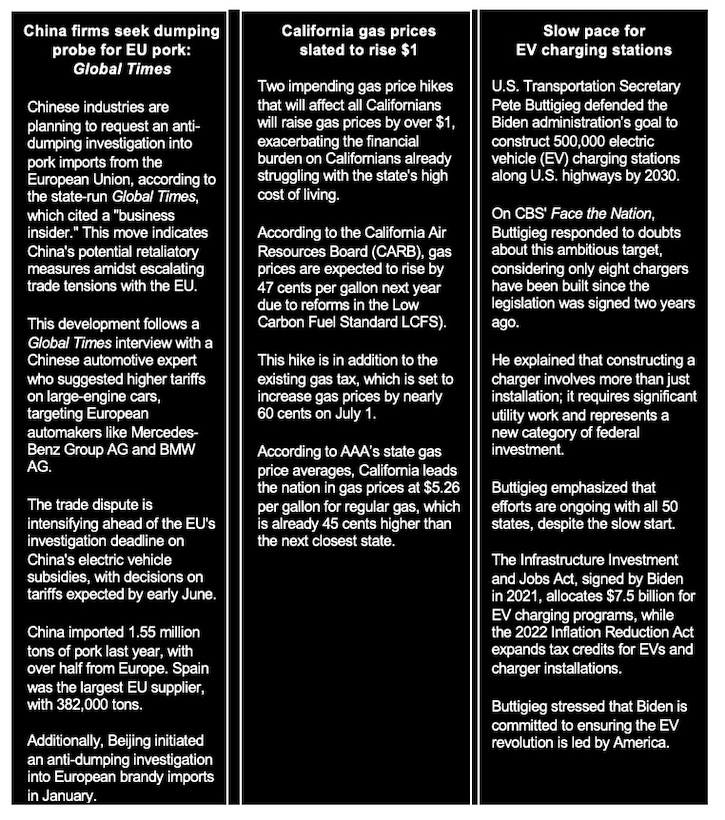
Tester in close Montana race | China firms want probe of EU pork | EV charging stations
Washington Focus
Congress is now doing what it does best: take off for a recess, in this case the Memorial Day recess. But as usual, they have a lot of unfinished business to deal with and again will be “rushed” to get must-pass bills dealt with before departing for Nov. 5 elections.
— The must-pass legislative agenda primarily will focus on fiscal year (2025) appropriations bills. With nearly eight months into the fiscal year, and key decisions and action on FY 2025 bills lacking, it is very likely another stopgap spending measure will be needed so lawmakers can focus on spending bills in a lame-duck session after elections. That could also be the case for a contentious farm bill as the House farm bill has several no-way provisions in it that Democrats from both chambers will insist be rectified. The Senate hasn’t even produced a full text bill.
— Next up for the House Ag Committee farm bill, which passed last Thursday with four Democratic votes along with all 29 GOP members on the panel: House Ag Chair GT Thompson (R-Pa.) acknowledged no House floor movement on the farm bill would take place until September, when the hope is that FY 2025 appropriations bills will be dealt with in some manner. Other key issues include whether GOP rebels on the House Rules Committee can issue a rule that will allow farm bill consideration on the floor, and if so the number and type of amendments. Another key will be House Speaker Mike Johnson (R-La.) decisions on the measure (timing, etc.). A big issue is whether Thompson can garner more Democrats other than the four who voted for the farm bill in committee to vote for the farm bill when it is considered on the House floor. That is key because several Republicans are expected to vote no on the farm bill, unless there is a major surprise of unanimity among the feisty party GOP members in the House.
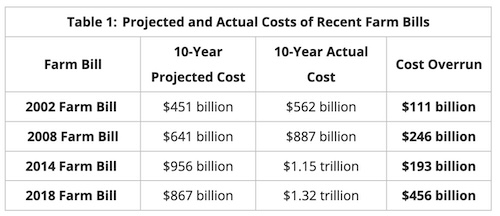
— CBO has a bad track record on sizing up farm bills. The cost of federal farm bill has increased significantly over time, according to Taxpayers for Common Sense. Since 2002, farm bills have roughly doubled in cost. When the 2002 and 2008 Farm Bills were passed, they were projected to cost taxpayers $451 billion and $641 billion over ten years, respectively. Their actual cost was much higher (see Table 1 for more details).
The most recent 2018 Farm Bill was expected to cost $867 billion over ten years but is on track to cost $456 billion more.
The costliest sections of the farm bill:
— USDA on Friday kept its food price inflation forecasts unchanged from April levels, predicting a 2.2% rise for all food, 1.2% for groceries, and 4.2% for restaurant prices in 2024. This is the first time the 2024 forecasts have remained steady since they began in July 2023.
However, there were shifts within grocery price categories. Meat, poultry, and fish prices are now expected to rise 1.5%, down from 2.1% in April. Beef and veal prices are forecasted to increase by 4.0%, up from 3.3%, while pork prices are expected to slightly decrease by 0.1%. Egg prices are projected to rise 1.8%, down from 4.8%, reflecting recent price drops.
Dairy prices are now seen falling 0.7%, an improvement from the previous 1.6% decline forecast. Prices for fats and oils are expected to rise 3.1%, up from 2.2% in April. Despite these changes, the overall food price inflation remains lower than the 20-year average, with only a few categories exceeding historical averages.
Restaurant prices continue to rise faster than grocery prices, reflecting a trend where food prices overall have increased significantly in recent years.
— Montana's Senate race shaped by pandemic-induced migration. The influx of out-of-state transplants to Montana, particularly during the pandemic, has significantly altered the state’s economy and political landscape. This surge has driven up housing prices and introduced new luxury developments, creating an affordability crisis and local backlash, the New York Times reports (link).
Senator Jon Tester, the Democratic incumbent, faces a tough re-election battle against Tim Sheehy, a businessman and retired Navy SEAL. The state’s newcomers' voting preferences remain uncertain, adding a layer of unpredictability to the race. Despite a third of the new arrivals coming from left-leaning states, experts suggest many are conservative transplants seeking a more Republican lifestyle.
Of note: Montana's traditionally conservative yet contrarian political climate, with a history of voting red in presidential elections while electing Democratic leaders like Tester, complicates predictions. The state’s population growth from 2020 to 2023, exceeding 52,000 people, highlights the potential electoral impact, given Tester's narrow re-election margin in 2018.
Local resentment towards the newcomers is evident, with rising property taxes and living costs contributing to the tension. The articles says both Tester and Sheehy must navigate these dynamics, with Tester leveraging his bipartisan appeal and farming background, and Sheehy emphasizing his contributions to the community since moving to Montana.
— Former President Donald Trump won't be among the pool of candidates for the Libertarian presidential nomination because he never submitted the paperwork necessary to qualify, CNN first reported Sunday, news that comes one day after the Republican nominee was met with boos and heckling during a half-hour speech at the party’s national convention.
— Robert F. Kennedy Jr. has a chance to participate in the June presidential debate, Axios reports, potentially disrupting the Biden and Trump campaigns, which prefer a direct 1-1 contest. This would mark the first time in 32 years that an independent candidate appears on the debate stage, making Kennedy only the third in history to do so.
To qualify, Kennedy needs to be on enough state ballots to total 270 electoral votes and achieve 15% in four national polls. While Biden and Trump's decisions to skip the traditional fall debates have disrupted the usual timeline, Kennedy appears to have met the polling requirement in three polls and has until June 20 to qualify in a fourth.
Currently, five states — Delaware, Hawaii, Michigan, Oklahoma, and Utah — confirm that Kennedy has qualified for the ballot, accounting for 35 electoral votes. The Kennedy campaign claims eligibility for 201 electoral votes, with submissions for ballot access in seven states (139 electoral votes) and sufficient signatures for another eight states.
The verification process for signatures varies by state and can be lengthy, with many deadlines extending into late summer. Kennedy's campaign director, Amaryllis Fox, criticized the enforcement of a 270 electoral vote threshold before September as impractical but expressed confidence in meeting the criteria.
Kennedy's campaign has received significant financial support from his running mate, Nicole Shanahan, who has contributed $10 million to their campaign and $4 million to a supporting super PAC.
— President Joe Biden's certification as the Democratic presidential nominee in Ohio is currently in jeopardy due to legislative delays. Ohio’s Republican Governor Mike DeWine has called for a special session of the state’s General Assembly on May 28 to address this issue, stressing that time is running out to ensure Biden's name appears on the November 2024 ballot.
The certification process requires presidential candidates to be confirmed with Ohio’s Secretary of State Frank LaRose’s office 90 days before the general election, making the deadline Aug. 7. However, the Democratic National Convention, where Biden will be formally nominated, is scheduled for Aug. 19-22, after this state deadline. LaRose had warned Ohio Democrats on April 5 that legislation to extend this deadline needed to be passed by May 9.
Although the Senate passed a bill to extend the deadline on May 9, the House did not vote on it, causing the legislature to miss the deadline. The Senate's bill included an amendment banning political campaign donations from foreign entities, which Democrats opposed. The House proposed a straightforward deadline extension from 90 to 74 days before the election, but House Speaker Jason Stephens did not bring the Senate’s version to a vote, citing a lack of support.
In response, DeWine announced the special session to resolve the issue promptly, stating his frustration with the delays and emphasizing the importance of ensuring Biden is on the ballot. The session aims to pass legislation to certify both major party candidates for the November ballot and to ban foreign contributions to campaign spending in the state.
|
|
|
Other Events & Hearings
Tuesday, May 28
Wednesday, May 29
Thursday, May 30
Friday, May 31
Economic Reports and Events for the Week
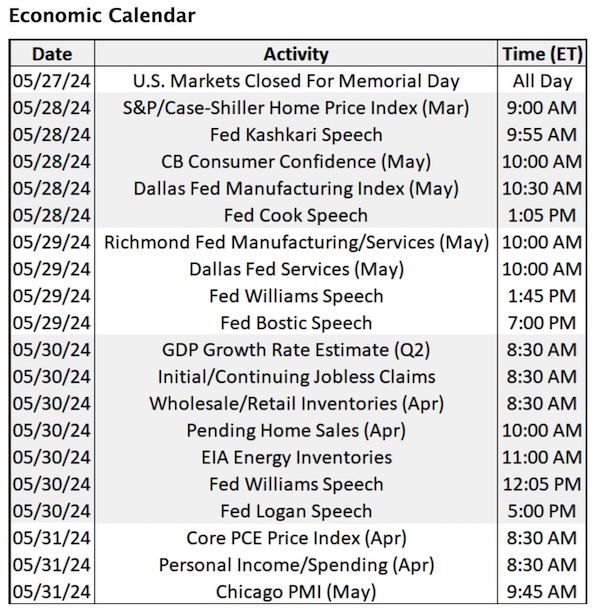
The economic-data highlight of the week will be Friday's personal consumption expenditures price index for April from the Bureau of Economic Analysis. The consensus estimate is for the Federal Reserve's preferred inflation measure to be up 2.7% from a year earlier, matching the March increase.
Tuesday, May 28
Wednesday, May 29
Thursday, May 30
Friday, May 31
Key USDA & international Ag & Energy Reports and Events
The three-day Russian Grain Forum will be held in Sochi during the week.
In the energy sector, OPEC+ will hold its critical ministerial discussions — which will determine the alliance’s production policy for the coming months — on June 2, a day later than originally expected. Hess Corp. will hold a shareholder meeting on Tuesday to decide on Chevron Corp.’s takeover bid.
Tuesday, May 28
Ag reports and events:
Energy reports and events:
Wednesday, May 29
Ag reports and events:
Energy reports and events:
Thursday, May 30
Ag reports and events:
Energy reports and events:
Friday, May 31
Ag reports and events:
Energy reports and events:
|
KEY LINKS |
WASDE | Crop Production | USDA weekly reports | Crop Progress | Food prices | Farm income | Export Sales weekly | ERP dashboard | California phase-out of gas-powered vehicles | RFS | IRA: Biofuels | IRA: Ag | | Russia/Ukraine war, lessons learned | | SCOTUS on WOTUS | SCOTUS on Prop 12 pork | New farm bill primer | | Gov’t payments to farmers by program | Farmer working capital | USDA Ag Outlook Forum |