Your Monthly News & Updates | |
|
|
A few weeks ago, Marc Pizzuto came into the society to research trains. (See article below.) While he was looking through our collection, he mentioned that he had a room at home dedicated to railroad memorabilia.
In the course of the conversation, he also said he was 65, and I asked if any of his kids were interested in trains.
No.
So I asked him what’s going to happen eventually to the railroading collection he’s been painstakingly putting together for so many years – are they going to throw it all in a dumpster?
There was silence for several seconds. He doesn’t know.
I don’t know either, as I face a similar problem, with my 2,000 LPs and a high-end audio system on which to enjoy them.
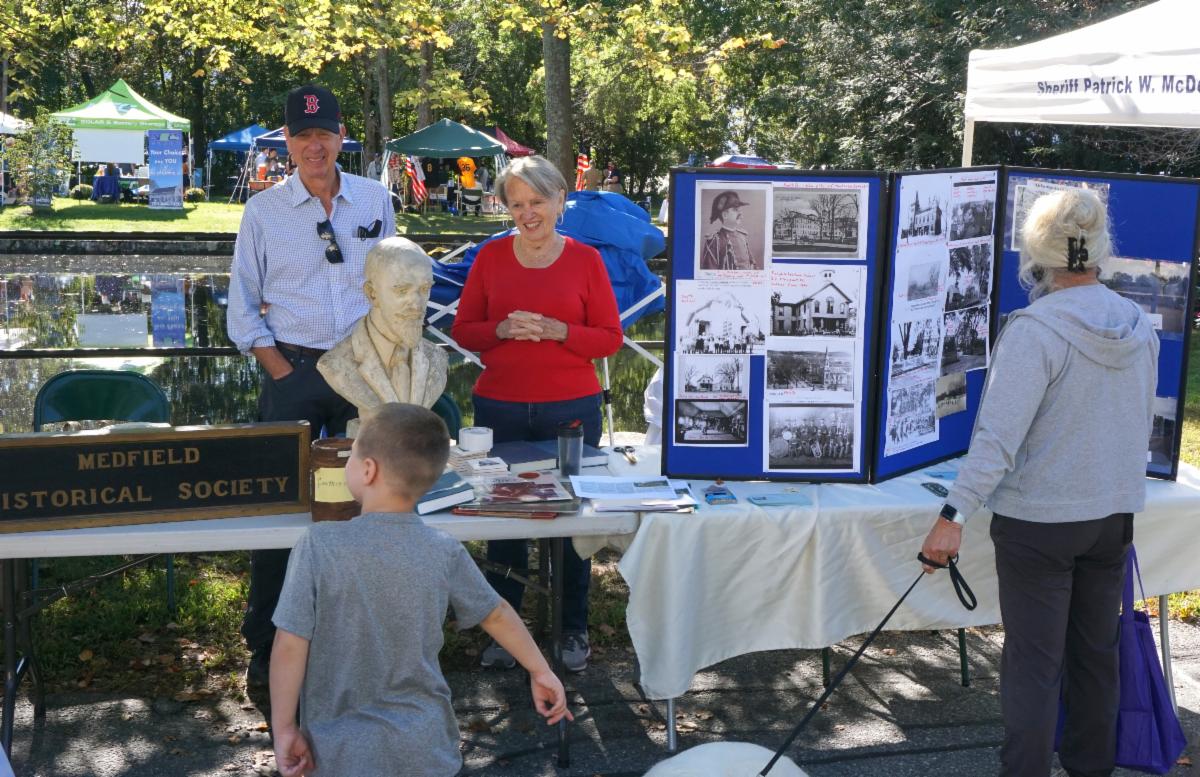
About 10 years ago the historical society had a walk-in appraisal day, which featured an appraiser who had appeared on Antiques Road Show. The first thing he said, emphatically, to the assembled crowd: “YOUR. KIDS. DON’T. WANT. YOUR. STUFF!”
All this made me wonder about collectibles and hobbies throughout history. It is assumed that singing and dancing were enjoyed in prehistoric times. The oldest known work of art is a 27,000-year-old image of a human hand in the Chauvet cave in France. Newer than painting, coin collecting was popular in ancient Rome. Hunting – killing animals for fun – was popular for centuries. Taxidermy was popular with Victorians, as was bicycling, which continues unabated. My siblings and I did not share my grandmother’s enthusiasm for her Hummel figurine collection, which now heads the list at this website.
If you’re ever bored and looking for something new and interesting to do, here’s a fascinating time sink. It lists, with hperlinks, over 600 hobbies, ranging from such mundane activities as eating, talking, and riding public transport – to dandyism, fossicking, herping, jukskei, kabbadi, LARPing, noodling, and scutelliphily.
Bon appetit!
| |
MEMO's Discover Medfield Day | |
|
Saturday, Sept 24
9:00 am to 3:00 pm
North and Frairy Streets
Medfield
On Saturday, September 24, MEMO is hosting Discover Medfield Day, now in its 42nd year. The Event consists of over 150 booths highlighting Medfield businesses and organizations. To add to the fun, there is an entertainment stage and Kids’ alley filled with rides.
Stop by and see us in Booth 39, right across from the Dwight-Derby House.
| |
Legacies of Lowell Mason, Medfield’s Master Musician | |
|
Monday, Oct 3
7:30 pm
First Parish Unitarian Universalist Church
26 North Street
Medfield
On Monday, October 3 at 7:30 pm at the old meetinghouse, aka Unitarian church, the featured speaker will be Stephen Marini, who has taught at Wellesley College since 1976. Prof. Marini made a very significant donation of Lowell Mason papers, music, and memorabilia to the historical society last spring.
About the October 3 program, he says “I plan to present a number of Mason’s legacies—spiritual (his Savannah materials), educational (public music education), performance (Handel and Haydn, etc.), compositional (the hymns), and commercial (publishing and more)—to interpret him as a quintessential 19th-century Bostonian.”
The presentation is free and open to the public, of course. Please join us!
| |
Coming on November 7 - Retired Judge Thomas A. Connors of Medfield will speak on the history of the Dedham court and some of the interesting cases he has participated in. | |
|
The Peak House 2022 Visitor Season More Than Half Over
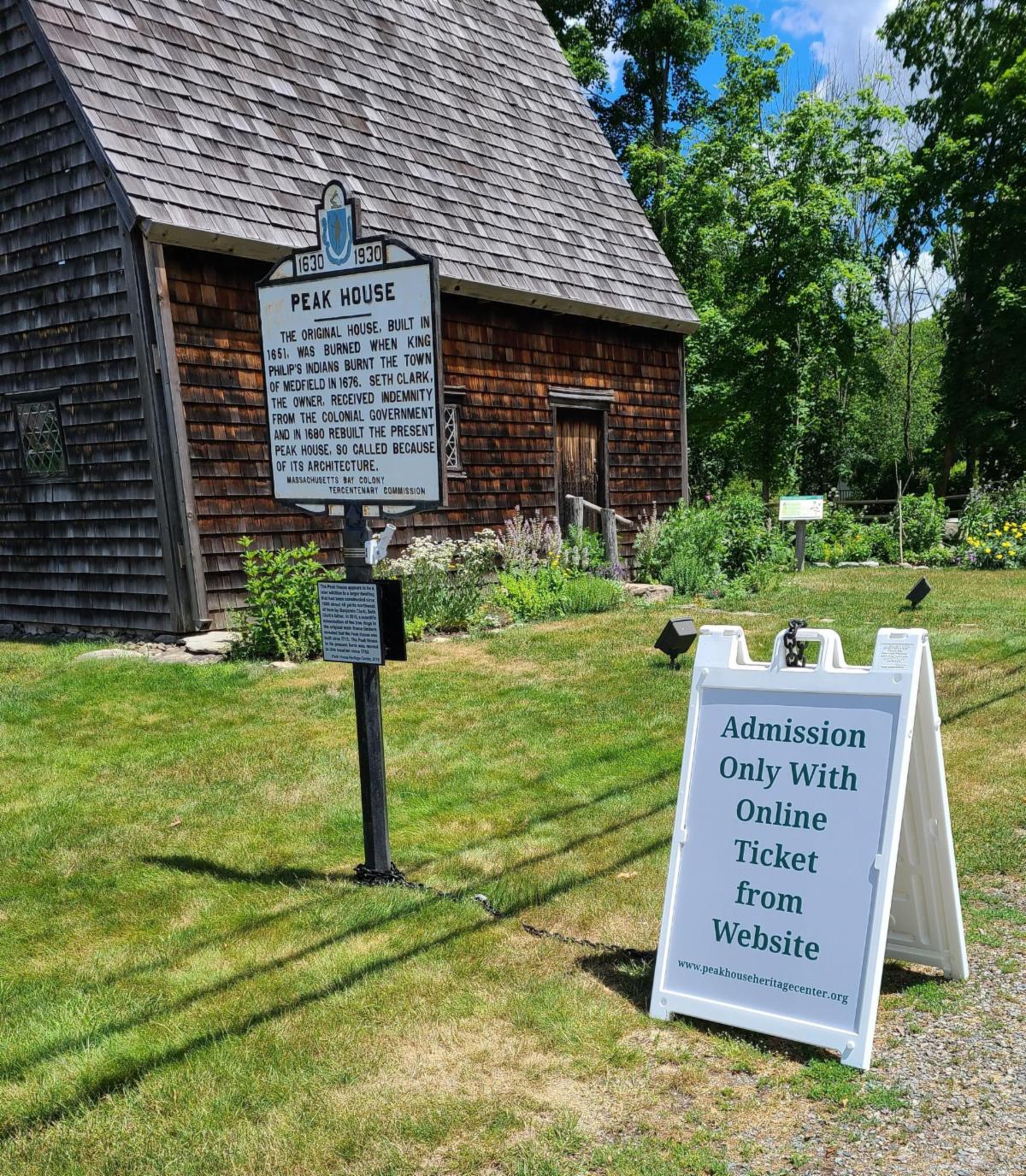
The Peak House Heritage Center 2022 visitor season kicked off on July 9, with six sold out sessions that day and rave reviews.
There are only a few remaining sessions for the 2022 season—the second and fourth Saturdays of September and the fourth Saturday of October.
Schedule your visit today to discover new self-guided displays featuring intriguing artifacts, interactive exhibits, authentic colonial gardens.
Paid admission is by tickets available only through their website. You first choose a date for your visit and then select a time slot from the six available on those Saturdays.
Covid-related restrictions limit eight (8) visitors at a time for a suggested visit duration of twenty (20) minutes. You are welcome to tour the outdoor gardens for as long as you wish.
| |
When Trains, Not Automobiles, Ruled | |
|
If you Google “railroad enthusiasts” you get 39 million hits! Organizations for railroad enthusiasts, 8.6 million!
Marc Pizzuto is one such enthusiast. He has a room full of railroad memorabilia in his Norwood home. He recently came to visit the Medfield Historical Society to conduct some research and share stories and pictures about railroading.
Marc also brought two publications which provided much of the historical information in this article – a 40-page historical brochure, Bay Colony Railroad Excursions, by J. Leonard Bachelder of the Massachusetts Bay Railroad Enthusiasts, Inc., and a 13-page article, The Charles River Line, by C. A. Brown, which appeared in Shoreliner, a publication of the New Haven Railroad Historical and Technical Association. Other information in this article came from Wikipedia articles.
--
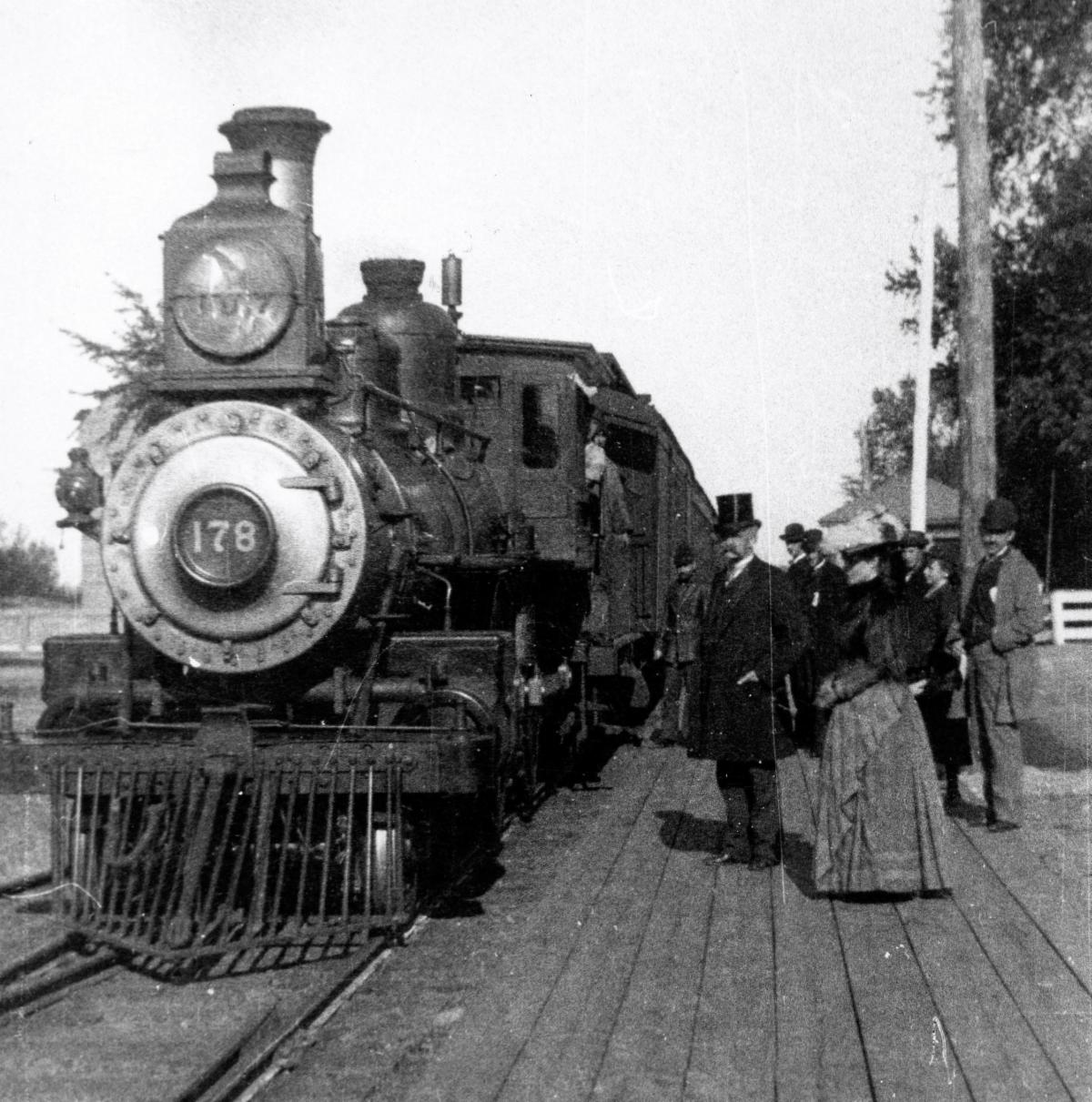
For decades, Medfield residents and other drivers on Route 109 have been accustomed to sporadic interruptions as freight trains rumble through the crossing between Park and Spring Streets. But for a century, trains were a Big Thing, before they succumbed to the automobile.
| |
The first railroad in Massachusetts went into operation May 16, 1834, connecting Boston to Newton with three daily trains. Construction continued westward, and the first train steamed into Worcester in June 1835. In that decade rails were laid to connect Boston to Lowell and Providence.
In 1852 service began on a new branch connecting Newton with Needham, and a charter was issued for the Charles River Railroad to build a line from Dover to Bellingham.
Service connecting Medfield to Boston, via Needham, began November 18, 1861. The service stopped and resumed several times, but it stopped for good April 21, 1967.
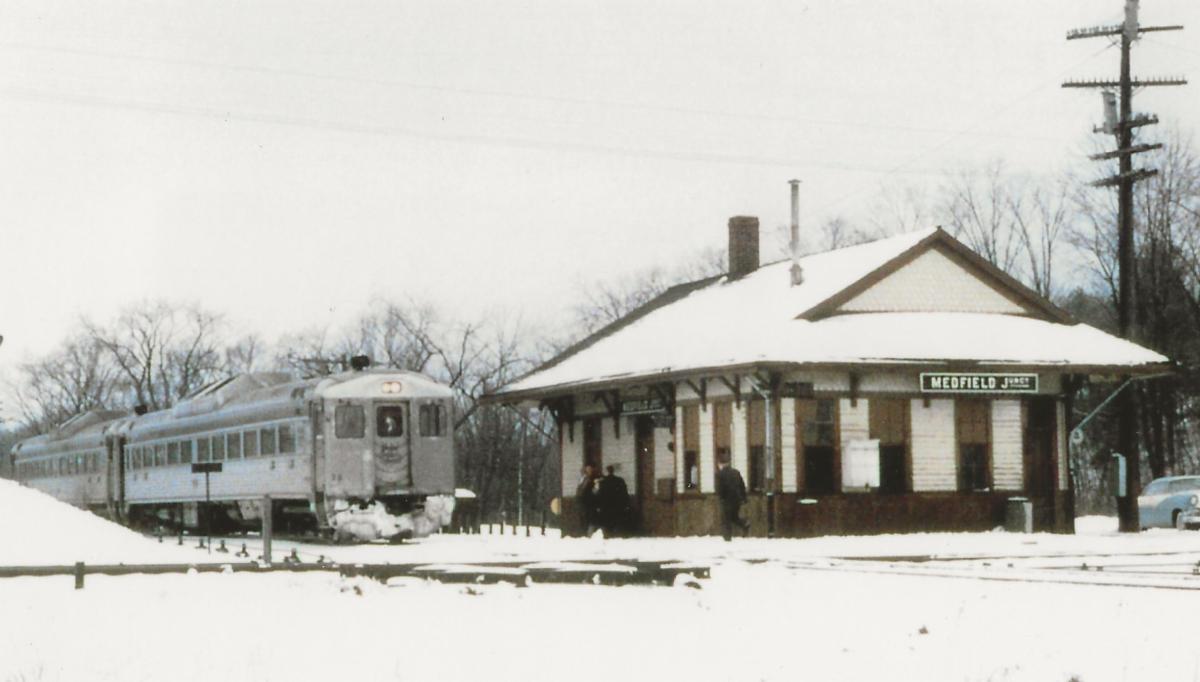
| The Medfield Junction station was at the intersection of Adams and West Mill Streets, at the crossing of the two railroad lines. | |
|
The winter scene at Medfield Junction was shot in the late 1950s – the parked car barely in the photo is a 1956 Ford. On the tracks are two Budd RDC-1 cars, joined together. Each car could hold 90 passengers and is self-powered with its own diesel engine; they were intended to provide rail service for passengers on less-traveled routes. The fare from Medfield to Boston was $1.16 in 1965.
In 1867, the Mansfield and Framingham Railroad opened on a perpendicular route, crossing the Charles River Railroad line at Medfield Junction and opening its own station closer to the center of Medfield. Passenger service on this line ended in 1933.
Click here to read more>>
| |
Medfield Happenings in '22 | |
|
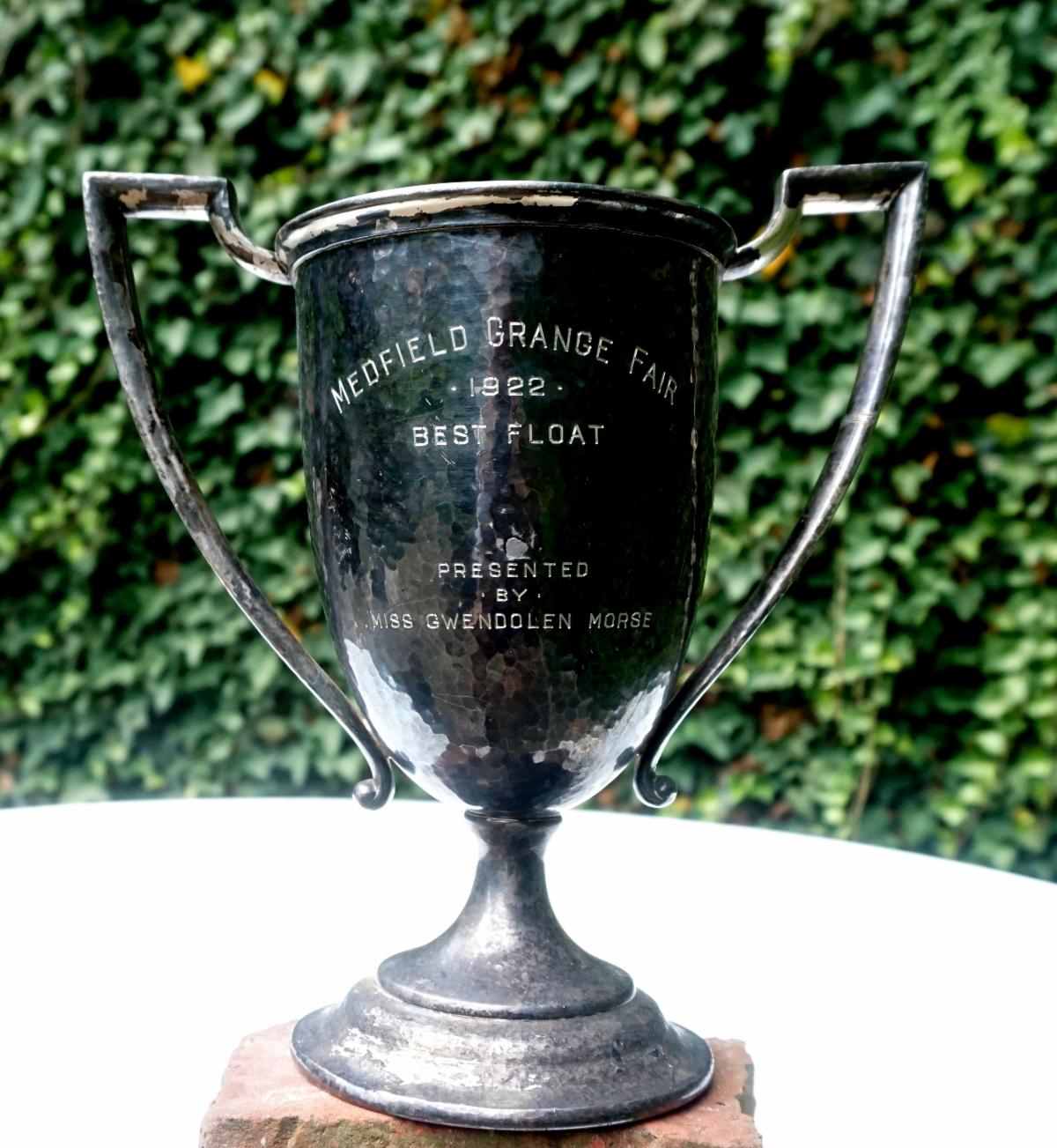
This trophy awarded 100 years ago begs the question – what else happened in Medfield 100 years ago? 200 years ago? 300 years ago?
1722
Three hundred years ago, Medfield was a very different place than we see around us today, with acres of undeveloped land, free-flowing streams and rivers, paths that led through dense forests and significantly fewer houses. As is still the case today, though, there was an issue about education, and Medfield was “held to answer for not maintaining a grammar school according to law . . .” (History of the Town of Medfield Massachusetts 1650–1886, by William S. Tilden) The selectmen were Adams, Bullard, Ellis, Plimpton, names well-known to us by streets named in their memory. There were approximately 130 landowners in town, a small number of whom were women who had been widowed.
In this year, the United States of America was yet to be formed, and its inhabitants lived under British rule. Nonetheless, it produced some remarkable individuals and events. Boston’s own Samuel Adams was born on 27 September. A graduate of Harvard College, he went on to become active in the Revolution. Benjamin Franklin’s first letter from Mrs. Silence Dogood was published in the New England Courant, a Boston newspaper.
In London, Moll Flanders, a scandalous novel by Daniel Defoe, was published anonymously, and General Johnny Burgoyne, the British general who fought against us in the Revolution, was born.
In a curious set of circumstances, a statute in the colony of Pennsylvania was enacted requiring a fee of £5 for any individual who brought into the colony a person previously convicted of sodomy.
1822
It seems that this was a fairly quiet year in Medfield. Tilden reports only that the Baptist church was enlarged, the Town granted $50.00 for a “singing school,” and the Congregationalists collected $26.55 for a gentleman in Mendon whose house had been destroyed by fire.
Click here to read more >>
| |
People and Places of the Past | |
Remembering and Celebrating the Iafollas | |
|
In the last issue of The Portal, I wrote about the Palumbo family of Frairy Street. This month the focus is the Iafolla family on that street that was known as Little Italy.
In the 40 years between 1880 and 1920, some 40 million Italians emigrated to the United States.
Antonio Patrizio Iafolla, born on April 19,1883 in Villa Lago, Italy. His work life began at age 12 in 1895 when he worked as a mason and on a railroad in Rome. He emigrated to the United States in 1900 and worked few years in Pittsburgh, Pennsylvania as a coal miner and iron worker.
Antonio returned to Italy and worked for the military police. In 1906 in his hometown of Villa Lago, Antonio at the age of 23, fell in love with and married 19-year-old Caterina Gatta. Caterina had more formal education than Antonio, and she was very adept at reading and writing Italian. She also learned the domestic arts of cooking, knitting, and crocheting, which she enjoyed all her life.
In Italy and America, she was a homemaker and by hand cut wheat for bread. She also trained in domestics, for sewing, knitting and crocheting which she fulfilled all her life.
Antonio visited the United States in 1907 and again in 1910, at which point he decided to stay and seek his fortune in this land of opportunity. Antonio had spoken of the hard life in his homeland of Italy – was no running water, no facilities, hard work with no opportunity…where “we had rocks to eat.”
| |
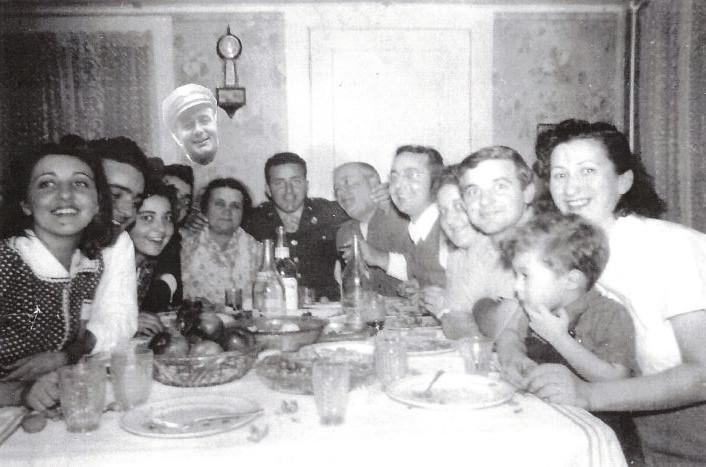
Iafolla family photo taken around 1945. Left to right: Tess, Nina (who became a Medfield police sergeant), Helen, Henry, Peter (insert), Caterina, Pat, Antonio, Curley, Paulina, Mario, Florence (holding young Eric in her lap). | |
|
Uncle Bob Palumbo changed his last name to Palson in part because of anti-Italian (and general anti-immigrant*) sentiment that grew from the sensational trial of Sacco and Vanzetti, two Italian men falsely accused of murder in the 1920s. Uncle Bob was a graduate of Harvard University and taught classes at Boston Trade High School. He was a brilliant man who was a devoted husband to wife Polly Iafolla and benevolent father to their son, Barry and daughter, Diane.
Click here to read more >>
| | | | | |