POLICY & ADVOCACY UPDATE

Issue #37, 23 January 2025

  • Coalition supports entertainment expenses tax deductibility
  • Migration meeting discusses key issues
  • Talk on a visitor tax in TNQ
  • Hotel performance in 2024 was positive
  • Overseas arrivals for November 2024

Coalition supports entertainment expense tax deductibility

Earlier this week the Opposition Leader Peter Dutton announced that the Liberal National Coalition if elected would allow small businesses (up to $10 million in turnover) to claim up to $20,000 in business-related meal and entertainment expenses as tax deductions and that these not be subject to Fringe Benefits Tax. This policy change has long been sought by the Australian Hotels Association who welcomed the announcement. AHA National CEO Stephen Ferguson said the Association had spent years pushing for FBT relief for hard-pressed small businesses and their workers and that the proposal is a win for common-sense. Large businesses have always been able to get around the tax and FBT rules by offering in house catering but for small businesses, client and worker relationships are critically important and are often best cemented over a meal or in a social setting. The policy was a key issue raised in the AHA's pre-budget submission and is included in the AA's submission to be finalised this week. It is hoped that, in the run up to the federal election, both parties take forward the change in taxation treatment of entertainment expenses. It would be a major stimulant for spending in hotels across the country and big benefit to small businesses in all industries who use this type of expenditure to improve their relationships with customers, suppliers, investors and staff.

Migration meeting discusses key issues

Last week AA CEO James Goodwin and I met with lead managers of Australia's skilled migration and working holiday maker programs at the Department of Home Affairs to discuss key issues impacting the accommodation sector. We took the opportunity to confirm that changes have already been made to the regulations which came into operation in December in order to clarify that chefs can be sponsored under the new Skills in Demand temporary migration visa from any country, not just those we have free trade agreements with (see story in the update of 19 December 2024). It was clear that outcomes from last year's regional migration review (to which AA made a submission) will not be seen this side of the election. Issues such as the concern that restaurant managers are no longer available for sponsorship, improving the processing of inter-company transfers, reducing the Skilling Australians Fund levy and broadening the regional definition used for specified work of working holiday makers were also discussed. Migration remains a key issue for members and is part of our pre-budget submission to be sent to Treasury this week as well as our election platform.

Talk of a visitor tax in TNQ

Tourism stakeholders from across Queensland are meeting in Cairns this week to discuss a strategy for growth to 2045. The Queensland government said that the 20-year tourism plan is aimed at

enhancing Queensland’s global appeal, unlocking untapped lifestyle and cultural opportunities,

and maximising the legacy of the 2032 Olympic and Paralympic Games. This is all good news for the accommodation sector in that state. However, of significant concern is that some of the tourism operators in the region are pushing for a local tax on tourism or "visitor tax". Almost inevitably, this becomes are discussion about a bed tax which would be a dangerous precedent as the burden of the tax is borne only by accommodation providers rather than all that benefit from tourism. Even if the tax is broadened to all businesses in the region, the levy becomes a de facto increase in local rates and taxes on commercial businesses. It is also a truism that once any tax is imposed it is hard to remove, even when the original idea of what uses the money can be put to change over time. You only have to look at the Passenger Movement Charge for an example of over-collection. When the GST was implemented in 2000, existing bed taxes such as in the NT were removed. From a pure policy perspective, tourism benefits all who live in a region, not just tourism related businesses, but those who work in the industry, and those who benefit from the spending of not just tourists but tourism workers. This is the policy argument behind why bodies such as Tourism Australia and the state tourism marketing bodies are funded out of consolidated revenue. That is why (as the old tourism slogan goes) "tourism is everyone's business".

Hotel performance in 2024 was positive

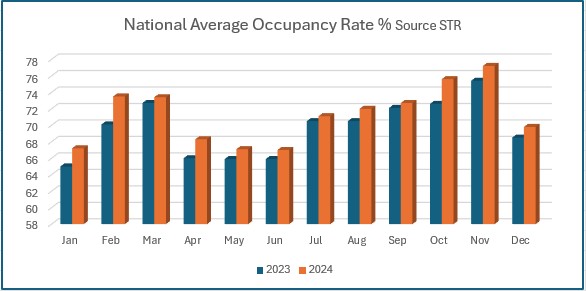
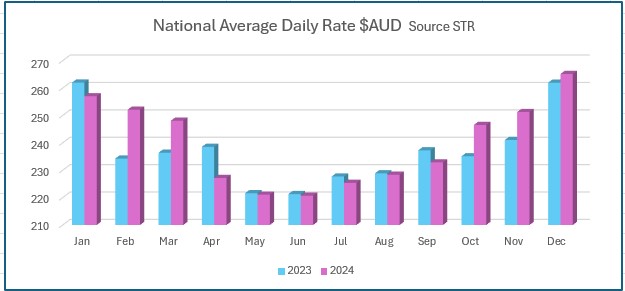
The STR data released this week for the calendar year 2024 shows that the Australian average occupancy and Average Daily Rate for 2024 were both up compared with 2023. The average occupancy in the month of December across Australia was 69.8% compared with 68.5% in December 2023, and the Average Daily Rate was 1.2% higher at $265.13 compared with $261.95 in December 2023. Revenue per available room in December 2024 was $184.93, an increase from $179.31 in December 2023. For the year to December 2024, the average Australian occupancy rate was 71.3% compared with 69.5% in 2023. The rise in the ADR over this period was only 1.1% to $239.63, which remains below the inflation rate. Growth in revenue per available room increased from $164.88 in the year to December 2024 to $170.86 in 2023. Occupancy rates for calendar 2024 were up in all States and Territories, with particularly strong performance in WA followed by Queensland and Victoria. The same can't be said for the ADR changes, with falls in ADR in Tasmania, NT, ACT and Victoria. In contrast to the rise in occupancy rates in Australia, New Zealand continues to struggle, with an occupancy rate for the year at 67.1% compared with 68.0% in 2023. ADR for the year was also down, being NZD226.83 in 2024 compared with NZD228.49 in 2023.


The graphs below derived from the STR data show the performance of occupancy and ADR across the full calendar year. As can be seen, occupancy rates were better than 2023 in every month, but the average ADR improved only in February and March and then finished well up on last year in October to December.

Overseas arrivals for November 2024

The latest statistics from the ABS for November 2024 show that there were 679,290 short-term visitor arrivals in Australia, an increase of only 2.3% compared to November 2023 and 16.7% below pre-COVID November 2019 arrivals, with this last comparison a deterioration from last month. New Zealand was the largest source country, followed by the USA and the UK. Of the top 10 source countries, only South Korea and India had more arrivals in November 2024 compared with November 2019. For the year ending November 2024, there were 8.18 million short term visitor arrivals compared with 6.96 million in the previous corresponding, but still down by 13.5% from the 9.5 million arrivals in the year to November 2019.


In November 2024 there were 32,570 international student arrivals to Australia, a decrease of 1,980 students compared with the corresponding month of the previous year. The number of student arrivals in November 2024 was 14.9% lower than the pre-COVID levels in November 2019.

Drop me an email at policy@accommodationaustralia.org or give me a call on 0418 277 919 if you have any national policy issue that you think AA should be following up.  If you know an AA member who is not receiving this advocacy report but wants to, then encourage them to email me and we can add them to the distribution list.


Kind Regards


Jenny Lambert OAM

National Policy Director

Accommodation Australia

Facebook  Linkedin