Sonoma Water E-News | September 2024 | |
Sonoma Baylands Restoration Project Recognizes Supervisor Susan Gorin | |
This week we recognized retiring Sonoma County Supervisor and Sonoma Water Director Susan Gorin for her tireless work on the Sonoma Baylands Restoration Project. In a gathering out on Hudeman Slough that included key project partners from the County of Sonoma, Sonoma Land Trust, San Francisco Bay Restoration Authority, U.S. Fish and Wildlife Service, Ducks Unlimited, Sonoma County Ag and Open Space, Sonoma Water, partners shared project milestones, future vision for restoration, and most importantly celebrated Supervisor Gorin with the dedication of a bench in her honor. The view of the Baylands is great from that bench! | |
|
Looking back over 75 years: The 1980s
| |
In response to drought conditions in the late 1970s, Sonoma Water launched a water conservation program in 1981 focused on outreach to schools and the landscape industry. Through the program, Sonoma Water distributed free water conservation booklets, bumper stickers, and pencils with the message "use water wisely" to teachers and students at schools in Sonoma and northern Marin counties. Sonoma Water also developed water auditing and leak detection programs and used the Sonoma County Fair to promote conservation. | |
|
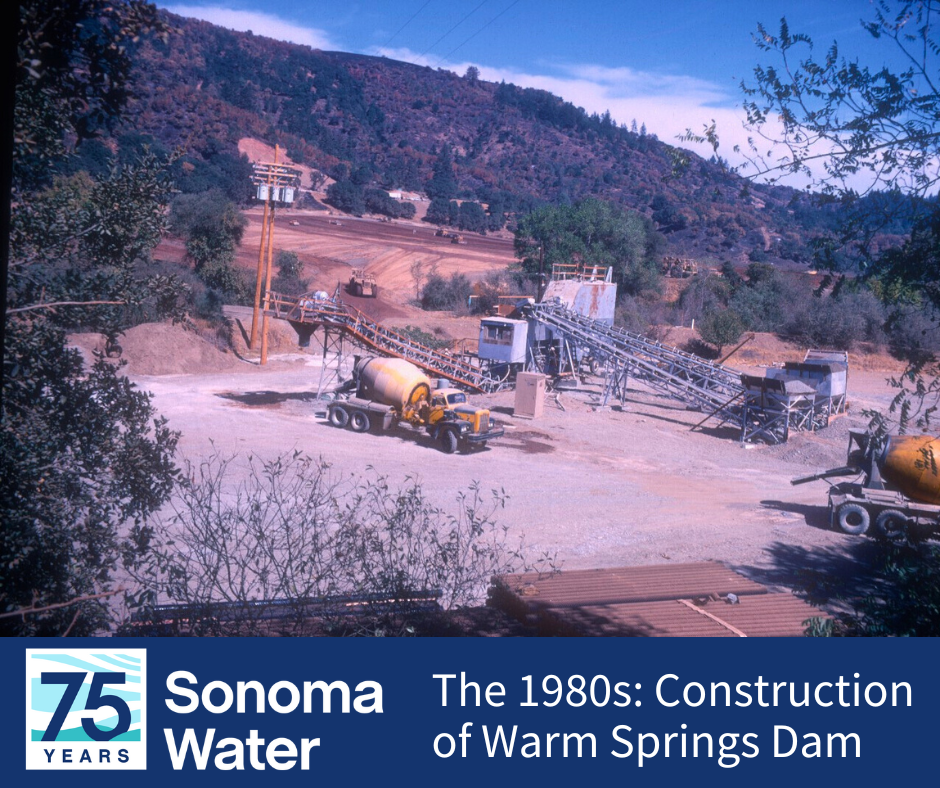
In 1983, Lake Sonoma began storing water behind the newly completed Warm Springs Dam. (dam construction pictured above)
Sonoma Water developed its first Urban Water Management Plan in 1985. The plan, which is updated approximately every five years, most recently in 2020, estimates past, current, and projected water use; describes available conservation measures, including their cost-effectiveness and environmental and other effects; schedules implementation of proposed conservation measures; and estimates the frequency and magnitude of droughts and water supply emergencies. The plan also includes an evaluation of water reclamation possibilities, opportunities for water transfers or exchanges, conservation incentives and public outreach or educational programs.
In 1986, the operation of Lake Sonoma and Lake Mendocino changed to accommodate the State Water Resources Control Board's Decision 1610, which established minimum in-stream flows for Dry Creek and the Russian River downstream of Lake Mendocino. These flows were designed to support recreation, fish and wildlife, and other beneficial uses of the Russian River.
| |
Protecting water from streets to creeks | |
Did you know that anything that goes down the storm drain flows untreated into your local creek? Simple actions have a BIG impact. This video below provides has some practical tips that are both easy to do and impactful. And check out StreetsToCreeks.org to learn more about actions you can take to protect our local watershed. | |
|
A Call to Action grant program inspires long lasting changes on campus | A visit to local recipients of the last few years of grants from A Call to Action demonstrated that, when kids are offered the chance to make a difference for a more sustainable way of life, they engage wholeheartedly. Jessica Brandenberg, teacher at Piner Olivet Charter School has seen this on her campus. Three years ago, she worked with her leadership class to launch a program to start a compost bin collection system at lunch time. At the time, few students were familiar with the idea, or even knew what composting was. Now, they fully understand and expect it, and take the lead in making it happen on campus. She noted that on a field trip, the students were all asking where the compost bins were for their food scraps, and the site they visited didn’t have anything set up. Now, it’s routine, expected, and understood how important it is to do for environmental impact. |  | |
At Brooks Elementary School in Windsor, teacher Allie Hartley combines gardening with science and used an A Call to Action grant to support a three-year project based learning initiative with her students to transform dry, vacant planting beds to vibrant teaching gardens to attract pollinators like butterflies, bees and hummingbirds. Students started in third grade with research and planning. In fourth grade the same students planted the gardens and installed features such as stepping stones and places to sit and enjoy the space. And now the students are in fifth grade and will conduct observations of plant and pollinator life in those plots. Hartley said that between this project and the on-campus garden, there are a wealth of opportunities to teach math, science, art, nutrition and more.
The application period is now open for this year’s A Call to Action grant program. Teachers or student clubs with a teacher advisor in Sonoma and Mendocino counties and the City of Novato may apply for the grants from Sonoma Water’s Water and Energy Education Program offered in partnership with Sonoma Clean Power.
The deadline for applications is Oct. 16. If all grant funds are not allocated, there will be a second round of funding for applications received until Jan. 15, 2025.
| | |
Water Distribution Public Tour
Saturday, Nov. 16, 9 a.m. – 11:30 a.m.
Do you know where your water comes from? Join us and visit facilities that divert, pump and treat the water delivered by Sonoma Water to more than 600,000 residents in portions of Sonoma and Marin counties. In addition, we’ll visit the Fish Viewing Gallery and Fish Ladder for a chance to see migrating salmon.
Reservations Required. Please visit https://www.sonomawater.org/tours.
| |
|
Sanitation Public Tour
Saturday, Sept. 21, 10 a.m. – 11:30 a.m.
Explore the Russian River County Sanitation District’s wastewater treatment facilities, including the lab monitoring millions of live protozoa and microorganisms essential for cleaning and recycling wastewater.
Reservations Required. Please, visit https://www.sonomawater.org/tours.
| |
Pollution Prevention at Home | |
|
Wastewater travels from kitchens and bathrooms to wastewater treatment plants before it’s discharged. Treatment can remove many pollutants, but some complex chemicals may resist degradation. Everyone plays a part in keeping our water resources free of pollution. In honor of National Pollution Prevention Week this month we are sharing these tips from BayWise.org on how you can actively help prevent pollution in and around your home.
Toilets Aren’t Trash Cans
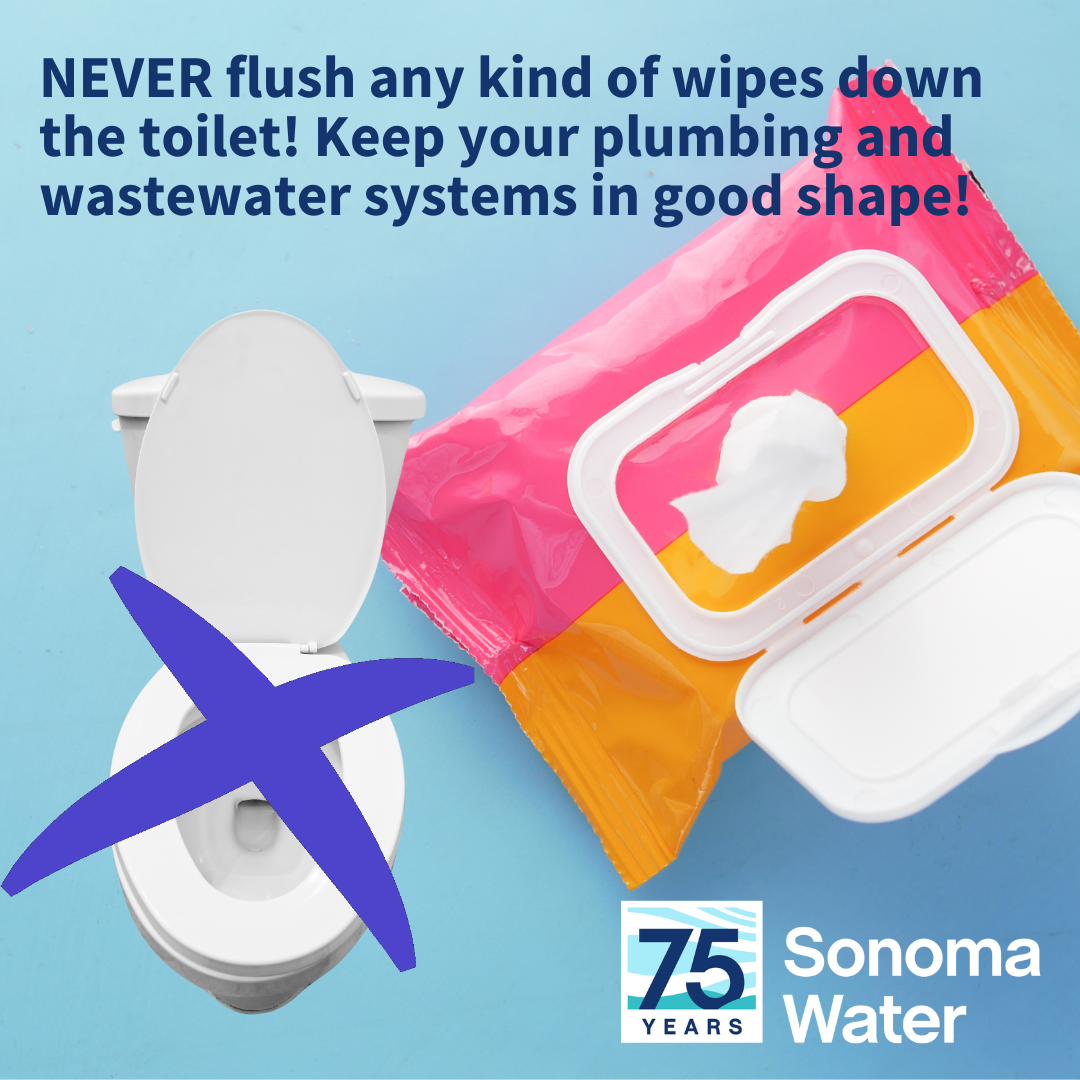
Toilets are often misused as easy trash cans. Cotton swabs, dental floss, wet wipes and menstrual products should never be flushed, even if the packaging says it’s okay. They belong in the trash. See what else doesn’t belong in the toilet.
Keep all Fats, Cooking Oils & Grease (FOG) Out of the Sink
When grease is poured down sinks it can solidify and cause sewer backups into houses or onto streets. Never pour fats, oil, or grease down drains, even if you have a garbage disposal. Learn how to properly handle FOG.
Safely Dispose of Unwanted Medications
Medications that are flushed down toilets or poured down drains pollute waterways. The presence of pharmaceutical compounds in treated wastewater is a growing environmental concern. Find a safe disposal location for your unwanted pills.
Reconsider Topical Flea and Tick Medicine for Your Pets
To avoid exposing pets, your family, and local waterways to toxic pesticides from harmful chemicals, use sound flea and tick prevention measures and consider oral medications instead of topical treatments. Learn what the science shows.
Try Non-Toxic Soaps & Cleaners
Soaps and cleaners often contain harsh chemicals that become pollutants when they enter waterways and the Bay through our stormwater and sewer systems. Instead, try environmentally friendly cleaners. The selection and quality keep growing! Find out how to make your own cleaners. Here’s a guide to non-toxic leaning at home.
| |
|
Fall is busy time in the garden. The days get shorter, the weather cools, aside from our typical late heat waves, and plants wind down their growth for the year. As such, here are some tasks and resources from the Sonoma-Marin Saving Water Partnership to guide you in the garden:
Adjust your irrigation controller to reduce watering times. Plants need less water during this time of year. Get a tailored irrigation schedule for your location using the Sonoma-Marin Saving Water Partnership’s Irrigation Scheduling Tool.
Prune away dead, woody material from your trees and plants to reduce fire fuel. The free, 40-page Water Smart Gardens Maintenance Manual has a maintenance calendar and instructions on how and when to prune the different kinds of plants in your garden.
Fall is a great time to plant trees and shrubs. Start planning now with the Water Smart Plant Picker
| |
|
Current water supply conditions as of 9/9/2024:
Lake Mendocino FIRO* Target Water Storage Curve: 111,000 acre-feet
Current Storage: 70,750 acre-feet (63.74% of FIRO Storage Curve)
Lake Sonoma Minor Deviation Curve: 264,000 acre-feet
Current Storage: 235,975 acre-feet (89.38% of Minor Deviation Storage Curve)
*FIRO is the acronym for Forecast Informed Reservoir Operations
Current rainfall conditions (10/1/23 –9/9/24)
Ukiah:
Current Water Year: 38.18” which is 103% of average
Average (1894-2023 water years): 36.95"
Santa Rosa (STS):
Current Water Year: 35.69” which is 99% of average
Average (1950-2023 water years): 35.97"
Rainfall Data Source: NOAA's California Nevada River Forecast Center
| | |
|
Did you know about telemetry?
Water managers watch weather forecasts and conditions carefully all year long. They need to know if heavy rain is coming, or if we are experiencing a time of drought; it all impacts local water supply. Sonoma Water uses telemetry to monitor weather. Telemetric systems use automatic meteorological readings delivered in real time, and can incorporate other factors, too.
Sonoma Water’s One Rain website shows real-time and historical rainfall, river and stream levels, and reservoir levels and flow data for Lake Mendocino and Lake Sonoma, all possible because of our telemetry systems.
| |
|
Upcoming Meetings
Eel-Russian Project Authority Board of Directors
No meetings scheduled at this time
Sonoma Water Board of Directors Meetings
The Sonoma Water Board normally holds its regular meetings on Tuesdays, beginning at 8:30 a.m. and will be facilitated virtually through Zoom and at Board of Supervisors Chambers (BSC) 575 Administration Drive 102A.
•Sept 10 BSC/Virtual
•Sept 17 BSC/Virtual
•Sept 24 BSC/Virtual
•Oct 8 BSC/Virtual
•Oct 15 BSC/Virtual
•Oct 18 BSC/Virtual
Board Agendas:
View upcoming Agenda items
| |  |
|
Employment Opportunities
No postings at this time
| | |
Sonoma Water | 404 Aviation Blvd, Santa Rosa, CA 95403 | SonomaWater.org | | | | |