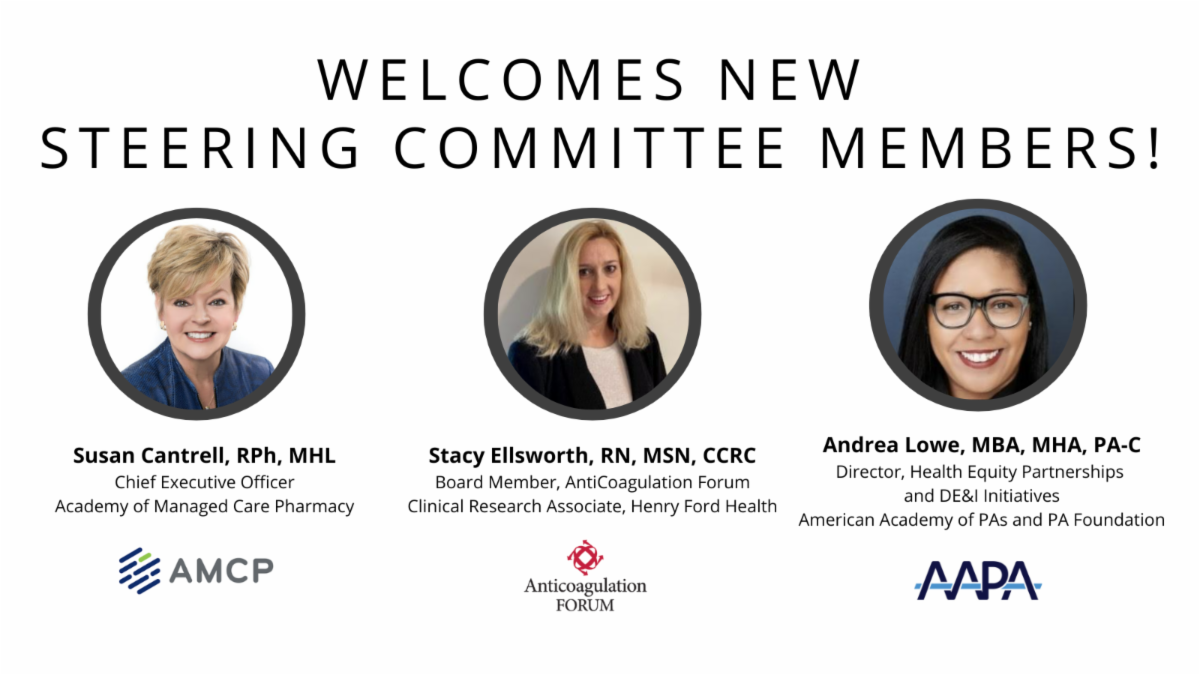
The National Minority Health Alliance is pleased to announce the addition of three new steering committee members: Susan Cantrell, AMCP, Stacy Ellsworth, Anticoagulation Forum, and Andrea Lowe, AAPA. The experience and insight these individuals bring to the NMH Alliance steering committee will be invaluable as we continue to expand our mission within and beyond minority cardiovascular health. Joining the diverse voices of our current membership within academia, patient care, advocacy, government, and community-based organizations, our new members bring representation of managed care, pharmacy, nursing, and physician associates. Welcome, Susan, Stacy, and Andrea -- we look forward to working together!
Members of the steering committee guide the work of the Make Well Known Foundation’s National Minority Health Alliance and collaboratively engage in work that aims to eliminate health inequities among Black, Hispanic/Latino, Asian/Pacific Islander, and Native American populations.
More about our new members and their organizations:
Susan Cantrell, RPh, MHL joined the Academy of Managed Care Pharmacy (AMCP) as CEO in 2016 where she leads the organization in fulfilling its mission of increasing patient access to affordable medicines, improving health outcomes, and ensuring wise use of health care dollars. Since joining the organization, she has worked to advance AMCP’s priorities of addressing rising health care costs, optimizing value and access, and addressing racial and ethnic disparities related to medication use and access.
Stacy Ellsworth RN, MSN, CCRC is a Board Member at the Anticoagulation Forum, and a Clinical Research Coordinator for the Henry Ford Health System in Detroit, MI, with a specialty in anticoagulation research and DVT prevention and treatment. Currently, Stacy helps design, coordinate, and implement a variety of research studies involving anticoagulation and quality improvement. She helped develop and is currently coordinator of the DVT intervention team at Henry Ford Hospital. Her research study involvement has been primarily focused in anticoagulation with atrial fibrillation and venous thromboembolism. This includes pharmaceutical studies, registries, and quality improvement. Her current interests also involve the education of patients prescribed direct oral anticoagulants.
Andrea Lowe, MHA, PA-C has a lot of ideas about how to raise public awareness of Physician Associates (PAs), and how to increase career opportunities. Lowe practiced as a PA in emergency medicine and then transitioned to increasingly visible leadership roles. She has a unique understanding of what both PAs and employers are looking for, and experience on both sides of the table. She joined the staff of the American Academy of Physician Associates (AAPA) in February 2019 to provide employer advisory services and lead the organization’s employer strategy efforts. Lowe was recently appointed “AAPA DEI Business Partner.” She now serves as staff liaison to the DEI Commission, external partners, and also leads an internal staff DEI task force to identify and support DEI efforts within AAPA.
|
|
AMCP is a professional association leading the way to help patients get the medications they need at a cost they can afford. AMCP’s diverse membership of pharmacists, physicians, nurses, and professionals in life sciences and biopharmaceutical companies leverage their specialized expertise in clinical evidence and economics to optimize medication benefit design and population health management, and help patients access cost-effective and safe medications and other drug therapies. AMCP members improve the lives of nearly 300 million Americans served by private and public health plans, pharmacy benefit management firms, and emerging care models. AMCP advocates at the national and state level for developing and applying evidence-based medication use strategies that improve access to medication, enhance patient and population health outcomes, and safeguard the wise use of health care dollars.
Anticoagulation Forum was established more than 30 years ago, and is the largest organization of its kind helping practitioners improve patient care by providing current and relevant information on best practices. Their membership includes more than 13,000 physicians, nurses, and pharmacists representing over 3,000 anticoagulation services (clinics). Members directly support over 1 million patients annually.
AAPA: Founded in 1968, the American Academy of Physician Associates is the national professional society for PAs (physician associates/physician assistants). It represents a profession of more than 150,000 PAs across all medical and surgical specialties in all 50 states, the District of Columbia, U.S. territories, and the uniformed services. AAPA advocates and educates on behalf of the profession and the patients PAs serve. They work to ensure the professional growth, personal excellence and recognition of PAs. AAPA also enhances the ability of PAs to improve the quality, accessibility and cost-effectiveness of patient-centered health care.
National Minority Health Alliance provides a central space for diverse groups to pursue meaningful dialogue and solutions related to health disparities faced by people in minority populations. Together, we are working to better understand the similarities and uniquenesses of genetics, culture, and socioeconomic status, in order to prevent, diagnose, and treat disease and manage the health of these populations.
|
|
National Minority Health Alliance | Website
|
|
Together, we are working to better understand the similarities and uniquenesses of genetics, culture, and socioeconomic status, in order to prevent, diagnose, and treat disease and manage the health of African American, Hispanic/Latino, Asian/Pacific Islander and Native American populations. |
|
|
|
|
|
|