|
The Resilience Roundup highlights announcements and events along with links to the previous month's state, regional, and national resilience news.
Learn more about CIRCA at circa.uconn.edu
and the Resilient Connecticut Project at resilientconnecticut.uconn.edu
| | |
Reducing Parking Minimums Factsheet
The latest addition to CIRCA’s Resilient Zoning Library fact sheet series addresses how Parking Minimums exacerbate climate change issues like urban heating and stormwater flooding. Requiring excessive parking contributes to the proliferation of surface level impervious surfaces which shed stormwater and absorb heat. By reducing mandated parking, denser more affordable construction is allowed leading to more efficient land use. Recent changes in statute have encouraged towns to rethink and limit the required amount of parking for new and redevelopment projects in appropriate locations, helping our communities become more resilient to climate change. To view the factsheet, click here.
| | |
CIRCA Presents at National Adaptation Forum
CIRCA recently participated in a poster session at the National Adaptation Forum in Pittsburgh, PA, with other project leaders as part of the National Science Foundation (NSF) Regional Resilience Innovation Incubator (R2I2) program. The session, which was organized by the R2I2 National Office, provided an opportunity to connect with other teams and learn more about resilience research priorities across the country, as well as share our proposal in the Northeast. You can check out the poster that CIRCA presented on our collaboration with Stevens Institute of Technology, Brooklyn College, and the University of Maine here.
| |
2025 CEQ Annual Report:
The Warming and Rising Waters of Long Island Sound
In 2025, the average annual surface and bottom water temperatures for Long Island Sound were 58.4 degrees Fahrenheit (°F) and 55°F, respectively. Annual variations in water temperatures and water levels in the Sound are less important than longer term trends. The longer-term trends for average annual surface and bottom temperatures of the Sound from 1995 through 2025 have been rising. While the long-term impact of warmer water in the Sound is unknown, species diversity and biomass remain high, although there has been a shift to more warm water tolerant species.
| | |
New Climate Progress Report Shows that State Programs are Helping to Reduce Emissions, Improve Environmental Quality, and Lower Costs
The Connecticut Department of Energy and Environmental Protection (DEEP) released its latest report of the state’s progress under the state’s Global Warming Solutions Act (GWSA). The Connecticut’s Climate Progress report, required every three years by the legislature, highlights how Connecticut is continuing to reduce greenhouse gas (GHG) emissions while delivering real benefits for residents and businesses—lower energy costs, cleaner air, and stronger, more resilient communities. The report projects that despite the absence of federal leadership today, Connecticut will achieve at least a 34% reduction in GHG emissions below 2001 levels by 2030, thanks to decades of efforts at the state and federal level to invest in energy efficiency, more fuel-efficient and zero emissions vehicles, and clean power.
| | |
DEEP Highlights City of Groton Green Infrastructure Project That Will Reduce Flooding and Stormwater Pollution
On Thursday, May 14, the City of Groton will show off its newly installed porous concrete at Washington Park, utilizing federal Clean Water Act Section 319 Grant funds the Eastern Connecticut Conservation District (ECCD) received through the Connecticut Department of Energy and Environmental Protection (DEEP) to improve water quality of Birch Plain Creek. Pavement- often used for sidewalks and roads- is usually impervious, meaning water cannot soak through it and into the ground where the water would be naturally filtered through the soil. Unfiltered stormwater carries contaminants like bacteria, sediment, and heavy metals from roadways that pose risks for waterbodies like lakes, streams, and Long Island Sound. For Birch Plain Creek, which runs a few miles through the City of Groton and into Baker Cove, porous concrete is one important solution for maintaining the river system’s health.
| | |
USDA: Emergency Community Water Assistance Grants
in Connecticut, Massachusetts, and Rhode Island
Application Deadline: Rolling
This program supports rural communities, nonprofits, and federally recognized tribes in Connecticut, Massachusetts, and Rhode Island that need help preparing for or recovering from an emergency that threatens safe, reliable drinking water. Eligible areas are rural towns with populations of 10,000 or less, tribal lands in rural areas, or colonias with household incomes below the state’s non-metro median. Funding may be used for waterline repairs, new wells, treatment plants, or other improvements to restore or secure water supplies. Applications are accepted year-round through your local USDA Rural Development office or online.
| | |
Governor Lamont Announces $15 Million in Available Funding To Support Clean Air Projects
Proposals Due: June 11, 2026
Governor Ned Lamont announced that the State of Connecticut is allocating $15 million from the national Volkswagen (VW) emissions settlement to support clean air initiatives statewide. The funding, administered by the Connecticut Department of Energy and Environmental Protection (DEEP), will support projects that reduce nitrogen oxide (NOx) emissions and meet program eligibility requirements. NOx emissions are a major contributor to ground-level ozone, or smog, which can reach unhealthy levels in Connecticut during the warmer months.
| |
Resilient Forestry Practices Grant
Deadline: June 15, 2026
Municipally-owned woodlands play a vital role in supporting well-functioning natural systems and a high quality of life for Connecticut residents. They improve air and water quality, support a variety of plant and wildlife species, strengthen landscape health and resilience, and provide recreational and other community benefits. These forests, however, face growing threats to their health from pests, diseases, invasive species, extreme weather events, and other stressors. Many of these stressors and threats can be managed or mitigated through resilient forestry practices. With support from the Inflation Reduction Act, CT DEEP’s Urban and Community Forestry (UCF) Program has $1 million available to help rural communities in Connecticut implement resilient forestry practices.
| |
Request for Proposals (RFP) for Small Multi-Unit and Multifamily Weatherization Assistance Program (WAP) Service Providers
Deadline: June 30, 2026
DEEP will use the results of this RFP to select one or more qualified Service Providers for the CT WAP Small Multi-Unit and Multifamily Programs. The Service Provider(s) will be selected through the process required by state and federal laws, regulations, and procurement practices. Pursuant to the Code of Federal Regulations 10 C.F.R. 440.15, Service Provider(s) must be a Community Action Agency or other public or nonprofit entity.
| |
FEMA BRIC Grant
Deadline: July 23, 2026 at 3:00 p.m. ET
As of March 25, 2026, the combined FY24–FY25 Notice of Funding Opportunity (NOFO) has been released and is now available on Grants.gov. This NOFO provides $1,000,000,000 in funding for States, Territories, and Tribes, with $757 million available nationwide through a competitive grant program that includes a $20 million cap on the federal share. Applicants are encouraged to review their Hazard Mitigation Plans to identify eligible mitigation actions and ready-to-go projects.
| | |
Flood Mitigation Assistance Grant Program
Deadline: August 6, 2026 at 3:00 p.m.
The Flood Mitigation Assistance grant program is a competitive program that provides funding to state, territory and local governments and federally recognized Tribal Nations. Since the National Flood Insurance Reform Act of 1994 was signed into law, funds are used for projects that reduce or eliminate the risk of repetitive flood damage to buildings insured by the National Flood Insurance Program.
| | |
Urban Forest Resilience Grant Program
Deadline: August 3
Healthy urban forests are essential to Connecticut’s communities. They improve air and water quality, reduce urban heat, manage stormwater, and provide economic, recreational, and public health benefits. However, many urban forests are facing significant stress from invasive pests and diseases, including beech leaf disease, spongy moth, and emerald ash borer. This can result in declining, hazardous, or dead trees that create safety risks and pose barriers to replanting. With support from the U.S. Department of Agriculture (USDA) Forest Service, CT DEEP’s Urban and Community Forestry (UCF) Program is offering funding to help municipalities restore their urban and community forests.
| | |
Sean Patrick Gallagher's Art Exhibit:
These Wine-Dark, Warming Currents, Rising
May 29 - June 28, 2026
Location: 873 Whalley Avenue New Haven, CT 06515
Gallery Hours: Friday - Sunday
12 p.m. - 5 p.m.
Using CIRCA data, Sean Patrick Gallagher created the artwork featured at his exhibition at Kehler Liddell Gallery in New Haven. The series draws on climate and environmental data to explore themes of rising seas, instability, and the emotional weight of climate change. As Gallagher explains: “These images display no horizon, no land beyond the vast, red waters. Width, greater than the height, suggests expanse laterally, a continual horizontal immersion. The 'wine-dark' adjective is a reference to the often-used epithet describing the sea in the Odyssey and Iliad. It is possible this phrase was less a realistic description than a useful poetic device as metaphor; however, via contemporary climate change and political waves, this metaphor becomes less romantic and more ominous, prophetic. The red, rising waters warn us: the heating and rising of the oceans is an active, existential threat."
| | |
Connecticut Trails Day
June 6 and 7, 2026
Explore trails and enjoy the great outdoors with Connecticut Trails Day for National Trails Day! The first weekend of June, trail lovers across Connecticut head outside to hike, play, ride, explore, climb, run, and paddle. Discover over 200 free, guided events, resources, and photos!
| |
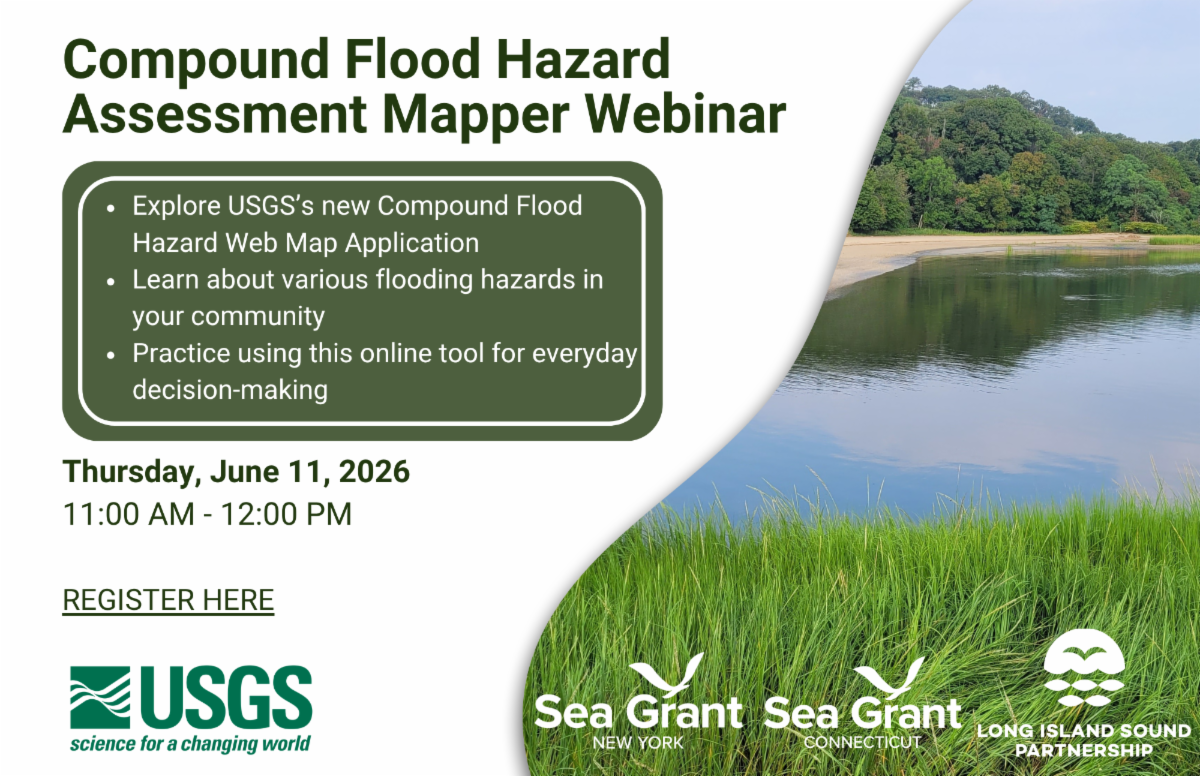
Compound Flood Hazard Assessment Mapper Webinar
June 11, 2026 11:00 a.m. – 12:00 p.m.
This virtual webinar hosted by New York Sea Grant, Connecticut Sea Grant, and the U.S. Geological Survey, with funding from the Long Island Partnership. The webinar is geared towards municipal staff, state agencies, and other partners, you will learn how USGS developed this new tool and how to utilize it in planning and decision making.
| |
CEEJAC Quarterly Meeting & Community Tour in Waterbury
June 23, 2026 10:00 a.m. – 4:00 p.m.
Location: Mattatuck Museum, 144 West Main Street Waterbury, CT 06702
The Connecticut Equity and Environmental Justice Advisory Council (CEEJAC) will hold its upcoming quarterly meeting in Waterbury, CT to discuss ongoing environmental justice priorities and initiatives across the state. As an advisory council to the Commissioner of the Connecticut Department of Energy and Environmental Protection (DEEP), CEEJAC works to address both historical and current environmental injustices affecting Connecticut communities.
| | |
Connecticut's Wildlife Action Plan: Conservation Action Tracker
Connecticut’s Wildlife Action Plan identifies species of greatest conservation need, their affiliated habitats, and the threats they face. The plan then prioritizes conservation actions and research needs to address problems facing these species and habitats. Tracking and mapping actions helps conservation organizations work together, share information, and gain visibility for their work. This public map viewer enables conservation partners to add points highlighting their actions and showcasing their successes.
| | State and Regional News Clips | | |
Audubon Awarded $460,917 to Design Coastal Resilience Strategy for East River Marsh in Guilford, Connecticut
Audubon Connecticut - May 19, 2026
More than half of Connecticut’s salt marshes have been lost after hundreds of years of human intervention, but there is a growing movement to restore these habitats for the future. The National Audubon Society in Connecticut is prioritizing this work across the Long Island Sound and has just received a $460,917 grant from the Connecticut Department of Energy and Environmental Protection (DEEP) to develop a restoration design plan for the Guilford Salt Meadows Audubon Sanctuary.
| | |
Hurricane Season is Just Days Away in CT.
Here’s What to Expect this Year.
Hartford Courant - May 27, 2026
As the 2026 Atlantic hurricane season approaches, Connecticut officials said they are prepared in case a storm makes landfall this year. Hurricane season officially begins June 1 and runs through Nov. 30, according to AccuWeather.“We have not had a hurricane make landfall since Gloria in 1985, but we’ve had a number of very close calls and tropical storms that have brought significant change and challenges to our state,” said Lt. Gov. Susan Bysiewicz at a hurricane preparedness briefing in East Haven.
| | |
Trump Cuts to Weather Data Could Make Forecasts Less Reliable, Warn Experts
The Guardian - May 18, 2026
As the US prepares for hurricane season and a summer of record-breaking heat, experts fear the Trump administration’s cuts to climate and weather data programming could make the federal government’s weather forecasts less reliable when they are needed most. The National Oceanic and Atmospheric Administration (Noaa) late last year launched a suite of artificial intelligence-powered global weather forecast models which it said would improve “speed, efficiency, and accuracy”. In March, an agency official said those models were being trained with centuries of weather data.
| |
Why Scientists Retired the Dire Climate Scenario Used Over a Decade
The New York Times - May 26, 2026
A recent New York Times article highlights a significant shift in climate science: researchers are moving away from RCP 8.5, the long-used "worst-case" greenhouse gas emissions scenario. Advances in renewable energy deployment, slower population growth, and climate policies have made this extreme pathway less likely than previously projected. While this reflects progress in reducing future emissions risks, scientists emphasize that substantial warming and climate impacts remain likely under current trajectories.
| | |
The Resilience Roundup highlights CIRCA's presence in the news, provides links to recent local/state/national news articles related to resilience and adaptation, and announces upcoming events and seminars.
The Connecticut Institute for Resilience and Climate Adaptation's (CIRCA) mission is to increase the resilience and sustainability of vulnerable communities along Connecticut's coast and inland waterways to the growing impacts of climate change and extreme weather on the natural, built, and human environment. The institute is located at the University of Connecticut's Avery Point campus and includes faculty from across the university. CIRCA is a partnership between UConn and the Connecticut Department of Energy and Environmental Protection (CT DEEP).
| | | | |