|
The Safer Mobility Report
The Latest in Vehicle Safety, Technology, and Policy
November 23, 2026
Issue #20
| A Retrospective Look At CoMotion LA 2026 | |
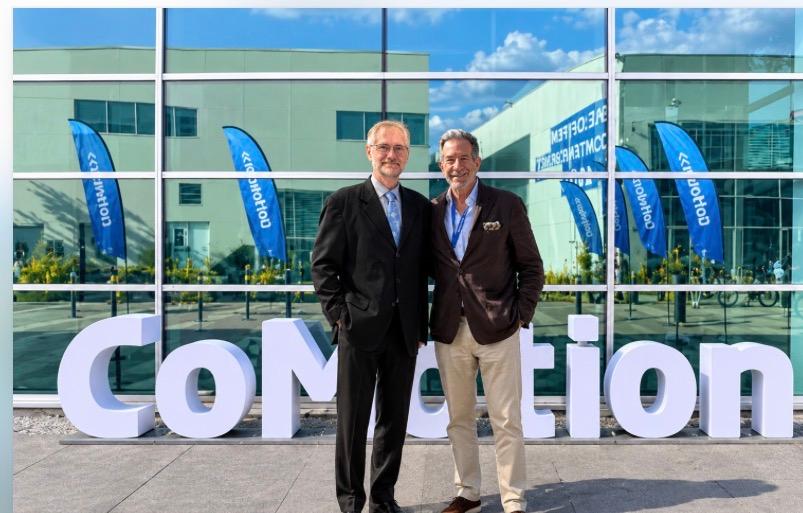
Eric Richardson, CEO and Founder, EBR Safety Solutions and John Rossant,
CEO and Founder, CoMotion
| |
|
Last week's CoMotion LA 2026 had a wealth of leading voices in innovation, public transit, multimodal mobility, road safety, sustainability, and venture capital.
A recurring theme was that mobility innovation should create lasting improvements, not just solve for a single event or challenge. In her opening keynote, Stephanie Wiggins, CEO of LA Metro, applied this to the recent FIFA games in LA, stressing that residents and workers remained the priority even as the games’ demands and ridership grew. On the panel “A Decade in Motion: Shaping the Next Era of Urban Mobility,” former Los Angeles Mayor Eric Garcetti echoed this, explaining that the city’s bids for major events centered on making Los Angeles better and fitting the games into that improved environment, rather than reshaping the city solely for the event. The panel “Delivering a Mega-Event Legacy: Mobility and Beyond” reinforced the message, with speakers addressing capital investment, workforce development, and community benefit agreements.
| |
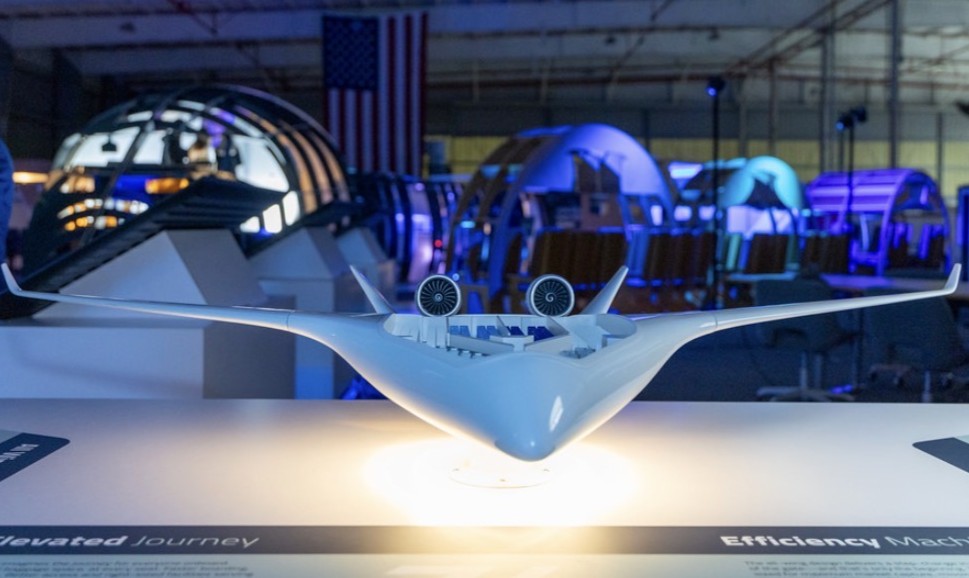
Is This the Future of Flight?
JetZero: The First Full-Scale Blended-Wing-Body Aircraft
| |
The conference also went beyond travel by car, bus, or train. In “Ferries and the Future of Urban Water Transit,” speakers took a deep dive into moving new urban water transit technologies from testing to mass implementation, and into the challenges of fueling and charging the vessels of the future.
Our transportation future for passengers and packages via the air was also on display, beginning with a reception at JetZero in Long Beach where attendees learned about the company’s new aircraft. Its design blends the wings and fuselage into one smooth shape, cutting drag and delivering an expected 50% fuel reduction compared with today’s planes. This should lower operators’ costs and, more importantly, significantly reduce aviation emissions.
Wing, an autonomous drone delivery service, held live demos showing how its system delivers packages and light goods from restaurants, grocery stores, pharmacies, and more. Its small, dual-propulsion, vertical-lift drones fly at 150 feet and up to 60 MPH, carrying less than five pounds. Already operating in six US cities with more to come, the service has the promise of reducing truck, van, e-bike, and moped deliveries off our streets, reducing congestion, lowering emissions, and improving road safety. Those gathered for the panel "New Modes of Delivery: Reinventing Urban Freight" heard more about Wing and other autonomous delivery vehicles, sidewalk robots, micro fulfillment hubs, and zero emission freight from Gina Gribow, Senior Vice President EKA Government Advocacy & Public Affairs; Trevor Thomas, Senior Transportation Planner, City of Santa Monica; Laura Stuchinsky, Emerging Mobility Program Lead, City of San Jose; and Kendal Prosack, Global Lead, Local Policy and Community Affairs, Wing.
| |
Wing Drone Delivery Demonstration at CoMotion LA 2026 | |
Road safety was a main focus during the final day of CoMotion and featured three sessions with road safety leaders from national, state, and local governments, road safety advocacy, and journalism.
That days’ opening keynote came from Lee White, Deputy Administrator of NHTSA, who outlined the agency’s approach to regulating automated vehicles: balancing safety with innovation, advancing the federal regulatory framework, and using data and research to stay at the forefront of emerging transportation technologies. He also described NHTSA’s cooperative agreement with SAE on ASCEND (“Advancing America’s Safety and Competitiveness for the Evolution of National Deployments”), a consortium developing data-driven performance standards for Automated Driving Systems (ADS). ASCEND will set the criteria and testing methods for determining when ADS is “safe enough,” creating a standardized evaluation framework that builds consumer trust and regulatory clarity.
Leah Shahum, Founder and Director of the Vision Zero Network, provided the Open Mobility Foundation (OMF) keynote, giving an overview of why the Vision Zero Network exists: to ensure that cities do not have to recreate the wheel and can learn from each other on what is working and the reasons why government officials in cities such as LA or NY took on the challenge of Vision Zero even with it being so hard and so visible. She reminded the audience the work we all do on road safety is because of those lives that we have lost on our roads, the families and loved ones that have been impacted, and the often tragic results that we see on our roads, including the 115 people who die each day.
As Leah stated, often those numbers of a 115 a day or 36,000 a year in the US get lost because these are events that happen one at a time, in different cities, for different reasons, but that road safety really needs to be viewed the way a plane crash or other major casualty event would be.
She reminded us, we get the results that we design for, whether it is roads built for speed or big vehicles built so that drivers can not see people, particularly children, in front of them.
As Leah puts it, Vision Zero is not a slogan, it is not tagline, and it is not even a mantra; Vision Zero is fundamentally different-a paradigm shift of how we see our roads, our speed limits, and our vehicles.
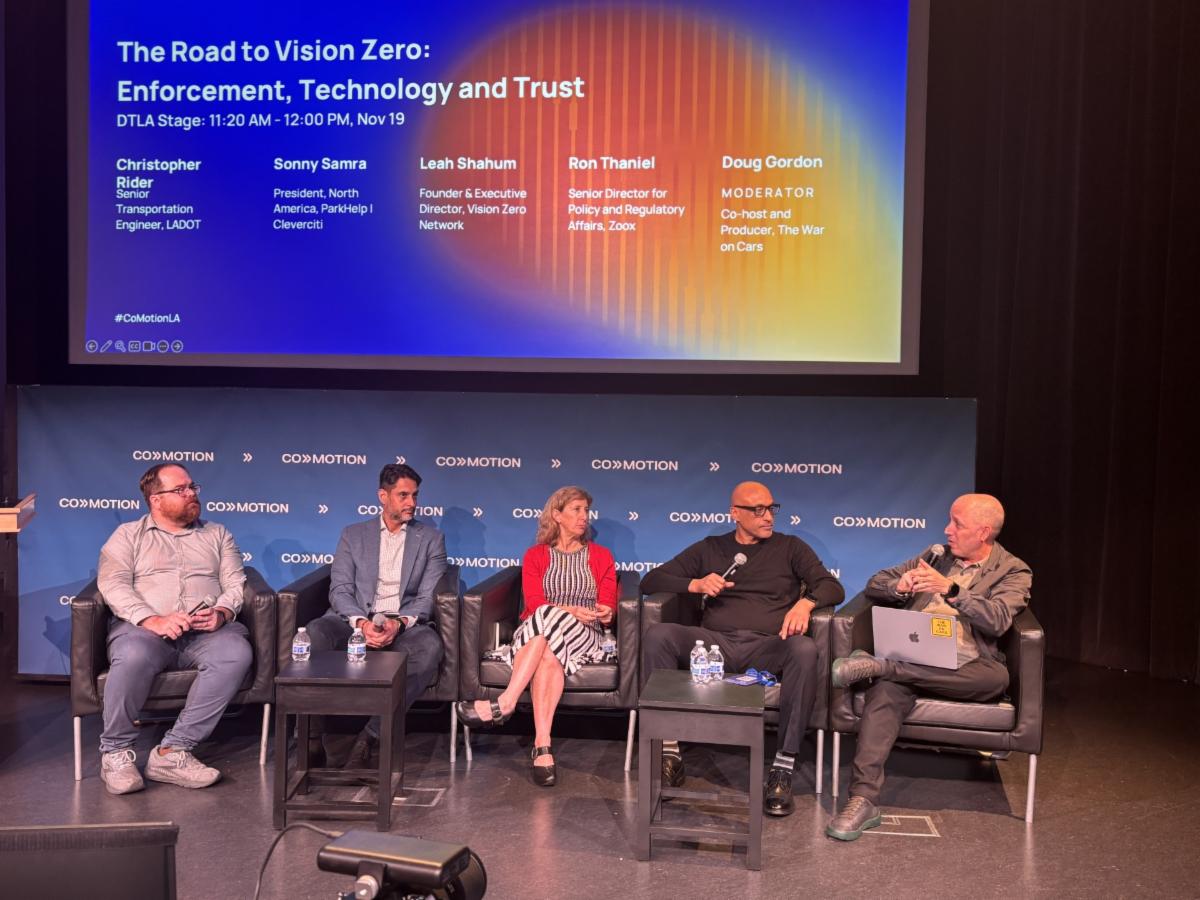
| Chris Rider, Senior Transportation Engineer, Los Angeles Department of Transportation (LADOT); Sonny Samra, President, North America for ParkHelp and Cleverciti; Leah Shahum, Founder and Director of the Vision Zero Network; Ron Thaniel, Senior Director for Policy and Regulatory Affairs at Zoox; and author, producer and advocate Doug Gordon. | |
The road safety portion of the day closed out with a panel “The Road to Vision Zero: Enforcement, Technology, and Trust” that included Leah Shahum; Chris Rider, Senior Transportation Engineer, Los Angeles Department of Transportation (LADOT); Sonny Samra, President, North America for ParkHelp and Cleverciti; Ron Thaniel, Senior Director for Policy and Regulatory Affairs at Zoox; and author, producer and advocate Doug Gordon.
The discussion ranged from the promise of autonomous vehicles in helping to solve our road safety crisis by removing drunk, impaired and distracted drivers from our roadways; how we can use automated safety cameras for speeding and red light violations in a equitable way; how roads can be redesigned to reduce the severity of crashes when humans make bad choices or mistakes; and the promise of vehicle design changes such truck sideguards and intelligent speed assistance.
| |
Mark Seeger, Founder and Co-CEO of Glydways | |
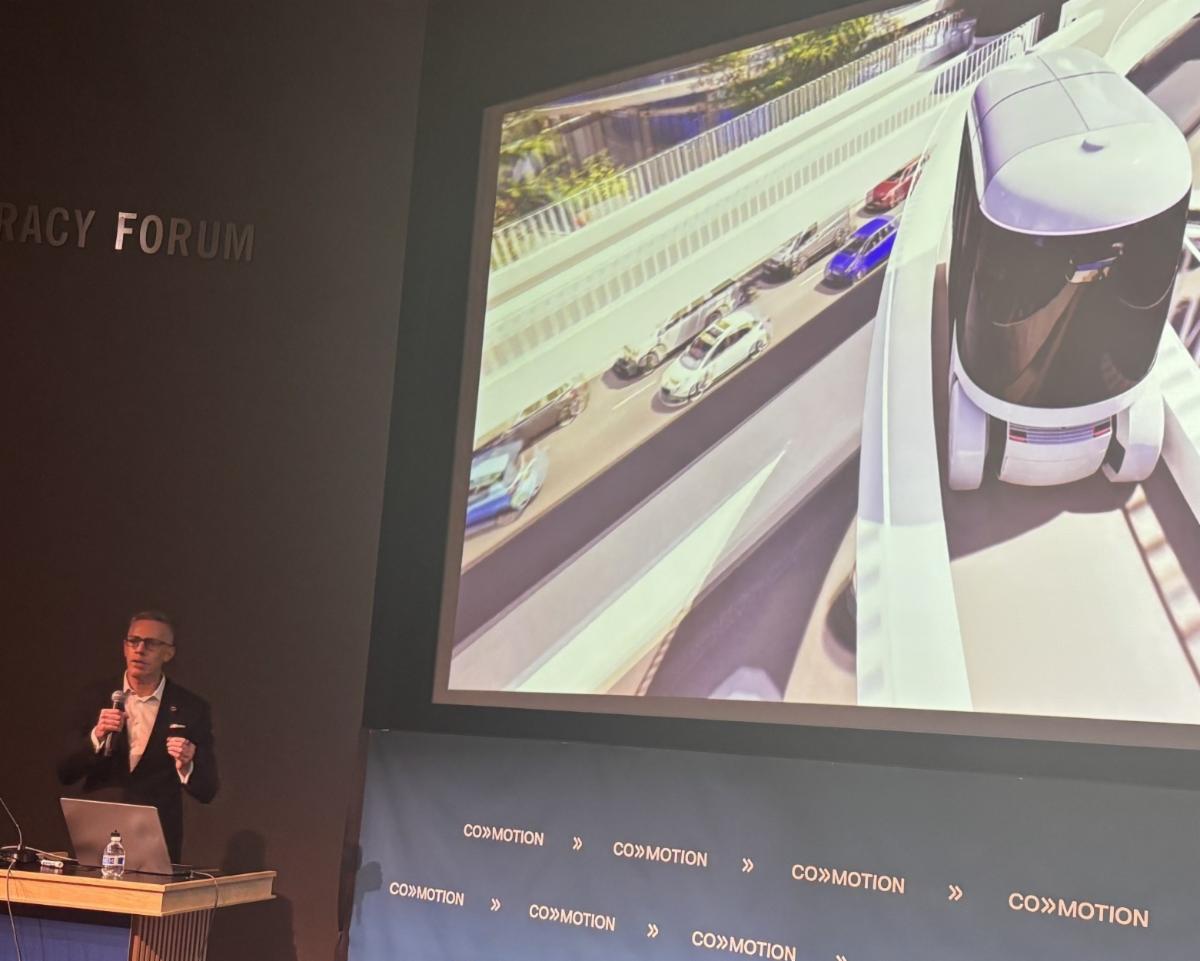
I was intrigued by the presentation from Mark Seeger, Founder and Co-CEO of Glydways. He opened by noting that an autonomous vehicle stuck in traffic is still just a vehicle stuck in traffic, and explained that Glydways aims to reimagine transit with AVs that run on small, dedicated guideways, removing them from traffic entirely. The first public system in the US will soon open in south metro Atlanta, connecting the SkyTrain at the Georgia International Convention Center to the Gateway Center Arena. Plans include a possible expansion to improve transit connectivity through Fulton County. With the Government Fleet Expo taking place in Atlanta in June 2027, visiting the Glydways project will certainly be on my agenda.
The programming, networking, and exhibits at CoMotion LA 2026 gave attendees a look at the progress made in meeting growing demand for public transportation, both for everyday needs and large events. They also offered ideas and real-world solutions for safe, sustainable passenger, freight, and package delivery in the future; insights into the infrastructure required for expanding multimodal mobility; and practical ways to make our streets safer.
CoMotion Miami 2027 will be held April 27-28 and you can register now for 50% off by clicking here.
Future editions of “The Safer Mobilty Report” will have information about speakers and the schedule as they are released.
|
AAA Testing Finds Gaps in Intersection AEB Crash Prevention
New research from AAA found that automatic emergency braking (AEB) systems designed to prevent intersection crashes perform consistently in standardized testing but may not respond effectively to other common collision scenarios.
AAA tested four 2026 model-year vehicles equipped with standard intersection AEB technology. All four avoided collisions during standardized left-turn tests. However, three of the four vehicles failed to prevent collisions when another vehicle turned into their path from a side road. The findings raise questions about how fleet managers should evaluate advanced driver-assistance systems (ADAS) when selecting vehicles and developing driver safety programs.
"Intersections are some of the most dangerous places on the road," said Greg Brannon, AAA's director of automotive engineering and research. "AEB is making progress in the limited intersection scenarios it is tested to handle. Unfortunately, performance outside those scenarios is spotty."
Source: Automotive Fleet
Click here to read more
Transport Committee Recommends Independent Road Safety Commissioner
An Oireachtas committee has recommended the establishment of an independent road safety commissioner to co-ordinate road safety activities across departments and agencies.
The proposal is one of over 50 made in a report which finds that Ireland has an action plan and a range of bodies working on road safety, yet outcomes have worsened. The report by the Oireachtas Committee on Transport, titled, 'The Urgent Need for Action', is due to be published later.
It says that road safety remains a significant public challenge in Ireland, with road deaths increasing, adding that the evidence points to a gap in delivery and accountability. It says a proposed road safety commissioner would be put on a statutory basis, with the authority to monitor delivery and to report publicly where it falls short.
Source: ITE News
Click here to read more
RAC Urges Road Safety Minister To Commit To Alcolocks For Repeat Drink-Drive Offenders
With the Government expected to respond to its consultations on the Road Safety Strategy shortly, the RAC has written to road safety minister Justin Madders with a new review of international evidence showing how effective alcohol interlocks (‘alcolocks’) can be in reducing drink-drive casualties.
As part of its consultation on toughening motoring offences to improve road safety, the Government asked for views on the use of alcolocks. These are breathalyser devices that, once fitted to a vehicle’s ignition, stop the vehicle from being started if the driver has consumed alcohol above a set threshold. Alcolocks are already used widely across the world to tackle repeat drink-driving – including France, Belgium, Canada, Australia and the United States. Now, the RAC has written to the road safety minister with further evidence that shows just how effective these programmes have been, and why now is the time for the UK to follow suit.
For example, the latest evidence from California in the United States shows that alcohol interlocks fitted within two years of drivers being arrested for drink-driving led to a 17% reduction in reoffending and an estimated 26% reduction in associated crashes. Researchers concluded that effectiveness would be increased even further if more drink-drivers were to have alcolocks fitted.
Source: RAC Media
Click here to read more
| |
December 2
TSR Talks: From Adoption to Impact: What 2026 Taught Us About Scaling Fleet Safety
Noon EST
Click here to register
December 16-17
National School Bus Safety Summit
Washington, DC
Click here for more information
January 10–14, 2027
Transportation Research Board (TRB) Annual Meeting
Washington, D.C.
Click here for more information
January 19, 2027
Vision Zero Peer Cities Webinar
Insights from Helsinki, London, Auckland, and more
Co-hosted by ProjectEDWARD and EBR Safety Solutions
Click here for more information
February 9, 2027
ITE Webinar: Safe for Whom?
Vehicles as the Overlooked Variable in Safe System Implementation
Click here for more information
| |
|
About the Safer Mobility Report
The Safer Mobility Report exists to bridge the gap between innovation and implementation. We will be sharing the technologies, policy discussions, research, and real world applications that can help companies, organizations, governments, and professional fleets make transportation safer. If one idea, technology, or shift in thinking saves one life, it will more than justify this effort.
| |
About EBR Safety Solutions
EBR Safety Solutions is a mission-driven advisory firm focused on technology and practical solutions to reduce traffic crashes that result in serious injury or loss of life.
Founded by Eric Richardson, the firm brings a deeply practical, systems-level approach to improving road safety across both public and private sector fleets.
Our work is grounded in years of leadership at the highest levels of transportation policy and operations. As former NYC Deputy Chief Fleet Officer and a representative on the NYC Mayoral Vision Zero Task Force, Eric helped shape one of the nation’s most ambitious urban road safety initiatives.
He has also served as a road safety advisor to Together for Safer Roads, Strategic Mobility Advisor to Windels, Marx, Lane, and Mittendorf, and as the Co-Chair of the Health and Safety Committee for the International Association of Transportation Regulators (IATR), giving him a unique perspective that bridges government, industry, and technology sectors. Eric is a proud member of the Worshipful Company of Carmen one of the City of London’s oldest and largest livery companies. He is a global keynote speaker on efforts to eliminate traffic fatalities.
Eric's work advances safer vehicle design, life-saving technologies such as intelligent speed assistance, anti–distracted driving tools, systems to prevent drunk driving and best practices for seat belts and telematics. He also guides safe fleet transitions for government, trade waste, school transportation, and trucking operations. Guided by the Vision Zero Safe System approach, Eric promotes safer vehicles, speeds, and drivers as connected pillars of crash prevention.
EBR Safety Solutions turns proven safety principles into real-world impact, helping organizations meet standards and protect lives on the road.
| | | | |