December 16, 2020
Top stories
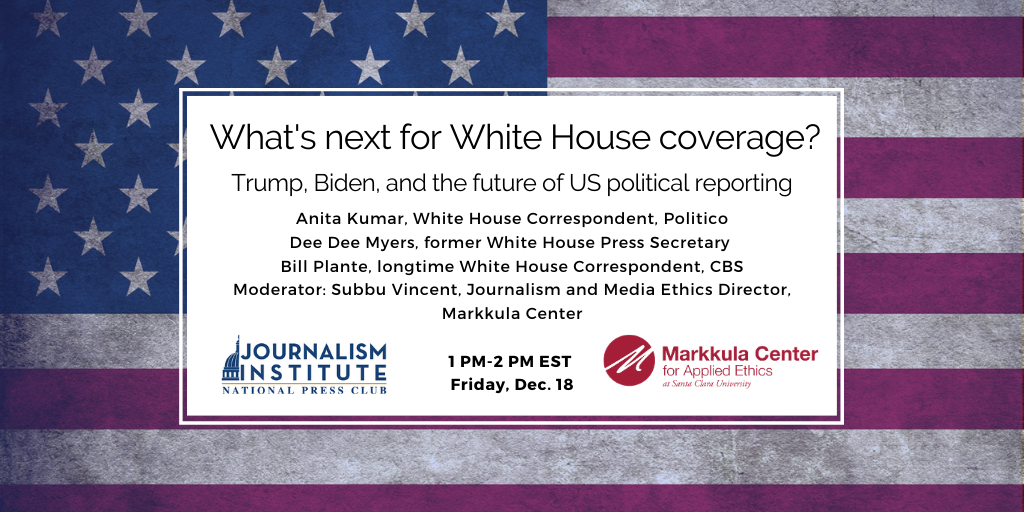
As president-elect Joe Biden prepares to lead a deeply divided country, what’s next for White House coverage? What can past coverage and recent experiences teach us about envisioning a better future for how journalists cover the president, and how Americans understand the United States?

Register now for this program, a partnership between the National Press Club Journalism Institute and the Markkula Center for Applied Ethics at Santa Clara University, which will address these topics.

Date: Friday, December 18, 2020
Time: 1–2 p.m. EST / 10–11 a.m. PST

Joining us with lessons from their firsthand experiences with the White House press corps are current Politico White House Correspondent Anita Kumar, former White House Press Secretary Dee Dee Myers, and longtime CBS White House Correspondent Bill Plante. The program will be moderated by Subbu Vincent, director of Journalism and Media Ethics at the Markkula Center for Applied Ethics.
Throughout 2020, journalists across the country have shared their best practices for working through the pandemic. As we approach 2021, we’re asking what they learned this year and what they hope to learn in the year to come. 

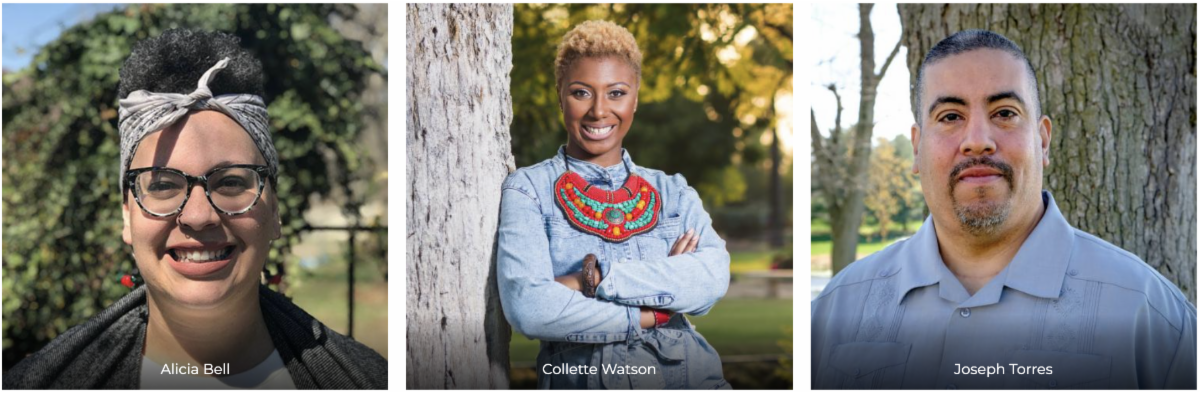
Current role: Three creators of Media 2070 
Previous Institute Q&A: How Media 2070 seeks to transform news

What are the main lessons you learned this year from your reporting that you’ll use next year?

Media 2070: We learned that people, both within the media and journalism sector and beyond, are really ready for transformative change in this space. We saw it in the newsroom reckonings happening from New York to LA, but we also heard local community organizers and residents lifting up the ways that newsrooms and newsroom coverage impacted their communities during elections and throughout the various Black liberation uprisings. When we released Media 2070: An Invitation to Dream Up Media Reparations, so much of the response was: “Tell us what to do.” We were prepared to process the information with folks and help bring folks into aligned dreaming and visioning but we really underestimated how ready so many people would be for media reparations right now. We’re taking that urgency and the need for change yesterday alongside the continued desire to move in alignment and vision into 2021.

How did your work change during the pandemic?

Media 2070: As much as we’ve loved the innovation and experimentation in trying to adapt new technologies or old technologies in new ways, the thing we’ve missed most is being able to gather with people in person. That’s really shifted our work because you build deeper trust and relationships when you’re able to at least have in person touchpoints and we haven’t had much of that at all this year. Our team is remote with folks from North Carolina to DC to Arizona and we’re organizing and strategizing with people across the country, so we’re accustomed to remote work, but the remote work without opportunity for in person connection is difficult. At the same time, this pandemic has forced us to be reflective, even when timelines speed up and that balance is something that we really appreciate.

What do you hope to learn or cover in the coming year?

Media 2070: In 2021, we’ll be building out a platform for media reparations across cultural, institutional, philanthropic, and governmental sectors. We’ll be building that with a consortium of people — technologists, artists, community organizers, journalists, entrepreneurs, funders, lawyers, etc. If you can name a person that has a role to play in the media, we’re looking to collaborate with them. We’re so excited to figure out what lives in that platform so that we can develop the strategies to make the platform real. In addition to that, we’re hoping to get answers to questions like:

  • What is the financial value of media reparations? What is the cost of exclusion from ownership, leadership, generational wealth, etc.? What are the equations that help us calculate that amount?
  • Where could funds for a media reparations fund come from?

How are you taking care of yourself now that you weren’t at the beginning of the pandemic?

Bell: I’m saying yes less in order to deepen and sharpen what I’ve already said yes to. This year has taught me so much about right sizing pace and commitments and that’s something I’m hoping to lean into more in 2021. I’m also checking my phone less in the morning and starting my days with movement, usually turning on some music and dancing before I start the day.

Watson: I’m taking a step back more often to think about “why,” instead of just ticking off the to-do list. I’m taking lots of morning walks and weekend hikes — looking at the stars at night and taking time to enjoy nature.

Torres: I started hiking for the first time, searching out and exploring different trails. I am also reading about issues of structural racism in other sectors such as housing and the environment in an effort to learn about potential policy solutions that can work to achieving media reparations.
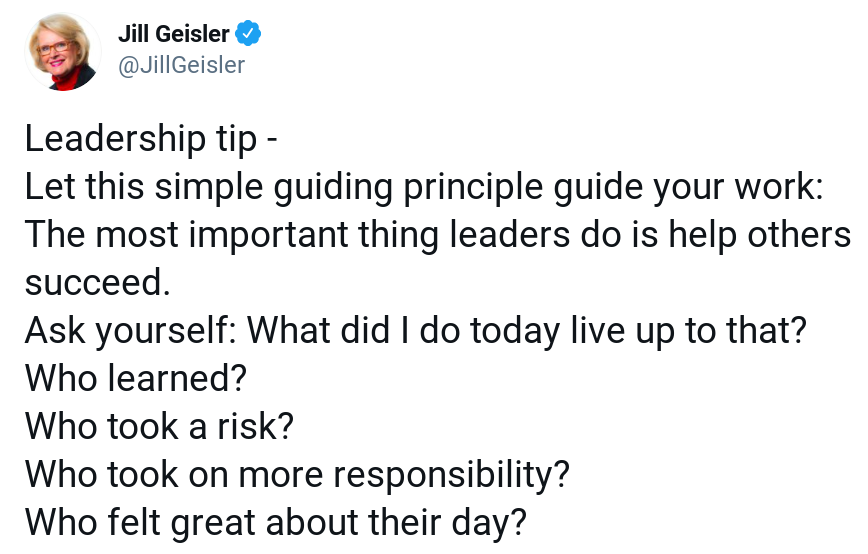
The urgency of news often overtakes our good intentions. Leaders can set an example by asking your team every day: What did you learn? What stretched you? What would make tomorrow great for you? 

Advice from Jill Geisler, Bill Plante Chair in Leadership & Media Integrity, Loyola University Chicago, Freedom Forum Fellow in Women’s Leadership

Click here to read Jill’s previous posts.
The next generation of journalists graduated in 2020 into a challenging job market unlike any other. We spotlighted them this summer, shared advice from their role models, and are checking in with them this month to see where they are now and what they’re learning about journalism. 

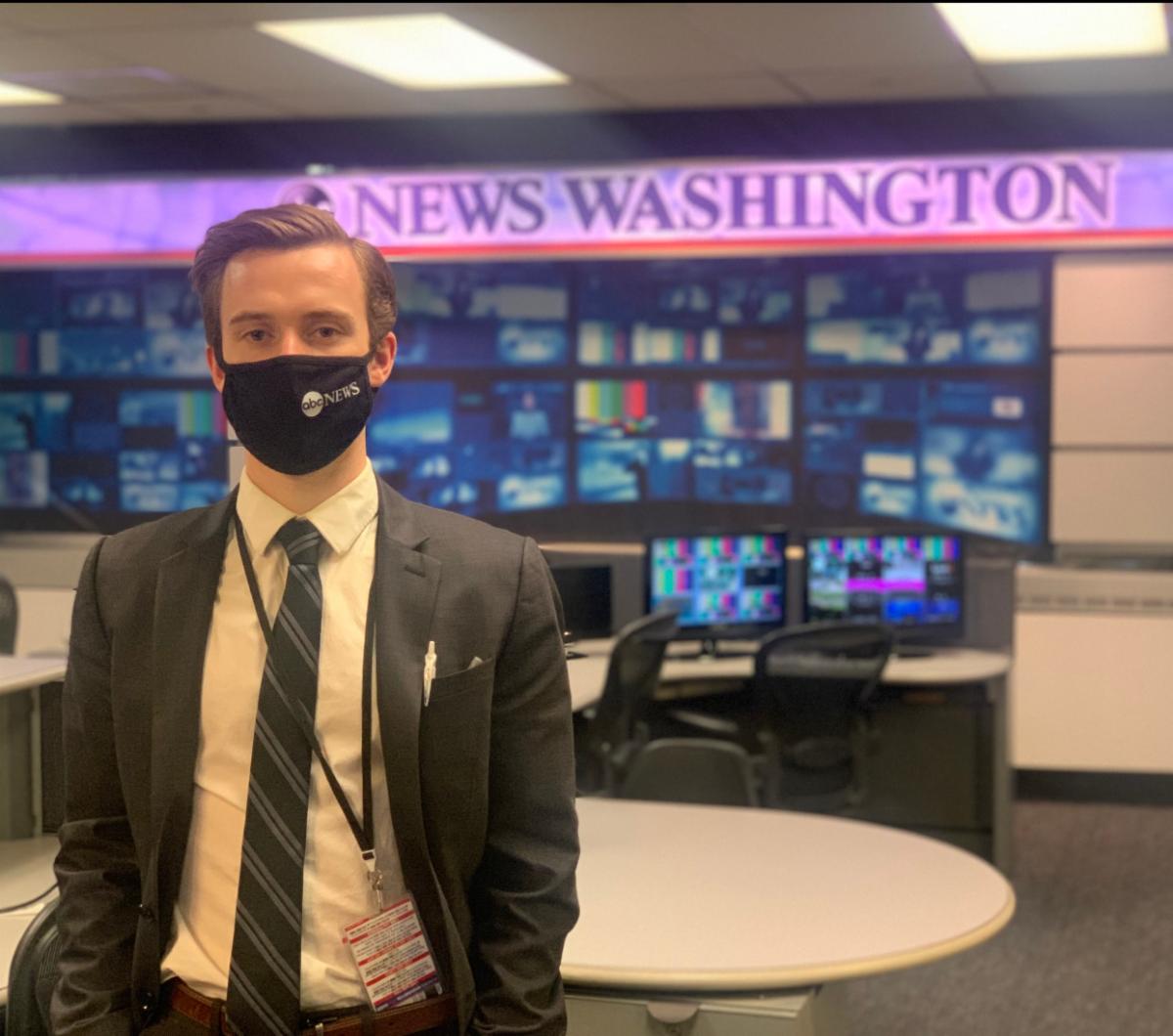
Name: Dan Toomey
School: The University of Southern California
Current job: Desk assistant, ABC News
Best moment in journalism: Election Day coverage

Where are you working right now? Is the position full-time, part-time or an internship?

Toomey: I’m currently a desk assistant at ABC News in Washington DC. I was fortunate enough to start in September. It’s a full-time position, and I help our team create World News Tonight, from researching to producing liveshots and helping coordinate our camera crews. 

What’s the biggest lesson you’ve learned on the job search?

Toomey: Stay in contact with everyone you know, use the internet to network, have an easily-accessible work portfolio, keep an active social media (in the right way), and be willing to take risks. Those lessons are all equally important because I wouldn’t have a job without them. Combine that with patience, optimism, and self-care, and your time will come. 

What’s been your best moment in journalism since graduation?

Toomey: Election week, by far. I was one of the many sleepless journalists constantly refreshing emails and Twitter feeds to check on vote tallies. I actually worked an overnight shift the night before we called Pennsylvania, but I stayed up through the next day so I could be there the moment the official announcement was made. 

My shift ended a few minutes after that, and I left our office where the streets of DC were flooded with people waving flags, honking their horns and, in one case, shredding a rendition of the National Anthem on an Ibanez. I try to walk by the White House every time I leave work, but when I passed it that day the energy was other-worldly. 

To be alongside this team, in this city, on that day — I’ll never forget it. I even printed out our official Tweet naming Biden the President-elect to hang in my room, so I could have that moment — coverage of my first presidential election — frozen in history. 

What do you wish you had learned as a student that you’re learning on the job?

Toomey: Pick your beat and stick to it. I’m still in the process of learning that here at ABC, and I’ve had wonderful mentors give me advice on where to start. But it focuses your energy so much when you don’t feel like you have to report on everything in the world — just one specific area. That was something I didn’t do so much of in college because I felt like I was curious about nearly every subject out there. You soon find out that isn’t a sustainable way of working.

Have your journalism goals changed since graduation, and if so how?

Toomey: Not really. I still envision myself working as a reporter then hopefully moving into a more senior editorial role once I really develop myself journalistically. I still believe the best editors and managers were once reporters themselves. My higher ups at ABC have been really supportive of that, especially when I mention the potential for new platforms — which is very encouraging. 

What’s the NEW wackiest story you’ve ever worked on?

Toomey: Unfortunately, nothing will beat my report on Merlin, the wheelchair duck that I did as an intern for NBC a few years ago. That was actually one of my ice breakers when I introduced myself to everyone at ABC. If that becomes my legacy, so be it. I’m not one to tempt fate.

This newsletter is written & edited by the National Press Club Journalism Institute staff: Beth Francesco, Holly Butcher Grant, and Julie Moos. Send us your questions and suggestions for topics to cover.

Get this from a friend? Subscribe, and view the archives.