December 2025-Non-Coercive Treatment & Eating Disorders | | Welcome to The Reasons Thread. This monthly resource explores one key topic in eating disorders, weaving together evidence, clinical wisdom, and personal perspective. Expect diverse viewpoints—because progress comes from curiosity, not consensus. | |
Non-Coercive Eating Disorder Treatment:
Why Collaboration Supports Recovery and Practical Tools for Outpatient Care
| | |
The way eating disorder treatment is delivered can be just as impactful as the interventions themselves. Non-coercive, collaborative approaches are increasingly recognized as essential to engagement, trust, and long-term recovery—particularly in outpatient settings where autonomy and real-world application matter most.
Our latest blog takes a clear, accessible look at:
- Why non-coercive treatment models support safety, dignity, and sustained change
- How collaboration strengthens motivation, accountability, and therapeutic alliance
- The risks of control-based approaches in outpatient care
- Practical, real-world tools clinicians can use to foster partnership without sacrificing structure
Click here to read the full blog ›
| | |
"At Reasons, we’re seeing how care is delivered shapes recovery as much as the interventions themselves. Control-based approaches, even when well-intended, can increase shame, resistance, and disconnection.
Non-coercive care is not the absence of structure—it reflects intentional leadership, clinical clarity, and collaboration. When clients are meaningfully included in treatment decisions, trust deepens and engagement becomes more sustainable.
For many clients—particularly those in higher-weight bodies, BIPOC communities, LGBTQIA+ identities, and people with disabilities—coercion can echo prior medical harm. Non-coercive care centers dignity, consent, and cultural responsiveness as foundations of ethical treatment.
In practice, this means leading with humanity—building care systems grounded in trust and responsiveness."
-Nikki Rollo, PhD, LMFT, CEDS-C
Executive Director at Reasons
| | |
Choice, Agency, and Recovery
Non-coercive care emphasizes collaboration, transparency, and shared decision-making—recognizing that autonomy and structure can coexist in treatment.
-In your day-to-day work, where do you most often see client agency matter?
-What have you noticed shift when choice or collaboration is made more explicit?
-Are there small practices or moments that seem to support engagement or trust over time?
We’d love to hear what you’re observing.
Click below to share how autonomy shows up in your clinical work or the systems surrounding your clients.
| | | |
Severe and Enduring Eating Disorders:
Ethics, Care, and Quality of Life
Journal of Eating Disorders
This paper examines the clinical and ethical complexities of working with individuals experiencing severe and enduring eating disorders (SEED). Rather than framing chronicity as treatment failure, the authors explore how long-term eating disorders challenge traditional recovery-only models and call for more nuanced, person-centered approaches. The discussion highlights tensions between symptom reduction, autonomy, harm reduction, and quality-of-life goals—particularly when repeated treatment attempts have not led to full remission.
The authors emphasize the importance of individualized care, collaborative decision-making, and flexible definitions of progress. They argue that ethical, effective treatment must account for lived experience, personal values, and meaningful functioning—not just weight restoration or symptom elimination.
This research broadens the conversation around recovery by recognizing that healing is not linear and that compassionate care can—and should—adapt when standard pathways are insufficient.
Takeaway for Providers:
Supporting individuals with long-standing eating disorders requires expanding our definition of success. Integrating harm reduction, quality-of-life measures, and shared goal-setting can foster engagement, dignity, and sustained therapeutic alliance—especially when full symptom resolution is not immediately attainable.
Read the full article ›
| |
Trauma-Informed Approaches in Eating Disorder Care
Non-coercive eating disorder treatment begins with understanding, not force. This trauma-informed article explores how eating disorder behaviors often develop as survival responses to overwhelming experiences—and why approaches rooted in safety, collaboration, and client choice are essential for meaningful healing.
Rather than focusing on compliance or symptom control, the piece invites clinicians and loved ones to consider what happens when treatment slows down, centers trust and honors a person’s lived experience. It highlights how pacing, consent, and shared decision-making can reduce shame, strengthen engagement, and support recovery that feels sustainable rather than imposed.
If you’re curious how trauma-informed care naturally aligns with non-coercive, autonomy-respecting treatment—and what that can look like in practice—this is a thoughtful read worth your time.
Read the full blog here ›
| | |
Care vs. Control in Eating Disorder Support: Insights from Psychiatric Nurse Practitioner, Grace Kim
In this episode of the Body Justice Podcast, host Allyson Yates is joined by Grace Kim, PMHNP-BC, for a thoughtful conversation about the difference between care and control in mental health and eating disorder treatment.
Through a trauma-informed lens, Grace explores how recovery is better supported when clinicians prioritize collaboration, transparency, and consent—rather than pressure or compliance-driven approaches. The discussion reflects key principles of non-coercive eating disorder care, highlighting how structure and safety can coexist with shared decision-making, dignity, and psychological safety.
Rather than removing boundaries, this conversation invites reflection on how care is delivered—and why moving away from control-based dynamics can strengthen engagement, trust, and long-term healing. For those interested in treatment approaches that center partnership over power, this episode offers valuable context for why non-coercive care matters.
Listen to the episode here ›
| |
Body Autonomy in Eating Disorder Healing
Project HEAL’s recent post on “Body Autonomy and Why It Matters for Eating Disorder Healing” highlights how reclaiming decision-making power over one’s body is a foundational step in recovery — freeing individuals from external pressures, diet culture, and the internal voice of the eating disorder itself. In the simplest terms, body autonomy is self-determination — the ability to make choices that align with one’s values, identity, and intrinsic motivations, rather than fear or coercion.
This perspective aligns directly with non-coercive treatment models, which prioritize collaboration, consent, and agency in care. Research and clinical practice show that coercive or directive approaches can disconnect individuals from their sense of agency and undermine engagement, whereas autonomy-supportive environments — ones that provide structure and honor the lived experience and choices of the person in treatment — foster trust, safety, and deeper motivation for lasting change.
Read full blog here ›
| | |
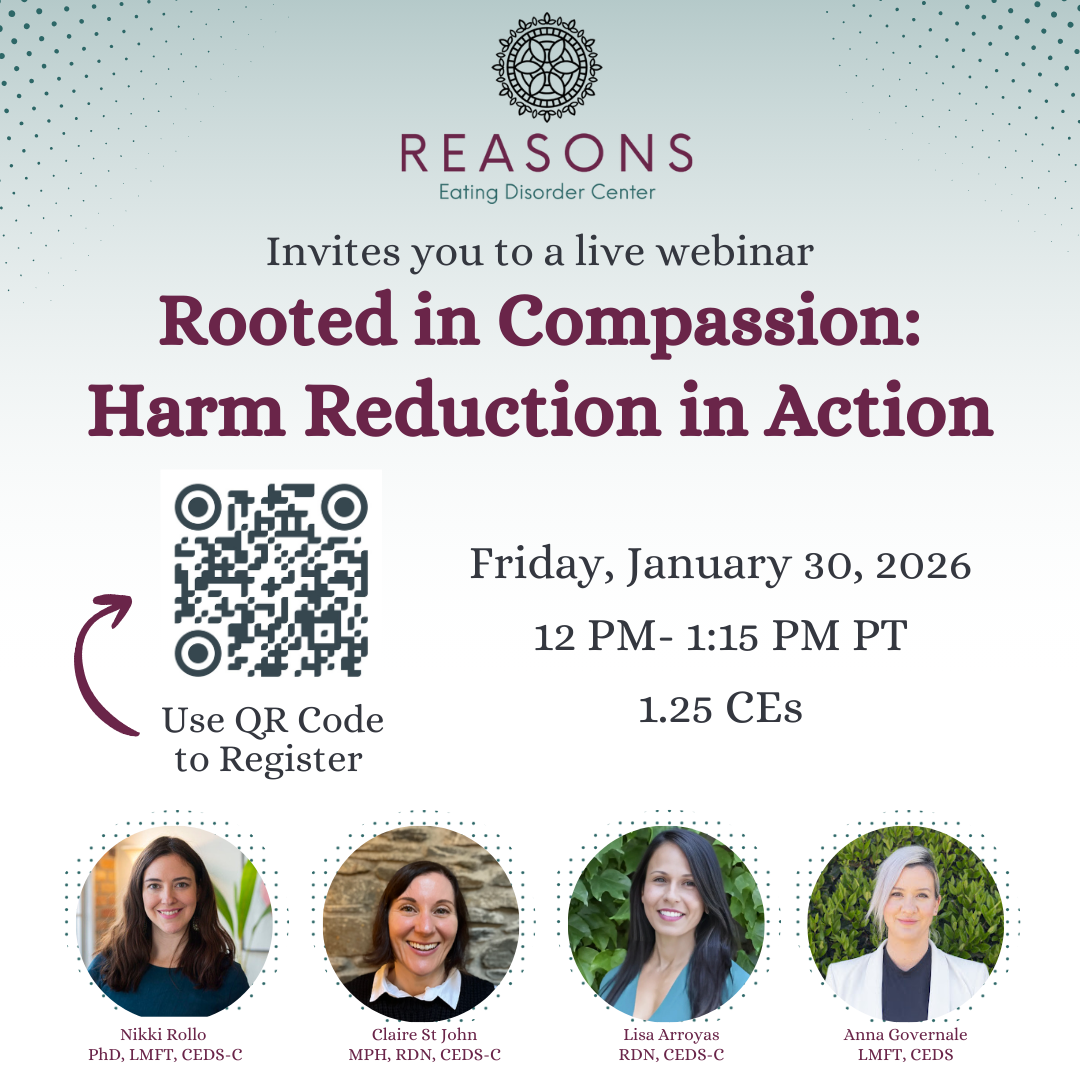
Rooted in Compassion: Harm Reduction in Action
Complimentary Webinar 1.25 CEs
For clinicians interested in learning more about non-coercive, harm-reduction approaches to eating disorder treatment, this upcoming educational webinar offers a practical, real-world perspective.
Rooted in Compassion: Harm Reduction in Action is a live training led by Reasons Eating Disorder Center leadership that explores how harm-reduction principles are applied in everyday clinical practice. The session focuses on reducing pressure and compliance-based dynamics while maintaining structure, safety, and clear clinical boundaries. Emphasis is placed on collaboration, client autonomy, transparency, and psychological safety—core elements of non-coercive care.
This webinar is designed for professionals who want to deepen their understanding of how harm reduction and shared decision-making can support engagement and sustainable change in eating disorder treatment.
Those unable to attend live may still register to access the on-demand recording and earn continuing education credits.
Learn more and Register Here›
| |
Progress comes from collaboration. If you have research, practice wisdom, or lived experience that could enrich this dialogue, or if you would like to suggest a topic that you would like to see featured, let us know by emailing Shannon.Braasch@uhsinc.com—we may feature it in a future edition! | |
|
Know Someone Needing Support?
Want to learn more about Reasons EDC or connect someone with treatment? Our admissions team is here to help—reach out by phone at
844-573-2766 or through our secure web form here to
explore care options.
| | | | |