| | |
POLICY & ADVOCACY UPDATE
Issue #63, 29 January 2026
| | | |
- From the AA CEO James Goodwin
- AA Pre Budget Submission sets out accommodation sector agenda
- Apprenticeship numbers continue to fall
- Overseas arrivals November 2025
- Tourism Forecasts to 2030
- Hotel performance in December and for 2025
- Job Vacancies in the industry on the rise again
| |
| |
From the AA CEO
The Australia Day long weekend marked the end of the traditional holiday season and despite the heat and extreme weather events in many parts of the country over the past few weeks, in the most part it has been one of the best December-January periods for our accommodation operators for some time. Well done and thanks to those who’ve been working through this busy period.
| | | |
|
Our political and policy work for the sector is well and truly back in the swing of things. AA has this week lodged our second major submission for 2026 – the Pre-Budget Submission to Treasury. Jenny has more details below and I thank members for their ongoing contributions through data and other feedback to help make this such a comprehensive and compelling document.
Federal Parliament resumed early for a special sitting to pass the antisemitism and hate crime legislation, and we’ve also seen another split in the Coalition and more speculation about Sussan Ley’s position as Opposition Leader. A credible opposition is important for our parliamentary system and AA will continue to engage with and brief all parties on the issues important to you, but this year looks set to be a challenging one in the halls of power.
On a brighter note, the full calendar year occupancy for 2025 has been released (below). Some encouraging results – particularly the second half of the year – which provides a good basis for hopefully an even more successful 2026.
James Goodwin
Chief Executive Officer
| | | | |
AA Pre Budget Submission sets out accommodation sector agenda
In a major submission sent to Treasury this week, Accommodation Australia outlined the size and scope of our industry and identified the major factors that will make a difference to our productivity and profitability. Key recommendations in the Pre-Budget Submission cover skills, migration, tourism promotional funding, airline capacity, short term rental accommodation and energy amongst others.
Linking migration outcomes with skills funding, the submission points out that sectors such as hospitality have been de-prioritised in training support, including a reduction in apprenticeship funding, resulting in a fall in the number of apprentices (see below). At the same time, our industry's need for skilled migrants has increased which resulted in over 10,000 visa grants in 2024-25 and a contribution of around $64 million to the Skilling Australians Fund, which is a compulsory levy paid by sponsoring employers. We have called for the SAF levy to be halved and for more of the proceeds go to training funding that will benefit the industries that are contributing.
Accommodation Australia will be in Canberra next month to advocate for the issues raised in our pre-budget submission.
| | | |
Apprenticeship numbers continue to fall
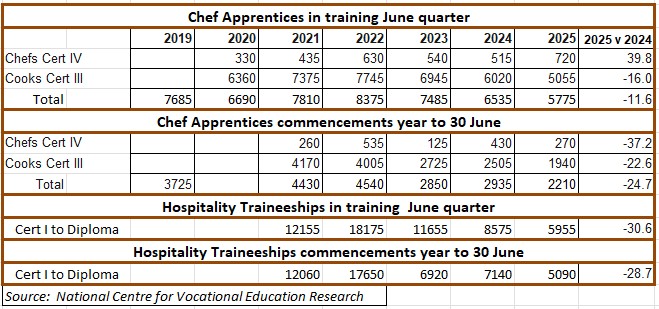
The latest data released by the National Centre for Vocational Education Research show that across all industries as at 30 June 2025, there were 307,080 apprentices and trainees in training, with almost three-quarters in trade occupations. The total number of in-training contracts decreased by 11.3% from 30 June 2024. Trade contracts decreased by 7.3%, to 221,510, while non-trade contracts declined by 20.2%, to 85,550. Compared to 2024, in the June quarter 2025, commencements in trades declined by 29.2% and for non-trade traineeships the decline was 26.5%. The largest trades decreases were among Food Trades Workers (down 1,345, or by 58.7%, to 945) and Construction Trades Workers (down 1,340, or by 27.1%, to 3,615). The table below show the figures for chefs, cooks and hospitality traineeships specifically. In the year to June the number of apprentices commencing as cooks and chefs fell by 25% to 2,210 compared to the 2,935 that commenced the previous year. Those in training fell by 12% to 5,775. These numbers compare unfavourably to the pre-COVID levels when the number of cooking apprentices in training in September 2019 were 7,685, and 3,725 commenced their training in the year to September 2019. The data also reveals that hospitality traineeships continued to dramatically fall following the removal of government funded employer incentives on 1 July 2024. Commencements fell by 29% to 5,090 in the year to June 2025 compared to the previous year, and as the table shows, there were only 5,955 traineeships in training as at June 2025.
| | |
Overseas arrivals November 2025
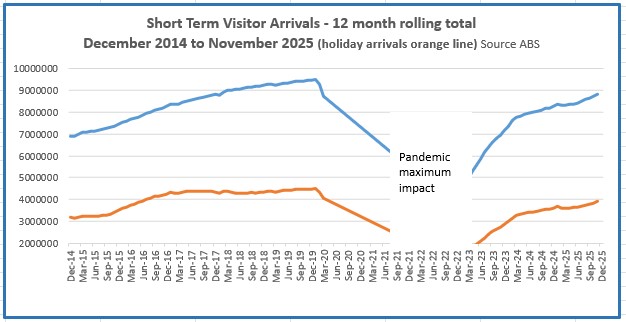
According to the ABS data released last week, there was a pleasing increase of 19.5% in short-term visitor arrivals in November 2025 to 831,170 compared to November 2024, and 1.8% more than pre-COVID November 2019. Holiday arrivals were up 28% compared with November 2024. New Zealand was the largest source country for overall short-term arrivals in November 2025, accounting for 127,820 or 15% followed by the UK (80,090 thanks to the Ashes series) and then China coming in third with 74,500 visitors. Of the top ten origin countries, New Zealand, the UK, Japan, India, South Korea, and Indonesia all had arrivals greater than November 2019.
The 12-month rolling total arrivals tell a more useful story, illustrating the recent improvement as well as the difference with pre-COVID visitors, particularly for holidaymakers. In the 12 months to November 2025, there were 8,646,960 arrivals up by 6.7% on the year to November 2024, with holiday arrivals at 3,916,820, up 9.8% on the previous year. Holiday arrivals historically peaked at 4.48 million in the year to December 2019. If holiday arrivals grow in the remaining 7 months of 2025/26 similar to the growth in the last three, then total year holiday arrivals will be over 4.8 million for the year to June 2026. The graph below shows rolling 12-month totals for total short-term arrivals and holiday arrivals.
| | |
Tourism Forecasts to 2030
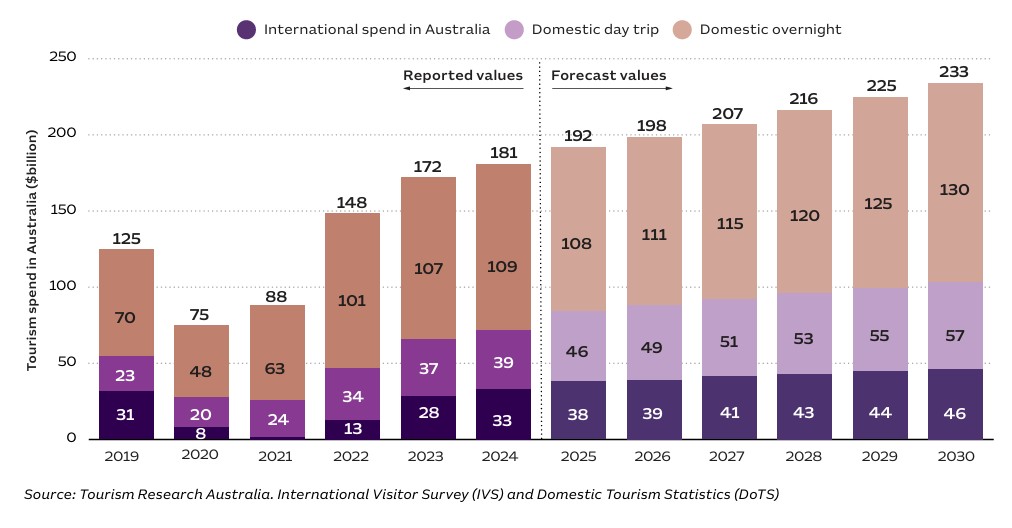
By 2030, Tourism Research Australia is predicting that international tourism spend in Australia will rise to $46 billion, and total tourism spend including domestic overnight and day trips will rise from $181 billion in 2024 to $233 billion in 2030. By 2030, TRA expect international visitor arrivals to Australia to reach 10.9 million, domestic overnight trips to surpass 123 million and domestic day trips to exceed 313 million. As can be seen by the graph below, by far the biggest spend comes from domestic overnight tourists, but relatively speaking the strongest growth will come from day trippers. International spend in Australia
is expected to rise after 2025 at an annual average growth of 4.0% over the forecast period. The slower pace of growth in international spend in the future years aligns with moderating inflation and tapering growth in international visitor arrivals. It also reflects a decline in average trip spend for some markets and travel types as travellers continue to seek out value-for-money. China is expected to be the fastest growing market over the full period to 2030, while Hong Kong, India, the Philippines, Vietnam, and Indonesia also show strong growth prospects. For the full TRA report, see here.
| | |
Hotel performance in December
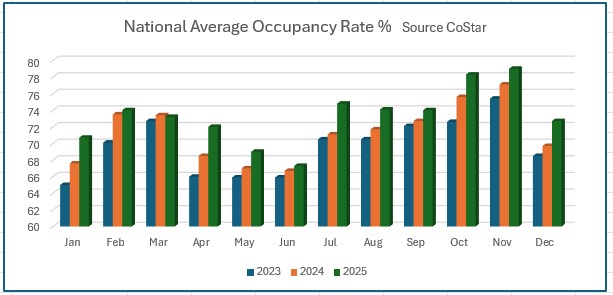
CoStar data (previously referred to as STR) for December shows that hotel performance remained relatively strong for all States and Territories compared to December last year with Victoria and South Australia the standout improvers in occupancy.
- National average occupancy was up 4.3% to 72.7% for December, ADR up 8.7% to $277.68 resulting in a strong rise in RevPAR of 13.4%;
- NSW experienced an average occupancy of 76.8%, up 2.8% compared with last year, with ADR up 8.9% to $252.20;
- Victoria's occupancy strongly rose 10.6% to 74.9%, and ADR also strongly up 11.6% to $244.10;
- Queensland occupancy was marginally up 0.3% to 68.8%, and ADR rose by 7.8% to $309.99;
- SA finished a strong second half of year with occupancy up 9.5% to 72.0% for December and ADR strongly up 14.3% to $252.21;
- WA occupancy up 3.7% to 76.5% and ADR up 8.7% to $271.07;
- Tasmanian occupancy up 1.4% to 76.9% and ADR up 7.5% to $263.70;
- NT occupancy up 1.6% to 39.6% but ADR down 2.1% to $166.87; and
- ACT & Canberra occupancy up 6.4% to 66.0% and ADR up 7.8% to $197.23.
Preliminary capital city CoStar data for the month to January 17th shows that hotel occupancy improved against the same period last year in most cities, with Hobart starting the year particularly well. Sydney has also started the year well with a 5% improvement in occupancy to 77.8%, and ADR rose strongly by 11.6% to $316.98. Melbourne's occupancy fell by 4.5% to 67.4% and ADR fell 10.9% to $208.60, but these figures are sure to reverse once the full month's figures are in, as the Australian Open was one week earlier last year. Brisbane occupancy was up 4.5% to 68.5%, and ADR up by 3.2% to $223.62; Adelaide occupancy up by 7.0% to 74.4% and ADR up 3.3% to $201.53; Perth occupancy up 2.7% to 74.1% and ADR up 8.2% to $257.65; Hobart occupancy up 2.2% to 92.5% and ADR strongly up 12.6% to $290.92; Darwin occupancy fell 8.2% to 31.0% but ADR rose 3.4% to $149.35; Canberra occupancy rose.8.1% to 66.2% and ADR slightly up 0.5% to $196.72; and Gold Coast occupancy down 3.7% to 78.8% but ADR up 8.1% to $439.72
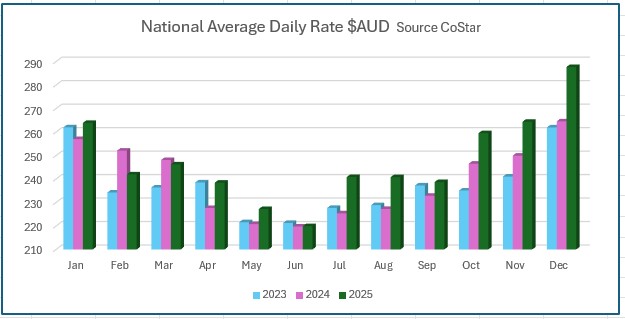
The graphs below derived from the CoStar data show the monthly average performance of occupancy and ADR across Australia since January 2023. December's strong rise in national ADR compared to the previous year is clearly illustrated.
| | |
Hotel Performance in year to December
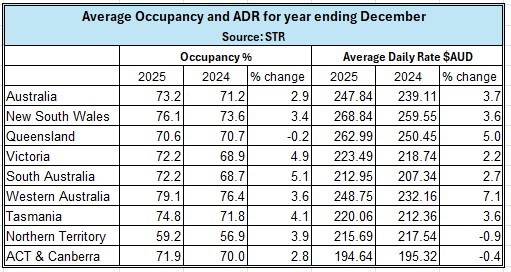
The STR hotel performance figures for the whole of 2025 as compared with 2024 are shown in the table below. The full year figures for Queensland reflected the issues they were having throughout the year, with occupancy down but one of the best results for an increase in the ADR. Western Australia's consistently strong performance is evident in a 3.6% rise in occupancy and a 7.1% increase in ADR. South Australia saw the biggest increase in occupancy for the year, but the ADR increase was more modest at 2.7%. Both of the Territories would be disappointed to see their ADR fall compared to 2024.
| | |
Job vacancies in the industry on the rise again
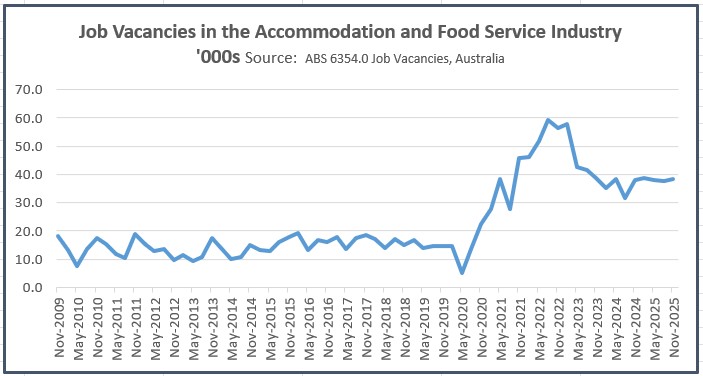
Data released earlier this month by the ABS show that job vacancies for the Accommodation and Food Service industry are on the rise again, reach 38,200 in November 2025 compared to 37,700 in August 2025 and about the same as the previous November. This contrasts with a fall in private sector job vacancies across all industries of 6.7% in November 2025 compared to the previous November. Public sector job vacancies rose 9.0% across the same period. Job vacancies in our industry are the second highest of all industries, with the health sector the highest. As can be seen by the graph below, the total number of vacancies in the AFS is now consistently higher than pre-COVID.
| |
| | |
3 things for you to do today to support the industry's jobs and careers platform eeger.com.au:
- Register on eeger to build your employer profile
-
Follow eeger on LinkedIn to stay in touch
- List your job vacancies on the site that has been developed for industry by industry
| | | | |
Drop me an email at policy@accommodationaustralia.org or give me a call on 0418 277 919 if you have any national policy issue that you think AA should be following up. If you know an AA member who is not receiving this advocacy report but wants to, then encourage them to email me and we can add them to the distribution list. Back issues of the fortnightly advocacy updates can be found here.
Kind Regards
Jenny Lambert OAM
National Policy Director
Accommodation Australia
| | | | |