League Logo.jpg

2025-2026 Legislative Bulletin

October 27, 2025

In this edition of the League's Legislative Bulletin, you'll find:

1. Floor Sessions Advance League Priorities

2. First Responders of the Year Honored in the Assembly

3. Recently Introduced Legislation of Municipal Importance

4. Public Hearings in the State Capitol this Week

5. Agency Actions, including:

a. Welcome to New DOR LGS Bureau Director

b. Comments to the PSC on Cost Overruns

c. WHEDA Housing Loan Program Applications

d. Final Brownfield Learning Session Tomorrow

e. Webinar on Lead Service Line Removals

f. Last Call for the Local Project Grant Program

g. Cyber Attack Resources for Municipalities

h. Urban Wildlife Abatement Grant Program

6. Federal Forecast on Shutdown and ARPA Reporting

Floor Sessions Advance League Priorities


The legislature is about to wrap up a productive month where we saw progress in different stages of the legislative process on several bills supported by the League. This includes two bills recently signed into law to support emergency medical services (EMS) departments of all sizes.


Senate Bill 182 looks to ease the EMS workforce shortage and test new strategies to ensure the correct emergency response levels are provided at the scene of an emergency. This legislation was passed by the Senate on June 18th, passed by the Assembly on October 14th, and signed into law by the Governor last Tuesday, October 21st, as 2025 Wisconsin Act 35. Three new programs were established by Act 35, including:


1. Creating a grant program for technical colleges to receive funding to expand access and enrollment in courses to train and prepare individuals seeking their certification or licensure as an EMT or EMR,


2. Creating a reimbursement program for individuals or employers to recover the costs they paid for tuition and materials in a program to obtain initial certification or licensure as an EMT or EMR, and


3. Creating a pilot program for public safety answering points (PSAPs) to establish real-time video and multimedia communications between PSAPs and people who call for emergency services.


Act 35 simply establishes the structure for the programs created by this legislation. For the agencies responsible for these programs to begin offering these services, the agencies will have to request that the Joint Finance Committee release funding set aside in the 2025-2027 State Budget. A total of $10.6 million was allocated, including $7.0 million for the first program, $3.5 million for the second program, and $100,000 for the third program.


Senate Bill 183 looks to address three separate concerns raised by EMS officials and all three prongs address issues the League has heard from its members in recent years. This legislation was passed by the Senate and Assembly on October 14th and was signed into law by the Governor last Tuesday, October 21st, as 2025 Wisconsin Act 36. The changes made by Act 36 include:


1. Exempting municipal expenditures for a fire and EMS district established under the current law levy limit exemption from the calculation for the Expenditure Restraint Incentive Program,


2. Increasing the Medicaid reimbursement for EMS response and treatment with no transportation from its current rate of $69 per call to the new rate of $175 beginning in 2027, and


3. Requiring an annual report to the legislature on state and national changes to the scope of practice of EMTs and EMRs and how those changes may affect training for EMTs and EMRs.


The League would like to express our appreciation to the lead authors of these bills, Senator Howard Marklein (R-Spring Green) and Representative Tony Kurtz (R-Wonewoc), the co-sponsors and supporters of these bills, and to Governor Tony Evers for his quick action to sign these bills into law. While no single action will resolve the EMS crisis in Wisconsin, these laws will make incremental progress tackling the growing challenges in this critical industry.


You can read press releases from the authors and Governor on the bill signing. Please consider sending a note of thanks to the authors of these important measures.


League members are also encouraged to stay tuned to future editions of the Legislative Bulletin for updates on the release of funding for Act 35 and for the implementation of the programs and changes made by these two new laws.


While the EMS legislation was a highlight of the legislative floor sessions on October 14th, other bills lobbied on by the League were also advanced. In the Senate, SB 337 to provide financial assistance for smaller municipalities to obtain grant writing and compliance services and SB 443 to ease eligibility requirements for the Agricultural Roads Improvement Program were passed.


In both chambers, SB 159 to modernize statutes regarding police vehicle lighting was also passed. This legislation now heads to the Governor for his action. If signed into law, the requirements for lighting on police vehicles would not change, but law enforcement agencies would be allowed to add additional lighting, which is currently prohibited, to vehicles to increase visibility to motorists and others within eyesight of a law enforcement response. 

🚓🚒🚑 First Responders of the Year Honored


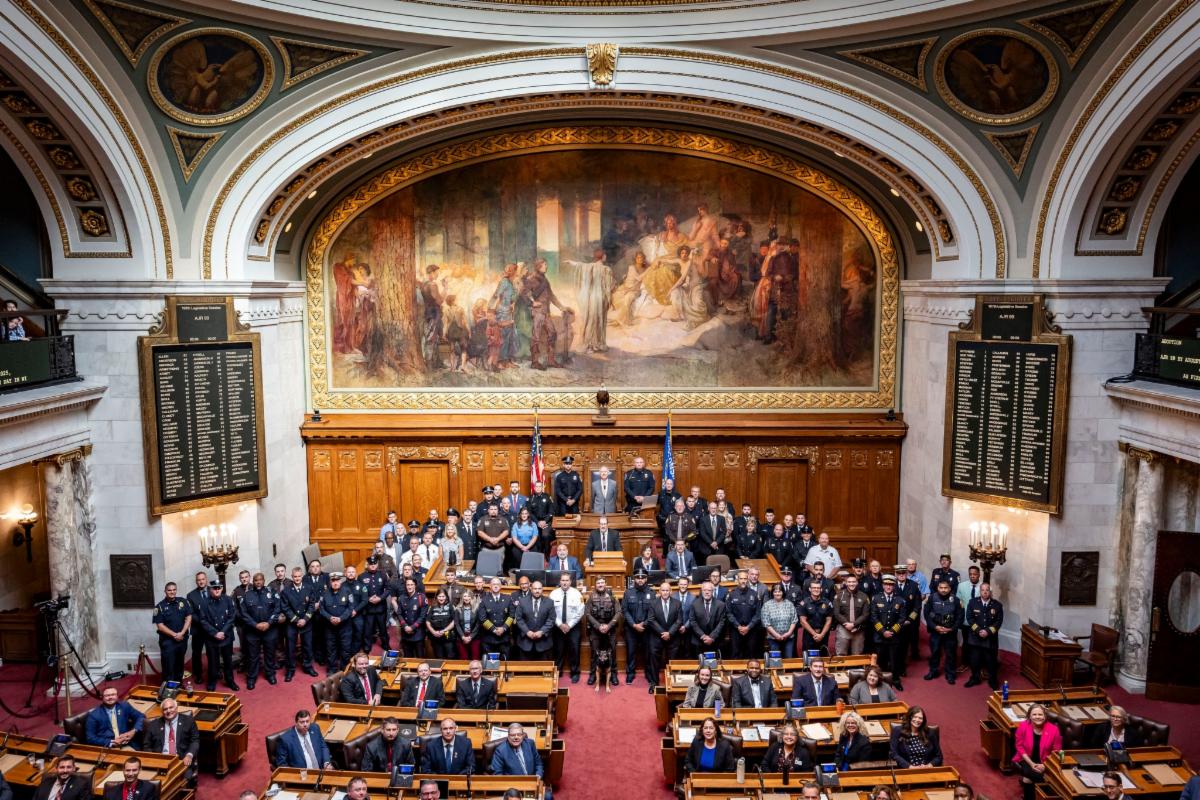
Each legislative session, the Wisconsin State Assembly takes a day in the October floorperiod to honor the First Responders of the Year chosen by Representatives in all 99 districts. Many of these law enforcement officers, firefighters, EMTs, and dispatchers make their way to the State Capitol to be honored in person during a ceremony in the Assembly Chambers.


The recipients of the First Responder of the Year awards for the 2025-2026 Legislative Session include everyday heroes including:

  • Assistant Fire Chief Chuck Beistle of the West Bend Fire Department, selected by Rep. Gundrum (R-Slinger),
  • Officer Hannah Carlson of the Beloit Police Department, selected by Rep. Anderson (D-Beloit),
  • Deputy Chief Brandon Frederick of Dells-Delton EMS, selected by Rep. Kurtz (R-Wonewoc), 
  • Chief Thomas Bischel of the New Auburn Area Fire Department, selected by Rep. Armstrong (R-Rice Lake), 
  • Officer Steve Rosemeyer of the Mount Horeb Police Department, selected by Rep. Novak (R-Dodgeville),
  • Captain Scott Rasmussen of the Oshkosh Fire Department, selected by Rep. Palmeri (D-Oshkosh), and 
  • Officer Daniel Gonzales of the Milwaukee Police Department, selected by Rep. Donovan (R-Greenfield). 

Each first responder honored in this ceremony received a legislative citation thanking them for their bravery and service. Along with celebrating the 99 recipients of the First Responder of the Year awards, both chambers of the legislature also passed Assembly Joint Resolution 99 recognizing October 14, 2025 as First Responders Appreciation Day in Wisconsin. 

Recently Introduced Legislation of Municipal Importance


The following bills have been recently introduced in the Wisconsin State Legislature and have been added to the list of those being monitored by the League. Unless otherwise indicated, no formal position has been taken on these proposals to date. 


  • Senate Bills (SBs) 557 and 558: State Emergency Relief Fund - Sen. Hutton (R-Brookfield) and Reps. Knodl (R-Germantown), Melotik (R-Grafton), and Donovan (R-Greenfield) - SB 558 creates a grant program for individuals and businesses adversely affected by a disaster declared by the Governor since the start of this year. Grants of up to $25,000 for individuals and $50,000 for businesses may be awarded for costs related to the disaster, with any grant amounts offset by federal assistance paid back to the state. SB 557 provides the funding for the programs in SB 558, with $10 million provided for individuals and $20 million provided for businesses.


  • SB 556: Local Aids for Energy Storage Facilities - Sen. James (R-Thorp) and Reps. Rodriguez (R-Oak Creek) and Dittrich (R-Oconomowoc) - Under current law, cities, villages, towns, and counties receive Utility Aid Payments for energy generation facilities located in that political subdivision. This legislation extends those aid payments to utility-owned energy storage facilities. Annually, cities and villages would receive two-thirds of the amount calculated by multiplying the facility’s megawatt storage capacity by $2,000 with the remaining one-third provided to counties. 

⭐If you would like to contact your legislators on any bills mentioned in the Legislative Bulletin, you can find contact information for all legislators here. To find out which legislators represent your community, use the "Find Your Legislator" function on the right side of the page. 


‼️REMINDER - The League’s website includes information on our advocacy efforts for Wisconsin’s cities and villages. Recently updated, the website includes copies of testimony and other legislative communications, comments submitted to state agencies, information on the 2025-2027 State Budget, and past editions of the Legislative Bulletin and Wheeler Report Bulletin. 

Public Hearings in the State Capitol this Week


As we approach the end of the fall portion of the legislative session, the legislature is staying busy with 11 different committees holding a public hearing, informational session, or executive session this week. This includes the Assembly Committee on Transportation which, on Wednesday, October 29th, will be holding a public hearing on Assembly Bill (AB) 502. This legislation revises the process for handling outdoor advertising signs, that do not confirm with local ordinances, during a state transportation project.


Also on Wednesday, the Assembly Committee on Local Government will be meeting. The committee will begin by voting on AB 443, a bill that raises the maximum municipal court fee from $38 to $48. The committee will then accept testimony on AB 483, a bill which requires all wheel tax ordinances, including ordinances already enacted, to pass by referendum. Also on the public hearing agenda are AB 559 which provides utility aid payments to local governments for energy storage facilities and AB 282 which requires local governing bodies to allow ordinances or resolutions to be reintroduced two-years after a previous proposed failed to pass in a vote. 

Agency Actions


Welcome to New DOR LGS Bureau Director


Last week, the Department of Revenue (DOR) Local Government Services (LGS) Bureau announced that Brenda Ayers will serve as the new Bureau Director. The League would like to extend a warm welcome to Brenda! She most recently served as the administrator and clerk for the City of Lodi and has decades of experience in local government finance.


DOR’s LGS Bureau handles a series of responsibilities and programs important to cities and villages, including shared revenue and the newly released $300 million Innovation Grant Program currently open for applications. Contact information for LGS may be found on DOR’s website. 


Comments to the PSC on Cost Overruns


This morning, the League submitted comments to the Public Service Commission of Wisconsin (PSC) on Docket 5-UI-124, an investigation on the Commission’s own motion to review cost overruns. According to the PSC, the intent of this investigation is to develop “a viable framework for utilities, merchant developers, parties, and Commission staff to employ when cost overruns occur.”


The League’s comments cautioned that a one-size-fits-all process for cost overruns will not work as each cost overrun in water utility projects is due to unique circumstances. Following our rationale for this request, we asked the PSC to either abandon its investigation or to remove municipal utilities from this broader investigation that also examines investor-owned electric and gas utilities.


Comments from the League on this investigation may be read here. This comment period is on the opening of the investigation. Stay tuned to future Legislative Bulletins for further information on this investigation and the PSC’s treatment of cost overruns in water utility projects. 


WHEDA Housing Loan Program Applications


In the 2023-2024 Legislative Session, the League’s advocacy helped lead to the creation of three new workforce housing loan programs at the Wisconsin Housing and Economic Development Authority (WHEDA). Funded through a historic $525 million investment, this initiative has already assisted in the creation of more than 1,000 units. These low-interest rate loan programs, that assist in closing financing gaps for workforce housing projects in Wisconsin, are now open for the Fall 2025 round of applications.


The first program, the Infrastructure Access Loan Program, assists local governments and developers with a portion of the cost of public improvements to serve new housing developments. The second, the Restore Main Street Loan Program, assists developers with rehabbing second- and third-floor rental housing over commercial spaces. And the third, the Vacancy-to-Vitality Loan Program, assists developers in converting vacant or underutilized commercial properties into housing.


In all three programs, for an applicant to be eligible for loan funding, the relevant local government must have made administrative, fee, process, or regulatory changes to lower the cost of that eligible housing project since January 1, 2023. More information on municipalities’ role in these loan applications may be found on WHEDA’s website.


While changes proposed in legislation this session will not be in place for this loan cycle, future loan cycles may be positively impacted by proposed revisions to these programs. League supported legislative modifications include moving the date municipalities had to make modifications to lower the cost of housing back to 2020 (instead of 1/1/23) and removing the prohibitions on stacking TIF and Historic Tax Credits for these projects.


Applications for the Fall 2025 round are due on Friday, November 21st. To learn more about these programs and prepare an application, visit WHEDA’s website. 


Final Brownfield Learning Session Tomorrow


The Department of Natural Resources (DNR) is hosting its final free Learning Sessions for Local Governments on Brownfield Redevelopment tomorrow, October 28th, in Fond du Lac. The League Government Affairs team joined the session earlier this month in Eau Claire and found it to be a great overview on the process of and funding for brownfield revitalization. The session also provided an opportunity to hear from local leaders that have successfully navigated this process.


More information on tomorrow’s Learning Session may be found on the DNR’s website. If you’re interested in learning more but cannot attend, the DNR has a series of resources on its website, including information for local governments, financial assistance resources, success stories, and a training library.


Webinar on Lead Service Line Removals


The PSC is hosting a webinar on Thursday, October 30th from 1:00pm to 1:45pm on utility programs for providing financial assistance to property owners for the removal of privately-owned lead service lines. As utilities face a deadline of 2037 for lead service line removals, this financial assistance program may be a viable path towards achieving those regulatory mandates. Registration for this webinar may be found here. 


Last Call for the Local Project Grant Program


Applications for the Grants for Local Projects Program are due by 5pm this Friday, October 31st. As shared in previous Legislative Bulletins, this highly-competitive program will award $50 million to non-state capital projects around the state that have a profound public purpose and support economic and community development. Municipalities are eligible entities, and applicants may receive up to $2 million or up to 50% of the project cost, whichever is less.


Continuing this program was on the League’s list of budget priorities for the 2025-2027 State Budget. Learn more and apply now on the Department of Administration’s (DOA) website.


Cyber Attack Resources for Municipalities


In response to increasing cybersecurity threats against municipal utilities, the DNR recently shared resources for municipalities that believe their cyber infrastructure may have been attacked. This attachment provides the state-level contacts that may be able to assist your municipality when these cyber threats occur. We would like to thank the DNR for highlighting these important resources! 


Urban Wildlife Abatement Grant Program


The DNR has announced the 2026 Urban Wildlife Damage Abatement and Control Grant Program is now accepting applications. Municipalities with a population density of at least 125 people per square mile (which encompasses nearly all cities and villages) are eligible to receive a grant of up to $5,000 to cover up to 50% of the cost of eligible projects such as developing an urban wildlife control plan, trapping deer and geese, modifying habitat, and more.


Applications for this competitive grant program are due on December 1st with awards expected to be announced by January 31, 2026. Learn more about this program and apply now on the DNR’s website. 

Federal Forecast


The shutdown of the federal government may have impacts that are felt by your municipality or in your community. While Wisconsin is more insulated than many other states from the impacts of a federal shutdown given that we have the lowest share of federal employment in the U.S. and no national parks generating tourism spending, the shutdown still has impacts in our state.


If you’re looking to see what, if anything, your municipality should do in response to a federal government shutdown, the National League of Cities has prepared a Local Official Checklist for Navigating a Federal Government Shutdown which may be read here.


Just because the federal government is shutdown doesn’t mean municipalities shouldn’t be preparing for future federal reporting periods. The U.S. Department of the Treasury has released new guidance on how communities should prepare to close out their American Rescue Plan Act (ARPA) State and Local Fiscal Recovery Funds (SLFRF) awards.


This new guidance allows for an early closeout option where municipalities that have fully obligated and expended their ARPA SLFRF awards may be eligible to do their final report prior to 2027, the current year of final reporting. Municipalities must be invited to participate in this early closeout process and Treasury has already begun the notification process to those it has deemed eligible with more expected to be notified on a rolling basis.


To review this new guidance from Treasury and learn more about preparing for the closeout of ARPA SLFRF awards, review this article from the National League of Cities. 

Email questions or comments to:

Toni Herkert, Government Affairs Director, therkert@lwm-info.org

Evan Miller, Government Affairs Specialist, emiller@lwm-info.org

Facebook  Twitter  LinkedIn  Web