"Gold card" law is first step in helping physicians with burdensome process
A new state law in Texas will exempt certain physicians from prior authorization requirements.
The law took effect earlier this month, and is designed to limit delays in patient care by "gold carding" physicians who have a 90% prior authorization approval rate over a 6-month period on certain services, the American Medical Association (AMA) explained.
Physicians who are gold carded will be exempt from prior authorization requirements for those services, meaning that state-regulated insurance companies will not delay patient care, according to the AMA.
|
|
The FDA granted orphan drug status to Soin Therapeutics for an investigational formulation of low-dose naltrexone as a treatment for complex regional pain system (CRPS).
Naltrexone is primarily used to manage alcohol or opioid use disorder [OUD] by reducing cravings or feelings of euphoria associated with substance use disorder. “It has also been shown in anecdotal reports to alleviate symptoms stemming from CRPS at very low doses (approximately one tenth the dose for OUD) of currently approved indications,” according to Soin Therapeutics, in a press release. “When the dose of the drug is substantially lowered, the pharmacological effects change favorably to treat CRPS.”
Currently, Soin Therapeutics is developing its own novel formulation of low-dose naltrexone, and is in the process of preparing an Investigational New Drug Application meeting with the FDA as a needed step to commence a large, multicenter, national clinical trial.
|
|
A proposed LCD on Epidural Procedures for Pain Management services was announced on June 10, 2021. This nationwide policy contains many onerous changes that will detrimentally affect patient access to care. ASIPP has written comment letters with detailed explanations of the issues and needed changes to each Medicare Contractor.
To date, with the help of ASIPP members, we have received interest and support from 70 Congress. Let us keep the momentum going! If you have not yet sent your letter and patients' letters, please do as soon as possible. If you have, please continue to collect and submit patient letters as we need each physician to send at least 100 letters from patients, colleagues, and staff. This is not that hard to do - it only takes a bit of time each day.
Instruction for patient letters:
- Print it off daily changing the date and ask your patients to sign as the check-in.
- Remember, your office should enter the letters otherwise the odds are they won't be submitted!
|
|
Insurers paid out about $100K on average
Hospitals billed private insurers an average of $317,810 for a complex COVID-19 hospitalization, according to new data from FAIR Health.
Insurers paid out an average of $98,139 on those claims, which involved intense care like ICU stays or use of a ventilator, according to a press release from the company.
Average charges and payouts for general hospitalizations for COVID-19 were lower, at $74,591 and $33,525, respectively, the company found.
|
|
Health systems and states have continued to announce COVID-19 vaccination requirements for employees. Amid these requirements, some organizations have fired workers for noncompliance, and workers have quit over the policies.
Here are numbers related to resignations and terminations from health systems, announced since June:
1. By the end of the day Sept. 15, the requirement deadline, Morehead, Ky.-based St. Claire HealthCare had fired 23 employees for noncompliance, hospital spokesperson Amy Riddle confirmed to Becker's.
2. Med Center Health in Bowling Green, Ky, said 180 staff members were terminated because of its vaccination requirement.
|
|
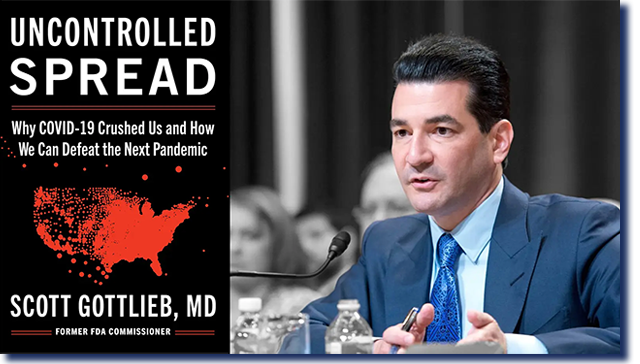
A commentary on former FDA Commissioner Scott Gottlieb's new book, "Uncontrolled Spread"
I recently finished reading Uncontrolled Spread, a new book by Scott Gottlieb, MD, which offers an incredible deep dive into what was and is still happening with the U.S. government's pandemic response. I believe Uncontrolled Spread will be the most authoritative book on the COVID-19 pandemic in the U.S. out of the many books that will be written.
From the beginning, Gottlieb has had an outlook on the COVID-19 pandemic that was both prophetic and personal. He carefully tracked the initial spread of the coronavirus from its early days in Wuhan, China, and then in Lombardy, Italy. Most of the country didn't take the pandemic seriously at that point, but Gottlieb -- who left his post as FDA commissioner in 2019 -- sounded the alarm. In January 2020, he warned that the outbreaks in other countries were previews of what would happen in the U.S. It's one of many predictions Gottlieb got right when so many were wrong.
|
|
Company is working with UCLA, Biogen to see if sensitive data like facial expressions, typing metrics could signal mental-health concerns
Apple Inc. is working on technology to help diagnose depression and cognitive decline, aiming for tools that could expand the scope of its burgeoning health portfolio, according to people familiar with the matter and documents reviewed by The Wall Street Journal.
Using an array of sensor data that includes mobility, physical activity, sleep patterns, typing behavior and more, researchers hope they can tease out digital signals associated with the target conditions so that algorithms can be created to detect them reliably,...
|
|
Since the beginning of the COVID-19 pandemic, retail giants have moved rapidly to establish a foothold in the telehealth boom.
Below are five updates Becker's Hospital Review has reported on:
1) Amazon Care is bringing both telehealth and in-person care to Philadelphia, Chicago, Dallas and Boston in 2021. Amazon plans to operate in-person healthcare in 20 major cities by the end of 2022.
2) In an effort to expand coverage of its services, Amazon Care approached several big health insurers, including Aetna, Premera Blue Cross and Blue Cross Blue Shield of Massachusetts.
|
|
Room Block Update
We will be adding more rooms and extending the room block
deadline to October 1.
If you plan to attend the Thursday afternoon workshop,
Regenerative Medicine Techniques with Ultrasound Guidance,
we recommend you book your hotel reservations today!
|
|
California has the lowest coronavirus transmission rate of any state following a sharp decline in cases and hospitalizations after a summer surge.
The nation's most populous state is the only one experiencing “substantial" coronavirus transmission, the second-highest level on the U.S. Centers for Disease Control and Prevention's color-coded map. So is Puerto Rico. In all other U.S. states, virus transmission is labeled as “high," defined as 100 or more cases per 100,000 people in the last week.
California's rate is 94 cases per 100,000. By comparison, Texas is 386 and Florida is 296.
State health experts say relatively high vaccination rates in California ahead of the arrival of the delta variant made a difference, and additional measures, such as masking, also helped stem the surge. Nearly 70% of eligible Californians are fully vaccinated, and another 8% have received their first shot, state data shows.
|
|
Trial participants in the U.S. who received a 2nd dose 8 weeks after the first had 94% protection against the illness
Johnson & Johnson said a booster dose of its COVID-19 vaccine administered two months after the first shot increased protection against symptomatic illness in trial participants, as federal regulators evaluate data for the country’s strategy for rolling out boosters.
Data released Tuesday from a late-stage clinical trial showed that study participants in 10 countries including the U.S. who received a second dose of the company’s vaccine two months after the first had 75% protection against symptomatic COVID-19. Participants...
|
|
ASIPP® is pleased to offer a new feature for
its members to help provide value to you and your practice.
Click here to visit ASIPP®'s newly created site where you can
make purchases on our Amazon Store, learn more about and
join the ASIPP® GPO and ASIPP®’s partnership with
Fedora Billing & Revenue Cycle Management Company.
|
|
Pfizer-BioNTech's COVID-19 vaccine is safe and effective for children ages 5 to 11 at one-third the dose used in adolescents and adults, according to a new study from the companies.
Many parents have been eagerly awaiting a vaccine for children, who have returned to school amid a national wave of COVID-19 cases. Cases of COVID-19 in children have jumped about 240% since July.
Children are less likely to become severely ill from COVID-19 than adults, but they can catch and pass on the virus and occasionally suffer serious disease and long-term consequences.
|
|
On Aug. 31, Israel registered 11,000 new Covid-19 cases, the highest daily number since the pandemic began. The worrying thing was: That day’s case count beat a record set in mid-January, when only a small proportion of Israel’s population had been vaccinated.
By the end of August, at least 68% of Israelis had received at least one vaccine dose, but even the vaccinated were falling sick enough to need hospitalization. Alarmed, the Israeli government set about administering booster shots, trying to contain a surge in cases driven largely by the Delta variant of the coronavirus.
In its speed and thoroughness, Israel’s vaccination drive was a shining model. But to other governments, Israel’s late-summer spike now presents the frightening prospect that vaccine immunity may wane quicker than expected.
|
|
Pain Medicine Case Reports (PMCR) and Editor-in-Chief Alaa Abd-Elsayed, MD, PhD would like to invite you to submit case reports and case series to the PMCR journal. Your article will be published free of charge.
Open access journals are freely available online for immediate worldwide open access to the full text of published articles. There is no subscription fee for open access journals. Open access journals are no different from traditional subscription-based journals: they undergo the same peer-review and quality control as any other scholarly journal.
Interested in becoming a member of the PMCR Editorial Board?
Editorial board members are asked to review 2-6 manuscripts per year. Please submit your most up-to-date CV to sgold@asipp.org for consideration.
For more information or to submit your articles, click here.
|
|
| CASE REPORT |
Austin Eells, BS, Philip Shumsky, MD, John Freeman, DO, Christopher Wie, MD, Alaa Abd-Elsayed, MD,
and Natalie Strand, MD
Abstract
BACKGROUND: Patients can have a lumbar puncture for numerous reasons, including therapeutic cerebrospinal fluid (CSF) drainage in patients with idiopathic intracranial hypertension (IIH). Aggressive CSF drainage to alleviate the IIH headache can inadvertently cause a low-pressure postdural puncture headache (PDPH).
CASE REPORT: We report the novel case of a patient with an IIH headache, which was treated with CSF drainage resulting in a PDPH and subsequent return of the IIH headache. Physical examination findings of papilledema and the nonpositional character after the epidural blood patch (EBP), and improvement of symptoms with topiramate and dexamethasone, show that IIH was the likely cause of her post-EBP headaches.
CONCLUSIONS: The best-case scenario is to prevent severe cases of PDPH in this patient population. The authors recommend targeting intracranial pressure (ICP) after the treatment of IIH to the high-normal range to prevent PDPH. If IIH headache symptoms arise after EBP, conservative measures to reduce ICP can be utilized, such as acetazolamide, topiramate, and dexamethasone.
KEY WORDS: Epidural blood patch, idiopathic intracranial hypertension, lumbar puncture, postdural puncture headache
|
|
| SYSTEMATIC REVIEW |
Sevilay Tumkaya Yilmaz, MSc, Ömer Elma, MSc,
Tom Deliens, PhD, Iris Coppieters, PhD, Peter Clarys, PhD,
Jo Nijs, PhD, and Anneleen Malfliet, PhD
Abstract
BACKGROUND: Chronic pain is one of the most often seen, but often undertreated, sequelae in survivors of cancer. Also, this population often shows significant nutritional deficiencies, which can affect quality of life, general health status, and even risk of relapse. Given the influence of nutrition on brain plasticity and function, which in turn is associated with chronic pain in the population with cancer, it becomes relevant to focus on the association between pain and nutritional aspects in this population.
OBJECTIVE: To identify relevant evidence regarding nutrition and chronic pain in patients with cancer/survivors of cancer.
|
|
| NARRATIVE REVIEW |
Jo Nijs, PhD, Eva Roose, MSc, Astrid Lahousse, MSc,
Kenza Mostaqim, MSc, Iris Reynebeau, MSc, Marijke De Couck, PhD, David Beckwee, MSc, Eva Huysmans, MSc, Rinske Bults, MSc,
Paul van Wilgen, PhD, and Laurence Leysen, PhD
Abstract
BACKGROUND: The presence of pain decreases survival rates in cancer. Pain management in clinical settings is often suboptimal and secondary to other cancer-related treatments, leaving many people undertreated. Opioid use is associated with side effects and decreased survival rate in cancer patients. Hence, there is an urgent need for considering factors such as perceived injustice that sustain post-cancer pain and trigger a behavioral pattern associated with opioid use. Injustice beliefs represent a maladaptive pattern of cognitive appraisal that may be a salient target for improving pain-related coping in these patients. Perceived injustice is associated with increased opioid prescription and prospectively predicted opioid use at 1-year follow-up, urging the need for targeted interventions to diminish perceived injustice.
OBJECTIVES: Explain the importance of screening for perceived injustice in patients with pain following cancer treatment, its potential relevance for opioid abuse, and its potential impact on the management of pain following cancer. Also, prove clinicians with a clinical guide for an approach comprising of modified pain neuroscience education, motivational interviewing, and acceptance-based interventions to account for perceived injustice in patients having pain following cancer.
|
|
Since this malpractice insurance program officially launched in November 2018, ASIPP has signed up hundreds of providers with an average savings of 30%. This is professional liability insurance tailored to our specialty and will stand up for us and defend our practices.
Norcal Mutual is 'A' Rated by AM best and is license in all 50 states. To read a few important points to keep in mind about the program, including discounts, administrative defense, cyber coverage, aggressive claims handling, and complimentary award-winning risk management CME activities, click here.
|
|
ASIPP® is now offering our members the benefit of a unique revenue cycle management/ billing service. We have received a tremendous amount of interest in the ASIPP® billing and coding program.
Click here to learn more about the negotiated rate for practices and more!
|
ASIPP® has formed a partnership with Henry Schein and PedsPal, a national GPO that has a successful history of negotiating better prices on medical supplies and creating value-added services for the independent physician. Working with MedAssets, PedsPal provides excellent pricing on products like contrast media that alleviate some of the financial pressures you experience today.
|
|
up-to-date news related to you, your practice, and your patients!
|
|
|
|
|
|
|