Wednesday Weblog for February 11, 2026 | | |
"Without Valentine's Day, February would be, well, January."
—Jim Gaffigan
| | Leading Off: You'll Thank Me Later | | |
Last year around this time, someone asked me what I thought about Valentine’s Day.
I paused longer than expected.
Not because I dislike it. Not because I’m cynical about romance. But because Valentine’s Day might be the single most misunderstood day on the calendar.
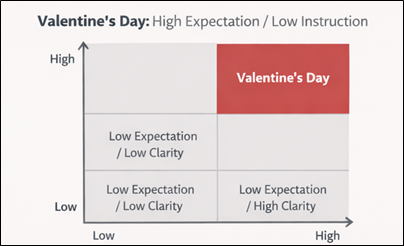
It isn’t really about love. It isn’t really about gifts. And it definitely isn’t about flowers. Valentine’s Day is about expectations. And more specifically, it’s about what happens when expectations go unspoken.
| | Valentine's Day is a Test with No Study Guide | |
The Most Pressure-Packed Day of the Year
There are holidays with clear rules.
- Thanksgiving? Show up. Eat. Say thanks.
- The Fourth of July? Fireworks, grill, patriotism optional.
- Christmas? At least we all agree there’s supposed to be something under the tree.
Valentine’s Day, on the other hand, hands you a test and refuses to give you a syllabus.
- Flowers or no flowers?
- Dinner out or dinner in?
- Card only? Gift too?
- Big gesture or quiet presence?
And here’s the trick: The grading rubric is different for everyone.
Which means two people can walk into February 14th with the best intentions—and walk out confused, disappointed, or quietly frustrated.
Not because no one cared. But because no one clarified.
| |
A Short History Lesson (Because This Was Never Romantic)
It helps to know that Valentine’s Day didn’t start as a Hallmark holiday—or even a romantic one. The roots trace back to Lupercalia, a Roman festival held in mid-February that mixed fertility rites, matchmaking, and a level of chaos that would never pass a modern HR policy. Later, the Church tried to civilize it by associating the day with St. Valentine, a figure who may have secretly married couples against the emperor’s orders. In other words, Valentine’s Day didn’t begin as poetry.
It began as rebellion. Which might explain why it still refuses to behave predictably.
| |
Signals Matter More Than Intentions
One of the most consistent leadership lessons I’ve learned over time is this:
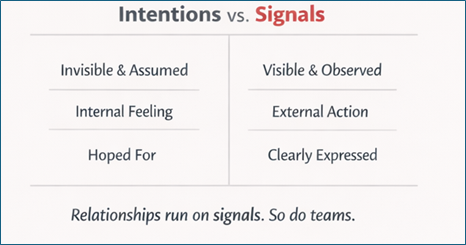
People don’t respond to intentions. They respond to signals.
Valentine’s Day is a live demonstration. You can intend to show love. You can feel appreciation deeply. But what lands is not what you meant—it’s what you did, said, or prioritized.
- A rushed dinner sends a signal.
- So does a thoughtful note.
- So does forgetting entirely.
- So does remembering one small thing that mattered.
None of these are neutral.
| |
The Quiet Truth About Romance
There’s an assumption—fed generously by advertising—that romance is about surprise.
- Big gestures.
- Grand reveals.
- Moments that feel cinematic.
But research on long-term relationships tells a quieter story. What people remember most isn’t the grand gesture. It’s:
- Being listened to
- Being remembered
- Being considered
- Being able to rely on someone
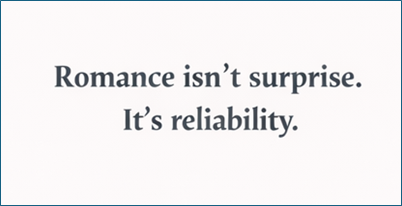
Romance, it turns out, isn’t about novelty. It’s about reliability.
| |
Valentine’s Day as a Leadership Lesson (Stay With Me)
If you’ve ever wondered why good intentions sometimes fail at work, Valentine’s Day has something to teach us. Because the dynamics are identical.
Leaders often believe:
- “They know I appreciate them.”
- “They know why this decision was made.”
- “They know how hard I’m trying.”
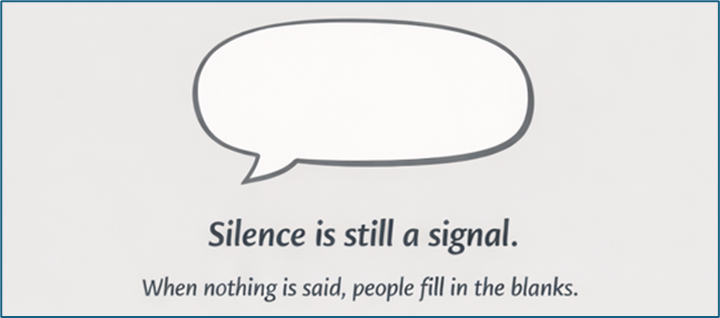
But knowing isn’t automatic. Just like love, appreciation must be signaled. And just like Valentine’s Day, silence creates interpretation.
| |
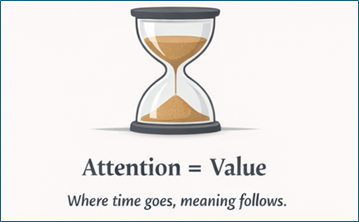
Attention Is the Real Currency
If Valentine’s Day had an honest slogan, it might be this: “Show me where your attention goes.” Time is finite. Energy is limited. Distractions are abundant.
Which means attention has weight. Who we focus on. What we remember. When we show up. These are not accidental.
People infer value from how we allocate time. On February 14th—and every other day.
| |
Why Valentine’s Day Triggers Disappointment
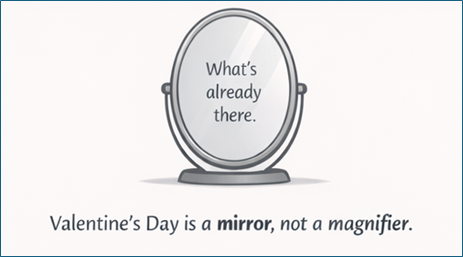
Valentine’s Day doesn’t create disappointment. It reveals it. Because unmet expectations are rarely about that single day. They’re about patterns. The day simply shines a spotlight.
If someone feels unseen on February 14th, it’s usually because they’ve felt unseen before. If someone feels appreciated, it’s often because appreciation is already a habit.
| |
The Most Meaningful Valentine’s Gestures Are Small
Some of the most meaningful Valentine’s moments I’ve witnessed didn’t cost much—or anything at all.
- A handwritten note.
- A remembered detail.
- A quiet walk.
- A consistent presence.
They didn’t try to impress. They tried to connect. And connection, unlike performance, doesn’t require an audience.
A Gentle Reframe
What if Valentine’s Day wasn’t about getting it right?
What if it was about checking alignment?
- Are expectations spoken?
- Are signals clear?
- Is attention intentional?
Those questions matter in love. They matter in families. They matter in leadership. And they matter far more than chocolate ever will.
| | Surprise Photo at the End | | Joe's Positive Post of the Week | | Join the Smart Subscribers | | If you are reading this on a social media platform, click below and you'll automatically receive a 'different' story every week on Wednesday. | | |
The Roll Call of states and countries where readers reside: Arizona, California, Colorado, Connecticut, Delaware, Florida, Georgia, Hawaii, Illinois, Indiana, Iowa, Kansas, Kentucky, Louisiana, Maine, Massachusetts, Michigan, Mississippi, Missouri, Montana, New Hampshire, New Jersey, New Mexico, New York, North Carolina, North Dakota, Ohio, Pennsylvania, Puerto Rico, Rhode Island, South Carolina, South Dakota, Tennessee, Texas, Vermont, Virginia, Washington and Washington DC, Wisconsin plus Canada, Conch Republic, Australia and the United Kingdom.
| | Refer a friend to Sign Up for the Wednesday Weblog | |
Ed Doherty
774-479-8831
www.ambroselanden.com
ed-doherty@outlook.com
Forgive any typos please.
| | | | | |