As we saw last week discussing book banning, the culture wars continue to rage. And as we are seeing this week in his bid to restore Imperial Czarist Greater Russia, Russian President Vladimir Putin seeks to drag us all back into a Cold (Hot?) War Redux. While all this is happening, something of potentially far greater consequence continues to unfold right before our largely oblivious eyes.
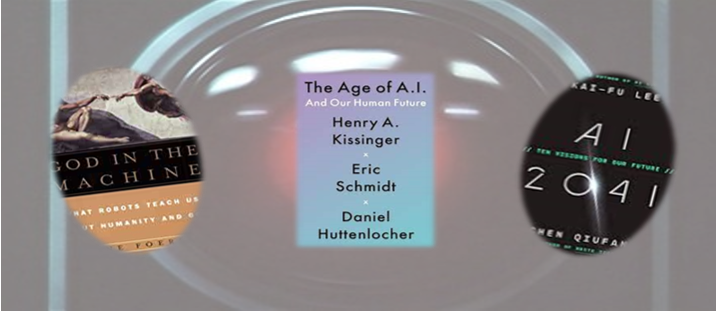
In the last 10 years, artificial intelligence (AI) has grown more powerful and more ubiquitous. Once the stuff of science fiction, as in the graphic above, the background of which is the rogue computer Hal from Stanley Kubrick’s 2001: A Space Odyssey, AI is as banal as Siri on your iPhone and as profound as an AI at the Massachusetts Institute of Technology discovering an antibiotic beyond human reason’s reach.
Are early 21st century humans, in their blithe indifference to nonhuman AI thought processes assuming more, hmm, not control, but influence over their daily lives, are we like the proverbial frog who, insensible to the gradually warming water, failed to jump out of the pot before being boiled to death?
Is it our fate to be replaced by machines of our own invention smarter than we?
Maybe, maybe not, but the question is not idle. Each of the three works collaged above atop Hal’s unblinking eye shed light on the question.
In God in the Machine, Anne Foerst, formerly a research scientist at the Artificial Intelligence Laboratory at MIT, where she founded the God and Computers Project, is a faculty member in theology and computer science at St. Bonaventure University. From her dual perspective, Foerst answers the question, “Can a robot ever have a soul and become human?” by suggesting that first one must answer two questions: “What do you mean by soul and what do you mean by human? What is a human-being?”
Kai-Fu Lee, a former Google executive turned venture capitalist, who has been writing about AI for years, and Chen Qiufan, a science fiction writer, in their AI 2041: Ten Visions for Our Future, illustrate, as Russell Flannery says in Forbes, “how AI will bring sweeping changes to daily life in the next 20 years.” [1]
In their The Age of AI and the Human Future, Henry Kissinger, Eric Schmidt, and Daniel Huttenlocher take a global perspective on AI in both senses of the word global. Like Foerst, they are interested in the macro issues (epistemological, metaphysical, and ontological) that AI raises about what it means to be human and the human future. A bit more down to Earth, they examine AI’s implications for how humans live their daily lives. Lastly, in a section I assume written largely by Kissinger, they parse the global impact of AI on the eternal question of war and peace between competing nations.
The emphasis on the last issue should come as no surprise, for the Henry Kissinger who co-authored The Age of AI is that Henry Kissinger. Kissinger, Richard Nixon’s Secretary of State and a major figure in the second third of the 20th century, at 98 keeps on keeping on worrying about America’s fate in a world where peace is only an interval in the perpetual strife between nations. Eric Schmidt is the former chief executive officer of Google who now leads Schmidt Futures, a philanthropic initiative identifying people who seek to make the world better; Schmidt also hosts Reimagine with Eric Schmidt, a podcast exploring how society can build a brighter future after the COVID-19 pandemic. Daniel Huttenlocher is the dean of the MIT Schwarzman College of Computing. [2]
When, based on my past interests, the AI inspired hype for the Age of AI and the Human Future began appearing in my news feeds last fall, it rekindled my interest in the topic (the pun intentional, for a Kindle’s recommending function is one of the many instances of AI in our daily lives). When I first returned to Erie in 2014 after retiring as president of Notre Dame College, I did some work with colleagues in Intelligence (National Security) Studies about the application of techniques derived from the use of Big Data, Knowledge Management, and Competitive Intelligence to managing complex organizations such as colleges and universities. We even did a conference about it in Dungarvan, Ireland in the summer of 2015.
That experience caused me to dive into the literature involving AI and its implications for the future. I read works such as the special edition of the journal Foreign Affairs’ “The Fourth Industrial Revolution” and books like The Second Machine Age; Rise of the Robots; The Second Intelligent Species; Whiplash: Surviving Our Faster Future; Irma Becerra’s Knowledge Management: Challenges, Solutions, and Technologies; Kevin Kelly’s The Inevitable: Understanding the 12 Technological Forces That Will Shape Our Future; Ray Kurzweil’s The Singularity Is Near: When Humans Transcend Biology; and numerous other books and journal articles.
Then, in 2016, I assumed the interim presidency at St. Bonaventure University and my interest shifted. When I returned to Erie in late 2017, I began the research that led to my The American Tapestry Project. My reason for noting this personal background is twofold. One, I know just enough about the topic of AI to be dangerous and to make some egregious errors and, two, like the frog in the slowly, now faster, warming water, I became inattentive to AI’s rapidly increasing role in our daily lives and future-shaping impact.
So, inspired by The Age of AI and the Human Future, this Book Note is a short, a very, very short, primer on artificial intelligence, its impact upon our daily lives and the questions, both mundane and profound, it raises for humanity’s future.
First coined by computer scientist John McCarthy in 1956, the term “artificial intelligence” (AI) “is smart software and hardware capable of performing tasks that typically require human intelligence.” [3] Or, quoting McCarthy, the IBM website defines it as “the science and engineering of making intelligent machines, especially intelligent computer programs. It is related to the similar task of using computers to understand human intelligence, but AI does not have to confine itself to methods that are biologically observable." (Emphasis added) [4] Which is what gets the authors of The Age of AI’s shorts in a knot – AI is capable of doing (thinking) things humans can’t. Before you worry, however, that our future is to be dominated by runaway Hals, note that “still, despite continuing advances in computer processing speed and memory capacity, there are as yet no programs that can match human flexibility over wider domains or in tasks requiring much everyday knowledge.” [5] The most important phrase in that sentence is “as yet.”
All this begs the question, what is intelligence? And how does it differ from instinctive behavior?
Insects perform intricately complicated actions, but no one ascribes intelligence to them. Why? Because regardless of circumstances changing, they perform the same behavior all over again. How do humans behave? If circumstances change, they adapt. So, one aspect of intelligence “is the ability to adapt to new circumstances.” [6] How do humans do that? They learn. How? Alan Turing famously set aside that question, saying that creating machines that could think like humans was not the challenge. In his “imitation game,” he posited that “if a machine operated so proficiently that observers could not distinguish its behavior from a human’s, the machine should be labeled intelligent … rather than requiring total indistinguishability from humans, the test applies to machines whose performance is human-like. In so doing, it focuses on performance, not process.” [7]
In short, machines that “think” do not have to “think” like humans, they just have to produce human-like results. Therefore, since human intelligence consists of multiple variables, AI research chiefly focuses on learning, reasoning, problem solving, perception, and using language. [8] AI lacks emotion, empathy, and self-awareness, “as yet.”
Here is where I know just enough to make some serious errors, so forewarned is forearmed. Basic computer programs are just increasingly more complicated systems of “If, Then” statements creating a rubric or algorithm, which is a statement of a procedure for solving a problem or accomplishing a task. They can only do precisely what they are programmed (instructed) to do. In short, they are instructed that “If” this occurs, “Then” do that, whatever that might be. Many of us mastered (sort of) BASIC (Beginners All Purpose Symbolic Instruction Code) when we purchased our first Apple II and tried to use its spreadsheet program VisiCalc and then advanced to be tortured by Excel’s “Nesting If/Then” statements.
When in 1996 IBM’s supercomputer Deep Blue defeated world chess champion Garry Kasparov, it wasn’t because it was more intelligent than Kasparov and could learn to adapt to changing circumstances. It won because it had a deeper reservoir of “If/Then” statements and faster processing power. Pre-programmed by a human with every possible move in a chess match, with each move assigned a probability for optimizing the desired outcome, Deep Blue didn’t “think.” It just reacted to Kasparov’s “Ifs” by “Then” choosing the highest probability move from among the database of possible moves at its disposal.
It did not learn how to play chess; it did not teach itself to play chess. But that was the 1990s. In 2017, when an AI program developed by Google Deep Mind, AlphaZero, defeated Stockfish, at the time the world’s most powerful chess program, as they say in The Age of AI, “a revolution occurred.” [9] Unlike Deep Blue and all of its descendants, AlphaZero had no preprogrammed moves, strategies, or chess knowledge uploaded by humans. Its style of play was all its own. Its creators simply supplied “it with the rules of chess, instructing it to develop a strategy to maximize its proportion of wins to losses.” [10] It taught itself to play chess and after a few hours of practice and playing against itself, it was the most powerful chess program in the world. It has caused human grandmasters to rethink chess strategy, because it plays chess with a strategy all of its own. Without a strategy, it analyzes moves by discerning “patterns of moves across vast sets of possibilities human minds cannot fully digest or employ.” [11]
Similarly, when an AI program at MIT discovered a hitherto unknown antibiotic, it did not do it by inferentially developing a hypothesis to account for observed phenomena, testing that hypothesis against the data, observing the results, adjusting the hypothesis, and testing again, i.e. it did not use the scientific method. Given no instructions on how to proceed, the program was provided with a set of 2,000 molecules known to inhibit bacterial growth. It developed its own profile of those properties, including attributes humans had not noted. It was then instructed to survey 61,000 other molecules, FDA-approved drugs, and natural products for molecules that would be effective as antibiotics, that did not look like known antibiotics and that would be non-toxic. It discovered one molecule that fit that profile which had eluded human research. The researchers at MIT named it halicin, after 2001’s Hal. [12]
So, simplistically but profoundly, AI is software that learns. How? Not by intuition, guessing, “feeling” nor inferential reasoning as humans do, but by pattern recognition across immense data sets beyond the ability of humans to process. As they say in The Age of AI:
lllllllAI’s are imprecise, dynamic, emergent, and capable of ‘learning’. AI’s ‘learn’
lllllllby consuming data, then drawing observations and conclusions based on the
llllllldata.While previous systems required exact input and outputs, AIs with
lllllllimprecise function require neither. … AI is considered dynamic because it
lllllllevolves in response to changing circumstances and emergent because it can
lllllllidentify solutions that are novel to humans. In machinery, these four
lllllllqualities are revolutionary. [13]
The philosophical implications of AI are immense, not only the epistemological (How do we know what we know?), but also the ontological and metaphysical. (What is the nature of being? If humans are creatures who think, what is AI if it can “think” in ways humans can’t, if it can perceive aspects of reality humans can’t?) Those questions fog the mind. What, on a more mundane level, are aspects of AI currently in our daily lives and what can we expect in the short-term future?
Regarding now, AI surrounds us. For example, when you open your phone with facial recognition software, when you check your Twitter newsfeed, log onto Facebook or TikTok, send an email or text, do a Google search, ask Alexa to play music or Siri for directions, deploy a “smart” thermostat to control your home’s “climate,” use a GPS program to find your way through a strange town or use driver-assist technology to park your car, bank online or book a flight, follow an Amazon recommendation “that you might like …” and tune into Netflix for a video summary of what’s popular, you’re using, you’re being guided by AI.
All of these have both benign and nefarious implications. According to Apple, facial recognition software makes it a million-to-one that someone else could open your phone, but it also makes it possible for someone to create an avatar of you placing you in a fabricated situation to your reputation’s detriment. Search software optimizes your results on the basis of your past practice, but it can also create a profile of “fake news” slanted to your interests. Smart cities, for example, integrate information and communications technology with physical devices connected to the “internet of things” to improve city operations to better serve citizens. The “internet of things” is AI talking to AI, or your phone telling your thermostat to turn on the air conditioner because you’ll be arriving at home in 15 minutes. In “smart cities” it also creates a web of surveillance monitoring all behavior within its environs, the most obvious being, as any TV viewer of crime shows knows, security cameras. I mentioned earlier using AI tools to improve the management of a college or university. One idea that was batted about was creating a record of student usage of campus facilities by mapping swipe card entry to different buildings, library usage, snack shop, and campus store purchases, etc. The original benign idea was, in MBA-speak, “to optimize facility usage and to enhance the student experience.” Apparently, some institutions have begun to do just that resulting in complaints from faculty and students and the inevitable lawsuits for infringing on student privacy.
In the future, Kai-Fu Lee and Chen Qiufan say “AI is an omni-use technology that will penetrate virtually all industries. Its effects are being felt in four waves, beginning with internet applications, followed by applications in business (e.g., financial services), perception (think: smart cities), and autonomous applications, like vehicles.” [14] Their AI 2041: Ten Visions for Our Future is an excellent overview of the near term (keep in mind 2041 is only 19 years away). They examine both the virtuous and the nefarious implications of that future in 10 vignettes each followed by analysis of the AI in action. The vignettes and accompanying analysis range from search engines that “program” us to a predetermined outcome in “The Golden Elephant” to facial recognition software in “Gods Behind the Masks” that tracks our movements in order to both protect us and to control us. Lee and Qiufan are not alarmists; they show both the positive and the not so positive implications of AI. In addition, Lee does an excellent job of explaining exactly how each of these AI do what they do.
The Age of AI and Our Human Future, on the other hand, while it suffers from the usual deficits of books written by a committee, looks at the big, big picture. With Kissinger’s background in international relations, it equates AI to the development of nuclear weapons as a threat to humanity’s future. Its many pages on the topic were both unnerving and at the same time boring. They’re concerned that an amoral, autonomous weapons system beyond human control with a decision function focused on maximizing victory above any cost might, in fact, be the doomsday weapon.
The book also includes one of the best short summaries of the history of Western rationalism I have ever read (although readers not interested in the history of philosophy might wonder why so many pages are devoted to the subject). Well, it covers the topic in order to set the context for a discussion of how AI “thinks” and how that is different, perhaps even superior, to how humans think. It’s hard to know who wrote this section, probably Kissinger, but I disagree with its reductionist description of human ways of knowing being entirely rationalist. Humans “think” in multiple ways, but since the Enlightenment in the West, it’s hard to argue in the Age of Science that rationalism wasn’t dominant. Regardless, the authors raise very important questions about what becomes of human identity and self-understanding if AI’s deep neural networks discover meaning in vast patterns of recognition beyond human reason’s ability to fathom? What happens to human identity when AI discovers aspects of reality unavailable to human perception and understanding? What happens when humans are the creature (mind?) that comes lagging after trying to understand AI’s discoveries?
As I said at the outset, this short note wants only to help all of us avoid the frog’s fate of being boiled alive because we weren’t paying attention. Attend, we must, to what AI is, how it does what it does, what it means for our daily lives and our collective future, and, as Foerst posited, what it means to be human. In addition to the works cited in this brief note, although a bit “text- booky,” the common consensus is that the best introduction to AI is Philip C. Jackson’s Introduction to Artificial Intelligence. It’s now in its third edition, which, while not definitive, is usually a sign of quality.
Keep your eye on the AI water’s temperature – it’s rising!