Weekly Digest Number 8 - February 21, 2023 |
|
Welcome to the RWU Rail & Labor News! This news bulletin is produced and emailed out each Tuesday morning. We hope you find each week's news and information useful. If so, please share with co-workers, friends, and colleagues. If you like, you can sign them up to get all the news from RWU HERE. Or forward them the link. Note: If you read over this news bulletin each week, you will be sure to never miss the important news of what is going on in the railroad world from a worker's perspective!
|
|
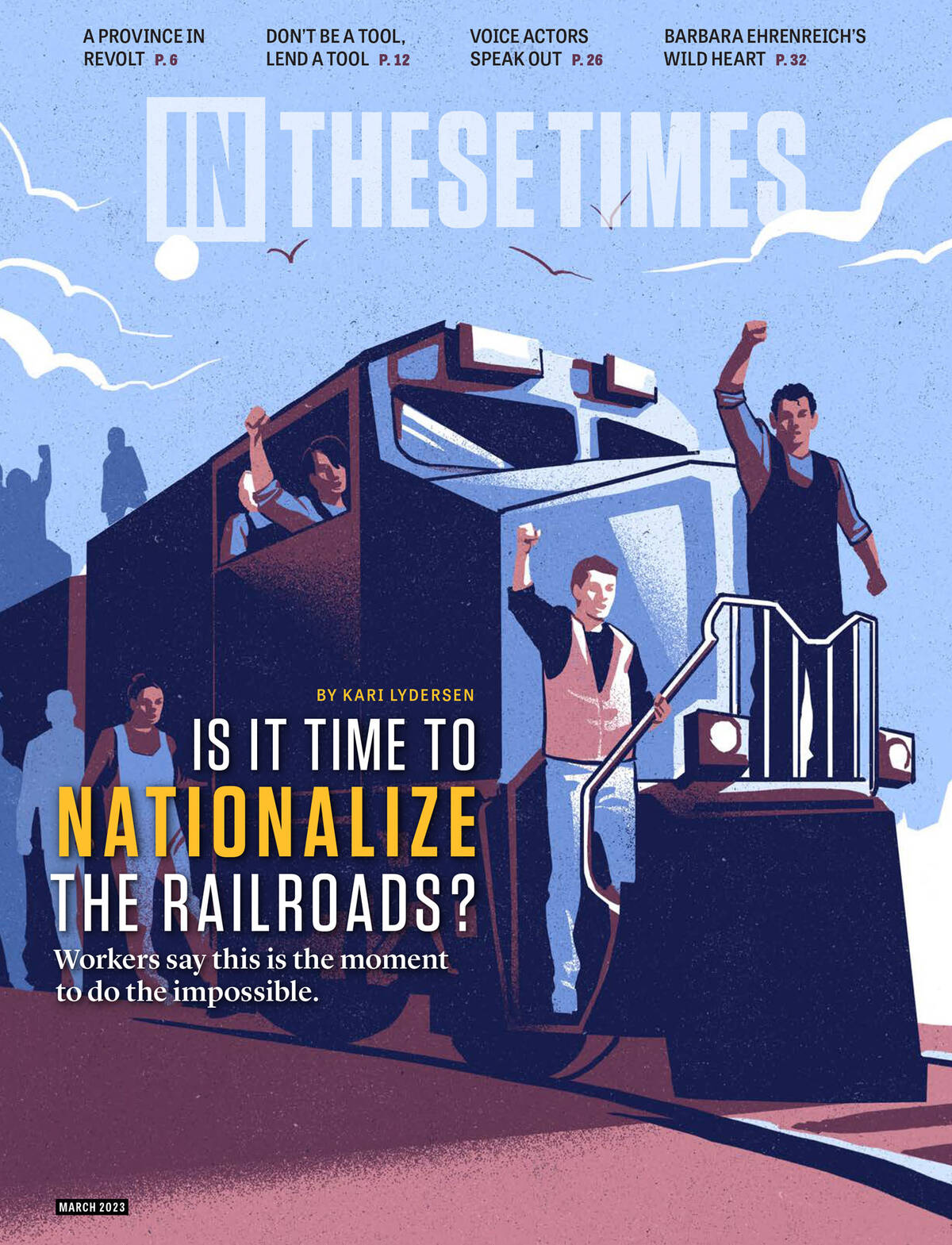
(Editor's Note: RWU has officially launched our Campaign to bring the railroads under public ownership and control. If you are a member of a union, citizens group, environmental organization, transportation justice group or rail advocacy association, please consider signing on to this idea to vastly improve and expand rail service - both freight and passenger - in North America. See below for more details.) |
|
The Case for Nationalizing the Railroads |
|
Railroad workers packed themselves into hotel conference rooms near Chicago’s O’Hare International Airport in June 2022 to talk fervently about a momentous event potentially on the horizon: the first industry-wide rail strike in three decades.
“All 12 railroad unions have proclaimed themselves united,” said Ron Kaminkow, Railroad Workers United (RWU) general secretary, during a conference session about chokepoints in the supply chain. “There could actually be a national railroad strike for the first time in almost 30 years.”
Contract negotiations between those 12 unions and the country’s major freight railroad companies had ground to a halt by the conference, which was organized by RWU and the pro-union group Labor Notes.
In July, 99.5% of the membership of the union representing railroad engineers — the Brotherhood of Locomotive Engineers and Trainmen — voted to authorize a strike if legal hurdles were cleared.
The possibility presented a challenge for the Biden administration. President Joe Biden had become known as the most labor-friendly president in recent history, while a walkout threatened to paralyze the economy with a potential cost of $2 billion per day. The administration eventually negotiated a deal with union leaders and company leaders, announced Sept. 15, 2022, requiring a significant pay raise for workers without meaningfully addressing their primary concerns: short-staffing and a lack of paid sick days.
Many elected officials and pundits lauded the deal, but it still needed to be ratified by each union’s rank and file.
Three unions representing railroad workers voted down the proposed contract, while others voted for it. Then, in November, the country’s largest rail union — the SMART Transportation Division, which represents conductors and brakemen — rejected the deal, and a national rail strike was firmly on the table. Even unions that approved of the deal pledged to honor any picket lines.
On December 1, 2022, at Biden’s urging, Congress intervened, passing a law to force the unions to agree to the deal. Many railroad workers were furious — and felt betrayed.
“It was very frustrating, from the ‘most pro-labor president America’s ever had,’” says Matt Weaver, legislative director for the Brotherhood of Maintenance of Way Employees, the nation’s third-largest railroad union. “When [railroads] have record profits and profit margins, and yet this deal is imposed, we’ve seen that our labor is expendable.”
|
|
(Editor's Note: More than a decade in the making, RWU has decided that enough is simply enough!) |
|
Railroad Workers United Launches Effort to Bring the Railroads Under Public Control |
|
While the rail industry has been incapable of expansion in the last generation and has become more and more fixated on the Operating Ratio to the detriment of all other metrics of success, Precision Scheduled Railroading (PSR) has escalated this irresponsible trajectory to the detriment of shippers, passengers, commuters, trackside communities, and workers. On-time performance is suffering, and shipper complaints are at all-time highs. Passenger trains are chronically late, commuter services are threatened, and the rail industry is hostile to practically any passenger train expansion. The workforce has been decimated, as jobs have been eliminated, consolidated, and contracted out, ushering in a new previously unheard-of era where workers can neither be recruited nor retained. Locomotive, rail car, and infrastructure maintenance has been cut back. Health and safety has been put at risk. Morale is at an all-time low. The debacle in national contract bargaining last Fall saw the carriers – after decades of record profits and record low Operating Ratios – refusing to make even the slightest concessions to the workers who have made them their riches.
Since the North American private rail industry has shown itself incapable of doing the job, it is time for this invaluable transportation infrastructure – like the other transport modes – to be brought under public ownership. During WWI, the railroads in the U.S. were in fact temporarily placed under public ownership and control. All rail workers of all crafts and unions supported (unsuccessfully) keeping them in public hands once the war ended, and voted overwhelmingly to keep them in public hands. Perhaps it is time once again to put an end to the profiteering, pillaging, and irresponsibility of the Class One carriers. Railroad workers are in a historic position to take the lead and push for a new fresh beginning for a vibrant and expanding, innovative and creative national rail industry to safely, efficiently, and properly handle the nation’s freight and passengers.
|
|
(Editor's Note: Curiously, wayside detectors - including hot box detectors - are not federally regulated. The railroad can apparently position them where they please, remove them from service at their discretion, and maintain them as they see fit.) |
|
Norfolk Southern Eliminated Key Maintenance Role in Derailment Region, Union Says
‘There used to be something called ‘maintenance’’
|
|
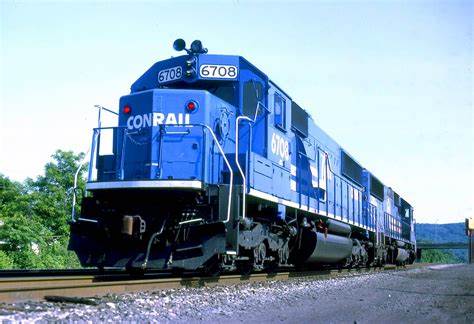
A device that can play a role in preventing derailments is the wayside hot-box detector. It uses infrared sensors to detect bearings, axles or other components of a rail car that are overheating, then uses radio signals to flag rail crews of any overheated components.
Wayside hot-box detectors are typically placed every 25 miles along a railroad, according to a Federal Railroad Administration (FRA) report. Their use has contributed to a 59% decrease in train accidents caused by axle- and bearing-related factors since 1990, according to a 2017 Association of American Railroads study.
Declining head counts have led to these mechanisms receiving less preventative maintenance, according to an official from the Brotherhood of Railroad Signalmen union.
The FRA has no regulations requiring the use or maintenance of hot-box detectors.
A hot-box detector in East Palestine notified the crew moments before the train derailed, according to the NTSB’s report.
It’s unclear if any hot-box detector prior to East Palestine notified crews. A surveillance video shared on Facebook from an industrial facility in Salem, Ohio, about 20 miles from East Palestine, suggests the train’s axle was already on fire.
Norfolk Southern did not respond to a request for comment, and the FRA declined to comment on the record.
Specialized signalmen called “electronic leaders” specialize in maintaining devices like hot-box detectors. As recently as three years ago, Norfolk Southern employed five electronic leaders in the area of its rail network that includes East Palestine. Today, it employs zero, according to Christopher Hand, director of research at the Brotherhood of Railroad Signalmen.
The area in question is Eastern Region North – Division B, shown in red on the map. It runs east to west from Mansfield, Ohio, to Harrisburg, Pennsylvania, and north to south from Morgantown, West Virginia, to Astabula, Ohio. It also includes rail track in Pittsburgh, as well as Youngstown, Ohio.
|
|
Corporate Greed and Deregulation Fuel Threat of More Bomb Trains As East Palestine Demands Answers |
|
Democracy Now!
We look at the failures that led to the massive train derailment in East Palestine, Ohio, that blanketed the town with a toxic brew of spilled chemicals and gases, fouling the air, polluting waterways and killing thousands of fish and frogs. Residents are suffering ailments including respiratory distress, sore throats, burning eyes and rashes, all with unknown long-term consequences. Many say they do not trust officials who tell them it is safe to return to their homes. This catastrophe could have been prevented, had it not been for lax regulation and the outsized lobbying power of corporations like Norfolk Southern, says Matthew Cunningham-Cook, a researcher and writer at The Lever who is part of a team that is reporting on the disaster.
|
|
(Editor's Note: RWU Steering Committee member and seasoned locomotive engineer speaks out about the dangers of long and heavy trains and other irresponsible practices of the Class One carriers.) |
|
Industry Insider Weighs in as Impacts from Train Derailment Near Ohio-PA. Border Continue |
|
As people in East Palestine, Ohio deal with the impacts of a major train derailment and chemical spill, many are wondering, could it happen somewhere else?
Those concerns were amplified Wednesday night in a hectic community meeting as people tried to get answers.
"Are my kids safe? Are my people safe? Is the future of this community safe?" said one East Palestine resident.
Representatives from Norfolk Southern, the company that owns the train that derailed, were not in attendance, citing safety concerns. We reached out to the Railroad Workers United, an advocacy organization made up of industry professionals. Steering Committee member Michael Lindsey said the crash is a sign of cutting corners.
"When you have a train that's, say, 12,000 feet long like the train that derailed in East Palestine, a lot of times there's not enough car inspectors in the yard to inspect those cars, and they're basically expected to spend less than one minute on every car. Sometimes less than 30 seconds," said Lindsey.
The Lehigh Valley has more than 300 miles of freight rail, including tracks owned by Norfolk Southern that run right through Allentown. It's got people wondering, if a dangerous derailment can happen in East Palestine, can it happen here?
"It absolutely can happen there. Not saying it will, but it absolutely could," said Lindsey.
We reached out to Norfolk Southern about safety. The company responded, saying "99.999% of hazardous material shipments reach their destination without an issue."
According to the National Transportation Safety Board, which is investigating the crash, the cause appears to be an overheated wheel bearing. Lindsey said he believes the federal government needs to step in to make sure trains are safe.
"The railroad industry needs to be compelled to invest into their infrastructure," said Lindsey.
|
|
(Editor's Note: All of these wild eyed theories popping up as to what is at the bottom of this train wreck only serve to draw attention away from the what really happened; i.e. a horrible manifestation for all the world to see of how the private for-profit rail system in the U.S. is irresponsibly run.) |
|
The Conspiracy of the Ohio Train Derailment Is Right in Front of Us
Conspiracy theorists are jumping on news of the train derailment in East Palestine, Ohio. But the truth is much more simple.
|
|
In the wake of the Norfolk Southern train derailment in East Palestine, Ohio, conspiracy has run rampant about how this disaster happened, and whether there is a deeper sinister plot underlying it. As residents try to navigate the unprecedented situation, seeking support from their neighbors and from Facebook groups, disinformation is flourishing.
Conspiracy theorists online appear less concerned with the actual residents’ turmoil, and more with using them to advance narratives that foster social distrust of government and even of other people. Yet many residents have in fact relied on each other while hoping for a stronger, not weaker, government response.
Stew Peters, for example, has positioned himself as an East Palestine truth-teller. He asserts there are “crickets from the media,” while it seems he only began tweeting about the situation days ago. (Meanwhile, The New Republic, dedicated local reporters, and many other media outlets had already been covering it.) Perhaps Peters only began to focus on the disaster once he realized he could use it to farm traffic toward the rest of his content; his account is littered with posts, from implying Damar Hamlin has been replaced with a doppelganger to run-of-the-mill anti-vaccine content and posts attempting to stoke racial hatred.
Peters is one of many right-wing conspiracy theorists doing the same thing. Ian Miles Cheong insinuated that the government’s poor response to the disaster was because of the demographics of East Palestine, which is majority white. Benny Johnson has claimed that the “climate cult” is silent on the matter. Jack Posobiec propped up a clip of Ohio Senator J.D. Vance brazenly saying that “the leaders of this country have decided to disregard the people of East Palestine,” as if he has done anything substantive for them.
What’s concerning is how these figures have likely ensnared people who are reasonably concerned for the residents of East Palestine into a potential radicalization pipeline. If someone finds them to be revealing unspoken truths about something that seems normatively bad, they may come to see the rest of their more vicious content as equally worth consideration.
None of these figures are advocating for a coherent political vision that would actually help the people they purport to care about. They play off people’s well-founded distrust of power structures, but instead of channeling those feelings into strategies for how to make power serve the people, they focus mainly on casting villains for their own sake—to create targets to pile on and people to hate.
In the case of East Palestine, there is no greater conspiracy than what’s already in front of us. The derailment is a classic story of corporate greed—tolerated by bipartisan permission—successfully chasing profits and shaving away much-needed regulation, leaving us and the environment worse off because of it all. It’s a story that doesn’t fit nicely on superficial party lines, but is part of a dynamic that only a growing number of progressives—not conservative Democrats or Republicans or libertarians—have spoken to for years.
Norfolk Southern is a $55 billion company that recently reported record fourth-quarter and annual revenues; just last year, the company announced $10 billion in stock buybacks. It is also among the massive corporations that have successfully lobbied against industry improvements like updating the same braking system that failed in East Palestine.
|
|
(Editor's Note: This article shows as clearly as possible how the super profits made by NS in recent years - including the profit margins, dividends, and stock buybacks - are directly related to their irresponsible across-the-board massive staffing cuts.) |
|
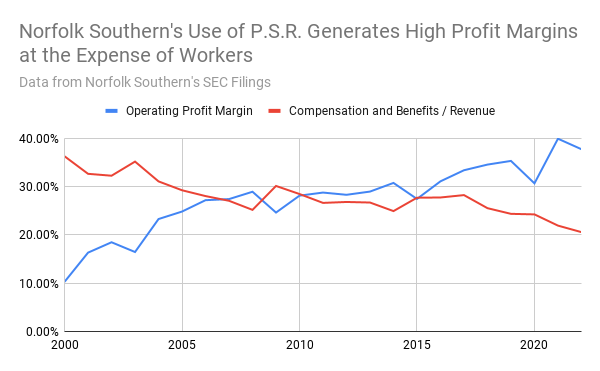
Norfolk Southern Boosted Shareholder Payouts 4,500%, Slashed workforce 33% Prior to Ohio Disaster
“They cut their workforce to barebones, and now they’re paying the price for it because the wheels are falling off the train.”
|
|
The derailment of a Norfolk Southern train carrying 20 railcars of toxic chemicals in western Ohio has renewed scrutiny on precision scheduled railroading (P.S.R.)–a controversial management approach that prioritizes profit at the expense of all else.
Since its introduction in the early 1990s, the approach became an effortless way for rail executives and shareholders to inflate profits, while limiting the actual effort of management. At its core, P.S.R. mandates trains to transport bigger and heavier loads with fewer workers.
In practical terms, it means that trains went from 80-90 railcars supported by 5 workers, to 2 workers overseeing 150 railcars or more. This enabled management to effectively invert how much companies spent on workers and how much profit they generated for shareholders. Of course, this came at a cost: safety and reliability. Reports indicate that before it derailed, Norfolk Southern train 32N broke down due to its excessive size.
“The root causes of this wreck,” Railroad Workers United said in a statement released days after the derailment, “are the same ones that have been singled out repeatedly, associated with the hedge fund initiated operating model known as “Precision Scheduled Railroading.”
In 2002, Norfolk Southern employed 29,000 people. By the end of 2022, the company had slashed its headcount by 33%. Meanwhile, management more than doubled profit margins.
The industry tracks this through a metric termed an “operating ratio.” For his part, after missing the target in 2020, C.E.O. James Squires was paid a bonus nearly 100x the company’s median salary for achieving Norfolk Southern’s operating ratio goals in 2021. In total, Squires earned $14 million for the year.
One way to look at the impact of P.S.R. is through the lens of employee productivity, which the rail industry measures through a metric called “revenue-ton-miles per employee.” From that perspective, productivity at Norfolk Southern has increased by 30% since 2015.
|
|
(Editor's Note: While the focus of attention the last 6 months has been first rail workers and now trackside communities, another group that is highly disgruntled with the railroad are shipping groups and rail car owners. The Class Ones do not discriminate - they run roughshod over everyone.) |
|
Rail Shipper Sees Investor Monopoly Within Class I Railroads
‘Fundamental issue here is that the railroads are a regulated industry, and they’re not acting like a regulated industry’
|
|
Following the Staggers Act of 1980, a spate of consolidations occurred among the Class I railroads, resulting in what some captive rail shippers would characterize as operational monopolies because shipping options became reduced.
But Herman Haksteen, president of the Private Railcar Food and Beverage Association (PRFBA), suggests there is an investor monopoly as well among the Class I railroads. In examining filings from the Securities and Exchange Commission, Haksteen found four major institutional investors each own between 20% and 21% of three of the Class I railroads: Union Pacific (NYSE: UNP), CSX (NASDAQ: CSX) and Norfolk Southern (NYSE: NSC).
What’s significant about this stock ownership is each of these four have classified themselves as passive investors, which means they don’t take an active role in working with a railroad’s board of directors in steering the company. As a result, the boards have less pushback from their investors over company direction, acccording to Haksteen.
Haksteen recently chatted with FreightWaves about his findings. PRFBA’s membership includes large shippers of consumer packaged goods, such as PepsiCo, General Mills, Kellogg’s and Kraft Heinz, as well as other shippers, such as Boardman Foods, Gallo Wines and Molson Coors.
This question-and-answer session was edited for clarity and length.
FREIGHTWAVES: Why did you start looking into investor profiles of the Class I railroads?
HAKSTEEN: PRFBA meets twice a year. And that group of people are frustrated shippers, and we’re constantly trying to figure out a way to make the railroads more user-friendly.
We formed that group in 2015. Our first strategy was, if we get together as a large group of shippers, we’ll just meet with the railroads as one and maybe we’ll get more influence over the railroads by saying we have hundreds of thousands of shipments here as opposed to tens of thousands.
We went down that route, and it just didn’t seem to have an impact. The railroads didn’t like it when they were sitting in a room with 20 shippers that represented, combined, the largest shippers of the railroads. Having them all get together and say we have the same problem made the railroads very uncomfortable. They were town hall-style meetings. They weren’t beat-’em-up meetings. They were, hey, this is what we’re seeing.
So, that door got closed. And so we thought that we need to influence through the Surface Transportation Board because the railroads are a federally regulated body or industry. So, we spent a lot of time with the STB. We went to all their hearings, had ex parte meetings with them. And we were just a little bit frustrated by the speed of change that came from that.
So then we said, OK, so what’s next on the list? Well, maybe we need to talk to the lawmakers — House committee folks or the Senate folks. It was a great experience with Sen. [Tammy] Baldwin [a Democrat representing Wisconsin], who’s a very strong supporter of shippers and also wants the railroads to be more user-friendly. [But] if any of your readership has ever tried to get anything passed in D.C., they know it’s a very long, slow process, and certainly it wasn’t successful influencing the railroads.
So, at our last meeting a couple months ago, we’re all sitting around b
|
|
(Editor's Note: It is one thing if the corporation simply produced some irrelevant trinket, and existed just for the sake of making money. But the nation's railroads are just too damn important to let a bunch of vulture capitalists use them for their own selfish ends of making profits. Like other basic vital infrastructure, they need to be run democratically by the public in conjunction with the workers themselves.) |
|
Humanity Can No Longer Tolerate Corporations That Exist Almost Entirely to Make Money
Society must make the necessary shift from a society that prioritizes wealth accumulation and economic growth to one that puts personal and societal well-being above profits.
|
|
In most countries, it’s left up to business owners, CEOs and boards to decide what their purpose is, and all too often the choice is ultimately based on greed.
In many countries — most notably the U.S. — corporations are considered “persons” under law, enjoying many of the same legal rights and responsibilities as “natural” persons. Judging by the way some corporations operate, you might conclude they’re not very good people.
Defining corporations as “persons” simply means they have a legal identity separate from shareholders and owners. But what is the purpose of a business or corporation? If you look at sectors such as the fossil fuel industry, you might be led to believe the primary aim is to enrich shareholders and CEOs, and maybe create some employment, regardless of the costs to society.
Generating profits and jobs is important in an economic system that relies on those principles, but they shouldn’t be the ultimate goals. The British Academy — the U.K.’s national institution for the humanities and social sciences — concluded from its research on the future of the corporation “that the purpose of business is to solve the problems of people and planet profitably, and not profit from causing problems.”
"Generating profits and jobs is important in an economic system that relies on those principles, but they shouldn’t be the ultimate goals."
In most countries, it’s left up to business owners, CEOs and boards to decide what their purpose is, and all too often the choice is ultimately based on greed. That’s why many countries, including France and the U.K., have started incorporating corporate purpose into legal frameworks.
|
|
Ohio is Facing a Chemical Disaster. Biden Must Declare a State of Emergency
|
|
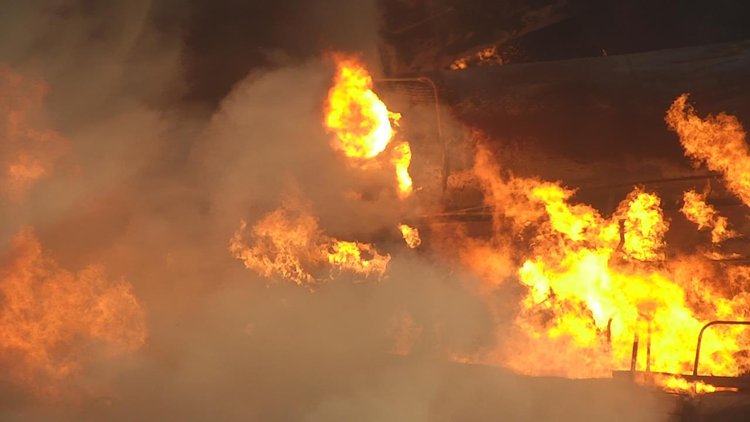
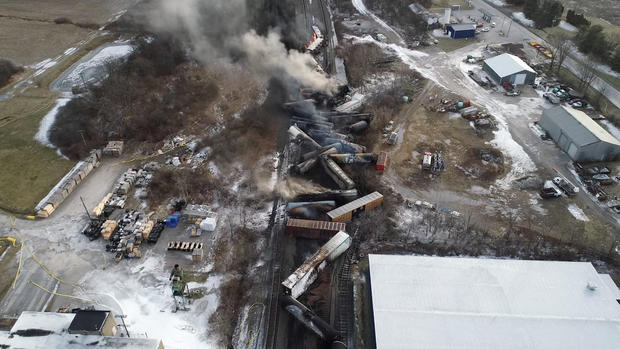
Earlier this month, a train carrying toxic chemicals derailed in eastern Ohio, exploding into flames and unleashing a spume of chemical smoke on the small town of East Palestine. The train’s freight included vinyl chloride, a chemical known to cause liver cancer and other sicknesses.
In response, government and railway officials decided to “burn off” the vinyl chloride – effectively dumping 1.1m lbs of the chemical into the local community, according to a new lawsuit. Officials said that they did so to avert the vinyl chloride from exploding; in contrast, an attorney for the lawsuit has said that the decision was cheap, unsafe, and more interested in restoring train service and appeasing railway shareholders than protecting local residents.
East Palestine residents are reporting headaches, sore throats, and burning eyes; dead pets and chickens; and thousands of fish corpses in nearby waterways. The Ohio Department of Natural Resources has said that approximately 3,500 fish, of 12 different species, died across 7.5 miles.
In other words, Norfolk Southern’s “controlled burn” may have caused a mushroom cloud of poison to spread over eastern Ohio. The situation demands immediate action from President Biden. Without it, thousands of people – including children and the elderly – and animals will be at continued risk of premature death. Biden must declare a state of emergency and create an independent taskforce to take over the remediation of this eco-catastrophe.
Norfolk Southern “basically nuked a town with chemicals” to “get a railroad open”, a former hazmat technician told a local news outlet. It certainly seems like a company with a $55bn market cap chose to sacrifice the health of thousands of people to keep its profits flowing.
|
|
(Editor's Note: The internal opposition caucus in the Track Workers union - known as the "BMWED Rank & File United" - gets it right. RWU agrees that these 10 things would assist greatly in transforming the union, help to build internal democracy, and to activate the membership. All of this of course is designed to ultimately translate into better wages, benefits and working conditions.) |
|
10 Ways Rail Labor Can Win Big in the Future
from BMWE Rank and File United
|
|
BY CORY AARON
February 17, 2023
“Rail labor unions can build their power, engage their members, and create leverage over employers.”
Rail Labor unions can win by employing a combination of strategies and tactics that build power, engage members, and create leverage over employers. Here are 10 ways to create a powerful Rail Labor union that wins big in the future.
1. Building membership: A union must have a strong membership base to be effective. This involves actively recruiting workers and encouraging them to be involved in the union’s activities.
2. Developing unity and solidarity: Union members must have a shared sense of purpose and work together to achieve common goals. This can involve regular meetings, open communication, and a culture of mutual support.
3. Educating members: Union members need to be informed about their rights as workers, the issues facing the industry, and the strategies and tactics that the union can use to achieve its goals. This can involve training programs, informational materials, and other forms of education.
4. Skill-building workshops on key union functions, such as grievance handling, organizing, and leadership development, to strengthen members' abilities to carry out their roles effectively.
5. Negotiating with employers: The union must be able to negotiate with employers effectively, using a combination of bargaining power, persuasive argument, and, if necessary, the threat of labor action such as strikes.
6. Leadership development: Offering leadership development programs can help identify and cultivate the next generation of union leaders, ensuring the continued strength and sustainability of the organization.
7. Building alliances: A union can be more effective when it works with other organizations and community groups to amplify its voice and achieve its goals.
8. Engaging in political action: Unions can also be powerful by advocating for legislation and policies that support the rights of workers and advance the interests of the union and its members.
9. Organizing campaigns: Unions can also win by organizing new workers and expanding their membership base. This can involve building relationships with workers, listening to their concerns, and developing a collective vision for the workplace.
10. Rail Labor must become more United. We need one bargaining coalition that stands together— Everyone in and nobody out. That’s how we win. Together as one.
By using these and other strategies, Rail labor unions can build their power, engage their members, and create leverage over employers. By winning better wages, benefits, and working conditions for workers, Rail labor unions can help to create a more equitable and just society for all.
|
|
(Editor's Note: For all of you rail workers who simply cannot stand working for a Class One freight carrier any longer, take the plunge and make the switch. Better hours, better schedules - except of course when delayed by the lengthy freight trains of your previous "host" railroad - better treatment, and better quality of life. Thousands have made the switch. You can too!) |
|
Amtrak Recognized as a 'Best' Large Employer |
|
Amtrak has been recognized by Forbes as one of the country's "best large employers" on the magazine's 2023 list, the railroad announced yesterday.
The railroad's workforce of more than 20,000 employees includes 3,700 new hires in 2022, Amtrak officials said in a press release.
The magazine's list was compiled following an independent survey taken by nearly 45,000 American employees working for companies with more than 1,000 employees in the United States. A total of 500 employers were recognized across 25 industry sectors based on recommendations from respondents who were asked to rate their willingness to recommend their own employer to friends and family.
"We are actively recruiting and hiring thousands of additional people to join a challenging and rewarding environment where we lead with our values to do the right thing, put customers first and excel together," said Qiana Spain, Amtrak executive vice president and chief human resources officer.
|
|
(Editor's Note: One by one, the big rail carriers and rail unions will reach some sort of agreement on sick time. All of the hell-raising is paying off ... but the number of days/hours granted and the conditions under which the rime can be taken still fall far short of what is needed and just. This fight is just beginning.) |
|
Union Pacific, Two Unions Reach Agreement on Paid Sick Leave
Agreements with National Conference of Firemen and Oilers, Brotherhood of Railway Carmen make UP second Class I railroad with sick-time deals
|
|
OMAHA, Neb. — Union Pacific has become the second Class I railroad to reach an agreement offering paid sick days to some employees, the railroad has announced.
“Union Pacific remains committed to addressing our employees’ concerns and signed a deal with the National Conference of Firemen and Oilers (NCFO) and Brotherhood of Railway Carmen (BRC),” UP said in a statement. “Effective April 1, employees represented by these two unions will receive access to up to seven paid days to use for sickness. Union Pacific employees currently receive paid personal days off, and we will continue to work with other unions to address paid sick time solutions.”
The National Conference of Firemen and Oilers says on its website that the agreement is prorated at 24 hours of sick time for 2023, while members will accrue 32 hours in 2024. They will be able to use sick time in half-day or full-day increments. The difference between the sick time noted by the union and the paid-day figure cited by the railroad presumably includes the ability to use personal-leave days.
|
|
|
|
|
|
|