|
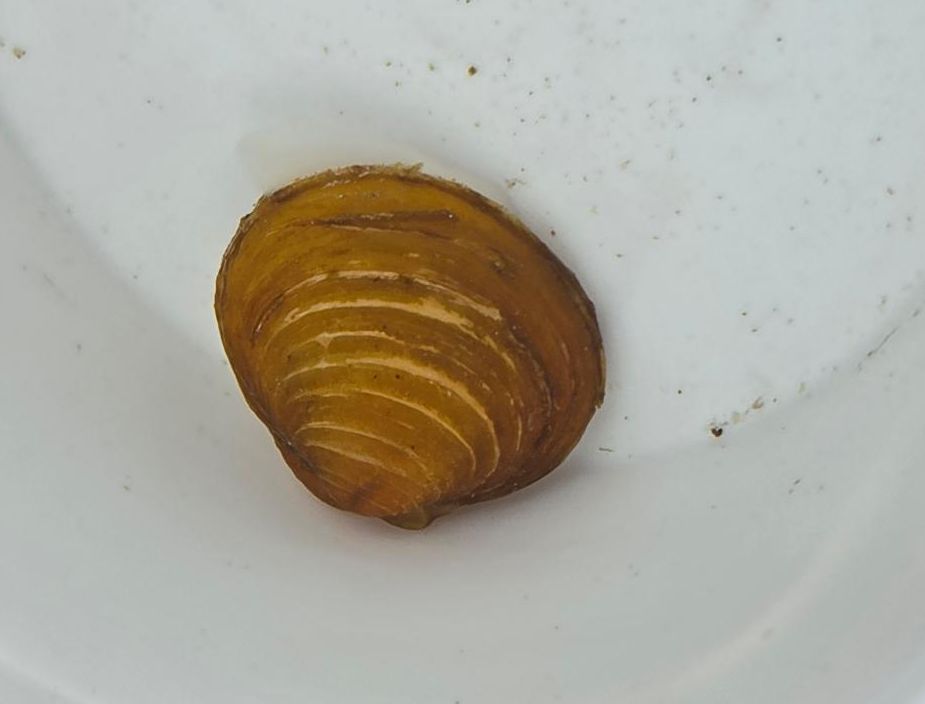
The Asian clam, as its name suggests, is not a species endemic to North America. This clam was introduced from southeastern Asia, and it is the only member of its genus that is present in North America (Corbicula fluminea). The shell of the Asian clam is thick, strong, and possesses spaced and distinctly raised growth rings. This results in the shell feeling rough when a fingernail is run across it, which is a good indicator of identification for the Asian clam. Preferring slow moving and well oxygenated water, this clam is usually found on sand and mud substrates. However, it can live on any substrate, including bedrock.
First observed in the Columbia River in the Pacific Northwest of the United States in 1938, the Asian clam has since become widespread. Now, it can be found in the United States from California to Florida, all along the Mississippi River, and eastward to the Atlantic. Even though it is widespread, it is limited to the southern portion of the United States as it cannot tolerate low winter temperatures.
Asian clams have a very rapid growth rate, facilitated by their high filtration rate to obtain food. In the freshwater habitats that it inhabits this clam has become the dominant species of invertebrate, and it is considered a pest because it can multiply so rapidly. It is capable of building up very high densities, sometimes as much as 10,000 per square meter! The ability to rapidly multiply can outcompete native species, and it can cause problems for infrastructure. Asian clams can clog water intakes of factories, power plants, and municipal water supplies, resulting in expensive prevention and removal procedures. The shells of Asian clams often become a major part of the substrate of the environment that they live in, as they accumulate in enormous numbers on sand and gravel bars.
If you find this macroinvertebrate while conducting Missouri Stream Team sampling, it belongs to the Group Two Taxa!
Source:
Voshell, J. Reese, Jr. A Guide to Common Freshwater Invertebrates of North America. The McDonald and Woodward Publishing Company, 2011.
|