News and information to help journalists serve the public and stay safe.
June 4, 2020
TOP STORIES
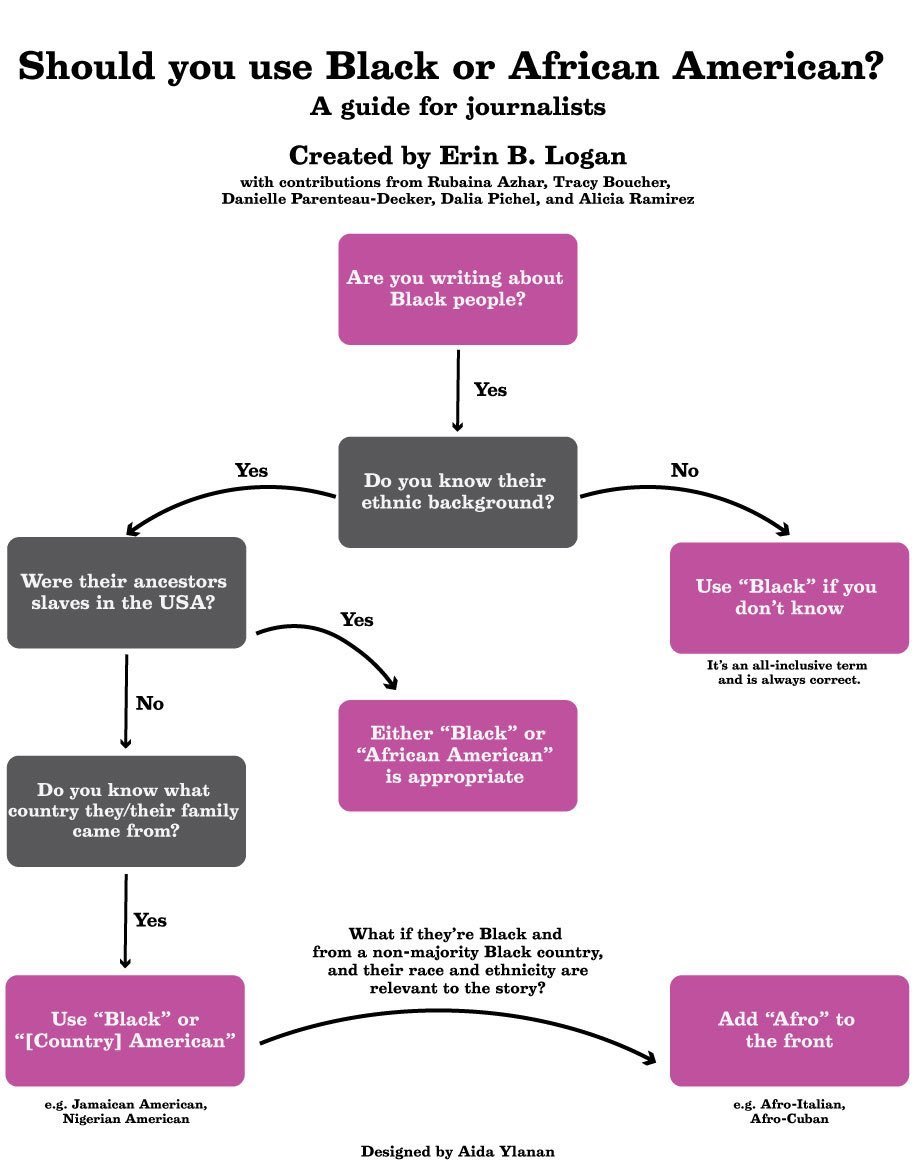
As more journalists across the country actively cover race and racism in the aftermath of George Floyd’s killing, L.A. Times reporter Erin Logan (pictured) created a guide on correctly identifying Black Americans.

“Accuracy in how we identify folks is paramount always but especially right now,” she tweeted. 

We reached out to Logan by email with questions about the guide, which she provided permission to republish.
What prompted you to create the guide?

Logan : The general lack of awareness on how to identify Black people was astounding. I made the graphic so reporters could stop using incorrect language to describe their sources and to move the needle on publications capitalizing the B in Black .

What has the response been since you shared?

Logan : From white journalists, shock. Many were shocked they were using the term "African American" incorrectly. 

What's your advice for asking people how they want to be identified?

Logan : Really, just asking " how should I identify you? " This is a broad question that can unearth other assumptions one might take, like on gender-identity and sexual orientation. 

Do you anticipate AP Stylebook changing its recommendations for identifying Black Americans?

Logan : I hope so. It’s about damn time.

Advice from   Jill Geisler ,
Bill Plante Chair in Leadership & Media Integrity, Loyola University Chicago
Freedom Forum Fellow in Women’s Leadership

Journalists are doing a remarkable job of documenting this moment. Even in the face of physical attacks and the health threat of a pandemic, they are delivering compelling images and memorable stories of nationwide protest in the wake of the killing of George Floyd. 

The best way to honor that work is to be as good at reporting on systemic racism as we are at covering protests.

Systems don’t make for compelling television or light reading. They take time to deconstruct. They involve history and social science and data. 

Systems are complicated and nuanced. Peeling back their layers makes people uncomfortable, particularly if they created, maintain or benefit from them. Some will attack journalists for doing it, calling them biased or untrustworthy. 

No matter. Dive into processes, protocols and laws that underlie education, employment, wages, lending, credit, business and neighborhood development, health care, criminal justice, policing, and access to voting. 

Look for patterns. Who benefits and thrives? Who suffers? Who has the power over decisions and who and what influences them?

It will take the same courage shown by journalists in the streets to tell the deeper stories about systemic racism. It will take an investment of time and resources, even as the news industry is struggling financially.

While we’re at it, we also have to take a hard look at the role journalism has played in the problem. What have our majority white newsrooms ignored over the years, or reported only as events? It’s easier and cheaper to report on overnight crime than explore the criminal justice system - or to host a food drive without examining why food insecurity and food deserts exist, who’s responsible for that and what real change looks like.

Nothing I say here is new. We’ve had these conversations at journalism conferences. Groups like the Solutions Journalism Network and IRE offer help in digging deeper. Each year, we give awards to news organizations for stories that take on systems. 

We need so much more of it.

We reached out to the American Psychological Association for self-care guidance as journalists navigate today’s stresses. Dr. C. Vaile Wright , the APA’s senior director of Health Care Innovation, provided tips for managing stress, screen time and taking a break.  

What advice can you share about balancing high-stress, high-stakes work and family life mentally and physically? 

Wright : Give yourself permission to set boundaries around your work, including disconnecting from your devices to spend quality time with family. Breaks are important for our brains to have recovery time and to “reset.” It’s not selfish to take time for yourself. You need to be emotionally healthy in order to do your job effectively – to get important information to your readers, viewers or listeners and to perform your public service.
 
Some journalists have openly shared their personal frustrations and stress using social media. Why is it important to vocalize such feelings, and what are meaningful ways to do so?

Wright : Knowing that others are experiencing similar stresses helps you to feel less alone and can help you identify new ideas to face your own struggles. Share the joys and the sorrows of work and recognize one another’s successes. Maintaining your relationships ... strengthens our sense of self and provides that needed emotional connection with those we care about.
 
What other advice might you give to journalists and communicators? 

Wright : Human beings have an enduring capacity to be resilient. We can move forward — we have done it before, we can do it in the future.

Read on for more self-care tips, or share your own .
This newsletter is written & edited by the National Press Club Journalism Institute staff: Beth Francesco, Holly Butcher Grant, Jim Kuhnhenn, and Julie Moos. Send us your questions and suggestions for topics to cover.

Get this from a friend? Subscribe , and view the archives .