|
President's Message
The Deception of the Gibeonites (Joshua 9:1–27)
“So Joshua spared them and did not allow the Israelites to kill them. That day he made them woodcutters and water carriers for the congregation and for the altar of the Lord at the place the Lord would choose. And that is what they are to this day.” (Joshua 9:26–27)
After Israel’s victories at Jericho and Ai, a state of alarm spread throughout Canaan. Gibeon in particular became anxious. It was located about seventeen miles west of Jericho and five miles south of Ai, making it a likely next target for Israel.
The Deception of the Gibeonites (9:1–15)
All the kings of the Hittites, Amorites, Canaanites, Perizzites, Hivites, and Jebusites formed an alliance to fight Israel to the death. The people of Gibeon, however, clearly recognized that God was leading Israel. Rather than resisting them in battle, they sought to secure their survival by surrendering.
Although Gibeon was a great city at the time, the site today is only a small village known by the Arabic name el-Jib. The Gibeonites were Hivites, a people frequently listed in the early books of the Bible as nations Israel was to conquer. During the patriarchal period, the Hivites had also occupied Shechem.
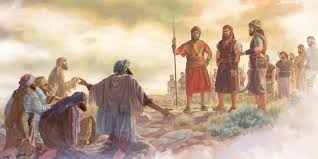
The Gibeonites resorted to deception. They put on worn-out clothes and prepared moldy food. Then they went to Joshua at the Israelite camp in Gilgal, pretending to be envoys from a distant land. They referred to themselves as Joshua’s servants, which was a customary diplomatic greeting and did not mean they intended to become actual slaves of Israel.
Seeing their appearance, the leaders of Israel examined the provisions the Gibeonites brought and swore an oath to maintain peace with them. Joshua then made a peace treaty with them. However, before making this treaty, the leaders failed to seek the Lord’s guidance, which they normally did through the Urim and Thummim.
Israel Spares the Gibeonites Despite Their Deception (9:16–27)
Even after the Gibeonites’ lie was exposed, Israel did not destroy them. Joshua, however, was deeply disappointed and rebuked them. The expression “Why did you deceive us?” in verse 22 vividly conveys his bewilderment and resentment. In truth, Israel had been deceived not only because of the Gibeonites’ lies but also because Israel failed to inquire of the Lord. Yet in this passage, we do not see explicit self-reflection from Joshua or the Israelites.
From the beginning, the Gibeonites’ lie in seeking a covenant showed a lack of the sincerity that such an agreement required. Joshua emphasized the seriousness of their deception by using the word arar (“to curse”), highlighting that their lie was as grave as breaking a covenant already made. The Gibeonites had tried to escape destruction, but now they belonged to the Lord. They became servants attached to the sanctuary. Although there is a record that the Gibeonites were made slaves, it is likely that such measures were not fully enforced until the time of Solomon, three centuries later.
The Gibeonites Serving in the House of God (9:27)
In describing the Gibeonites as woodcutters and water carriers, the text uses various expressions for the place of their labor, such as “the house of God” and “for the altar of the Lord.” This shows that their service was not in an ordinary place but in the very location of God’s presence. They were assigned to work for God Himself.
The Gibeonites escaped the curse destined for the pagan nations and entered into God’s covenant, becoming recipients of spiritual blessing. Historically, we see that after the exile, the Gibeonites participated with Nehemiah in rebuilding the wall of Jerusalem (Nehemiah 3:7), and they were also listed among those who returned from captivity (Nehemiah 7:25). This suggests that the Gibeonites eventually became fully integrated into Israel.
Reflection
The Gibeonites’ lie did not last long—it was exposed within only three days. Israel experienced considerable shock from this event. Making peace with a Canaanite people whom God had commanded them to destroy was a serious matter. Nevertheless, Israel did not annihilate the Gibeonites, because their oath had been made in the name of the Lord and therefore could not be broken.
In later years, King Saul violated this oath by killing Gibeonites, which brought famine upon Israel, and Saul’s descendants suffered a tragic curse. Yet the Gibeonites shared Israel’s fate: they went into Babylonian exile together and later returned together to help rebuild Jerusalem and the temple.
As a consequence of their deception, the Gibeonites and their descendants were destined to remain servants of Israel. However, while other Canaanite nations perished, they preserved their lives. Moreover, though their role was that of servants, they were given the privilege of serving near God. In this way, they became blessed people. Here we see the hopeful future of those who fear God and long for His grace.
|