The New Question for Schools
Artificial Intelligence (AI) is here to stay. In education, the conversation often splits into two camps: those who fear AI will erode critical thinking and academic integrity, and those who see it as a powerful partner for learning. The truth lies somewhere in between. AI’s potential is enormous, but it comes with real risks that schools must address head-on.
The Benefits of AI: Amplifying Learning and Teaching
When used thoughtfully, AI doesn’t replace human thinking—it magnifies it. It frees educators to focus on deeper learning and empowers students to explore, create, and problem-solve.
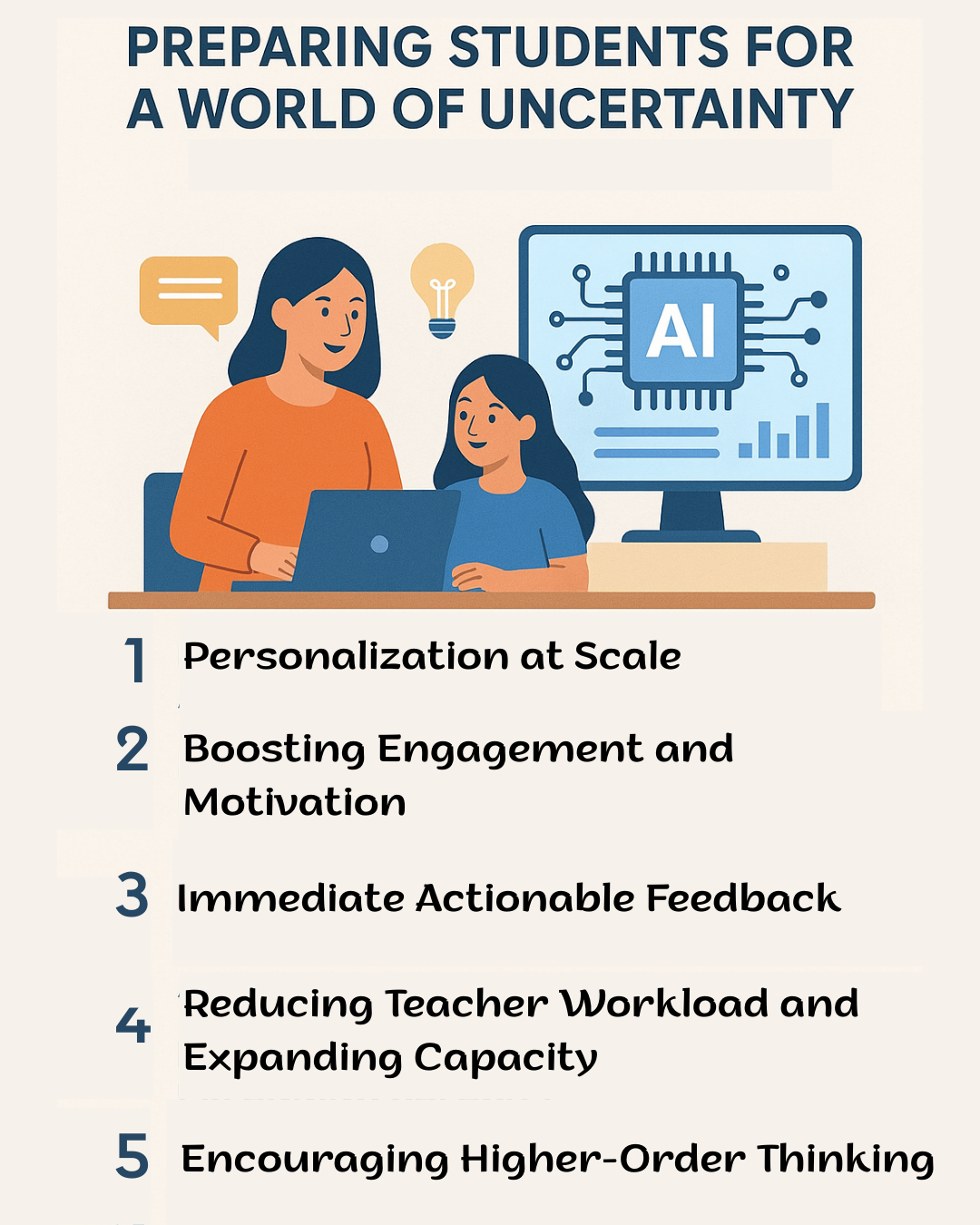
1. Personalization at Scale
One of AI’s greatest strengths is its ability to adapt content for individual learners in real time. In a 2025 meta-analysis of 31 studies, Generative AI tools had the largest positive effects in K–12 settings, particularly in flipped classrooms and short-to-medium-term interventions. This flexibility enables teachers to tailor materials to different reading levels, learning styles, and linguistic needs, whether through simplifying complex texts or providing enrichment for advanced learners.
2. Boosting Engagement and Motivation
AI-supported lessons can spark student curiosity and sustain attention. In gamified physics classes, ChatGPT-powered activities improved both student performance and motivation. In arts education, generative tools encouraged experimentation with style and composition, helping students feel more confident in their creative abilities. These examples show that when AI is integrated into meaningful, hands-on learning, it can increase participation and ownership.
3. Immediate, Actionable Feedback
AI can give students real-time guidance, allowing them to refine their work without waiting days for feedback. This supports formative assessment practices that keep learning on track. For teachers, it means more time for rich, in-person discussions rather than repetitive marking. As Amir Taron Ayres, writing for Edutopia, points out, when teachers treat AI as a “thought partner” to brainstorm, scaffold, or refine instructional materials, the process becomes more responsive and collaborative which leads to more engaged classrooms.
4. Reducing Teacher Workload, Expanding Capacity
From automating basic administrative tasks to generating draft lesson plans, AI can save teachers hours each week. This reclaimed time can be reinvested into relationship-building, small-group instruction, or one-on-one conferencing. Digital Promise emphasizes that this efficiency, coupled with intentional teacher exploration, can free up mental space for deeper instructional design and creativity.
5. Encouraging Higher-Order Thinking (With the Right Scaffolding)
Far from undermining critical thinking, AI can be used to strengthen it. Holmes et al. (2022) highlight that with proper professional development, teachers can design activities where students critique AI outputs, compare them to their own ideas, and refine their arguments. This shifts AI from an answer machine into a provocation for analysis, synthesis, and evaluation—the very skills students need for a world of uncertainty.
Risks Worth Addressing
While AI offers promising benefits, ignoring its risks could undermine the very skills schools aim to nurture. These challenges are not reasons to ban AI, but signals that careful, deliberate planning is essential.
1. The Quiet Erosion of Critical Thinking
When students lean too heavily on AI to brainstorm, structure, or even fully write their work, the cognitive heavy lifting shifts from their minds to the machine. A recent study out of MIT found that students who relied solely on large language models (LLMs) for essay writing exhibited weaker brain connectivity, especially in the frontal and parietal regions tied to reasoning and problem-solving, compared to peers who wrote without assistance. This “cognitive debt” left them less engaged and less able to recall their own work. The takeaway? Without intentional guardrails, AI can foster passive consumption rather than active creation.
2. Overdependence and Loss of Authorship
In the same study, LLM users reported the lowest sense of ownership over their essays, and in some cases struggled to quote or explain their own arguments. This detachment from one’s own work poses long-term risks to academic integrity and self-efficacy. If students stop seeing themselves as the authors of their ideas, the erosion of identity as a learner can follow.
3. Widening Equity Gaps
AI literacy is becoming as essential as reading and math, but not all students have equal access. Those in well-funded districts may have devices, high-speed internet, and trained teachers guiding responsible use. Others risk being left behind. Holmes et al. (2022) argue that without broad, inclusive teacher professional learning programs, AI adoption could exacerbate inequities, benefiting only those already advantaged. This means any AI integration plan must consider infrastructure, training, and culturally responsive pedagogy.
4. Bias, Misinformation, and Safety Concerns
Generative AI systems are trained on massive datasets riddled with human bias. Without explicit teaching on bias detection, students may accept flawed or prejudiced outputs as fact. The risk extends to emerging threats like deepfakes, which have already been used maliciously against students and teachers in other contexts. Addressing this means embedding digital citizenship and AI ethics into curricula from the outset. AI integration should always be guided by community input, transparency, and clear safeguards.
A Call to Action
The research shows that AI’s benefits are not hypothetical; they are measurable and achievable. But, the risks are real, too. By relying on thoughtful design, teacher agency, and ethical guardrails, AI can be used in education as a catalyst for deeper engagement, personalization, and innovation and not just a shortcut to learning.
If we want our students to thrive in a world of uncertainty, we cannot treat AI literacy as an optional add-on. It must become part of the fabric of how we teach, just as essential as reading, writing, and critical thinking. It begins with empowering educators, giving them the time, training, and support to explore AI with confidence, experiment with it in low-stakes ways, and model for students what responsible use looks like. It means designing learning experiences that ask students to do more than consume answers, to challenge AI’s responses, refine them, and bring their own perspectives to the table. It also means engaging families, school leaders, and communities so that AI integration is transparent, ethical, and equitable.
AI is neither a magic bullet nor a threat we can ban away. It’s a reality. Students deserve the skills to question it, use it wisely, and create with it ethically. To resist change is to leave them unprepared; to lead through it is to empower them for a future where uncertainty is the constant.
|