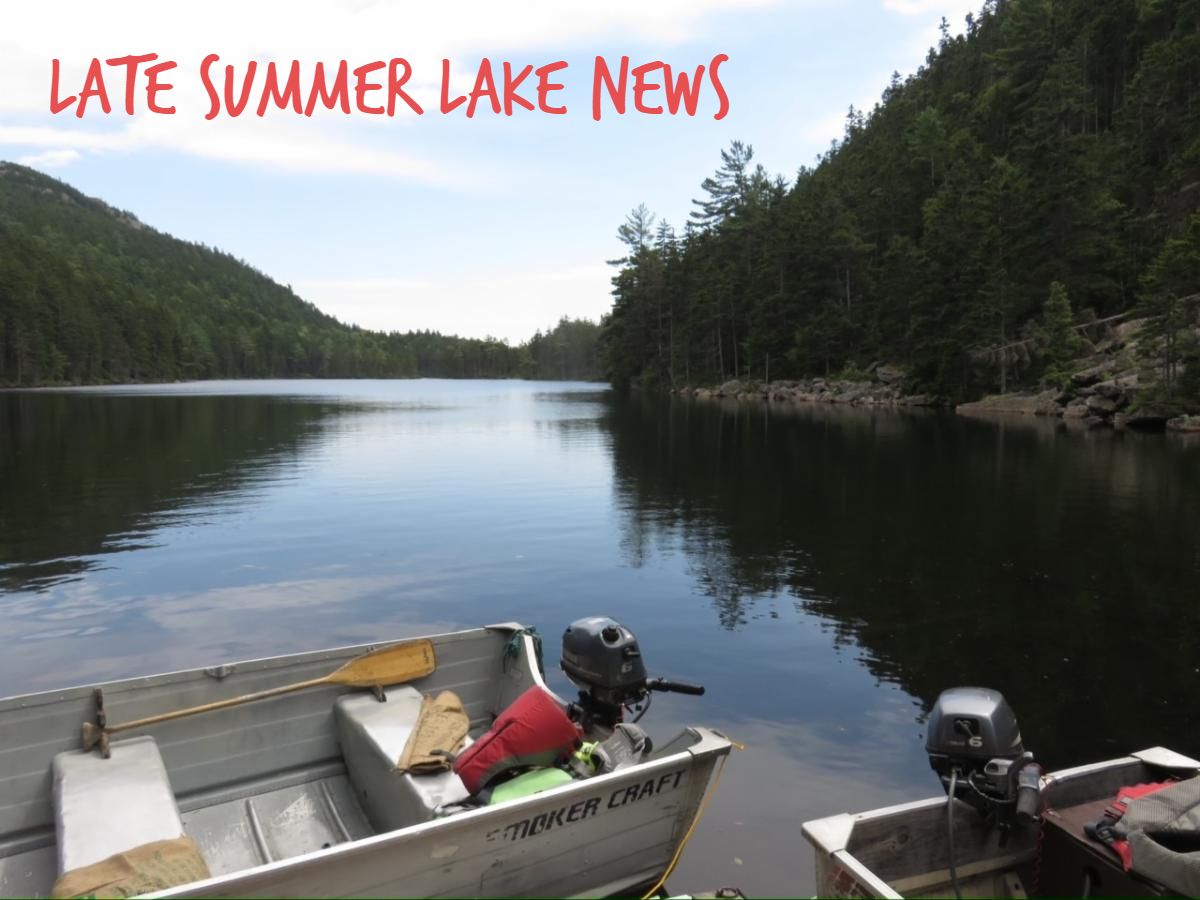
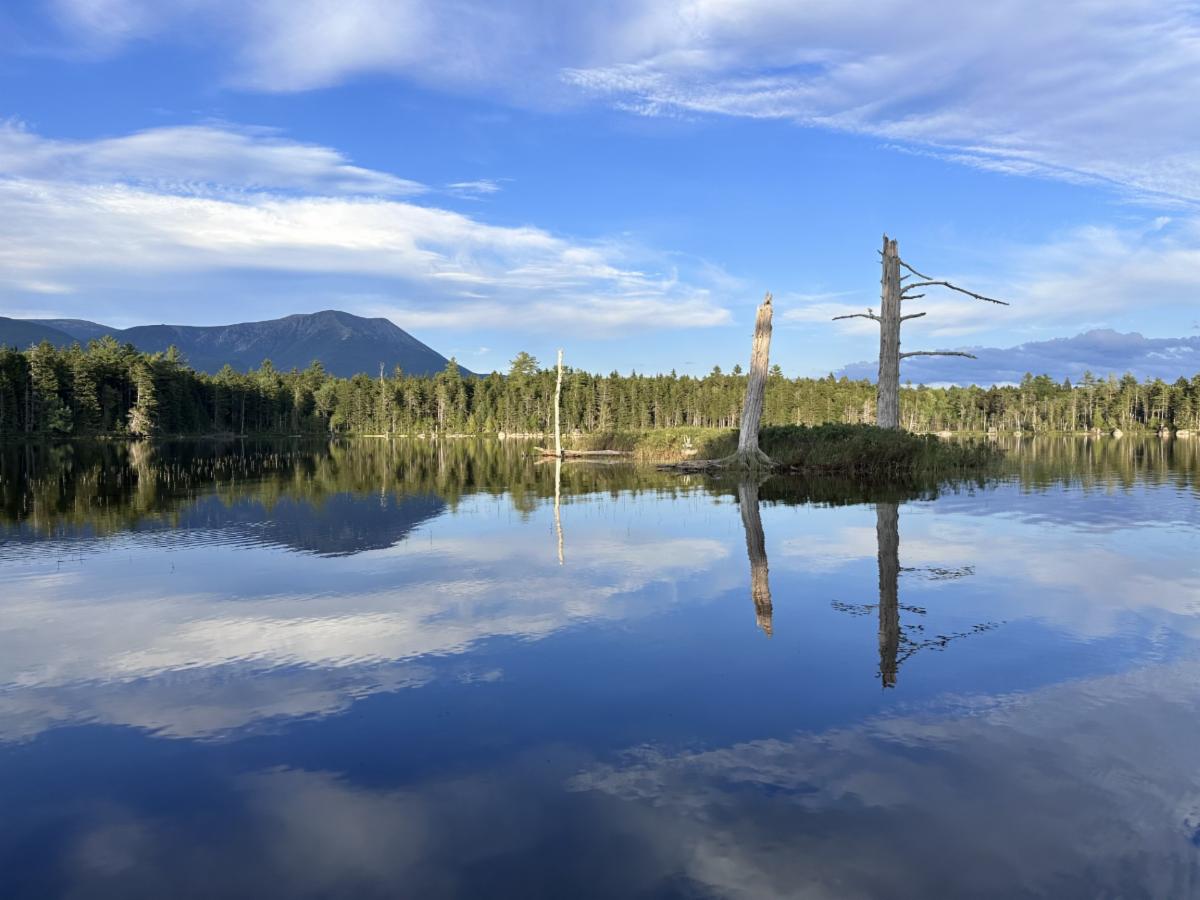
The peace of Midday Pond in Elliottsville Plantation. | |
- Summer Update and Annual Meeting: September 17 at 5:30
- Membership Appeal
- “Houses” on Maine’s Lakes
- An Update from a Look Out For Loons Volunteer
- Amphibian-friendly Lakeshores
- Natures Connects
- Loon Translocations in 2024
| |
|
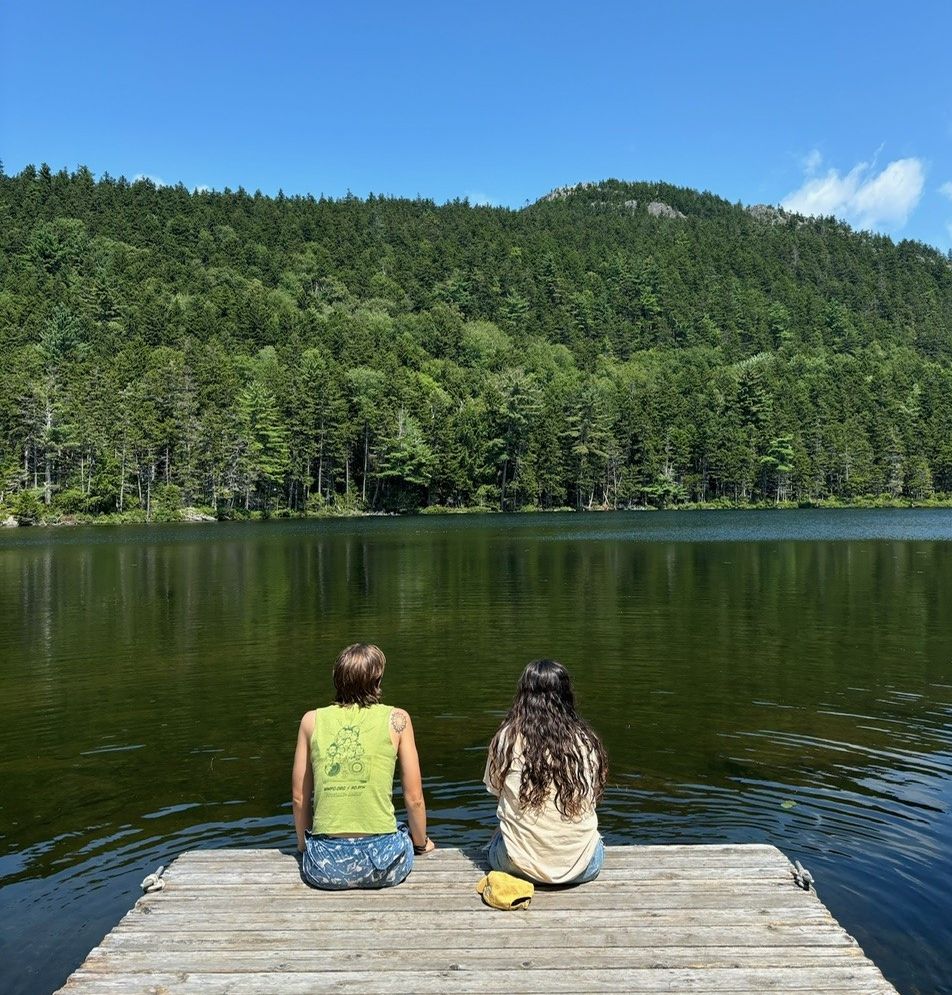
Enjoying the view at Sunrise Pond, one of three in a chain of alpine
lakes at the foot of Borestone Mountain.
| |
|
Dear Friend of Maine Lakes,
I hope you have been enjoying this glorious summer on Maine’s fabulous lakes. I just returned from a long weekend at three of my all-time favorite alpine lakes (Sunrise, Midday and Sunset Ponds), found at the foot of Borestone Mountain in Elliotsville Plantation. It’s a truly special place for me and my family. This year it was extra special to have our 11-month-old great niece join us. Watching her first “swim” in the pond and remembering my own kids' early experiences (they first swam in Sunset Pond when they were 3 and 5), reminded me of how grateful I am to work for an organization whose mission is to keep lakes (and ponds!) clean and healthy not just for us, today, but for future generations. But boy is there a lot of work to do!
And luckily Maine Lakes staff and volunteers are working hard this summer for our lakes! Andrea and Caroline, our intrepid LakeSmart program staff, have been busy training and supporting both long-standing volunteers as well as new LakeSmart teams all over the state. Thank you to the incredible LakeSmart volunteers who invest so much time and energy motivating homeowners to take action! Andrea and Caroline hosted a “thank you” event for LakeSmart volunteers last week, and are busy at this time of year with evaluation reviews and consultations.
James is incredibly busy with an amazing cadre of Look Out For Loons volunteers. I was lucky to see several of these passionate folks in action this summer. Thank you for all you do to motivate audiences with contagious excitement and enthusiasm, changing behaviors to better protect and enhance loon success on our lakes.
Our Freshwater Education Network leader Tamara Whitmore has been busy connecting with educators, researching all kinds of education network models, tabling at education conferences, and building a strong foundation to ensure network success in the coming years.
Leah, our office manager and program assistant, has been working hard behind the scenes updating our website, keeping our social media machine going, answering calls and emails, designing beautiful appeal letters, and doing everything that needs to be done to keep our organization running smoothly.
I am so thankful for Maine Lakes terrific staff and enthusiastic volunteers, for the Maine Lakes board that keeps the organization paddling steadily along in the right direction, and for all of our members and supporters who do so much to keep our lakes clean and healthy. I hope to see many of you at the Annual Meeting in September (details below).
Thanks for all you do and keep enjoying this beautiful season on Maine’s lakes!
| | |
|
On behalf of Maine Lakes board and staff, | |
Susan Gallo
Executive Director
| | |
|
Maine Lakes Annual Meeting
Tuesday September 17th 5:30 - 6:15 via ZOOM
All members invited to join.
You are a member if you have made a donation to Maine Lakes in 2023 ir 2024.
| |
|
Maine Lakes is a membership organization, meaning that if you have donated any amount to Maine Lakes in the last 18 months, you are considered a member with full voting rights. You can put those voting rights to use not just this November, but also on Tuesday, September 17th at the Maine Lakes Annual meeting where members will be voting in a slate of officers and one new board member, Dick Tinsman, who is actually returning to the board after a few years away.
For an agenda and the board slate, click HERE.
You’ll also hear a brief but lively update on what Maine Lakes has been doing over the last year (and a few of the exciting plans taking shape for 2025!). We'll also be looking to hear from you with your questions, suggestions, and feedback.
We’ll have "door" prizes (see below for our favorite one!), lake trivia, and more!
The meeting will run from 5:30 to 6:15 via Zoom. For anyone interested in learning more about how our board functions, with perhaps an eye to joining the board in the future, feel free to stay on the Zoom from 6:15 to 6:45 to join an abbreviated full board meeting.
Please register for the annual meeting using the button below. The board and staff look forward to seeing you there!
Not sure if you're a member? All current Maine Lakes members will receive a member-only message via email next week. If you don't get the membership message or you want to check the status of your membership, email info@lakes.me. Non-members can attend the annual meeting but will not have voting privileges.
| | |
|
Annual Meeting Door Prize!
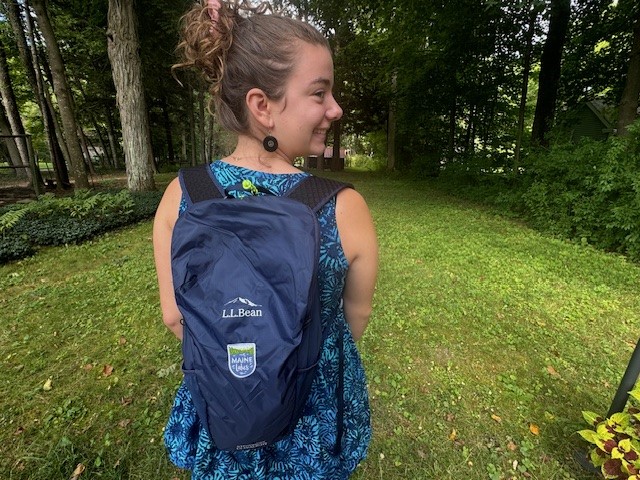
One lucky annual meeting attendee will win a Maine Lakes L.L. Bean Stowaway Back Pack, perfect for trips around the lake, around the neighborhood, and around the world.
Register today at the button above to ensure your name is in the drawing. Must be present to win!
| | |
|
Many of you received our recent membership appeal in your mailbox or your inbox. If not (or if it’s been lost among piles of mail or a cluttered inbox), have no fear!
Please read our summer appeal HERE!
Maine Lakes relies on our members, supporters, and donors to help meet our budget goals and carry out the important programming our staff and volunteers do around the state, working with so many of you on efforts that keep Maine lakes clean and healthy.
Donations from individuals like you and from our member lake associations make up about 20% of our annual budget. We would love to have your support in the form of a donation to directly support our work. Many thanks if you have already donated, or if you are moved by our work to donate today!
| |
“Houses” on Maine’s Lakes | |
|
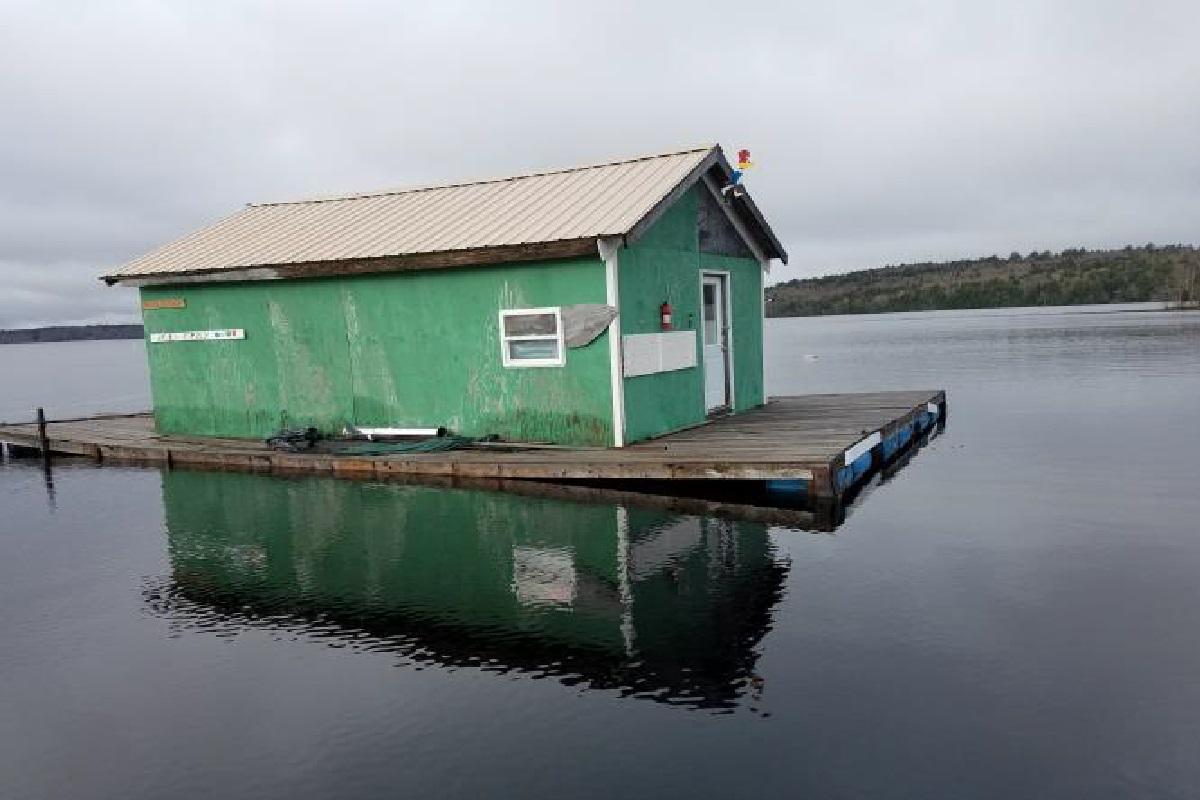
There is a growing trend both in Maine and across the nation to use floating structures as vacation camps and rental properties. A recent search of short-term rental sites yielded several dozen properties in Maine and across New England where folks can rent a floating camp, a moored houseboat, or even a camper sitting on top of a large float. This is a new and unregulated area, where definitions and uses are not clearly stated in law, and where there are significant potential risks to the health of Maine’s lakes.
Those risks include management of sewage, gray water (water from doing dishes and taking showers), nutrient pollution (from food and other waste), and issues with noise, wildlife habitat disturbance, congestion, and safety. Several U.S. cities, including Seattle, WA and Newport, RI, have passed laws to ban or significantly curtail the use of “non-water-dependent floating structures" (NWFS). Several Maine towns (Rangeley, Ellsworth, and Edgecomb to name a few) have enacted or are in the process of enacting limits to NWFS, and more are going to be grappling with the pros and cons of this emerging economic and recreational activity in the years ahead.
In 2022, the Maine Legislature created a working group with staff from the departments of Inland Fisheries and Wildlife; Agriculture, Conservation and Forestry; Marine Resources; and Environmental Protection. Their Floating Structure Report was released last fall and provides an overview of the legal and regulatory complexity and challenges, the overlap between many state agencies and municipalities in their jurisdiction over NWFS, and the need to create some kind of regulatory framework. However the report does not go into the risks these structures pose to lake health or possible solutions to reduce those risks in order to accommodate structures on our publicly-owned lakes.
The working group recommended two possible regulatory approaches. One would be to prohibit floating structures that are “non-water-dependent” use, including floating homes with a primary purpose of habitation rather than navigation. “True” houseboats, which are navigable and meet requirements for pollution control, would be excepted.
Two would be to create a new section of law establishing a program that would create authority and regulations, along with the ability to create permitting systems.
The most important thing, in light of Maine Lakes' mission to keep our lakes clean and our lake ecosystems healthy, is that risks to lake health, including wastewater, pollutants, and noise disturbance, be regulated so that they are absolutely minimized. We will be talking to legislators this fall about approaches that might work to reduce risks. We are always happy to hear your thoughts on this important topic. Email Susan at sgallo@lakes.me any time with your feedback!
FMI:
-
The full Floating Structure Report is HERE.
-
For a helpful “Q and A” for municipalities from the Department of Inland Fisheries and Wildlife, including questions about moorings and NWFS, click HERE.
Thanks to Bill Dexter from Moose Pond Association for allowing us to adapt his original article from the association newsletter. You can read that article, and more about what is going on in Bridgton, HERE.
| |
An Update from A
Look Out For Loons Volunteer | |
Volunteer Robin Stevens works to reach visitors to Kidney Pond in Baxter State Park. | |
|
Look Out for Loons Volunteer Robin Stevens is in her 12th summer at Baxter State Park and her 7th at Kidney Pond Campground as a Park Ranger. When she arrived at her rustic cabin in May (no electricity, no cell service, and she hauls her own water), she dropped me a note to say, “I was moving into my cabin earlier this week and it was great to hear the loons. So I know they are back and I can’t wait to see them!”
Recently, she got word out that in June the pair had two new chicks. “I think it's been several years since we’ve had a successful hatch. It’s been amazing watching them this year. I feel like a new parent!”
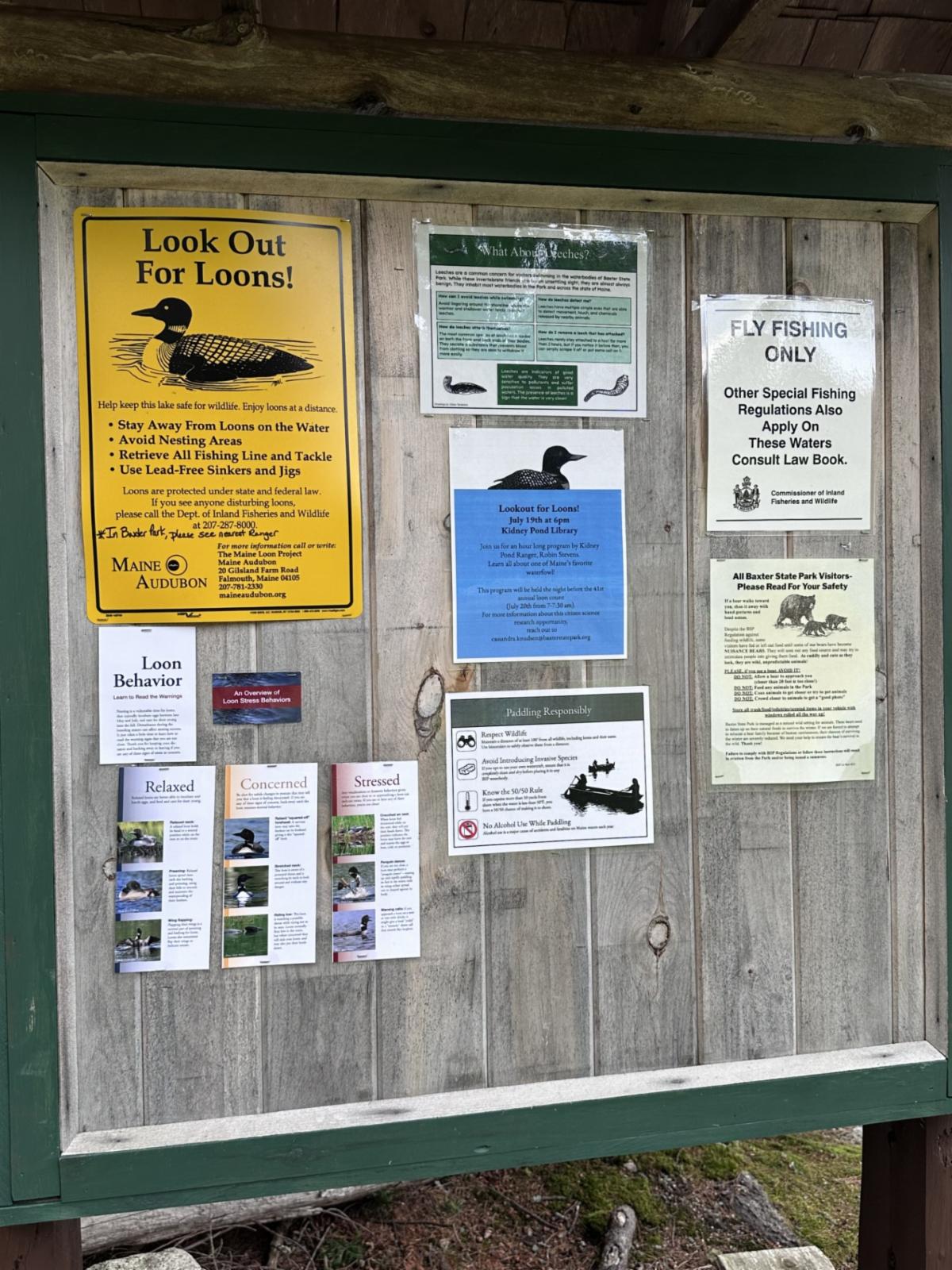
Robin’s excitement is infectious. She is using the chicks as a teachable moment with Park visitors. Using the brochure, How Close is Too Close, she regularly explains to paddlers how to judge when they are maintaining a respectful distance to observe the loon family. She has also placed information about loons on the kiosk where the Park’s canoes and kayaks are located (see photo above) and conducts occasional presentations for campers.
We thank Robin and the dozens of Look Out for Loons volunteers like her spending their time this summer educating lake users about Maine’s loons. The loons thank you, too!
James Reddoch
Look Out for Loons Program Manager
| |
Amphibian-friendly Lakeshores | |
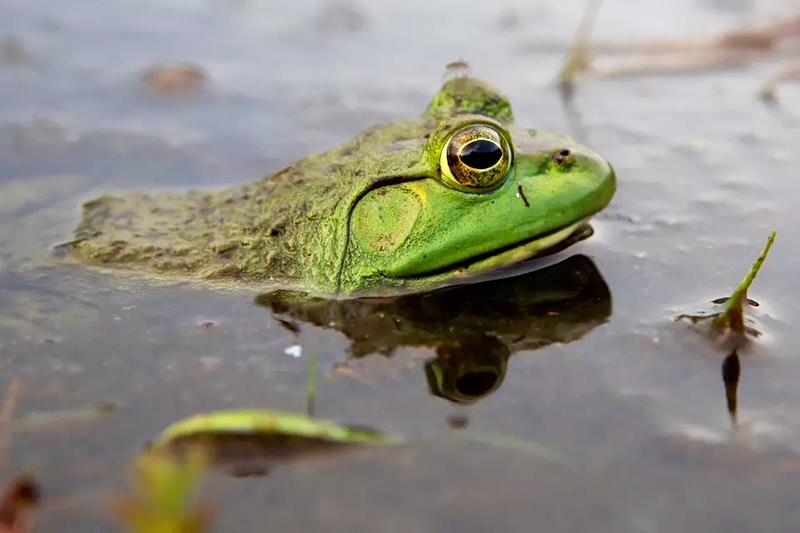
A bull frog lying in wait (Photo courtesy of Will Greene, NPS, Friends of Acadia) | |
|
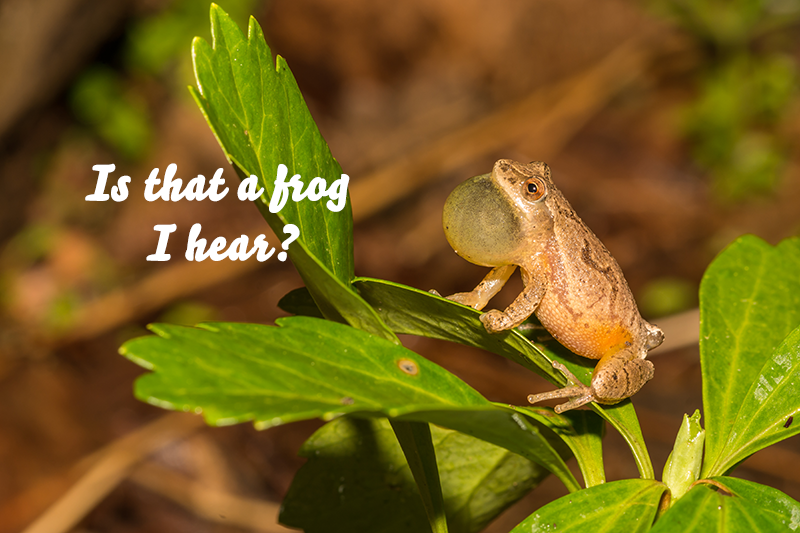
Frogs are fascinating animals that play an important role in our ecosystems. Frogs not only eat tons of insects – including those pesky mosquitoes – but they also serve as an important food source for birds, fish, snakes, and other wildlife. Since they breathe through their skin, frogs are particularly sensitive to changes in the environment, including pollution and toxins. This makes them great “indicator species” that serve as early warning signs of negative changes in the environment.
If you live near a lake or stream or have wetlands around you, you have a special opportunity to help frogs. Like all amphibians, they need access to water on a regular or seasonal basis. The following are actions you can take to transform your property into a haven for frogs. The great thing is that many of these actions are also steps to be LakeSmart – so you can help your lake and a frog at the same time!
-
Protect existing natural areas to the greatest extent possible. Protect woodlands, wetlands, meadows, stream corridors, shorelines, and other wildlife habitat on your property. Encourage your friends and neighbors to do the same. You can also restore these habitats by adding more native plants to your property.
-
Maintain leaf litter, woody debris, and groundcovers. These materials provide moist hiding places, attract food sources, and stabilize loose earth. Not only is this good for frogs, but covering bare soil also helps to reduce erosion, which in turn prevents phosphorus-rich soil particles from polluting nearby streams and lakes.
-
Avoid herbicides and pesticides. These products contain harmful chemicals that frogs absorb through their skin or by consuming contaminated food sources. These chemicals can also run off your property into waterbodies, further polluting the areas where baby frogs mature. Natural yard and lawn care techniques are a great way to have a beautiful yard that is better both for amphibians and your family. There are great lawn care tips in the updated Maine Yardscaping Guide.
-
Leave some of your lawn or yard unmowed to allow a buffer of at least 10 feet or more to grow along lakeshores. Any areas you do mow, set the mower blade as high as possible and leave grass clippings on the lawn. Using a weed-whacker is a good alternative, but in either case, be sure to watch out for any amphibians while you’re working and be ready to stop your machine!
-
Create a LakeSmart shoreline! Frogs need lake or stream edges for breeding and cover. To make your shoreline frog-friendly, replace some of your shoreline lawn with a mix of shrubs, trees, or perennials, which provide cover and overhanging vegetation. These deeper-rooted plants also protect your shoreline from erosion and help clean and filter out pollution.
| |
|
Did you know some frog species start calling in the early spring, as soon as the snow melts, and others don’t start until early or mid-summer? The males call to attract mates. You can still hear occasional calls of most Maine frogs at this time of year…they are all finished breeding but their calls let us know they are around.
Click HERE for recordings of all 9 Maine species!
| |
|
|
Note that Northern Boreal and Eastern Spadefoot Frogs are not currently found in Maine.The Department of Inland Fisheries and Wildlife has excellent information sheets for our native species, including range maps and habitat information.
Thanks to Dominick Leskiw of Snohomish County, WA, for permission to adapt his article from the spring 2024 LakeWise newsletter.
| |
|
Maine Lakes is happy to be part of a conservation collaborative that is working to publish a monthly column, Nature Connects, in the Portland Press Herald. The stories celebrate the wonders of Maine’s nature and we hope bring people together around important conservation issues. Maine Lakes' Executive Director Susan Gallo wrote the July column, focusing on the recent economics study and how she hopes that will help motivate people to protect lake health
Maine’s lakes were recently valued at over $14 billion. Conserving them will deliver enormous benefits for nature and our economy.
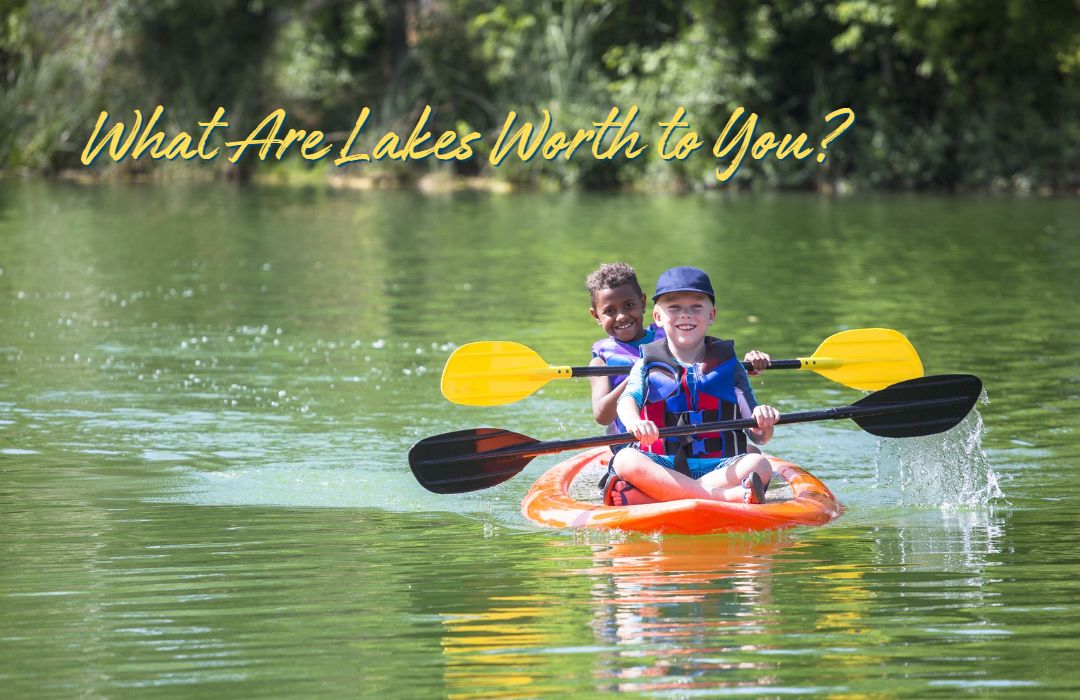
Maine is home to thousands of freshwater lakes and ponds, which offer immense value for residents and visitors. Each year, Maine lakes provide outdoor recreation opportunities for hundreds of thousands of boaters, anglers, birders, and swimmers. They create idyllic settings for youth summer camps, serve as stunning backdrops for scenic drives, reduce stress, and can even slow our heartbeat.
Maine’s lakes have important ecological benefits as well. Lakes and their surrounding riparian areas support 70 percent of Maine’s wildlife at different stages in their life cycles, including fish, turtles, bats, minks, amphibians, and pollinators, as well as two of Maine’s most iconic species—moose and loons. Maine’s lakes support public health, too, supplying roughly half of all Mainers with drinking water.
Maine’s former governor Percival Baxter once said, “These lakes and this water are public property of inestimable value.” Putting an economic value on nature is no easy task and can even feel like it undermines the intrinsic benefits nature provides that are impossible to quantify. Still, as policymakers consider how to make decisions around investing in conserving Maine’s natural resources, including our lakes, understanding the economic implications is important.
To that end, a team of researchers from the University of Maine led by Dr. Adam Daigneault, a professor at the University of Maine’s School of Forest Resources, recently conducted a three-year study to assess the economic value of Maine’s lakes. Using a range of methods, including surveys, modeling, and expenditure analyses, Daigneault and his colleagues estimated the total net value of Maine’s lakes to be a whopping $14.1 billion – with an additional $3 billion in direct and indirect expenditures for lake-related activities each year.
Another key finding from the study was the importance of water quality in determining the value of Maine’s lakes. The research team estimated that even a moderate decline in water quality would reduce the recreational use value of Maine lakes by $33 million per year. On the other hand, a one-foot increase in water clarity – a simple indicator of water quality – was correlated with a 1.1 percent increase in property values, or $146 million. Having clean, clear lakes pays off in real dollars.
Among the roughly 6,000 lakes and ponds in Maine, nearly half are “Great Ponds” over 10 acres in size. This means they are designated as shared public resources – jointly owned by all residents in the state. But the task of keeping them clean falls largely on the shoulders of nonprofits, including local lake associations, regional watershed organizations, and statewide lake conservation groups.
Today, growth in unprecedented threats to Maine’s lakes is increasing pressure on these nonprofits to raise the funds needed to protect and manage lake ecosystems. Major rain events spurred by the climate crisis carry unwanted phosphorus into the water, feeding unpleasant or even dangerous algae blooms. Invasive species and growing development pressures present additional challenges.
If you love Maine’s lakes and want to help protect them for generations to come, why not join a local, regional, or state lake organization? Maine Lakes has a map and list of lake associations at its website. While you’re there, you can sign up for legislative action alerts to help support common-sense lake protection policies in Augusta.
Governor Janet Mills recently proclaimed July to be Lakes Appreciation Month in Maine, in recognition of the value of these special, iconic ecosystems. There’s no better month to get outside and enjoy our lakes, appreciate all they provide us, and support their continued protection!
–
“Nature Connects” is a monthly column showcasing conservation stories from people and organizations across Maine. To learn more or suggest story ideas, email reply@mcht.org. Click HERE for past articles.
ABOUT THE AUTHOR
Susan Gallo is the executive director of Maine Lakes. She has enjoyed the many benefits of Maine’s lakes since 1966 when her parents first dipped her baby toes in Little Sebago Lake.
|
|
Loon Translocation Update | |
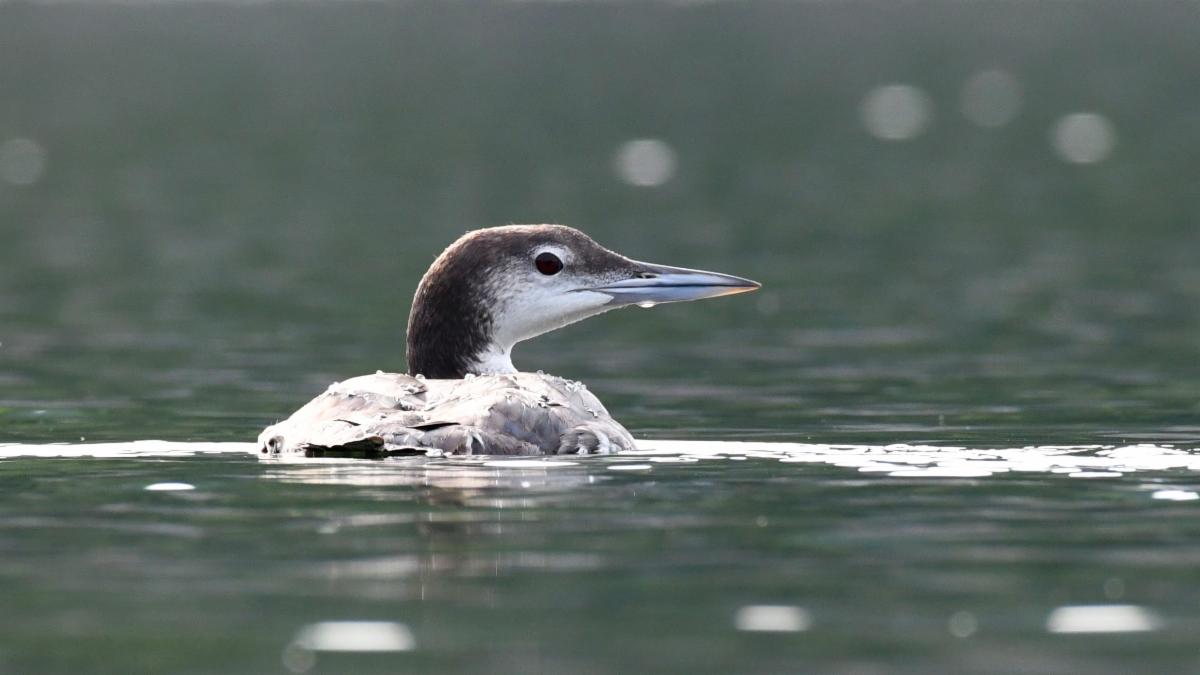
A juvenile Common Loon. Photo credit: USFWS Midwest Region | |
|
On April 27, 2003, the Bouchard Barge 120 struck ground near the Cape Cod Canal in southeastern Massachusetts, spilling between 22,000 and 98,000 gallons of No. 6 fuel oil into Buzzards Bay which poisoned and killed both resident and migrant birds and many other wildlife species, including many Common Loons. The spiller was required to pay for restoration of damages and losses.
Because the affected area is widely used by migrating and wintering Common Loons from New England, part of the payment for mitigation and restoration focused on helping loons throughout this region, including efforts in New Hampshire, Vermont, Maine and Massachusetts. These efforts include increasing productivity with placement of artificial nesting islands (rafts) and increasing the breeding population by 1) moving individual loon chicks from one area to repopulate another area (translocation), and 2) documenting the successful fledging, returning, and breeding of translocated chicks in subsequent years.
In 1974, New Hampshire marked the southern edge of the breeding range for Common Loons, and at the time that range was retracting southward. Recovery efforts carried out by loon conservation groups in New Hampshire and Vermont helped restore loon populations in those states. In Massachusetts, Common Loons were extirpated (no longer in the state) over 100 years ago, so recovery in that state has been much more difficult, especially as loons tend to stay fairly close to the lakes where they hatch and are raised. Several years before the oil spill, Biodiversity Research Institute (BRI) had started successfully translocating Common Loon chicks from New Hampshire and Maine to waterbodies in Massachusetts to help boost the breeding population and speed Common Loon recovery. BRI developed a safe and effective way to carefully raise loon chicks in an outdoor captive setting and prepare them to forage and thrive independently upon their release on freshwater lakes. This loon translocation project demonstrates how a population at the edge of its range can be restored for the benefit of the overall population.
Restoring lost bird populations to areas where they once flourished is a particularly effective bird conservation strategy, as shown by population recoveries of Peregrine Falcons, Bald Eagles and California Condors. Collaborative efforts between Biodiversity Research Institute (BRI), the Massachusetts Division of Fisheries and Wildlife, the Maine Department of Inland Fisheries and Wildlife, and the U.S. Fish and Wildlife Service, have resulted in a multi-year project funded by oil spill restoration money to restore Common Loons to areas of Massachusetts that contain exceptional potential breeding habitat where otherwise natural populations are slow to recover.
Common Loons are long-lived species that take many years to mature, with birds attempting to breed for the first time at 6 years of age, on average. Thus, it will take a long time for birds to begin breeding after translocation. Of 36 loons translocated as chicks (and assumed to have fledged based on post-release surveys) from Maine or New York in 2015-2017 and 2020, 44% (16 birds) have been reobserved in subsequent years since their release in Massachusetts.
Among these 16 loons, four have been part of pairs, with one pair successfully breeding in 2020 and a second pair in 2024. The additional 29 loon chicks that were translocated during 2021-2023 are unlikely to be re-observed until at minimum 2-3 years later.
During the summer and fall months, BRI staff biologists are actively surveying lakes in Maine to identify loon pairs with two chicks that may be likely candidates for translocation. BRI only translocate one chick from a two-chick brood. Single chicks are not considered for this project. Loon chicks selected for translocation are evaluated by wildlife veterinarians to ensure they are healthy and fit for transport, rearing, and release to areas of Massachusetts. All captive reared and released chicks are closely monitored by biologists to ensure they have acclimated to the wild and fledge their release lakes.
Further information on the loon translocation project can be found HERE. If you have questions, you can contact BRI directly at bri@briwildlife.org.
| |
|
Look for our next newsletter in September with resources
to get out the vote out for healthy lakes!
Did you find this e-news useful and informative?
Click here to support this enews publication with a donation. Thank you!
Join us on Facebook, Instagram, and the
Maine Lake Talk Slack Channel.
| | | | |