|
Greetings!
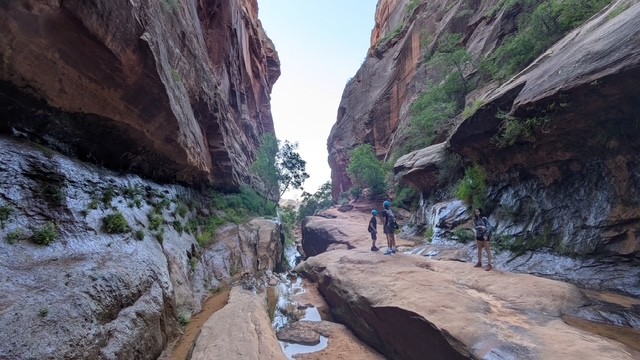
Last June we took a vacation with all of our kids and grandkids to one of our favorite travel spots; southern Utah. My wife secured a beautiful VRBO that could comfortably accommodate all of us in the little town of Hurricane; which is the gateway to Zions and Bryce National Parks. We love visiting and exploring these National Parks and have done it several times with our children when they were growing up, and now with our grandchildren.
One entire day of our week was earmarked for a guided canyoneering excursion that our daughter coordinated for us.
So, on Wednesday of the week we all arose early and met our guides at the trailhead at 6:30 AM. There were a total of 15 in our little group of explorers; our three adult children, a daughter-in-law, 8 or our 10 grandchildren (ages 20-10), me and our two guides. My wife stayed behind to hang out with the two youngest grandkids while we went on our hike.
After fitting each of us with helmets and rappelling harnesses and gear our guides sat us down and provided the following instructions. “Our hike up today will be on the edges of some sheer cliffs, and in several wet areas where streams and creeks are flowing. These areas are very slick. Follow the lead guide, stay on the path, always check your ropes and gear at least three times before you drop over a cliff, follow instructions, if you don’t understand, ask again.”
The following day, I learned that when our daughter was coordinating and scheduling this excursion weeks earlier, that the instruction she provided to the guides was: “I want the hardest and wettest trail you can take us on.” (I don’t know where she gets that from).
Well…we began hiking around 7:30 AM at a starting elevation of about 3,200 ft. Our ascent ended close to 11:00 AM at an elevation right around 5,800 ft. We had crossed two streams on our way up. This was now the time to find some shade, take a rest, and open our packs, to get some needed fluids in us, and eat some of the lunches we had packed.
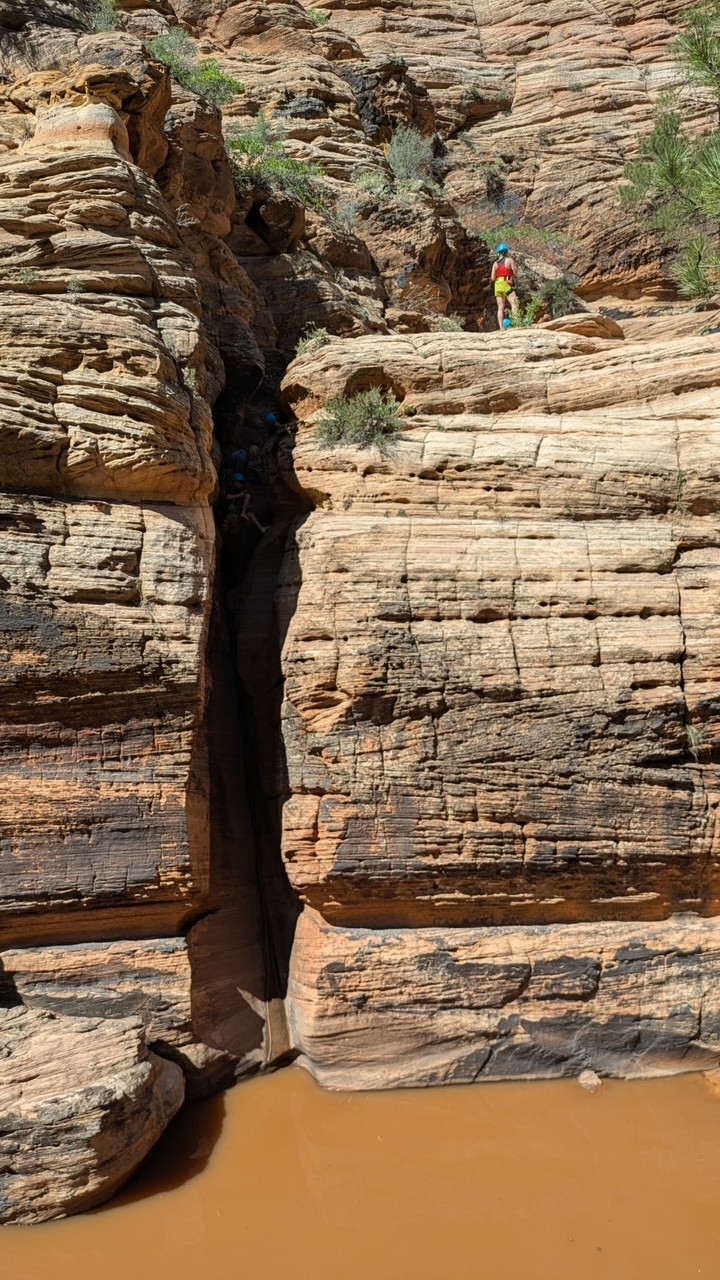
After a brief rest, our guides informed us that the remainder of the day would be spent in a series of 12 rappels between 80’ to 160’ in height and a 200-yard makeshift zipline, through a deep canyon from one of the climbing ropes anchored into the canyon wall.
While resting, we were again given a reminder about how to tie into our rappelling harnesses and gear correctly, how to position ourselves over the cliff as we descend the sheer face of the canyon walls, and other instructions. One of the more memorable rappels of the day was off a 110’ ledge. Unlike all of the other rappels where the rope we were using for our descent was always at least 50’ longer than the distance we were descending (which allowed us to very comfortably land on our feet at the bottom of the cliff face) the rope we used on this particular rappel was 5 feet shorter than the distance to the bottom. The instruction we were given on this rappel down was; “Watch the rope! As you get close to the end, simply let go and you will splash into the pond at the bottom of the cliff, and you can swim to the shore.
We made it back to the starting trail head and our cars at around 5:00 PM; dirty, tired, and…everyone smiling. It was a great day with the kids and grandkids.
Perhaps not surprising to those who read my newsletters, I found many parallels with our family canyoneering excursion and effective Risk Management.
The repeated instruction, the training and retraining, our gear (PPE), and oversight we received at the beginning, and throughout the day about the dangers and consequences of our actions and sometimes literally each step. The repeated training and instruction before each rappel. Where ropes were checked and triple checked by us and our guides every time before dropping off a cliff face.
Notice that even with trained experience guides, we…each of us still had to do all the work. We couldn’t just rely on our guides to do everything for us; we were required to perform. We had to hike up the mountain, we had to tie ourselves in correctly, we had to trust our ropes, we had to lean back and trust what we had in place. Even with our guides, it was still frightening, intimidating and difficult. But our guides were there by our side helping us through the hard work and challenging times. In fact, on our 3rd or 4th rappel down, one of my granddaughters (age 19) had a slight panic attack and froze. This was not as steep, as high, or difficult as some of the earlier descents, it just hit her wrong. The guide immediately recognized this and dropped another rope next to hers and rappelled all the way down next to her and calming her. She was fine the rest of the day.
An effective pro-active risk management program like our experience starts with communicating “why”. Followed by training, and training, and more training, by and with the individuals who are doing the work. Holding each other accountable for their performance and success and identifying and helping those who may be having a difficult day, week or month.
Here’s the other powerful risk management lesson from this trip. Because an effective and proactive risk strategy will protect and catch us when we slip or fall; that risk strategy can truly empower every organization (and of each of us) with the confidence to do things we have never done before.
My McGriff team and I believe in constant improvement and challenging the status quo of managing Corporate Risk. We are constantly learning so we can discuss strategies that will bring advanced tactics, solutions and value to you and your company. If you’re the type of organization or person who strives to get better every day, who believes in betting on yourself, if you want to take more control of your Corporate Risk, please give me a call and learn how a more strategic risk mindset take you to new heights.
|