NEWS FLASH!
MEDICAID EXTENSION FOR NEW MOTHERS
The American Rescue Plan Act of 2021 allows states to extend
pregnancy-related Medicaid coverage for a full year postpartum.
March 11, 2021
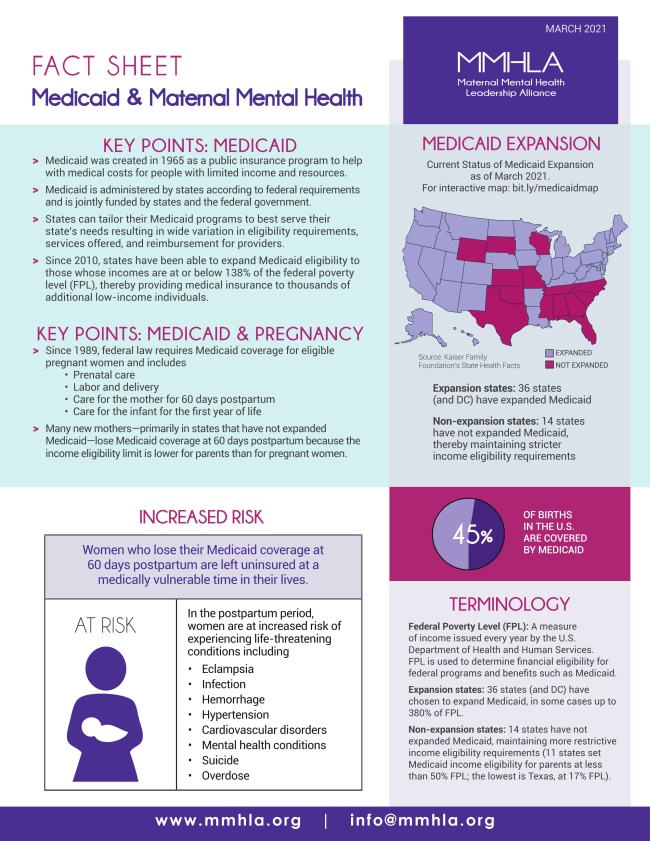
In the postpartum period, women are at increased risk of experiencing life-threatening conditions including
  • Eclampsia
  • Infection
  • Hemorrhage
  • Hypertension
  • Cardiovascular disorders
  • Mental health conditions
Here's MMHLA's NEWEST Fact Sheet: Medicaid & Maternal Mental Health
KEY POINTS ABOUT THE AMERICAN RESCUE PLAN ACT AND MEDICAID EXTENSION
  • States would have a new option to cover women in pregnancy-related Medicaid and CHIP coverage for one year after the end of pregnancy, extending their coverage well beyond the current cutoff of 60 days. 

  • States that opt to extend postpartum coverage must do so for both Medicaid and CHIP (if they cover pregnant women through CHIP). The option will be available to states for five years.

Edwin Park. Georgetown University Health Policy Institute. March 2, 2021.
Why is extending Medicaid coverage for a full year postpartum important in terms of maternal mental health (MMH) ?
  • Women of color are over-represented in Medicaid and disproportionately impacted by MMH: almost 50% of low-income mothers report depressive symptoms, and women of color are only half as likely to receive care for postpartum depression as white women. 

  • The peak incidence of postpartum depression is 3-6 months postpartum and the peak incidence of suicide is 6-9 months postpartum – both well beyond the mandated 60 days of pregnancy-related Medicaid coverage. 

  • The relatively short 60-day window of Medicaid coverage means that many women neither attend a postpartum visit with their obstetric provider nor are screened or treated for MMH following pregnancy.

  • Even if a new mother starts treatment for postpartum depression, Medicaid rarely covers treatment after 60 days.

Gray Babbs, Lois McCloskey, Sarah H Gordon. Health Affairs, January 14, 2021.
Does the American Rescue Plan Act go far enough in supporting new mothers and addressing maternal mental health (MMH)?
  • Some argue that the American Rescue Plan Act does not go far enough because it does not provide states any additional funding beyond their standard Medicaid federal match rate to extend Medicaid coverage for new mothers.

KEY POINTS ABOUT MEDICAID

Medicaid was created in 1965 as a public insurance program to help with medical costs for people with limited income and resources.

Medicaid is administered by states according to federal requirements and is jointly funded by states and the federal government.

States can tailor their Medicaid programs to best serve their states needs, resulting in wide variation in eligibility requirements, services offered, and reimbursement for providers.

Since 2010, states have been able to expand Medicaid eligibility to those whose incomes are at or below 138% of the federal poverty level, thereby providing medical insurance to thousands of additional low-income individuals.
KEY POINTS ABOUT
MEDICAID AND PREGNANCY

Since 1989, federal law requires Medicaid coverage for eligible pregnant women and includes
  • prenatal care
  • labor and delivery
  • care for the mother for 60 days postpartum
  • care for the infant for the first year of life.

Many new mothers – primarily in states that have not expanded Medicaid -- lose Medicaid coverage at 60 days postpartum because the income eligibility limit is lower for parents than for pregnant women.

Women who lose their Medicaid coverage
at 60 days postpartum are left uninsured at a medically-vulnerable time in their lives.
Suicide and overdose combined are the leading cause of death for women in the first year following pregnancy.
"When we started this conversation, I thought that we would want
to tailor something that was most legislatively palatable, but...
I think that we should recommend what's best
for pregnant women, pregnant individuals and their families."

Medicaid and CHIP Payment and Access Commission
Transcript from January 28, 2021 Public Meeting
Working with Policymakers to Address Maternal Mental Health Conditions
MMHLA -- founded in 2018 -- is a nonpartisan 501(c)3 non-profit organization
dedicated to promoting the mental health of childbearing women in the United States
by advocating for universal education, screening, referral, and treatment
of postpartum depression and related maternal mental health (MMH) conditions.

Our vision is that all childbearing women in the United States will be educated about and screened for maternal mental health conditions and have access to resources for recovery.