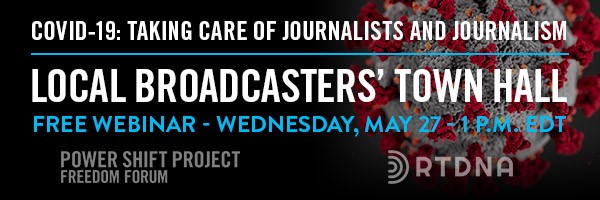
News and information to help journalists serve the public and stay safe.
|
|
Many writers find themselves on deadline with limited time, space and attention during this unprecedented crisis. The National Press Club Journalism Institute and the
National Association of Science Writers
are partnering for a program that will offer tips for creating a writer-friendly physical space, finding your focus, and developing new tools to write in short bursts.
|
|
Seeking an urgent lifeline, the NewsGuild and its President Jon Schleuss are lobbying federal lawmakers for short- and long-term measures designed to shore up and then sustain journalism with public aid. It’s an unusual role for a labor movement in an industry more comfortable holding the government accountable than seeking government’s help.
Schleuss argues the federal government has played a role in bringing independent news to the public since the nation’s founders gave
publishers preferred postal rates
to distribute newspapers.
“The only way I think that you can long-term
replant these news deserts
is by public support in a lot of these communities, because the economics don't work out,” Schleuss said in an interview.
“Short term keeps people from being let go, keeps people on the job, keeps people reporting during this pandemic,” he said. “But long term I think that this pandemic is accelerating the fact that ad supported news is hard, if not impossible, at the local level. So, we have to find a way to do it. Treat it more like our infrastructure, our intellectual infrastructure.”
With its
#SaveTheNews
campaign, the NewsGuild is pushing Congress for direct grants to local newspapers and local online news platforms, a plan that has not gained traction among lawmakers. More popular is another plan by the guild and others in the industry to let larger news organizations apply for Paycheck Protection Program (PPP) loans. Under that proposed plan, which has bipartisan support in the Senate, large news organizations, such as Gannett and McClatchy, would be able to obtain PPP loans for their individual newspapers.
Right now, only news organizations with up to 1,000 employees can obtain the PPP money, thus excluding chains and large television companies.
Long term, the guild is proposing changes in the tax code that would allow newspapers to operate as nonprofit corporations and make it easier for employee cooperatives to operate news outlets. The union also favors public financing of local newspapers, much like the Corporation for Public Broadcasting uses taxpayer money to help support local public television and local public radio stations.
|
|
Advice from
Jill Geisler
, Bill Plante Chair in Leadership & Media Integrity, Loyola University Chicago, Freedom Forum Fellow in Women’s Leadership
|
|
|
Reviewing
financial documents
is a part of a well-rounded self-care routine. But conversations about finances, particularly around mortality,
get complicated and stressful
. Help ease concern about your assets by breaking the work into manageable tasks.
Reviewing beneficiaries can be a way to start and to exercise a sense of control.
- List out accounts (checking and savings accounts; retirement accounts such as IRAs and 401(k)s; life insurance; HSAs; annuities; and so on).
- Review each account to ensure you’ve designated a beneficiary that reflects your current wishes.
- Designate a beneficiary where you haven’t. Keep in mind that, even if accounts are included in an overarching will, financial institutions carry a custodian agreement’s default provision that could control who inherits your funds if you do not name a beneficiary.
- Ensure the information for any individual named is correct and up to date. Consider suffixes (Sr., Jr. and III), legal name changes and other details.
- If you don’t wish to designate an individual, you can designate a nonprofit organization, school, church or other group whose mission you’d like to support.
Estate planning is complex. Your employer, insurance company or a community agency may provide assistance with estate planning at low or no cost.
|
|
This newsletter is written & edited by the National Press Club Journalism Institute staff: Beth Francesco, Holly Butcher Grant, Jim Kuhnhenn, and Julie Moos.
Send us your questions and suggestions
for topics to cover.
|
|
|
|
|
|
|