September 2024 Newsletter | |
Please see our website for more information. For Gmail users, to view entire message, click view entire message at the bottom of this email. | |
Paul Dryfoos, Elders Action Network | |
|
MONTHLY CHAPTER MEETING
TUESDAY, SEPTEMBER 10
Noon - 2 PM On Zoom
Join at 11:45 if you want to socialize.
Zoom link: https://bit.ly/4g4NXMY
Meeting ID: 735 454 252
Passcode: 223189 (You may have to try more than once)
Phone in: 305-224-1968
We'll let you know as soon as we do what the topics will be for this month's chapter meeting. We certainly have lots of questions! Is the Legislature coming back for a special session? What's the status of the climate bill? What can we do in this election cycle? What can't we do?
We will hear from Elders Action Network's Paul Dryfoos on what's happening with the Environmental Voter Project and how your efforts can make a difference in the November election. It's all hands on deck for the next 58 days.
SAVE THE DATE! Our October 8 Chapter Meeting will be in person in Arlington!
Our CHOICES and our VOICES make a difference and WE can change what we do AND what happens.
We look forward to seeing you on Zoom!
YES! We do record our meetings and they’re usually posted on our website within a few days here.
Maiyim Baron
| |
|
DEEP DIALOGUE
MONDAY, SEPTEMBER 23
4 - 5:30 PM On Zoom
Zoom link: https://bit.ly/3XoMOc8
Protect Our Public Watershed Forests as Wildlands Now!
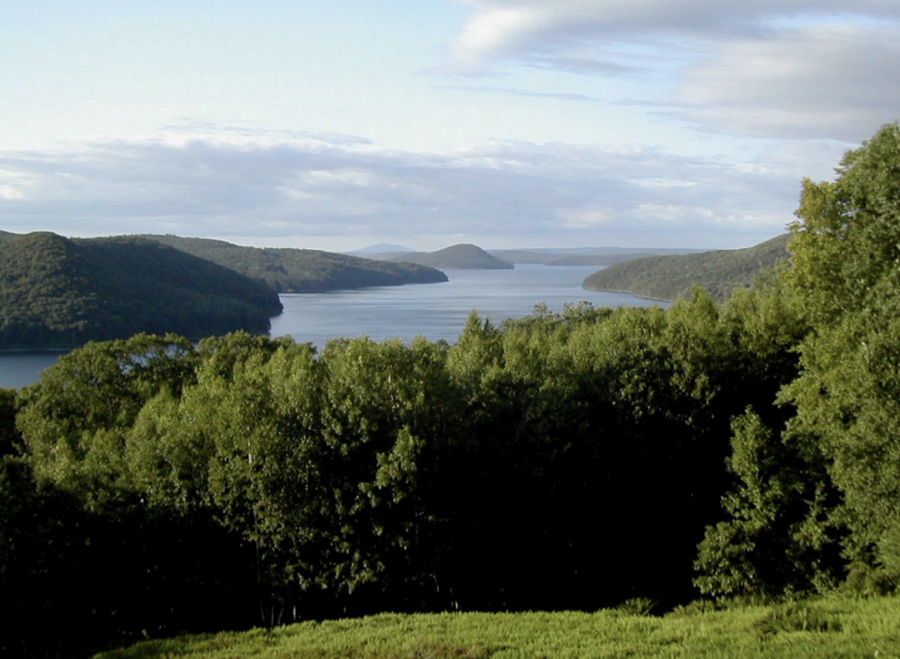
The recent surge in interest and concern about Massachusetts forests focuses on their ability to mitigate the global climate and biodiversity crises. Incredibly, MA state agencies in charge of our public forests continue policies and practices that emphasize active management, i.e. commercial logging. This includes the 130,000 acres of public forest lands in the Quabbin, Ware, and Wachusett watersheds, which supply water for over 40 percent of Massachusetts residents, including over 3 million people in eastern MA. The Division of Water Supply Protection, charged with managing these watersheds, promotes logging in these forests. They claim that this enhances “forest resistance and resilience” against increasing natural disturbances (hurricanes and other climate related events). There is a better alternative that is rooted in current science that challenges these practices - leave forests as wild reserves.
Join us to learn about the Massachusetts Sierra Club’s efforts to return the public forests of the Quabbin, Ware, and Wachusett watersheds to wildlands and how you can support this effort!
This presentation is presented by our Natural Solutions Working Group in cooperation with Sierra Club.
Speakers:
Bill Stubblefield, PhD has had a lifelong interest in ecology and evolution. He has an MA in Biology from the University of California and a PhD in Biology from Harvard University. Over the last few years, he has focused on the potential of natural solutions to the multiple planetary crises we now face, especially the potential of forests to accumulate carbon and preserve biodiversity. Currently, Bill devotes most of his time to climate activism through involvement with multiple environmental groups, including the Sierra Club’s Forest Protection Team, Wendell State Forest Alliance, and he is a founder of the Forest Facts group that analyzes data and reports that drive public policy around forest management from economic, political, social, and ecological perspectives. Bill has been instrumental in forming the MA Sierra Club's campaign to permanently protect the public forests of the Quabbin, Ware, and Wachusett watersheds as wildlands.
Lynne Man, PhD is the Sierra Club Forest Protection Team founder and co-leader. She began the group in 2021 in response to a personal experience of state-sponsored logging in a public forest that she loved. Lynne will explain how and why the team came to develop the Watershed Protection Campaign and how members of the public can support this effort.
| |
|
Do you have range anxiety?
This EV trip went (mostly) smoothly
| |
Buffalo during the tornado. | |
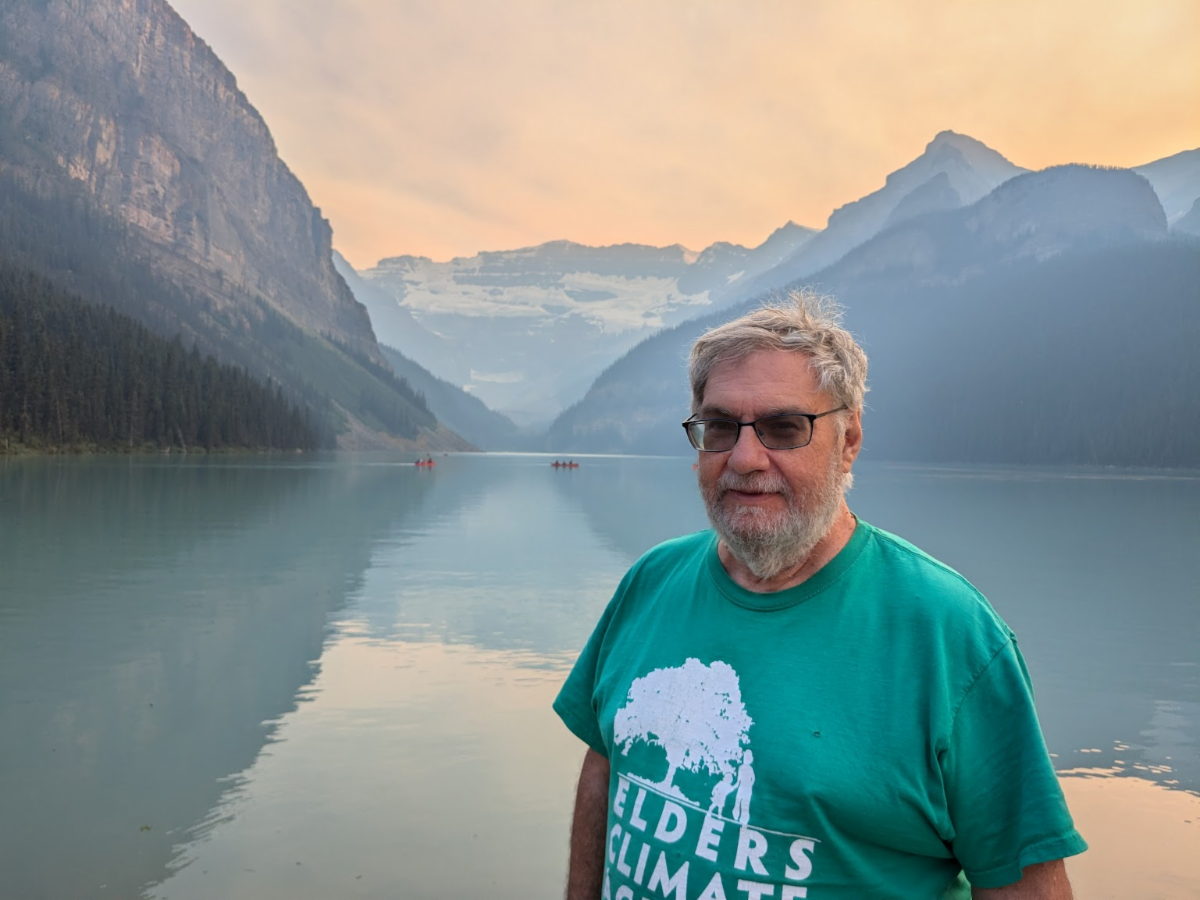
The intrepid traveler,
Paul Reisberg.
| |
|
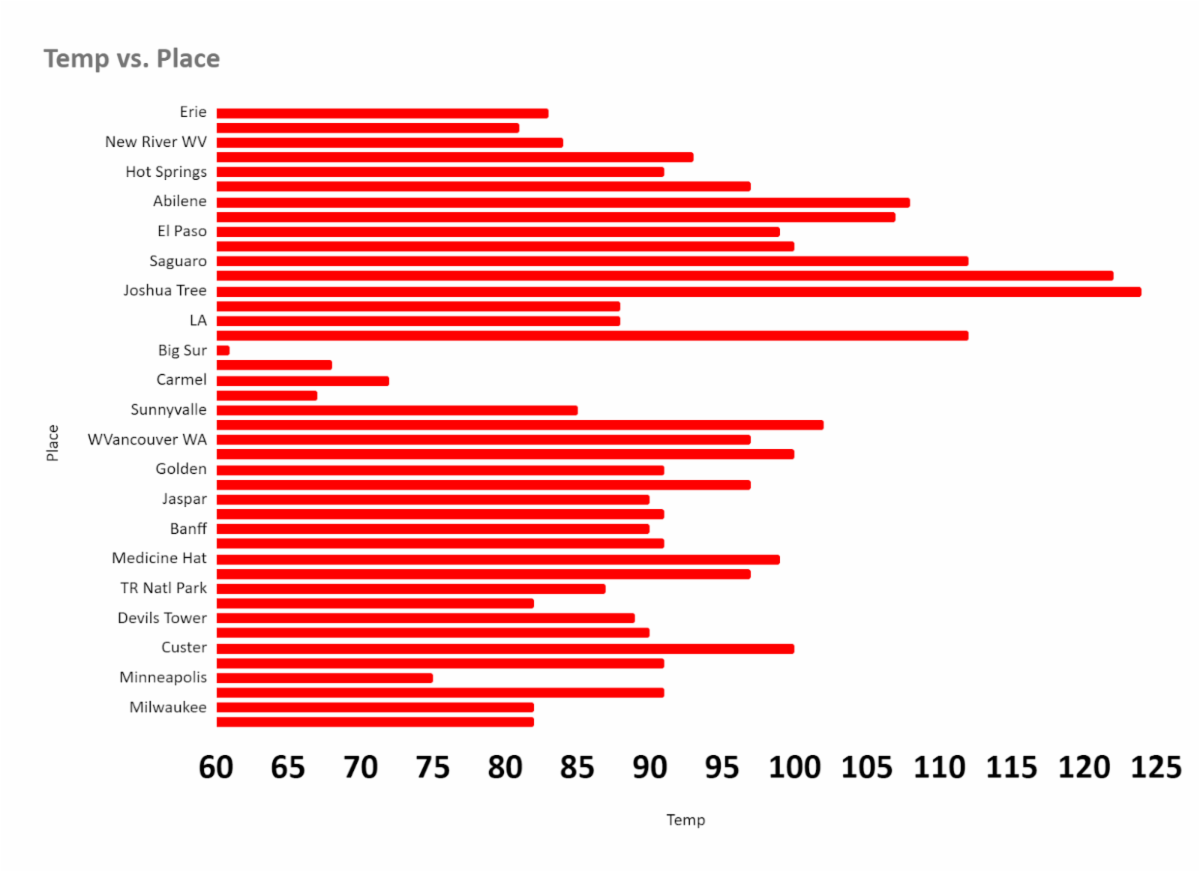
Temperatures during the trip. | |
|
Testing the Limits
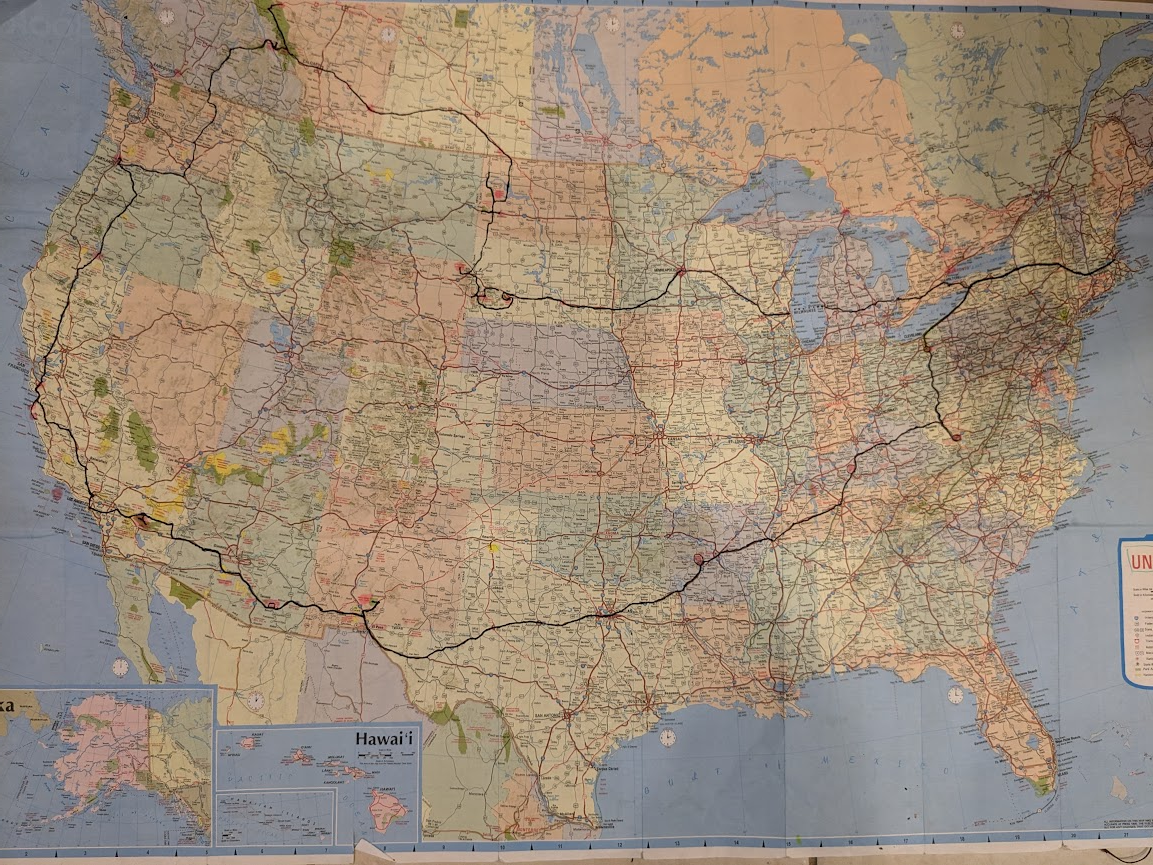
A major issue for many who are considering EV adoption is an anticipation of range anxiety, especially when taking extended trips. Dispelling these concerns was one of my motivations this summer as I tested the limits of my EV with an 11,000 mile trip around the US and Canada. Along the way, I preserved my mental health with stops at 15 previously unseen national parks.
Better Range Matters
Ten years ago, my first EV had a range of 110 miles and I never felt comfortable taking a trip as far as NYC, but now I have a car with a claimed range of over 300 miles. I have taken multiple trips to NY and Maine and have even gone as far as Washington DC without a worry. I was confident I could succeed in visiting my sister in California. There are over 200,000 public chargers in the US and thousands are added each week, but only a tenth are level three rapid chargers and these are not evenly distributed. Around Boston, they are about 5-10 miles apart. but in the charging deserts of West Texas, New Mexico, and North Dakota where I planned to go, they can be over 200 miles apart.
Over the 6 week trip I learned what situations can create anxiety and what can be done to alleviate it. The feeling I would often have is similar to what I had felt using mass transit in a European city for the first time. I know the system is good, but until I experience it, there are many unknowns such as payment methods, ticketing, transfers, and frequency of service which have to be learned.
Everything Impacts Range
The kinds of concerns I would have were around how my range would be affected by large elevation changes, high speed limits, strong headwinds, heavy rains, and extreme temperatures. These had never been a concern on the east coast, but West Virginia is hilly and the Rockies are high and much of the country has 80 mph speed limits. I encountered dust storms, blinding rains, lightning induced wildfires, dust storms, nickel sized hail, gusts of up to 64 mph, onslaughts of tumbleweed by the dozens, towns with power outages and multiple days with temperatures above 120 degrees. Additionally, I narrowly avoided both a tornado and a major fire evacuation of an area ½ the size of Massachusetts.
The Bottom Line
But I made the 11,000 miles without incident and with a sufficient charge every day.
A quick summation of the trip: It's an enormous, beautiful country that is mostly empty, largely on fire, and with lots of extreme weather.
Fires Everywhere
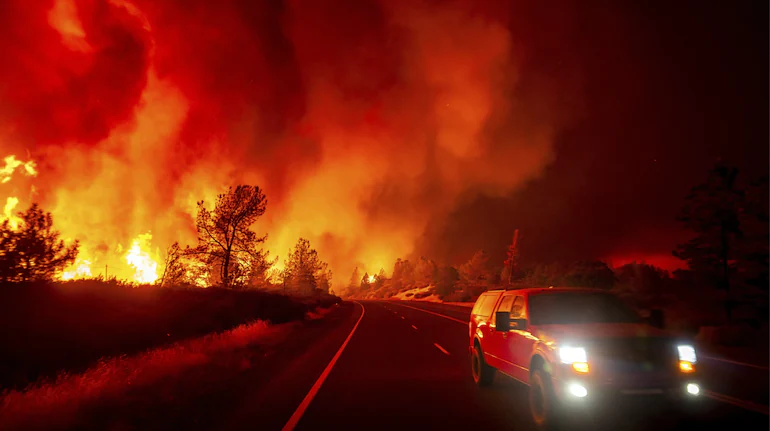
Heading to Joshua Tree National Park I encountered my first fire. I could see the smoke up ahead and called family to guide me as to whether I needed to detour (I did). They guided me to a map of active fires in California of which there were over 70 burning everywhere. In addition to California, Oregon, Washington, British Columbia, Alberta, and Saskatchewan each had scores of active fires requiring me to check apps for possible detours in each state and province.
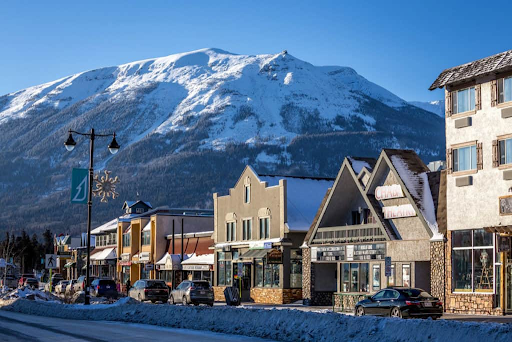
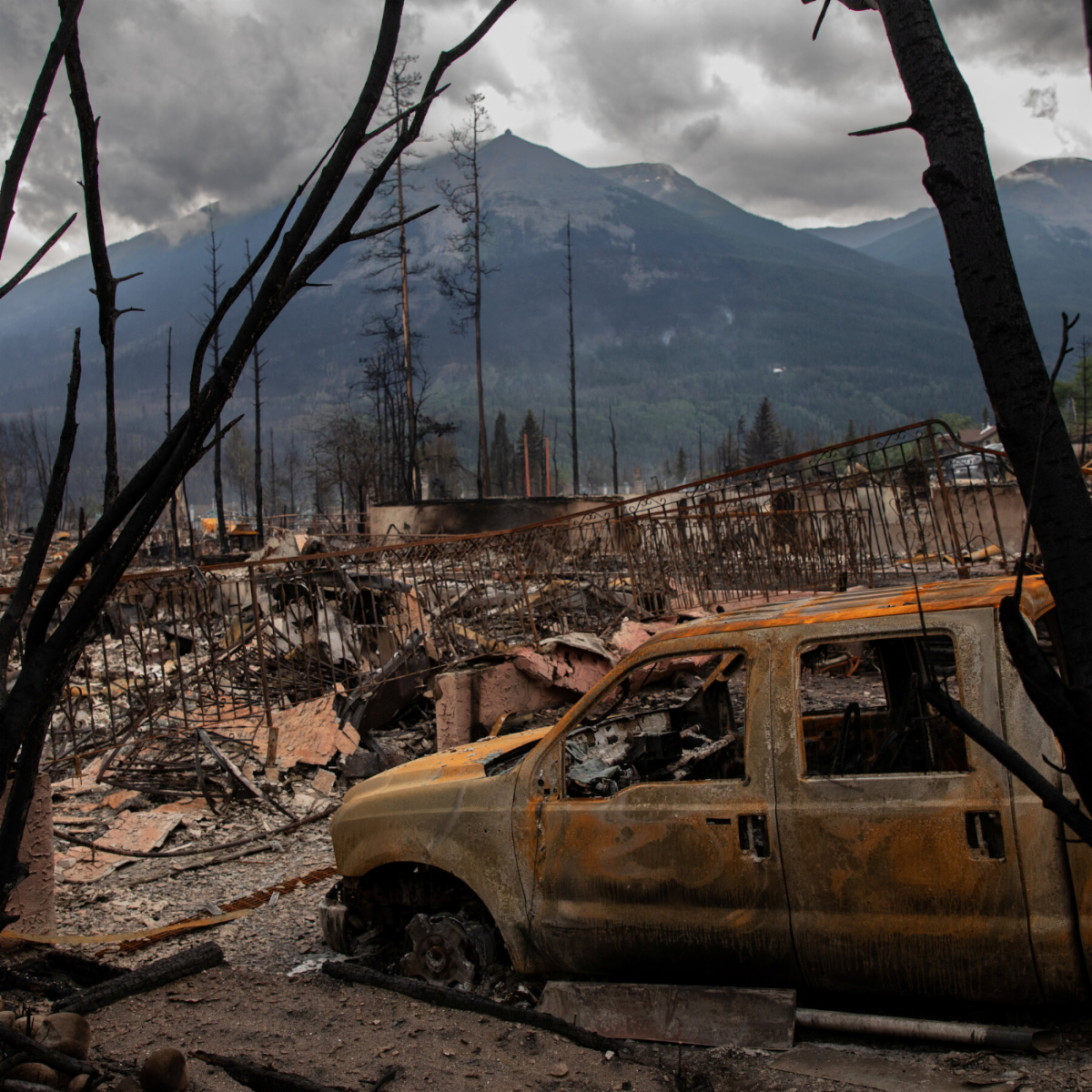
There were fires everywhere and the skies were smokey everywhere. Lovely sunsets, but I never saw a starlit night the entire time. The worst fire was in Jasper National Park. There had been an extant fire closing part of the park and skies were getting increasingly hazy from fires in British Columbia to the west. As I was leaving, heading to Banff, driving the 3½ hours through the park, I encountered a thunderstorm that started multiple uncontrollable fires. These quickly led to an evacuation of both the park and the town of Jasper just 2 hours after I had left it. Over the next few days half the park and the town of Jasper were destroyed.
Extreme Weather
During the trip there were several severe thunderstorms and alerts of damaging hail and possible tornadoes. When I finally arrived at the NY border and there was a storm alert, I thought to myself at least I don’t have to worry about tornados anymore. Well it turned out that a few hours before I entered Buffalo, a tornado had just passed through the city.
You get the point, lots of crazy weather everywhere. In each area of the country, people were aware of climate changes, but it was experienced differently in different locales. Fires, smoke, and upper ninety degree temperatures plagued the Canadian Rockies while Phoenix has had flash floods and recently hit its 101st day in a row with temperatures over 100 degrees. El Paso has its worst drought in 130 years, while Houston is hit with sequential floods and failure of the power grid.
Gaps Between Chargers
Back to range anxiety. It would certainly help if there weren’t gaps of 100-200 miles. Knowing there is charging every 50 miles or so removes almost any concern. When the town I intended to charge in had a power outage in British Columbia it was fortunate that the next town over also had a fast charger.
Impact of Speed on Range
Speed is a big killer of range as drag increases with the square of the velocity. Going the posted limit of 80 has twice the drag of going 55 mph. I got through the North Dakota charging desert without fear by just slowing down. Just as advocates of Slow Food point out its superiority over Fast Food, I found slowing down and not rushing through a place as fast as possible was much more enjoyable and relaxing. Along with stopping every 2-3 hours to charge and chatting with other EV owners and curious bystanders, I was left with more of a feeling of having been at a place than just whizzing through it
What We Need for EV Charging To Work
I’ve concluded that EV charging needs three things to alleviate people's fears.
- Reliability
- Easy to Use
- Easy to Find
Reliability: I only got as far as New Your before I encountered my first broken charger. Public chargers should be licensed and regularly inspected just as gas pumps. It should never enter someone’s mind “what if the charger is broken?”
Easy to Use: All chargers should be tap and pay like a gas pump.
I had over a dozen apps on my phone to deal with the various charging networks. Some require memberships, others registration and passwords, some need a card, others want information like my phone number and birthday. This has to go.
Easy to Find: Eliminate charging deserts. Also there should be a universal map of all existing public chargers. I often found chargers that were not on one listing or another. It shouldn’t be necessary to check multiple sources to find a charger.
In the end, I felt that driving an EV forces a more mindful approach, one that ultimately is more pleasant and present. As with most things, having done it once I feel I could do it again with greater ease and wisdom.
Paul Reisberg
| |
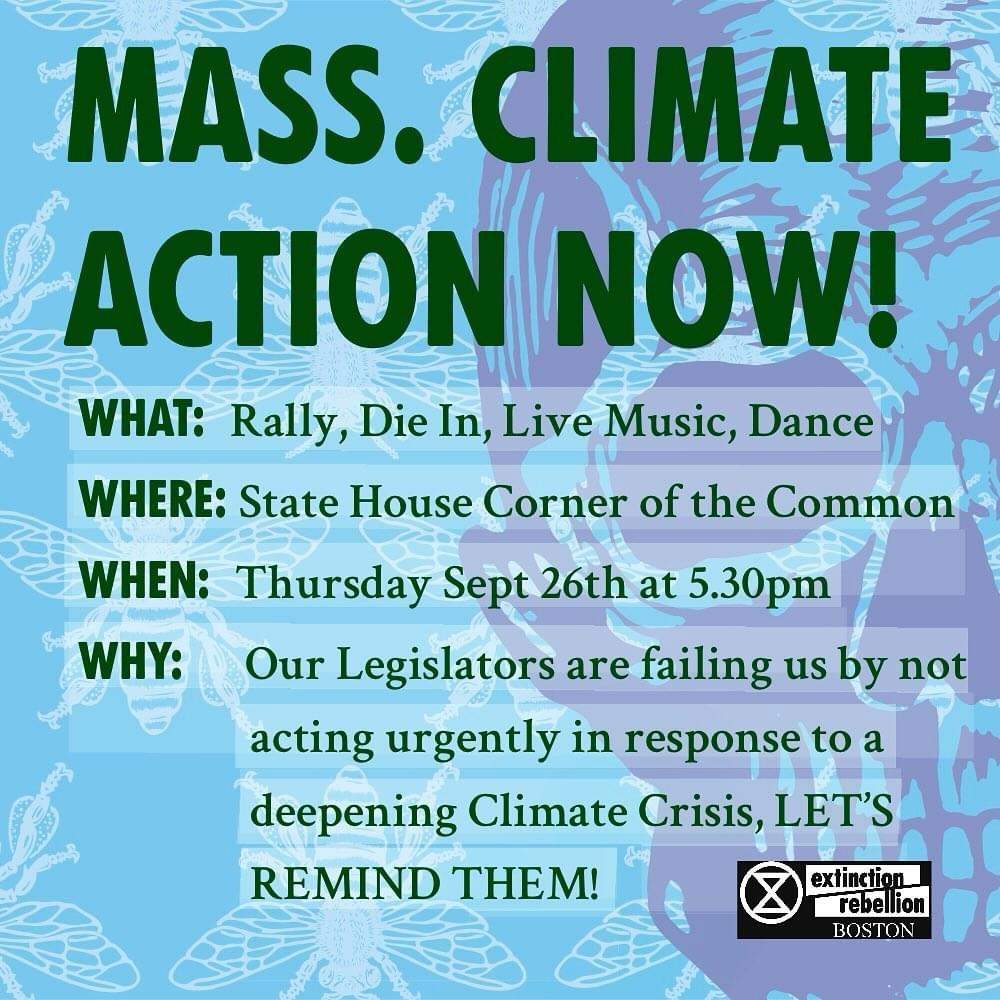
Demand Climate Action NOW! | |
How will you celebrate Climate Week? Partner with your local library! | |
|
Guess what? Climate Week is September 23 - 27 and your local library can help with community activities.
What are you doing in your town for Climate Week this year? Are you working with a local group? Are you engaged with your town library? If not, your library can be a great resource. The Massachusetts State Library system formed a group of librarians and libraries called “Blue Marble,” which is a network of Massachusetts library workers committed to climate change resilience and community building. They are partnering with Communities Responding to Extreme Weather (CREW) based in Boston. (If you are not familiar, the Blue Marble is the first image of the Earth taken by Apollo 17, which generated great awe and reverence for the planet.) CREW is available to discuss ideas for your library.
As an ECA Mass member, this is an amazing opportunity to partner with your local library to educate your community about climate change. Talk to your librarian about what activities they would like to participate in. Some suggestions include:
- Book displays
- Tabling of materials about clean energy incentives
- Activities for children
- Hosting a movie
- Educational presentations either by CREW or other experts
- Walks in the natural landscape
Let us know if you are partnering with your local library for Climate Week!
Tina Grosowsky
| |
No Climate Bill Last Session | |
|
Climate Bill Stalemate on Beacon Hill
Our Legislature ended its formal session with dueling climate bills still sitting in a conference committee, where House and Senate leaders remained deadlocked over gas system reform measures that the Senate leadership is committed to. Those reforms include requirements to consider non-pipeline alternatives to any proposed expansion of the gas system, to prioritize repair of leaky lines over replacement, and to develop a plan for downsizing the gas system.
Key Sticking Point: Gas System Reform
We understand that gas utilities are firmly opposed to some or all of these measures, while Senate leadership, including Senator Barrett, are insisting that gas system reform be part of the bill. Both the House and Senate have agreed that reforms to expedite siting and permitting of energy infrastructure are urgently needed and they mostly see eye to eye on what those reforms should look like. However, without agreement on gas system reform, the Senate leaders so far have been unwilling to support a bill on siting and permitting. So all elements of the Senate and House climate bills are gathering dust in the climate bill conference committee.
We hear that the conference committee may still be meeting, so perhaps there is some hope we will get a siting and permitting bill this session with some gas system provisions. If the conference committee released a bill, it could be voted on in informal session or during the special formal session that Governor Healey is calling for to act on the economic development bond bill.
Broad Climate Bill May Have to Wait
While we are supporting our allies’ call for all the measures in the Senate climate bill to be enacted, we think that siting and permitting are top priorities and that the many other elements in the Senate bill addressing decarbonization of buildings and transportation, consumer protection, and other matters (see a full list here) will likely have to wait until next session to be passed.
It is not clear how a siting and permitting bill with key gas reforms can be put together this session, but we are exploring all possible means to get at least this much of the climate bill to the Governor’s desk this fall. Stay tuned for updates and calls to support our advocacy efforts.
If you would like to learn more about what the Legislative Team is doing, or offer some of your time and talents to our effort, contact Roger Luckmann (roger.luckmann@umassmed.edu) or Tina Grosowsky (tgrosowsky@gmail.com).
Roger Luckmann
| |
 | |
During this all-important election season, ECA is continuing its strong partnerships with the Environmental Voter Project (EVP) and Elders for Sound Democracy (ESD) to encourage millions of underrepresented voters to vote and have their votes counted.
To promote this partnership, Paul Dryfoos, the Director of Elders for Sound Democracy, will be a featured guest at the next ECA Mass Chapter meeting on September 10. (ESD is also a part of Elders Action Network, the parent organization of Elders Climate Action.)
EVP, a national nonpartisan nonprofit based in Boston, identifies millions of non-voting environmentalists and turns them into consistent voters through their phone and text banking efforts. Since ECA is a 501(c)((3) organization, our efforts to turn out voters can’t be partisan, so our partnership with EVP is entirely appropriate.
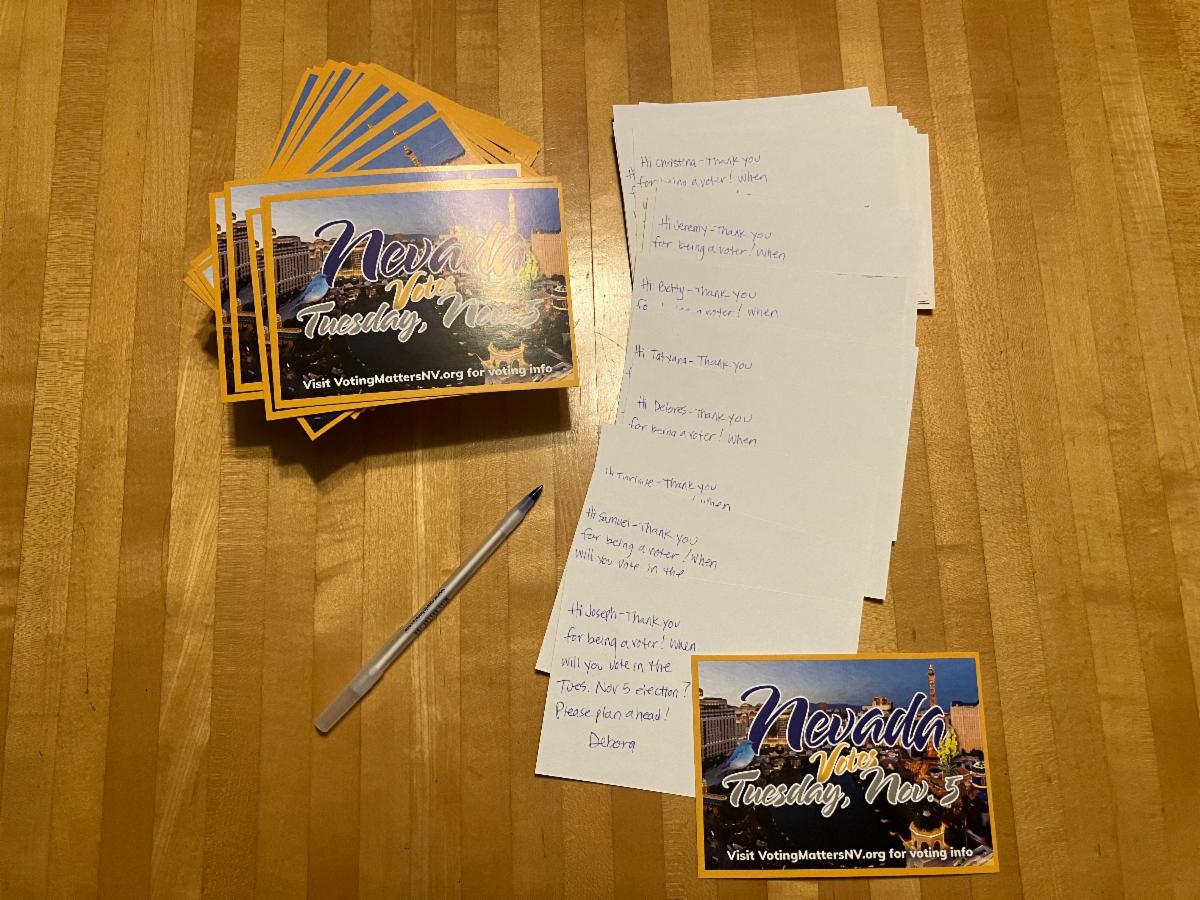
Many elders find phone banking, which is the primary method used by EVP, to be stressful or discouraging. If you haven’t phone banked recently, we can assure you that the technology has improved and the sessions can be fun! For those uncomfortable making calls, though, postcarding has been a way to help out. Many studies have shown postcarding to be a very effective way of turning out voters, increasing turnout by over 1 percent in some instances. That 1 percent as we know, can spell the difference between victory and loss in swing states in November. ECA Mass members have already written or committed to writing over 2,000 postcards through EVP this fall.
Interested in helping out? Contact Seth Evans to learn about upcoming postcarding opportunities near you!
Or, you can donate by check to Environmental Voter Project, PO Box 962002, Boston, MA 02196, or by credit card here.
Seth Evans
| |
ECA is all in for Get Out the Vote | |
|
What's at Stake this Election
We are at an important crossroads in the story of our United States of America. We are facing an election between a progressive woman with tremendous governing experience who champions reproductive rights and sound democracy, and a man who has avowed to take power by mob violence if necessary. The choice is clear, and we believe that if we let voters vote, they will do the right thing.
One alternative stands for further attacks on reproductive healthcare freedom, demonization of people of color, LGBTQ people and other “out groups,” and the dismantling of a functioning electoral democracy. The other alternative stands for a return to the Roe v. Wade standard of reproductive freedom, protection of the environment, common-sense gun safety policies, and fiscal policies more friendly to working families and less so to billionaires who are taxed at a lower rate than the people who clean their yachts.
According to polling and off-cycle election results, voters decisively support free elections, reproductive freedom, gender tolerance and respect, common sense gun safety measures, and environmental protection.
ECA is Helping to Get Out the Vote
Elders Climate Action and its parent organization Elders Action Network are all in on Get Out the Vote (GOTV). We have been active in voter empowerment for seven years and have learned a thing or two - work with populations and regions that have been most affected by voter suppression, use proven methods, and work with strong partners.
Here’s what we are doing:
- State GOTV teams in AZ, GA, FL, NV, PA and WI
- Environmental voter partnership with Environmental Voter Project
- Southern Black voter outreach with Center for Common Ground
- Young voter registration with the Civics Centers
We are postcarding, letter writing, phone banking, relational organizing (social media, friends and family outreach), canvassing, and tabling where possible. Many activities can be done across state lines, and we encourage Massachusetts activists to engage with one of our voter outreach campaigns.
What happens in the next seven weeks will be crucial to the survival of our democracy. The EAN board and ECA leadership have asked that we all do something to help empower voters, and that we do it now. Please send an email to pauld@eldersclimateaction.org for more information or to get connected with an active GOTV campaign.
Please join our national community of democracy activists at a GOTV town hall featuring Andrea Miller, founder and executive director of the Center for Common Ground, and an expert on the legacy of exclusion that still hampers the civic participation of Black People across the Southern U.S., and what we can do about it. Wednesday September 18th at 1 PM Eastern. Register in advance for this meeting.
One of our favorite quotes is from Helen Keller: “Alone we can do so little. Together we can do so much.” Please come together with friends, family, colleagues and our entire EAN/ECA network to make a strong impact in assisting the vulnerable voters who will determine the outcome of this election.
Paul Dryfoos
| |
Green Jobs are Good Jobs Event | |
|
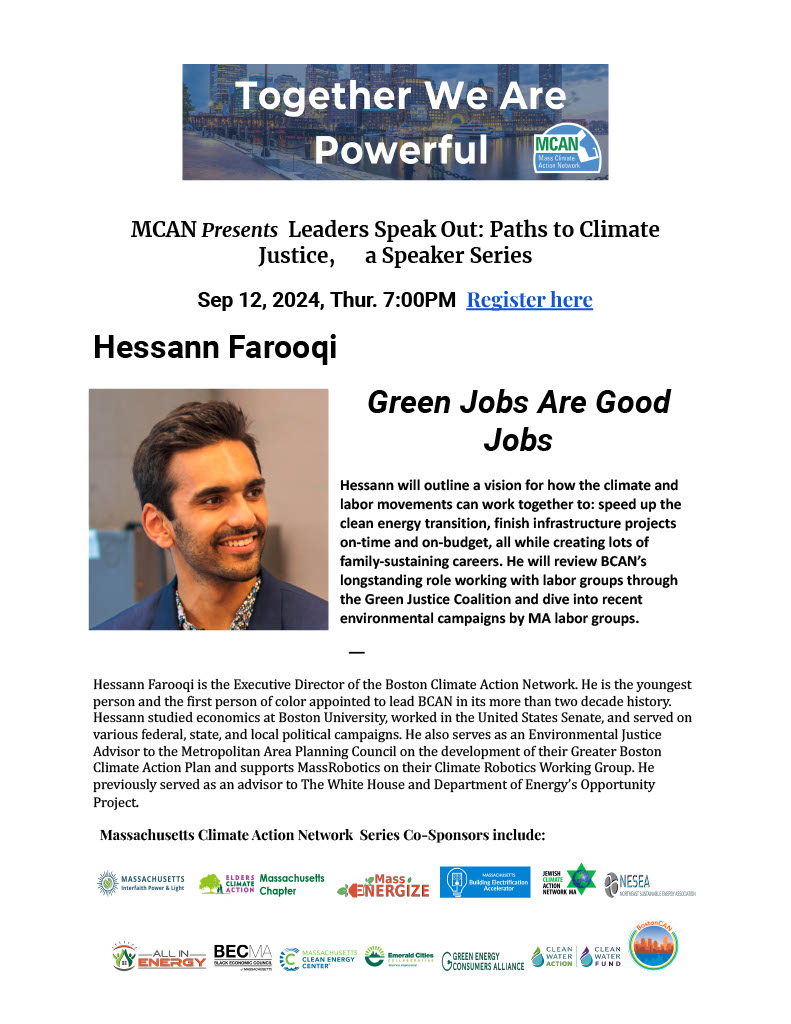
Join us for this ECA Mass-sponsored series starting
Thursday, September 12 at 7 PM.
| |
|
ECA Mass is looking for help with some specific roles. Are you in?
Publicity/Events Coordinator: Do you have experience doing publicity for events and creating engaging media? ECA needs your help to get more publicity for our events. Put your experience and expertise to good use to forward our cause!
New Member Outreach: Do you love connecting with people? Our Membership Team needs help with small finite tasks like calling new members to encourage them to become more involved. This role can be as big - or as little - as you want.
Respond to MaiyimBaron@gmail.com for both opportunities.
Maiyim Baron
| |
|
In August, John and Sarah Micklejohn hosted a lovely luncheon at their beautiful 1800s farmhouse in Granville. Guests included Barbara Baatz, Sylvia Staub, Steve Zimmerman, Seth Evans, and myself. Visited by hummingbirds, we were treated to a walk around the large property with a chestnut orchard. Over lunch, the conversation included how individuals were interested in contributing to climate change education. We also discussed what else ECA Mass could be doing as an organization. John Micklejohn has been successful in engaging with his local regional group of libraries and we talked more about how libraries could be hubs of climate education.
Thank you John and Sarah for hosting us!
Tina Grosowsky
| |
Clean Energy Battle in Hudson | |
 | |
Frustrating History
In Hudson, ECA Mass members have been unsuccessfully engaged in conversation with the investor-owned National Toll Brothers Builders on adoption of clean energy in new construction. In 2021, Toll Brothers began constructing a new 64 unit development (for those over 55) in Hudson named “Enclave.” The units were selling for $800,000. At the time, a couple of ECA Members who are also members of Green Hudson (a community environment and climate group) had a meeting with the Toll Brothers Northeast VP Dave Bauer and project manager David Nichols about the possibility of offering an electric option for the houses. The development was planned with gas for heating. Although the Toll Brothers were offering solar panels and EV charging, there was no option for electric heat pumps. At the conclusion of the meeting, they suggested that in a few years on a future development an electric option would be feasible.
Fast Forward to Today
In 2024,Toll Brothers took over the development of another property named “Lakemont” in Hudson on Lake Boon with homes for sale at $1.5 million. This is a smaller 24 unit development (another over 55 community) which is also being built with propane gas. Once again, Green Hudson/ECA Mass members had a conversation with the Toll Brother Community Liaison David Buckley who said an electric option was not feasible at Lakemont, even though Toll Brothers had suggested in 2021 it was possible.
Making Some Noise!
Now ECAMass/Green Hudson members have started a campaign to educate the public about this issue. The local paper The Community Advocate published this article about the effort to promote clean energy at Lakemont.
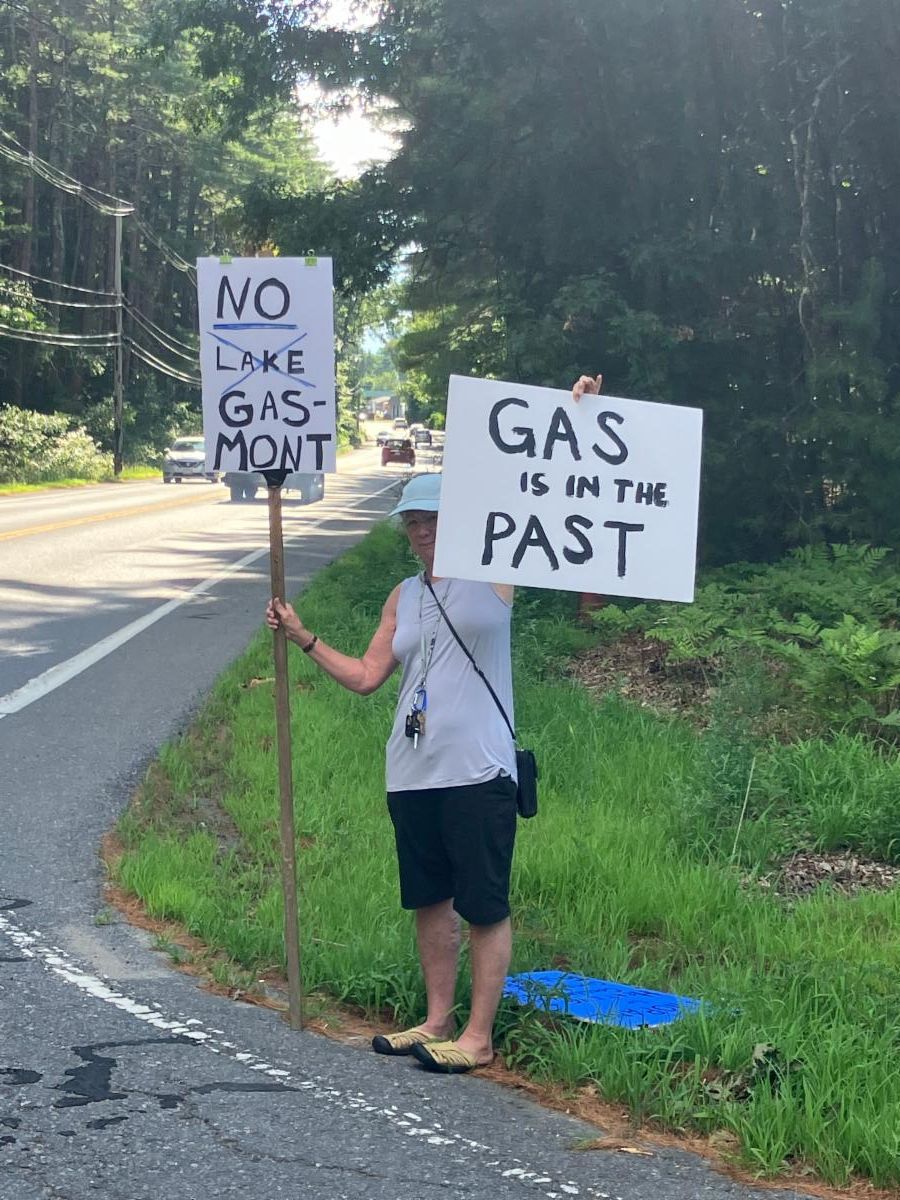
In addition, these members are picketing once a week in front of the property along a busy street with signs urging an electric option and no propane gas. The members have also been engaged in a social media campaign on the Toll Brothers Facebook & Instagram pages.
Tina Grosowsky
| |
|
Celebrate 10 Years of Climate Dedication!
Our parent organization, Elders Climate Action, turns 10 this fall. Not coincidentally, so does our Massachusetts chapter, which was the very first statewide chapter created by the organization. Grady McGonagill, the founder of the ECA Mass chapter had been part of the earliest planning discussions. Learn more about our origins, our achievements, and our prospects at the September 17th Virtual Gala!
Mark Your Calendar!
Everyone’s invited to ECA’s 10th Anniversary Virtual Gala: Leading Into the Future.
Join with more than 26,000 ECA volunteers and supporters fighting the climate crisis to mark this momentous occasion with a 90-minute joy-filled celebration of who we are, how we got here, and all we have accomplished together. Have fun, win prizes, and find out what’s happening now. Host a watch party in your home, or cozy up in your PJs with your favorite beverage, but be there to celebrate on September 17th, 7–8:30 PM (ET).
Register here.
Learn more about the event here.
Seth Evans
| |
|
We send announcements of our meetings and Action Alerts to eca-mass@googlegroups.com, which includes all those on our active list.
Please contact Dawn Edell if you want to confirm you are on our active list.
Maiyim Baron
| |
Did you miss a past meeting? | |
Did you miss an ECA Mass chapter meeting or deep dialogue? Or do you want to share one with friends and family?
We have you covered! Videos of past chapter meetings are here and videos of past deep dialogues are here.
| |
WHAT ARE YOU READING?
Would you like to review a book for our newsletter?
| | |
|
|
Join over 1300 ECA Mass members who have been following us on Facebook. Our Facebook page features listings of upcoming events (in-person and Zoom), news about climate change solutions, carbon saving ideas, and links to other organizations’ events, and more.
Visit the ECA Mass Facebook page and click the like button!
| |
|
This Newsletter is Published for Members and Friends of
Elders Climate Action - Massachusetts Chapter
ECA Massachusetts is a chapter of the national Elders Climate Action. We are a movement of elders committed to making our voices heard to change our nation's policies while there is still time to avoid catastrophic changes in the Earth's climate. Visit the ECA Massachusetts website, event calendar, and Facebook page to learn more about our chapter's activities and climate news. JOIN ECA MASSACHUSETTS AND STAY CONNECTED! Subscribe to our monthly newsletter, and for more active participation, sign up to receive Action Alerts and meeting announcements. Fill out our subscription form.
| | | | |