Your Requirements Are Our Standard | | This month's focus: Why Temperature Matters | |
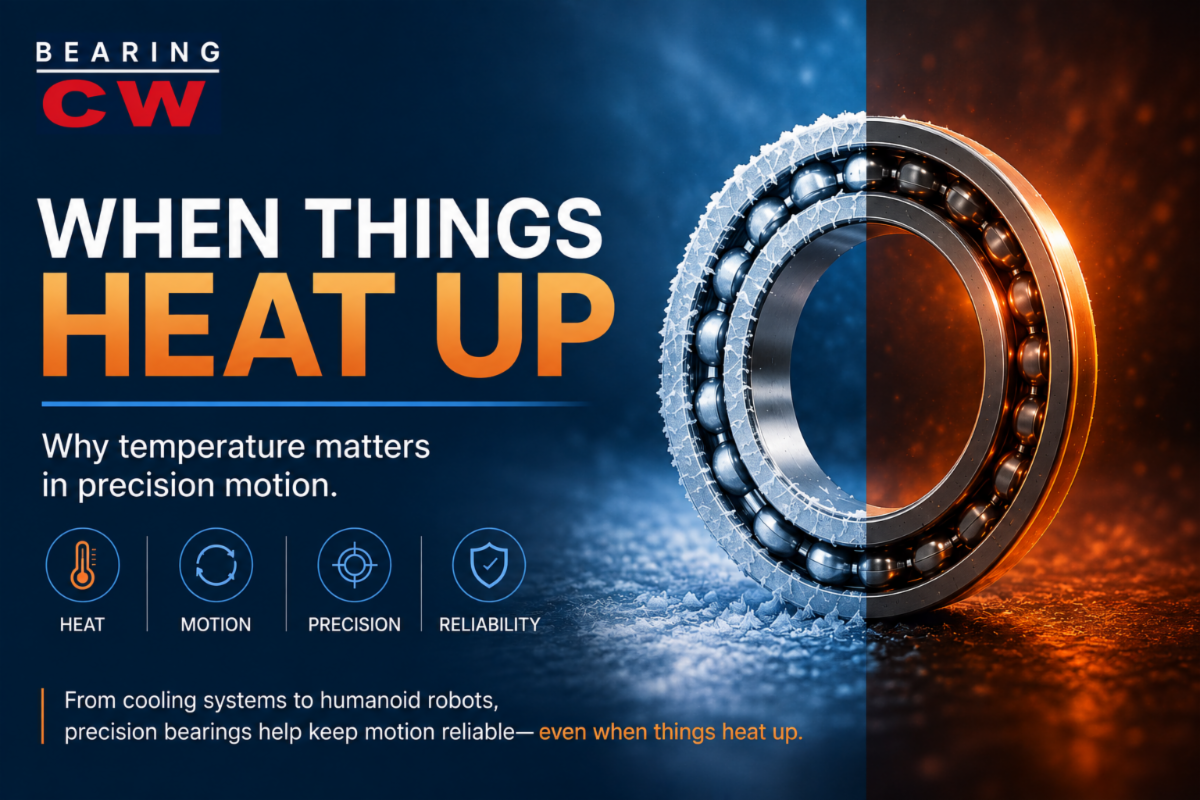
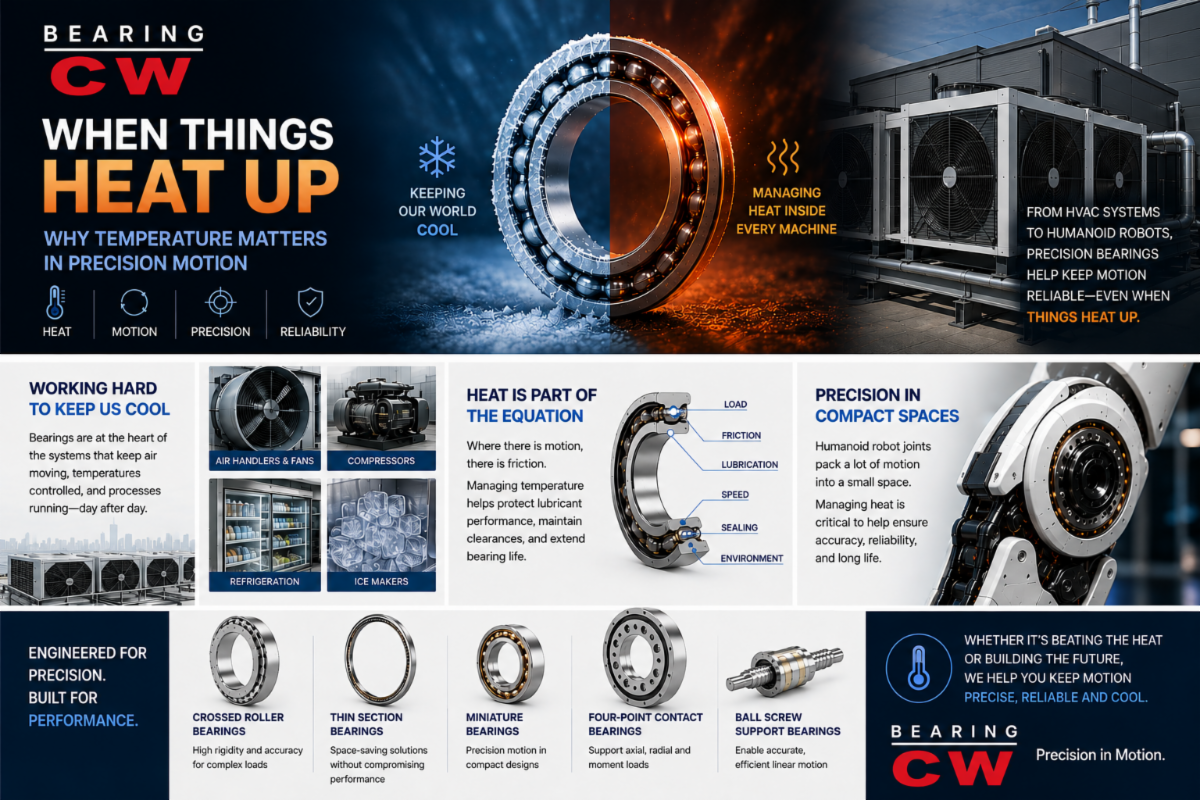
When Things Heat Up
(Why Temperature Matters in Precision Motion)
It’s hot out there.
Across much of the country, air conditioners are working overtime, refrigerators are working harder, and ice makers may be among the most appreciated machines in the building.
Behind many of the systems helping us beat the heat are components most people never think about: Bearings.
Bearings support the motors, fans, blowers, pumps, compressors and other rotating equipment that keep air and fluids moving. But while these machines are working to keep us cool, their bearings face a thermal challenge of their own.
And that challenge extends far beyond HVAC and refrigeration.
|
🌡️Heat is Part of the Motion Equation
Even in rolling-element bearings designed to minimize friction, some friction, and therefore heat generation, is unavoidable.
In a rolling bearing, operating temperature is influenced by more than ambient conditions.
Load, speed, preload or internal clearance, lubricant type and quantity, seal friction, alignment and heat generated by adjacent components can all contribute to the bearing's thermal operating condition.
That matters because temperature changes the system.
As bearing temperature increases, the rings, rolling elements, shaft and housing expand.
Because those components do not necessarily expand at the same rate, or experience the same temperature, the bearing's operating clearance or preload can change.
In a precision application, that change can affect friction, stiffness, running accuracy and ultimately bearing life.
Lubrication adds another variable. Grease and oil viscosity decrease as temperature rises. If lubricant viscosity becomes too low for the operating speed, load and contact conditions, the lubricant film separating the rolling surfaces can become insufficient, increasing the risk of wear and surface damage.
But more lubrication isn't automatically better.
In grease-lubricated bearings, excessive grease fill can increase churning and drag, generating additional heat; the very condition the designer is trying to control.
Temperature isn't simply something happening to the bearing. It can change how the bearing operates.
Bearing design is a balancing act.
|
⚙️The Bearings Keeping Us Cool
On a hot August afternoon, bearing-supported equipment is operating all around us.
Air-handling systems use motors and blowers to circulate conditioned air through buildings. Fans move enormous volumes of air through industrial facilities. Pumps circulate cooling fluids. Refrigeration and compressor systems keep food, beverages and manufacturing processes at controlled temperatures.
Even the refrigerator and ice maker in the break room depend on small motors and rotating components doing their jobs reliably.
These applications vary enormously in size and operating conditions, but they share an important requirement:
Reliable motion, hour after hour.
And increasingly, another rapidly growing technology faces its own version of the same challenge.
|
🌍 Speed Changes the Conversation
Higher rotational speed can increase frictional heat generation, making bearing geometry, cage design, lubrication and sealing increasingly important.
A contact seal, for example, can provide valuable protection against contamination, but contact between the seal lip and rotating ring also generates friction. In an application where contamination protection is critical, that tradeoff may be entirely appropriate. In a high-speed precision application, however, the designer may need to evaluate whether a shield, non-contact seal or another sealing approach provides a better balance.
The same principle applies to lubricant selection and fill quantity.
There is rarely a single characteristic called “the best bearing.” Bearing design is a series of engineering tradeoffs based on what the application actually requires.
| |
"Temperature isn't simply something happening to the bearing.
It can change how the bearing operates."
|
🔄 Now Put All That Inside a Robot
Humanoid robots make the thermal problem particularly interesting because multiple heat-generating components can occupy the same compact joint.
A joint may combine an electric motor, reducer or transmission, bearings, encoder, braking components and electronics within a tightly constrained envelope. Heat generated by one component doesn't remain neatly isolated from the others.
At the same time, the bearing system may be asked to provide high rigidity, low friction and precise rotational accuracy while supporting radial, axial and moment loads.
For a robotic joint, engineers therefore aren't selecting a bearing based on load capacity alone.
They may also need to consider:
- Stiffness.
- Preload.
- Starting and running torque.
- Speed.
- Lubrication.
- Sealing.
- Packaging.
- Accuracy.
- Duty cycle.
- And temperature.
Those variables interact.
Increasing preload, for example, can increase system rigidity—but excessive preload can also increase friction and heat generation. Increasing sealing effectiveness may improve contamination resistance—but may also increase torque. Reducing package size saves valuable space—but concentrates components and can make thermal management more difficult.
That's where bearing selection becomes system engineering.
| |
WHAT CAN RAISE BEARING OPERATING TEMPERATURE?
Speed • Load • Preload • Lubricant selection • Lubricant quantity •
Seal friction • Misalignment • Adjacent heat sources • Ambient temperature
|
🏭 Smaller Doesn't Mean Simpler
This challenge isn't unique to robotics.
As equipment becomes smaller, faster and more powerful, engineers are continually being asked to achieve more performance in less space.
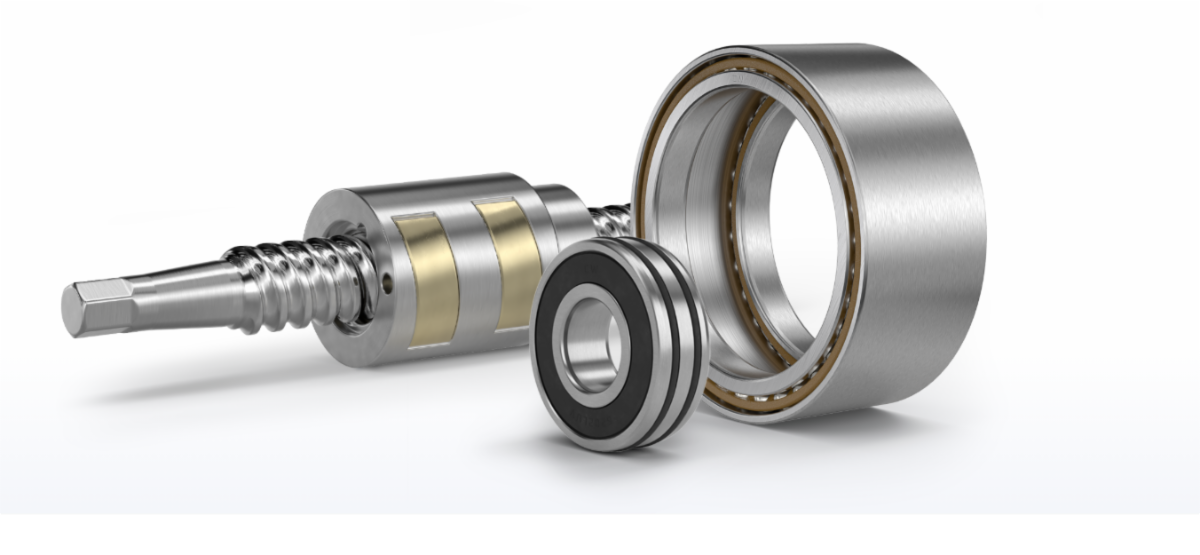
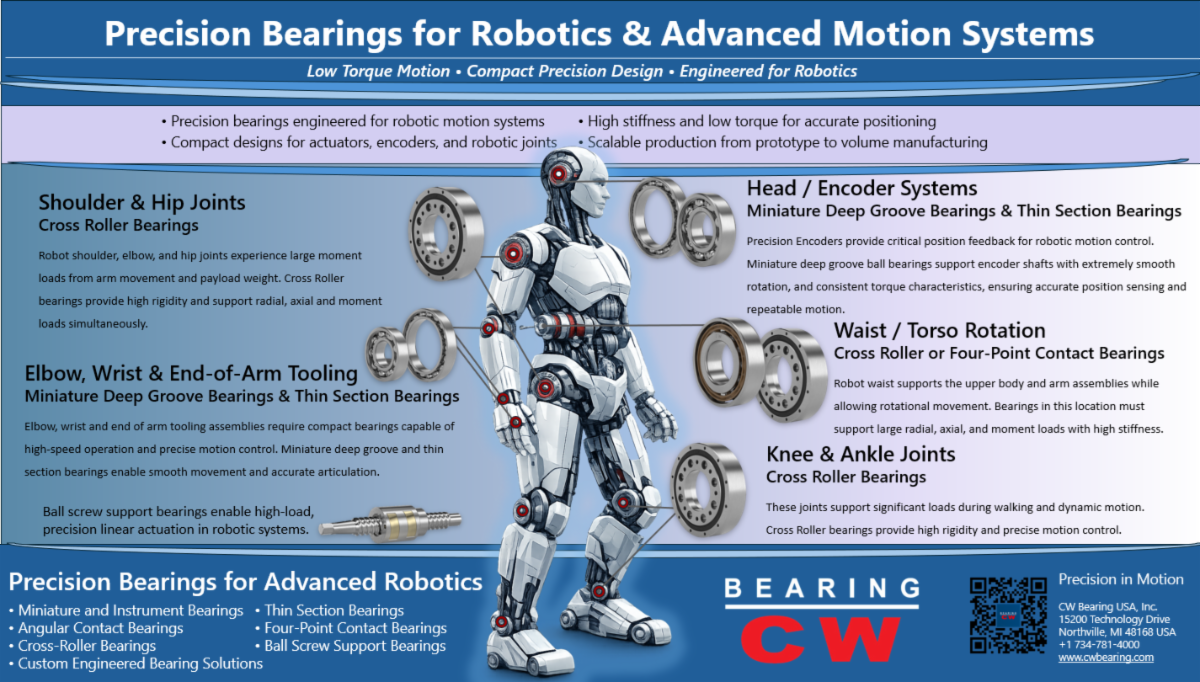
Miniature bearings may operate inside precision encoders. Thin-section bearings can help reduce packaging space. Crossed roller and four-point contact bearings can support complex loading conditions in compact assemblies. Ball screw support bearings help enable accurate linear motion.
The bearing itself may be a relatively small component, but its interaction with the surrounding system can have a significant impact on performance.
That's why successful bearing selection begins with understanding the application, not simply choosing a part number from a catalog.
🏁 Managing Heat is Part of the Design
Whether it's an air handler running through the hottest afternoon of the year or a compact joint controlling the movement of a humanoid robot, temperature isn't an isolated specification. It interacts with speed, load, lubrication, clearance, preload, sealing and the surrounding components.
Understanding those relationships is part of designing reliable motion.
So the next time you walk into an air-conditioned building on a 95-degree afternoon, you might want to appreciate the machinery quietly working behind the scenes.
Somewhere inside, a lot of very hardworking bearings are having a much hotter day than you are.
Precision in Motion.
Wondering which variables matter most in your application? Our engineering team can help evaluate how load, speed, temperature, lubrication, and other operating conditions influence bearing selection.
| | "Keeping things cool is easy to appreciate. The engineering that makes it possible is easier to overlook." CW Bearing | |
|
Failure doesn’t always come from design.
It often comes from what happens next.
| | |
Video: 5 Hidden Causes of Bearing Failure
Even in well-designed systems, bearing failures are often caused by factors that aren’t visible in the design itself. This short video highlights five common issues that can impact performance and reliability before the system ever reaches full operation.
🤖 Explore CW Bearing Application Engineering
▶️ Watch the Video
| | |
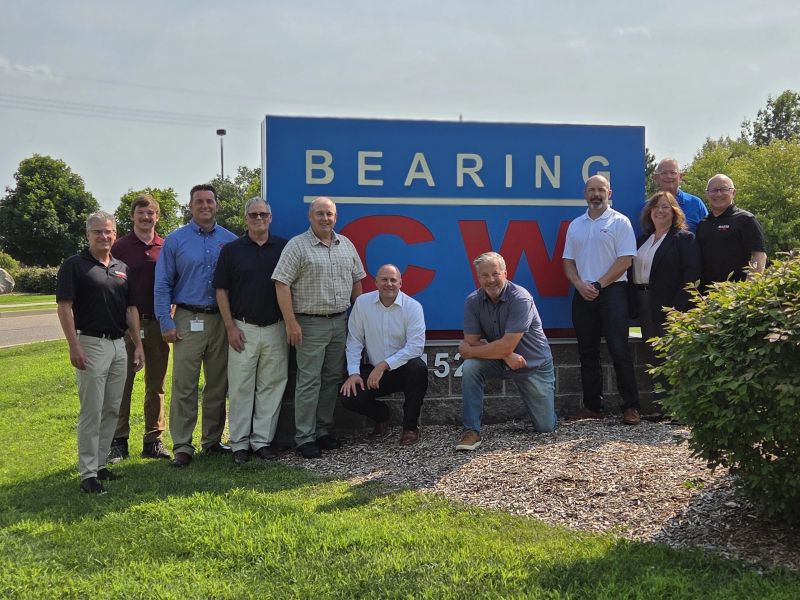
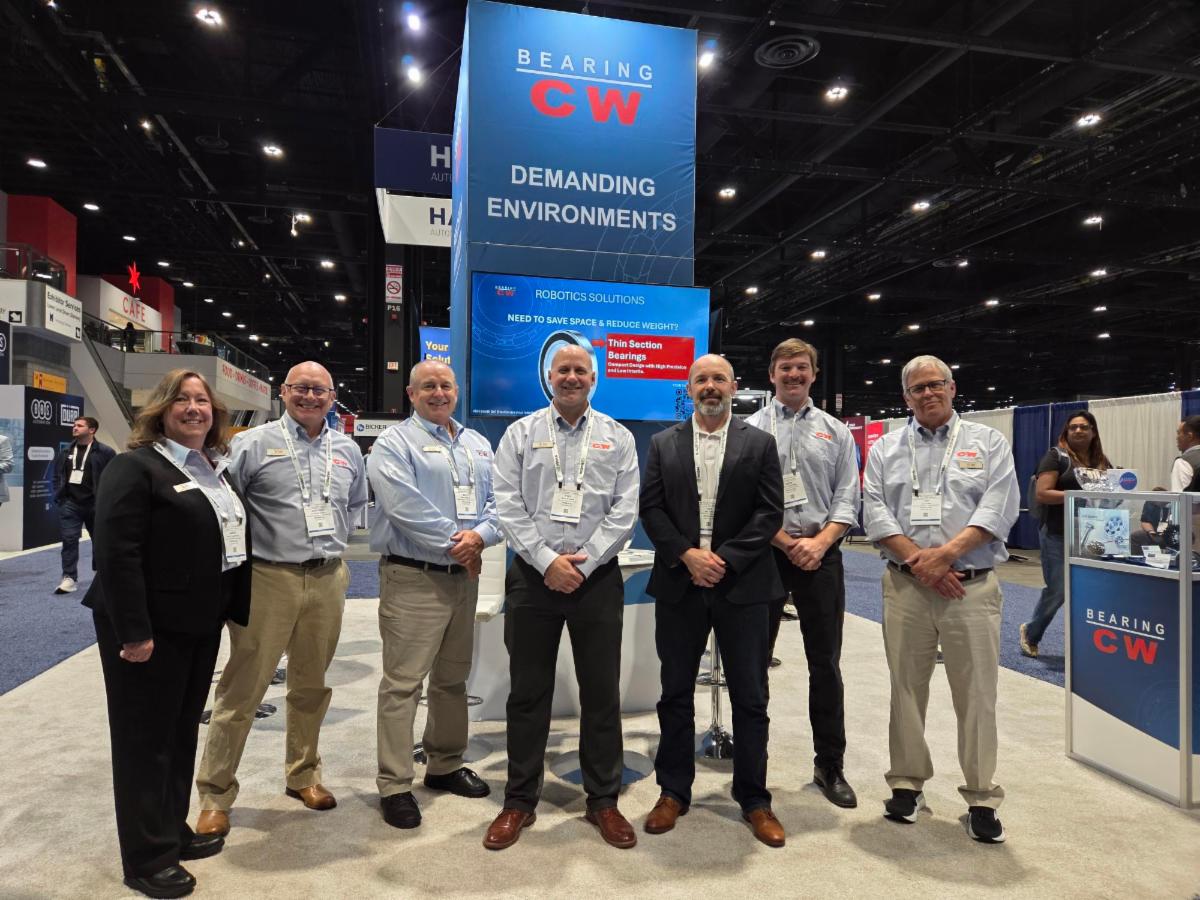
Your North America Sales Team
Left to right: Chris Keelean, Devin Hotchkiss, Greg Sturm, Joe Huffer, Mark Watson, Kyle Weyers, Marty Emery, Jay Click, Nancy Cogliandro, David Shephard, Jonathan Snyder
Not shown: Rodolfo Gomez, Rodney Hodge, Yuting Li. Photograph by David Smith
| | |
Visit us at RoboBusiness.
October 20 - 21 | Santa Clara, CA
Santa Clara Convention Center
Mark your calendars for RoboBusiness
find us at Booth 519!
| |
Schedule a Meeting with us at SEMICON WEST.
October 13-15 | Moscone Center | San Francisco, CA
Sales@CWBearing.com
Mark your calendars for Semicon West!
| | Explore CW Bearing's global capabilities and momentum. | | |
Visit CW Bearing at RoboBusiness
Booth 519 | Santa Clara
Talk with our team about your robotics projects, explore bearing solutions, and grab some swag.
| |  | |
Engineered to Work
CW Bearings are designed with the entire program in mind. Because someone is relying on what happens next.
| | | | | |