|
“Play is often talked about as if it were a relief from serious learning. But for children, play IS serious learning. Play is really the work of childhood.” ~ Fred Rogers
Welcome to the nature & play newsletter, which offers actionable ideas, resources, and research that support child-led play and nature connection for educators and families in ELRCs 8, 9, and 10.
| | |
Plan Ahead at Your Program for These Upcoming Days of Play!
| | | | | |
World Play Day, Thursday, May 28
Created by the International Toy Library Association (ITLA) and recognized to promote the importance of play for children and adults.
| | | | | |
International Day of Play, Thursday, June 11
Proclaimed by the UN General Assembly to champion, preserve, and prioritize play as a fundamental right for children to thrive. It aims to raise awareness among adults and decision-makers, encouraging them to invest in safe and accessible play spaces.
| | | | | |
International Mud Day, Monday, June 29
Encourages children and adults worldwide to connect with nature by playing in the mud. Started in 2009 by the World Forum Foundation to foster environmental appreciation and sensory play, it promotes getting messy through activities like making mud pies, painting, and sliding.
| | | Spring Outdoor Play Invitations | | |
Spring is the perfect time to bring learning outdoors as nature offers fresh materials, new life, and daily changes to explore. These outdoor play invitations use simple, natural items to spark curiosity, creativity, and child led discovery.
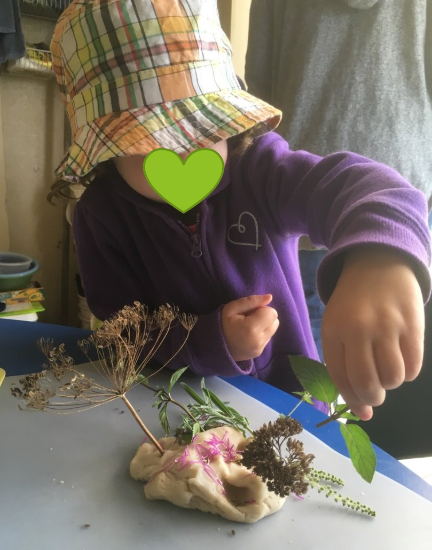
Nature Playdough
Make the DIY playdough recipe we shared last month (find it here again) and put out leaves, seeds, petals, and small natural treasures for a rich sensory experience that sparks creativity and fine motor exploration.
Color Matching with Paint Chip Cards
Invite children to search outdoors for natural items that match the colors on paint chip cards, strengthening observation skills and color recognition through a nature scavenger hunt.
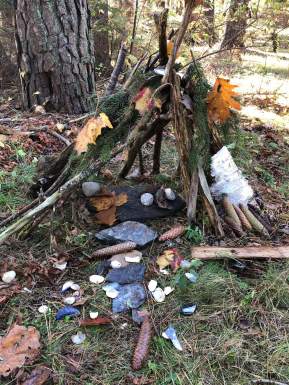
Fort Building
Provide sticks, branches, and loose parts for children to collaborate on building forts, encouraging problem solving, teamwork, and imaginative play.
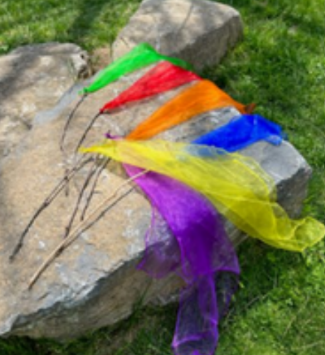
Feather Kites
Children create simple kites using lightweight natural and recycled materials, then test how wind and movement help their designs lift and glide. Offer feathers, fabric scarves, scrap fabric, ribbons, large leaves, thin sticks, and twine or string.
Worm Studies + the book Worm Weather by Jean Taft
After reading and observing worms outdoors, extend the learning with a few simple investigations. Compare how worms move through different soils, explore whether they prefer damp or dry conditions, and notice how they respond to light and dark spaces. Return to the area over several days to map where worms appear and look for signs like castings that show how they help enrich the soil.
Bug Hotels + the book Bug Hotel by Libby Walden
After reading, invite children to build small shelters for insects using loose natural materials. Provide small boxes, short sticks, bark, pinecones, hollow stems, dried leaves, straw, and stones. Children pack materials tightly to create cozy spaces, then place their bug hotels in quiet outdoor spots and return later to observe which insects move in.
Looking for additional ideas? Check out our "Tried and True Outdoor Learning Supplies and Materials" guide!
| | Upcoming Professional Development | | |
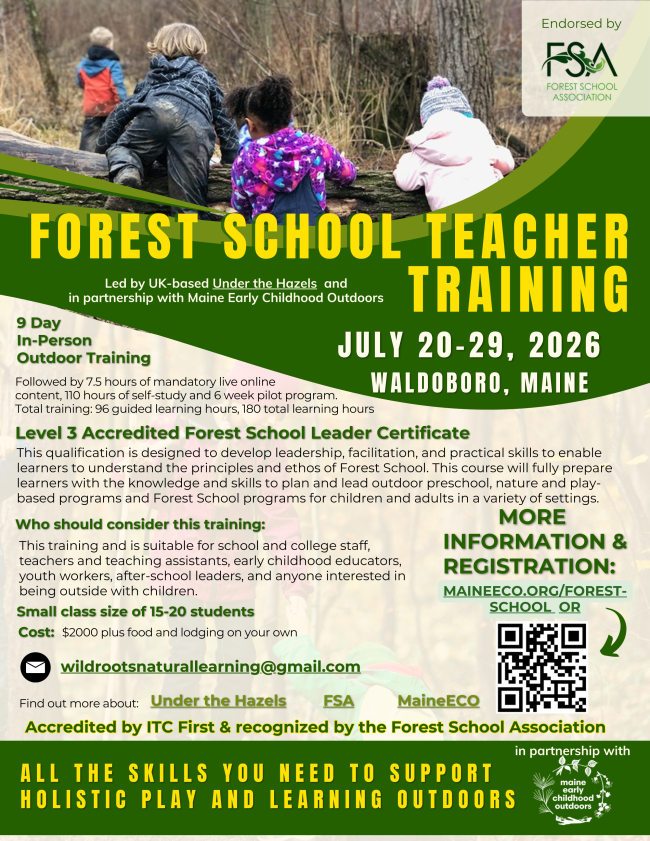
After a successful first-year event last summer in the woods of Maine, Forest School Leadership Training (an accredited professional learning program developed in accordance with the high-quality standards of the Forest School Association and led by UK trainers from Under the Hazels) is moving into its second year. In partnership with MaineECO, the in-person training will run from July 20-29, 2026, in Waldoboro, Maine.
This training covers the practical skills, safety protocols, nature-connection practices, and theoretical knowledge you need to confidently lead outdoor programs rooted in self-directed play, exploration, adventure, and discovery. This type of experience for children offers an antidote to indoor and/or screen-saturated lifestyles that dramatically limit the health, well-being, learning, development, life skill-building, and joy that should be part of every childhood.
This training is for anyone who works with children in any capacity, and is especially well-suited for those wishing to bring nature programs (i.e. Forest Days, Forest Fridays, Wild Wednesdays) to schools and early childcare programs. The training is ideal for teachers, early childhood educators, summer camp staff, after-school program leaders, conservancy education directors, and anyone interested in spending time outdoors with children.
Here is a testimonial of one of the participants:
"The Forest School Leadership training gave me the confidence to start a new nonprofit and expand access to nature-based education. Carol and Kate delivered the theoretical framework, policy structures, and playfulness I needed. Six months later, my co-founder and I are delivering weekly Nature Days to 90 public school students and their teachers." ~ Marie O., Boston, 2025 participant
See the above flyer for more information and to register for this exciting state-side opportunity!
| |
April 22, 2 PM | The Power of Outdoor Learning: Impacts on Early Childhood Development & Educator Well-Being | Natural Start Alliance | Join us April 22 at 2 PM ET with Dr. Arianna Pikus to explore how outdoor learning supports child development and educator well-being. | | | Apr 22, 2026, 2 PM | Nature Play at Home | Are you interested in learning natural and affordable ways you can engage children in outdoor spaces in your child care program? Join us for "Nature Play at Home" to learn how to implement a naturalized outdoor learning environment in your own backyard. Participants will gain hands on knowledge of different play settings they can add to their outdoor spaces and easy ways to create a dynamic and engaging outdoor space. Each participant will leave with materials to start implementing right away. | | | April 28, 7 PM | Learning with the Land: A Nature Playbook | Outdoor Learning School & Store | |
We will look at the Spiral of Inquiry and four foundational nature routines – Circle, Nature Walk, Nature Journal, and Sit Spot- which offer a flexible framework for responsive, inquiry-based outdoor learning. Rooted in inclusion and guided by respect, responsibility, and reciprocity, we will look at this new resource that bridges curriculum, well-being, and Land-based practice in ways that are both practical and transformative.
We will be joined by 6 incredible educators who will all provide insights and perspectives: Lauren MacLean, April Pikkarainen, Leona Prince, Heidi Wood, Linda Kaser and Judy Halbert.
| | | April 29, 2 PM | Reimagining Early Childhood Education to Embrace Nature-Based Learning by Dr. Rachel Larimore | In this action-focused webinar designed for program leaders and administrators, experienced early childhood nature-based program leader and author Dr. Rachel Larimore will share her Trail Map for Leading Change—an approach for inspiring and supporting staff as they move toward nature-based teaching. In previous ECI webinars, she focused on the big picture of the Trail Map for Change and Step 1: preparing yourself as a leader. In this webinar, she’ll focus on Step 5 of the Trail Map: reimagining teaching practices to embrace nature-based pedagogy. | | | May 5, 7 PM | How Does Your Garden Grow | |
Gardening offers many opportunities for natural learning to occur all year long. It’s a hands-on activity that provides fantastic health benefits as well as numerous developmental outcomes that promote cognitive, motor, and sensory skills appealing to a variety of learning styles and ages to connect, challenge, and problem-solve.
Learn what to plant and how to maintain and encourage ownership in your gardening pursuits to eliminate the frustration of trampled garden beds and planters that can easily become sensory bins. This webinar will encourage, educate, and demonstrate that simplicity is the key to any gardening adventure; start small and ‘grow’ from there.
| | | |
EP 38: Play & Mental Health - Defending the Early Years | Kisha Reid talks with Alison Bomba about her work as an experienced child and adolescent psychologist. She focuses on Nature Play as a tool to support her work. Dr. Alison Bomba is a psychologist, author, speaker, consultant, and community volunteer. | | | |
#234: From 'Why Them?' to 'What About Me?': Reclaiming Curiosity as an Educator | We often talk about curiosity in early childhood education. how we encourage it in children, how we observe it, and how we support it through play and learning. But what about educator curiosity? In this episode of The Everything ECE Podcast, we explore the shift from focusing solely on children's curiosity to reconnecting with our own. | | | |
Connecting the Dots: Seeing the Learning in Children's Nature-based Play | In this episode, host Dr. Rachel Larimore emphasizes the importance of being able to notice and name the learning happening in children's nature-based play. | | | |
Ep 27 | Getting Licensing and Risky Play to Fit Together - Rusty Keeler | In this episode of Play Nature Podcast, host Rusty is answering the question many educators ask: How do we keep nature play, loose parts, and risky play alive when licensing rules feel like a wall? The good news? The wall might actually be a doorway. Rusty explores the relationship between educators and licensors. At first it can feel tense. Someone arrives with a clipboard. They inspect logs, spoons, mud kitchens, and climbing trees. But licensors are there for a reason. Their job is to protect children. | | | | Access our Nature-Based Play Resource List on the Keystone Kids Go website. | | Check out the "Inspiring Nature-Based Early Learning" webinar here. This training counts for 1 hour of PQAS PD (and can count toward STARS indicator EC 3.4.6). | | | |
Quest for Quality Podcast
Part 1: The Benefits of Outdoor Learning and How to Start Small
Research shows that children thrive outdoors and have opportunities for learning, development and self-regulation that cannot be achieved indoors. In this podcast, Susan and Elizabeth discuss how nature play supports the health and well-being of children and adults alike, the features of an Outdoor Learning Environment compared to a playground, the barriers that may limit how much time children spend outdoors, and small-step solutions anyone can take to get started.
| | | | |
Quest for Quality Podcast
Part 2: Diving Deeper into Outdoor Learning Practices
In part 2 of this outdoor learning series, Susan and Elizabeth do a deeper dive into what outdoor play really looks like, including some additional areas you can set up, how to easily connect outdoor play to learning standards, and our role as the adult in this type of play-based, child-led exploration.
Click here for part 1 and 2 resources.
| | | Our Favorite E-Newsletters and Blogs | |
Looking for more information or coaching?
STARS Outdoor Learning Coach Elizabeth Marcello and Outdoor Learning & Play Consultant Susan Chlebowski can partner with you to provide center-based or individual classroom coaching and professional development in the topics of:
- Play pedagogy
- Outdoor learning environments
- Classroom management and challenging behavior support
-
Creating innovative solutions to barriers
Complete a "Consultation Request" through your PD Registry Organization Page's Keystone STARS tab to request coaching.
*For early learning providers in ELRCs 8, 9, and 10 only.
| | | Keep in Touch with Community Connections for Children! | | | | |